What is Singapore Merlion Brand?
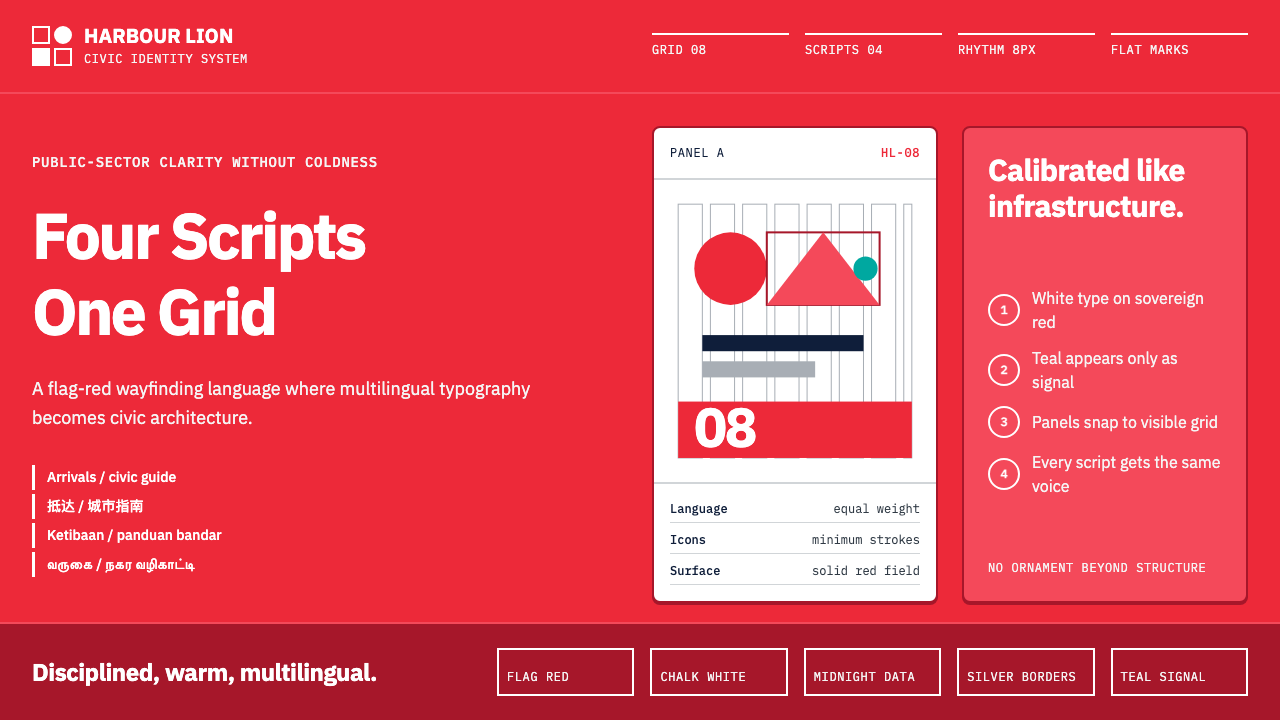
Singapore Merlion Brand forged fifty years of nation-building into one of the most precise multilingual visual systems in the world — flag red, chalk white, and a four-script grid that treats language equality as a design principle.
Singapore Merlion Brand in brief
The Singapore Merlion Brand is a city-state identity system unlike anything produced by conventional corporate branding. It is the accumulated visual output of a nation that has had to engineer its own cohesion — four official languages, three major ethnic communities, and a sovereign identity that was invented rather than inherited. The system does not merely present Singapore to the world; it argues, through every typographic and color decision, that this small, multilingual, postcolonial island can make a legible statement of who it is.
At its most visible, the brand is built on a bold national palette anchored by flag red — a saturated, civic-minded red that stops short of aggression — offset by chalk white that gives text and geometric icons room to breathe. Flat geometric forms, reduced to their minimum stroke count, appear throughout public communications: on transit signage, government brochures, tourism campaigns, and the environmental graphics of Changi Airport. The visual register is simultaneously official and approachable, a balance the system achieves through the strategic warmth of the red and the generous open spacing between elements.
What sets this system apart from other national identity programs is its treatment of multilingual typography as architecture rather than accommodation. Chinese, Malay, Tamil, and English do not compete for hierarchy; they are given parallel structural weight on every surface. A wayfinding panel in an MRT station does not privilege any one script. This commitment to typographic equity is not merely political — it is the design system's organizing aesthetic principle, and it gives the brand its distinctive quality of ordered abundance.
Where does Singapore Merlion Brand come from?
The story of the Singapore Merlion Brand begins not with a design brief but with a sculpture. In 1972, Lim Nang Seng — a Singaporean sculptor working in collaboration with the Singapore Tourism Board — completed the original Merlion statue at the mouth of the Singapore River. The creature itself, a hybrid of lion head and fish body, had been conceptualized earlier by Kwan Sai Kian, a fisherman-artist, drawing on two foundational myths: the Sanskrit name Singapura (Lion City) and the island's ancient fishing village origins. The Merlion was from the start a designed identity rather than an organic folk symbol — a deliberate act of nation-building through visual invention.
Through the 1980s and 1990s, Singapore's national brand expression was managed primarily by the Singapore Tourism Board (STB) in coordination with various government communications offices. The visual system of these decades was disciplined but eclectic, reflecting the pragmatic priorities of a rapidly industrializing city-state more concerned with economic positioning than with aesthetic coherence. The MRT opened in 1987, bringing with it one of the region's first large-scale multilingual wayfinding systems, which established practical conventions for rendering four scripts at equal scale and weight in the same field — a typographic discipline that would later inform the broader brand.
The decisive modern moment came in 2017, when the STB launched the 'Passion Made Possible' campaign developed by BBH Asia-Pacific. This was not a cosmetic refresh. It was a fundamental repositioning of Singapore's identity for international audiences — shifting from a destination defined by efficiency and cleanliness toward a city-state characterized by ambition, creative energy, and the lived intensity of a place where multiple cultures co-exist at close quarters. The campaign introduced a sharper graphic system: the flag red and white elevated to primary brand colors, flatter and bolder iconography, and an explicit commitment to showing all four official languages as coequal visual elements rather than accommodated minorities.
The 2024 refresh built on the 2017 foundation by tightening the grid structure and extending the system's reach into digital environments. The eight-column layout grid — rigid as an MRT timetable, as the brand team described it — was formalized as the underlying armature for everything from social media assets to airport environmental graphics. The refresh also deepened the commitment to multilingual typographic equity, ensuring that the weight, scale, and spacing of Chinese, Malay, Tamil, and English characters were calibrated with equal care rather than defaulting to English as the structural anchor and adding other scripts as subordinate text layers.
What defines the Singapore Merlion Brand look?
Civic Red and White Palette
The brand's primary palette derives directly from the national flag: a warm, saturated red paired with pure white. The red is not corporate or aggressive — it carries civic warmth, the kind that reads as confidence rather than alarm. On white grounds, it commands attention without dominating; on red grounds, white type and icons achieve the same clarity. This disciplined two-color foundation gives the system unusual versatility across formats and scales, from a postage stamp to an airport terminal wall, while maintaining immediate recognizability.
Four-Script Typographic Equity
The defining structural characteristic of this system is the treatment of Chinese, Malay, Tamil, and English as coequal visual presences rather than a hierarchy of primary and subordinate languages. On official signage, all four scripts occupy comparable scale and weight. This is not a technical compromise — it is the brand's central aesthetic argument. The visual effect of four scripts in equal balance creates a sense of ordered plurality that no single-language brand system can achieve. Designing within this constraint requires exceptional sensitivity to how different script systems interact optically at the same apparent size.
Flat Geometric Iconography
Icons throughout the system are reduced to their minimum recognizable form: flat planes, consistent stroke economy, no drop shadows, no gradients. The Merlion mark itself follows this logic — a silhouette that balances symbolic complexity (lion and fish, heritage and sea-faring) with graphic simplicity (readable at the scale of a favicon or an airport billboard). Supporting icons for transit, tourism, and civic communication follow the same discipline: every element drawn at the fewest strokes required for recognition, nothing added for visual interest.
Rigid Grid Architecture
The eight-column grid is not a loose guideline but a strict armature. Elements align to grid intersections with the precision associated with Singapore's urban planning culture — the same mindset that produced an MRT network without delays and housing towers where every unit meets a published specification. In practice, this means that every margin, column gutter, and content block sits in a mathematically determined relationship to every other. The grid accommodates the complexity of multilingual text without becoming chaotic because its underlying structure is firm enough to hold that complexity in place.
Geometric Sans Typography
The system's Latin and Malay text settings favor geometric sans-serif letterforms — constructed rather than calligraphic, modern rather than classical. This choice aligns with the flat-geometric aesthetic of the icons while maintaining legibility across the scale range required by a multilingual wayfinding system. The Chinese characters used in official materials follow a similar logic: clean, regularized forms preferred over brush-stroke expressiveness. Tamil text settings balance the inherent curvature of the script against the system's geometric preference, demonstrating that the brand's aesthetic can accommodate a script with radically different visual DNA without forcing it into an alien mold.
Wayfinding Clarity as Aesthetic Ideal
The Singapore brand draws its visual logic from wayfinding culture rather than from advertising or editorial traditions. This means that every design decision is tested against the hardest use case: a traveler who does not read any of the four scripts, moving quickly through a crowded environment, needs to understand where to go. Out of this constraint emerges the brand's defining quality — it cannot be ambiguous. High contrast, generous spacing, flat iconography, and consistent grid alignment are not stylistic choices; they are functional requirements that have been elevated to aesthetic principles.
Zero Decorative Excess
Like the city-state itself — where land is finite and every square meter is accounted for — the brand tolerates no decorative surplus. No ambient textures, no illustrative border treatments, no gradient backgrounds softening the confrontation between element and ground. What exists is what functions. This quality gives Singapore Merlion Brand work an almost architectural cleanliness that ages well: a brochure designed in this system in 2010 does not look dated today because it never relied on the period's decorative conventions. The discipline is not austerity — it is the same precision that makes Singapore's public infrastructure feel both modern and enduring.
Who shaped Singapore Merlion Brand?
Lim Nang Seng was the sculptor commissioned to create the original Merlion statue, completed in 1972 at the mouth of the Singapore River. His execution of the Merlion — translating a conceptual hybrid creature into a monumental public sculpture — gave the brand its primary symbolic anchor. The statue became one of the most recognized emblems of Singapore globally, and its graphic abstraction into a flat silhouette mark has defined the visual identity of the nation's tourism and civic brand ever since.
A fisherman-artist whose conceptual contribution to the Merlion predates its sculptural realization, Kwan Sai Kian is credited with the mythological synthesis that the brand rests on: the fusion of the lion — drawn from the Sanskrit name Singapura — with the fish body, referencing the island's origins as a fishing village and its enduring relationship with the sea. His conceptual work demonstrates that the Singapore brand's visual power derives from a genuinely rooted symbolic act rather than a purely commissioned corporate exercise.
The London-founded advertising and design agency Bartle Bogle Hegarty, through its Asia-Pacific studio, was responsible for the 2017 'Passion Made Possible' campaign that recast Singapore's global brand identity. BBH Asia-Pacific translated a national brief of considerable complexity — how to position Singapore as both a world-class city and a place of genuine cultural intensity, for audiences ranging from business travelers to leisure tourists — into a graphic system rigorous enough to serve as the foundation for subsequent years of brand evolution. Their work proved that a national tourism campaign could function as a coherent design system rather than an advertising burst.
The Singapore Tourism Board's in-house design office represents the institutional continuity behind the brand's disciplined evolution. Unlike many national identity programs that are periodically handed to external agencies for wholesale reinvention, Singapore's brand has maintained its typographic equity principles and red-white palette through multiple campaigns and decades, suggesting a level of stewardship that only in-house institutional knowledge can provide. The STB design office functions less like a creative department and more like a constitutional body — defining and protecting the rules of the visual system across all government and tourism communications.
How do you use Singapore Merlion Brand today?
The Singapore Merlion Brand system is one of the most instructive in the world for designers working on multilingual interfaces, civic products, or any project that must balance multiple cultural constituencies without creating visual hierarchy among them. Understanding what makes it work requires looking past the surface red-and-white palette to the structural commitments underneath: equal-weight type treatment, a non-negotiable grid, and the principle that no single language is the default.
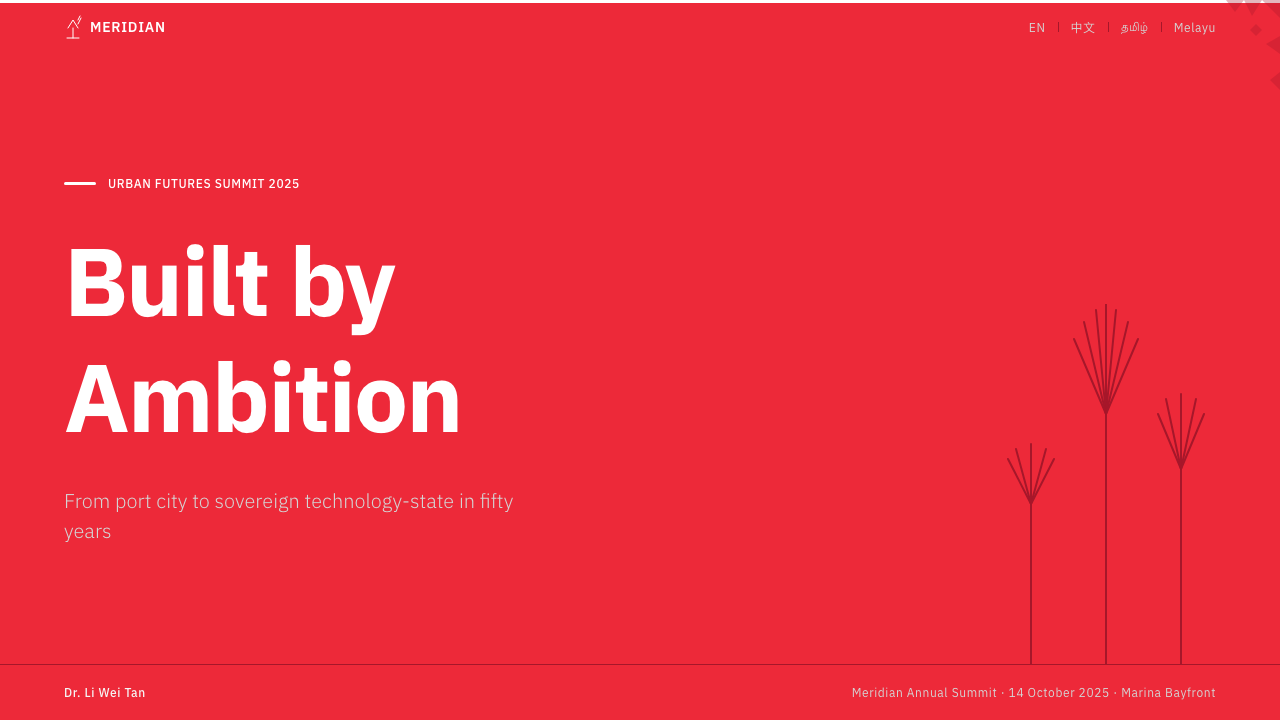
For presentation slides, the system's virtues translate directly. A cover slide built on this approach uses the civic red as a full-bleed background field, with the primary title in large white type set at generous scale — the kind of scale that makes the text function as a visual element before it functions as a text element. Content slides work best with a white background, a strict two-column organization, and text hierarchies defined purely by weight and size rather than by color or decorative rules. If the presentation is bilingual, the two languages should occupy parallel positions — side by side or stacked — rather than one presented as the main text and the other as a caption or footnote.
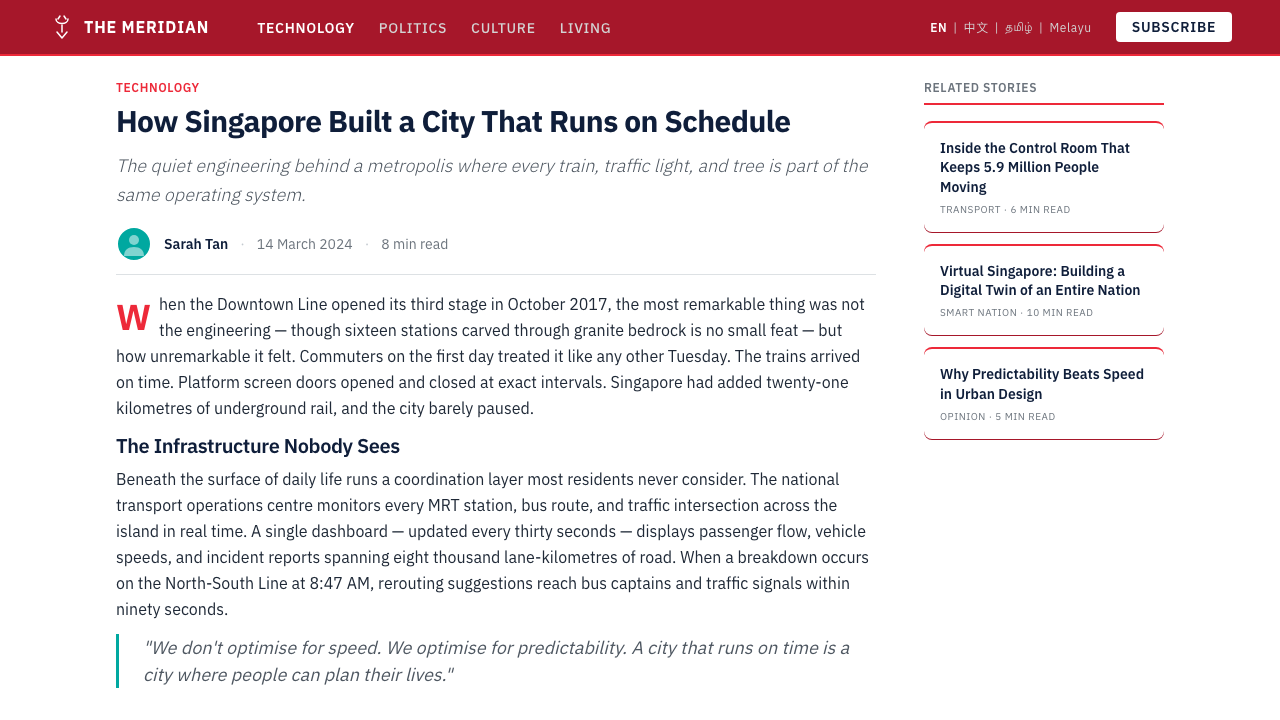
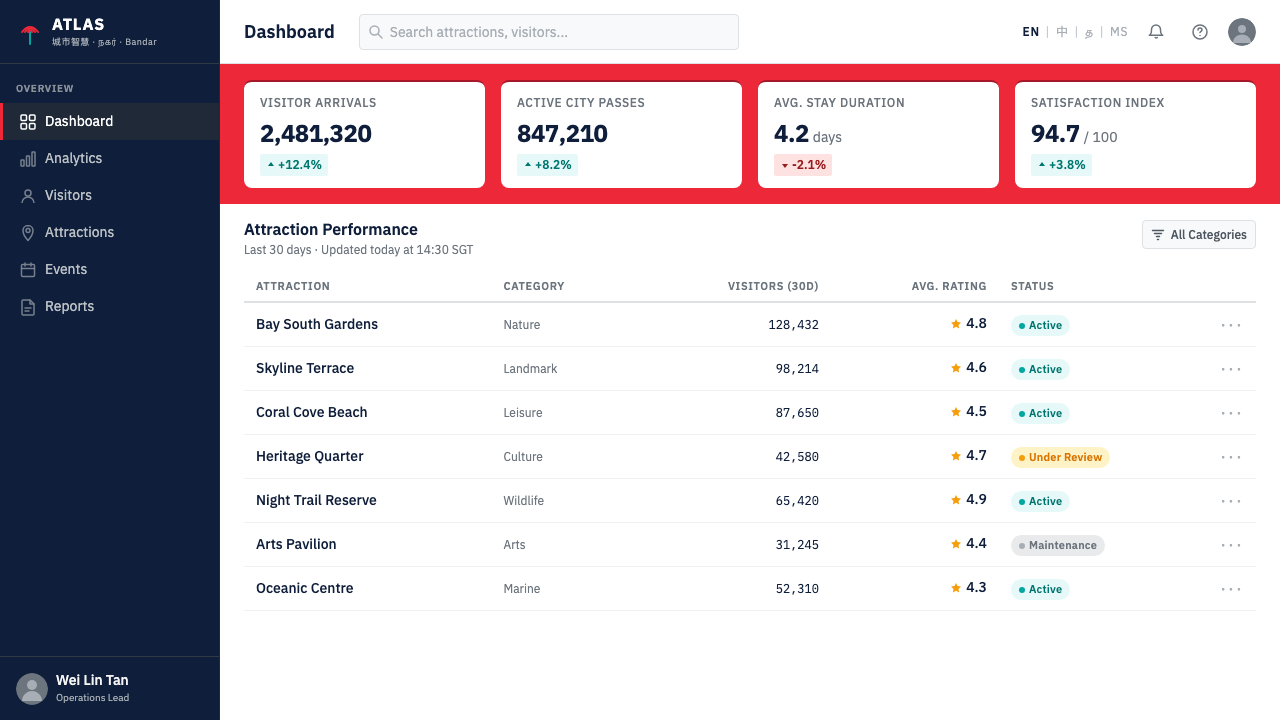
For web interfaces, the system is exceptionally well-suited to civic and government platforms, multilingual dashboards, travel and hospitality booking flows, and any public-facing product where clarity is more important than personality. The approach: white or very light background, high-contrast body text, flat icon system using a limited palette, and a grid-aligned card structure with hard-shadow treatment rather than soft diffusion. Navigation should be typographic. If the product serves users in multiple languages, the type system should be audited to ensure that the selected typefaces perform equally across all scripts — a common oversight that this brand's history is specifically designed to address.
For editorial and marketing contexts, the brand's poster-like boldness is its most transferable quality. A marketing layout in this system uses the civic red sparingly but decisively: one full-bleed section anchors the composition, with the remainder in black on white or white on black. Call-to-action elements take the red as their color; informational elements use the neutral tones. The wayfinding discipline — high contrast, clear hierarchy, nothing ambiguous — applies to marketing as clearly as to signage. This is a system that never whispers; it states.
A common mistake when referencing this system is treating the red-and-white palette as purely decorative while ignoring the typographic equity principle. This produces work that looks like Singapore branding but lacks its actual logic. The system's distinctiveness comes from the commitment to equal language treatment, not from the color combination. A design that presents one language prominently and others as decorative inclusions has misunderstood the source. Similarly, softening the grid — introducing rounded corners, gradient overlays, or organic shapes — undermines the brand's core commitment to the kind of legibility that works under pressure. This is a system that was designed to be read by a traveler who is tired, lost, and in a hurry; gentleness is not in its brief.
Singapore Merlion Brand — FAQ
How does Singapore Merlion Brand differ from Swiss International Style?
Both systems prize grid discipline and typographic clarity, but their motivations and outputs are quite different. Swiss International Style emerged from a postwar European context that sought a universal visual language for global corporate communication — it aspired to neutrality and reproducibility across cultures. Singapore Merlion Brand is explicitly rooted in cultural specificity: it is not trying to transcend cultural particularity but to represent four distinct linguistic communities as coequal presences. Where Swiss Style's grid serves efficiency and universality, Singapore's grid serves political equity. The result looks similar at a glance — flat, geometric, rigorous — but the underlying argument is different. Swiss Style would never put Tamil and English in the same visual hierarchy; that structural commitment is uniquely Singapore's.
Can this system work for private-sector or commercial products?
Yes, with appropriate adaptation. The system's core principles — civic-warmth color palette, multilingual typographic equity, rigorous grid, flat geometric iconography — transfer well to commercial contexts where trust, clarity, and multi-audience communication are priorities. Hospitality brands, financial services, civic-technology products, and logistics platforms have all used analogous systems to good effect. The key adaptation is that commercial applications can allow more flexibility in the secondary palette and can calibrate the warmth of the red toward their specific audience. What should not be adapted is the grid discipline and the equal treatment of languages — those are the system's functional core, not its decorative surface.
What makes the Merlion mark so durable as a symbol?
The Merlion's durability comes from the same quality that makes all enduring symbols work: it is legible at any scale, it carries multiple layers of meaning without requiring any of them to be decoded for the symbol to function, and it cannot be confused with anything else. The lion-fish hybrid is immediately strange enough to be memorable and specific enough to be unmistakable. Its silhouette translates cleanly into flat graphic form — the mark works as a stamp, a signage icon, a merchandise print, and a monumental sculpture because it was conceived with enough geometric simplicity to survive all those contexts. The fact that it also encodes two foundational Singapore myths — the lion of Singapura, the fish of a fishing island — gives it cultural depth that a purely invented logomark would lack.
Is this a good system to reference for dark-mode or night-time interfaces?
The system is primarily a light-ground system — the canonical application places red and white on light backgrounds, which maximizes the civic warmth of the palette and maintains the high contrast required for multilingual legibility. A dark inversion is possible but requires care. On a dark ground, the flag red can read as aggressive rather than warm, and the careful spacing relationships that the light-ground version achieves may need to be recalibrated to prevent the composition from feeling crowded. The flat geometric iconography translates well to dark grounds, and white type on dark backgrounds remains within the system's logic. The key principle to preserve in any inversion: every language should remain equally legible. Dark-mode implementations that achieve this typically use the red very sparingly — as an accent or interactive-state color — rather than as a dominant field.
How should a designer handle the tension between the system's rigidity and creative expression?
The Singapore Merlion Brand is a civic system, not an expressive one, and treating it primarily as a constraint rather than a canvas is not a limitation — it is the correct relationship to have with it. The creative opportunity within the system lies in the intelligence of arrangement rather than the introduction of new elements. How the four scripts are positioned relative to each other within the grid, how the civic red is deployed to establish rhythm and hierarchy, how the flat icons are scaled and grouped to create visual interest without decoration — these are the decisions where creative judgment operates. Designers who find this frustrating are usually looking for a system that rewards self-expression; Singapore's brand rewards discipline and structural intelligence, which is a different creative challenge and, for certain designers, a more demanding one.
Related design styles
 Pantone Very Peri (2022)Color becomes authority. Periwinkle field, reference codes, and white paper i…
 Singtel Modern BrandKeeps the red loudest on screen. Vivid Singtel red on cool tech-grey, with a…
 Adobe Creative CloudUnified, not uniform. Red anchor, white space, and saturated app tiles organi…
 Databricks LakehouseWarm enterprise confidence. Flame red-orange gradients meet DM Sans and clean…
 GitLab 2023DevOps in daylight. Tanuki orange-to-purple gradient, Inter, warm enough for…
 Mistral AI OrangeSovereign AI with restraint. Orange, black, and white lock the grid.