What is Changi Jewel Airport?
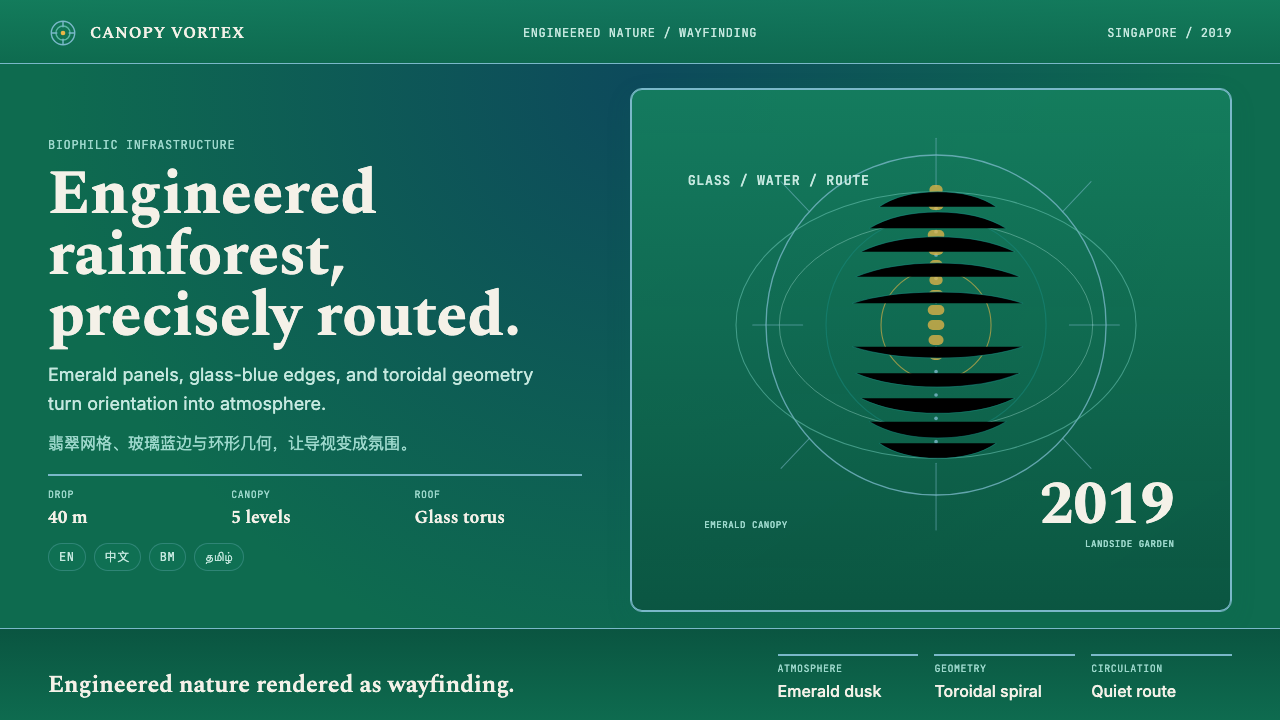
Jewel Changi Airport turned a working terminal into the world's most photographed indoor landscape — then distilled that spectacle into a flat graphic system precise enough to navigate five floors of living rainforest.
Changi Jewel Airport in brief
The Changi Jewel Airport design system is the visual identity that grew out of one of the most ambitious public infrastructure projects of the twenty-first century. At its physical core is the Rain Vortex — a forty-metre waterfall descending through the oculus of a toroidal glass-and-steel dome into a terraced indoor forest spanning five retail and leisure levels. The graphic language that surrounds this spectacle translates its essential qualities — living green, cascading water rendered in cool glass-blue, and the recurring ring of the dome itself — into a flat, scalable system deployable across wayfinding signage, digital touchscreens, retail graphics, and brand communications.
What makes the system distinctive is how faithfully it honours the architecture. Most airport visual identities are applied to a building; the Jewel identity emerges from the building. The toroidal spiral motif — a ring in continuous motion, referencing both the dome's cross-section and the waterfall's rotation — appears at every scale from floor-directory icons to full-facade banners. The palette of deep forest greens and translucent waterfall blues is not a brand decision imposed from outside but a direct transcription of the atrium's ambient light at dusk, when the canopy glows emerald and the vortex refracts into cool blue across the travertine floors.
The system operates in the tradition of what might be called biophilic graphic design — an emerging design discipline that uses imagery derived from living natural systems as the organizing logic for wayfinding and brand communication. Earlier airport identities tended to rely on abstract geometric motifs or typographic authority. Jewel instead reads more like a curated garden than a transit facility, with the graphic system serving as the bridge between the built engineering and the visitor's sensory experience of that engineering.
Where does Changi Jewel Airport come from?
The project was announced by Changi Airport Group in 2014, with Moshe Safdie appointed as lead architect. Safdie, whose career had long been defined by the intersection of mass housing and public landscape — Habitat 67 in Montreal, Moshe Safdie & Associates' subsequent civic buildings — brought to Changi a thesis he had been developing for decades: that large public buildings could and should incorporate living natural systems, not as decoration, but as structural and psychological infrastructure. The Jewel brief gave him the first opportunity to test that thesis at the scale of a working international airport.
The engineering challenge was considerable. A toroidal glass-and-steel dome of that span had no direct precedent in climate-controlled interior landscapes. The steel lattice structure had to carry both the skin of the building and the concentrated dynamic load of water falling continuously at that rate and height. Landscape architect Kathryn Gustafson, who had previously worked on the Diana Princess of Wales Memorial Fountain in London and the Millennium Park Lurie Garden in Chicago, was brought in to design the interior forest — a curated tropical environment composed of hundreds of species selected for their ability to thrive under the specific quality of light passing through the glass dome.
The visual identity was developed by Wolff Olins Singapore in close collaboration with Changi Airport Group's in-house design team beginning around 2018, approximately a year before the facility's April 2019 opening. The brief asked for a system that would work across a remarkably demanding set of contexts: multilingual wayfinding at scale (the facility serves over fifty million passengers annually across multiple nationalities and scripts), high-footfall retail branding, digital and physical media simultaneously, and the ceremonial communications around what was understood from the outset to be a globally significant destination.
Wolff Olins had already established itself as one of the leading identity practices for large civic and cultural institutions — their work on the London 2012 Olympics identity had shown an ability to build systems that could operate at both the intimate and the monumental scale. The Jewel assignment extended that capability into a context where nature itself was the primary architectural material. The challenge was not merely to brand a building but to translate the experiential core of that building — the sensory reality of standing inside an indoor rainforest beneath a forty-metre waterfall — into graphic language that could communicate at a glance, in motion, across ten languages.
What defines the Changi Jewel Airport look?
Color System
The palette draws from two dominant sources within the atrium: the layered greens of the forest canopy, which range from the deep shadow of the lower understory to the bright, light-catching fronds at the dome's apex; and the cool blue-whites of the Rain Vortex, a hue that evokes both running water and the quality of tropical sky glimpsed through glass. These are not decorative choices — each color corresponds to a distinct spatial zone within the building, functioning simultaneously as wayfinding signal and atmospheric reference. A third neutral anchors the system: the warm pale stone of the travertine flooring and interior walls, which prevents the palette from reading as purely graphic and grounds it in the material reality of the built space.
The Toroidal Motif
The system's most recognizable graphic element is a ring in continuous rotational motion — a reference to the dome's toroidal cross-section as seen from directly below, and to the spiral of water as it collects and accelerates through the vortex. This motif is extraordinarily versatile: at small scale it reads as a simple circle, signaling the brand; at medium scale the rotation becomes apparent, suggesting movement and the waterfall's kinetic quality; at large scale it can be used as a spatial framing device, a window through which the forest or the water is glimpsed. The motif is never treated as a static logo but always as a form in process.
Wayfinding Logic
In a five-level indoor landscape without visible exterior reference points, conventional wayfinding logic — left, right, straight ahead — quickly becomes disorienting. The Jewel system responds to this by anchoring navigation to the vertical rather than the horizontal: the Rain Vortex itself serves as the primary landmark, always visible from most of the facility, and the graphic system uses its presence as an implicit compass. Floor directories use the vertical axis prominently; color bands associated with each level reinforce spatial memory. Signage is kept typographically restrained so that it competes as little as possible with the atrium's visual drama.
Typographic Register
The typeface choices position the identity between the precision of international infrastructure and the warmth of a leisure destination — a balance that reflects the facility's dual function as transit hub and tourist attraction. Headline type is set with generous tracking in a contemporary geometric sans-serif, giving it an open, unhurried quality that contrasts with the urgency typically associated with airport signage. Body and informational text uses a slightly more neutral companion, optimized for legibility across multiple scripts including Chinese and Malay. There is no compression, no condensed type — the system breathes.
Scale and Layering
The system must operate coherently across an extreme range of scales, from the small ceramic tile markings set into the floor to facade-wide illuminated installations visible from the taxi rank outside. Rather than designing different graphic solutions for different scales, Wolff Olins built the identity around elements that are inherently scale-invariant: the ring motif, which reads at any size; the color palette, which works in full saturation on a backlit panel as well as in a single-ink print on a tote bag; and the typographic hierarchy, which can be collapsed or expanded without losing its proportional logic. The discipline of working with a limited but highly elastic vocabulary means that the identity coheres even in unanticipated applications.
Photography and Image Treatment
Photography within the Jewel system is treated with a consistent editorial hand: images are selected and cropped to isolate particular qualities of light, water, and vegetation rather than to document spaces comprehensively. A single fern frond backlit to translucency, the mist rising from the vortex pool, the lattice of the dome reflected in standing water — these are preferred over wide establishing shots that reveal the full complexity of the atrium. This selective treatment makes the photography feel curated rather than promotional, and it maintains visual coherence with the graphic elements by limiting each image to a narrow tonal and chromatic range consistent with the palette.
Multilingual Coherence
Singapore's four official languages — English, Mandarin Chinese, Malay, and Tamil — plus the informal presence of dozens of others in an international transit context, make multilingual coherence a foundational rather than optional design requirement. The Jewel system handles this by separating the linguistic layer from the graphic layer: the ring, the color, and the spatial proportions of any given sign remain constant regardless of script; what changes is only the letterform. This separation is clean enough that the visual identity reads consistently even in cases where only one script is present, and it allows the system to be extended to additional languages without redesign.
Who shaped Changi Jewel Airport?
The Jerusalem-born, Montreal-educated architect whose career has been defined by the challenge of making large-scale public buildings feel inhabitable at the human scale. His Habitat 67 housing complex demonstrated that density and communal living could coexist with private outdoor space; subsequent civic projects in India, Israel, and North America extended this thesis. At Jewel Changi, Safdie resolved a problem that had eluded airport designers for decades: how to make transit infrastructure feel like a destination in its own right. His decision to centre the building on a living landscape rather than a retail concourse fundamentally shaped every visual and experiential decision that followed.
The American landscape architect who designed the interior forest of the Jewel — a commission that required not only horticultural knowledge but an understanding of how vegetation behaves as a spatial and experiential material. Gustafson, trained at the École Nationale Supérieure du Paysage in Versailles, had previously worked on public landscapes defined by flowing form and the deliberate staging of natural processes. Her work at Jewel demonstrated that an indoor planting scheme could function as primary architectural character rather than as amenity, and her species selection established the visual logic that the graphic identity later translated into color and motif.
The Singapore office of the global brand and design consultancy responsible for the Jewel visual identity system. Wolff Olins had previously developed high-profile identities for London 2012, GE, and Tata — each of which required building a system capable of operating across an unusually demanding range of contexts and scales. The Jewel assignment extended this capability into a new territory: a built environment where the identity had to coexist with an irreducibly complex natural landscape, and where wayfinding, branding, and environmental experience had to be resolved simultaneously in a single coherent graphic language.
The Singaporean government-linked company that owns and operates Changi Airport, widely regarded as one of the world's best-managed aviation facilities. Changi Airport Group's in-house design team played an active role in the development of the Jewel identity, ensuring that it satisfied the operational demands of airport management as well as the experiential ambitions of the design team. The Group's long track record of treating design as a competitive differentiator — Changi has won the Skytrax World's Best Airport award multiple times — gave the design team unusual latitude to develop a system that prioritised coherence and atmosphere over cost-driven standardisation.
The Toronto-based firm that collaborated with Safdie Associates on structural and interior elements of the Jewel project. Their involvement in the technical resolution of the dome and the integration of the indoor landscape with the retail and transit infrastructure contributed to the spatial logic that the visual identity team later worked within. Their approach to material honesty — letting structural systems be legible rather than concealed — reinforced the identity design's emphasis on transparency and the visibility of natural processes.
How do you use Changi Jewel Airport today?
The Changi Jewel system is one of the most instructive contemporary models for any designer working on the problem of branding a destination where the architecture itself is the primary attraction. The key principle is correspondence: the graphic system should feel derived from the physical environment rather than applied to it. When working in this register, begin with direct observation — identify the two or three dominant visual qualities of the space and ask whether those qualities can be translated into graphic decisions that will reinforce and extend the experience rather than competing with it.
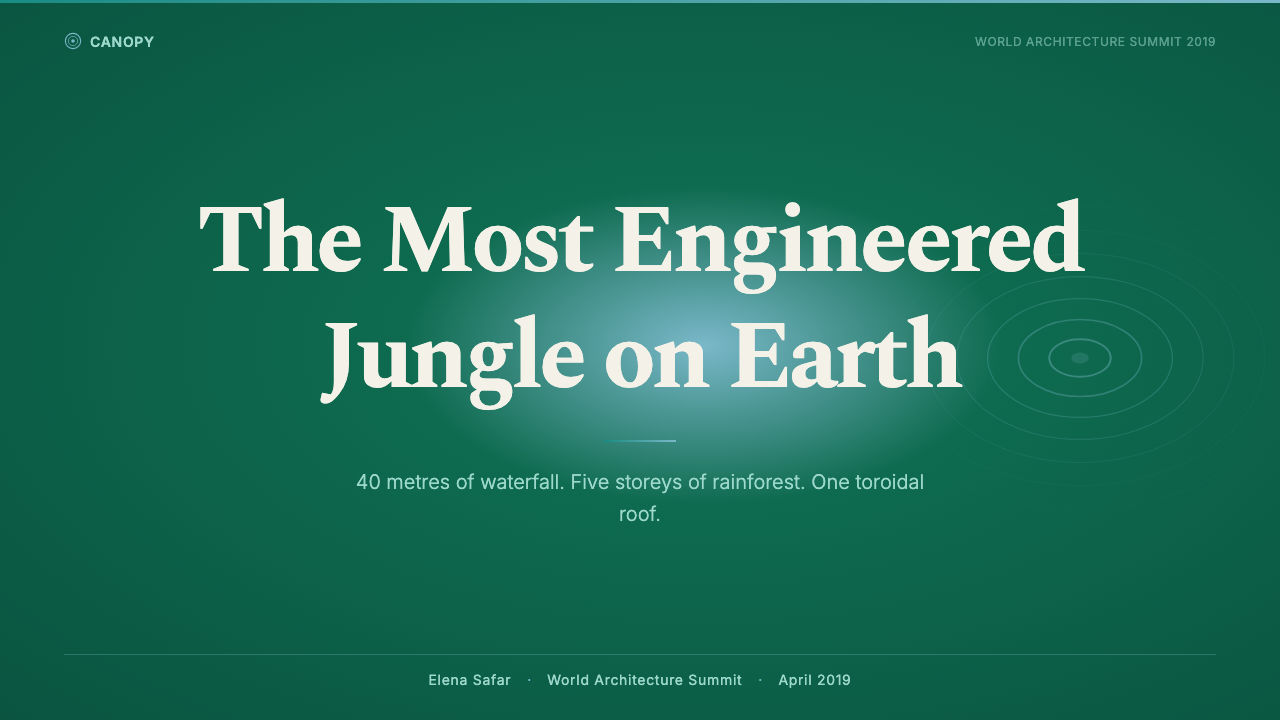
For presentation slides using this design language, the approach reverses the usual hierarchy: instead of a content-first layout with decorative edge elements, construct each slide as an environment. Use the deep green as a full-bleed background on section dividers; let photography of natural texture or light serve as the primary visual element on feature slides rather than an illustration or icon. Data slides benefit from the system's wayfinding logic — use color to assign each data series to a spatial zone, as if the chart were a floor plan, so that the viewer learns to associate color with meaning through repetition. The toroidal motif can anchor a corner of any slide without dominating it.
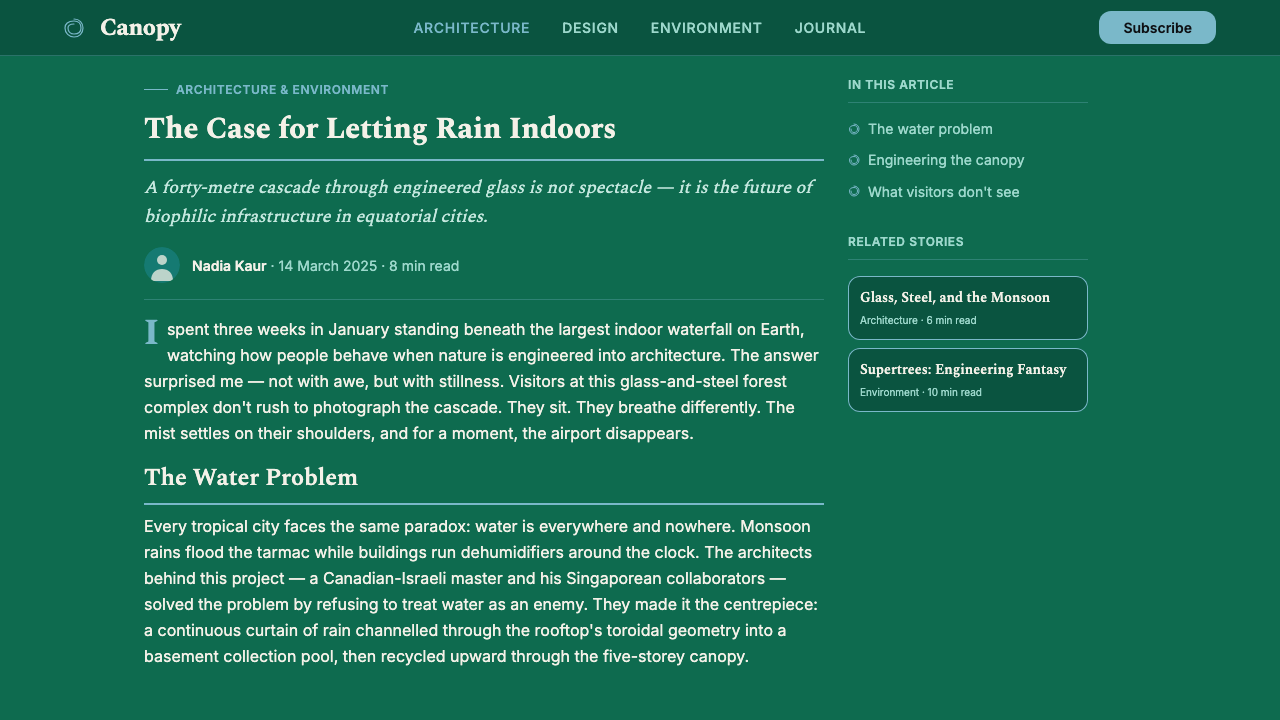
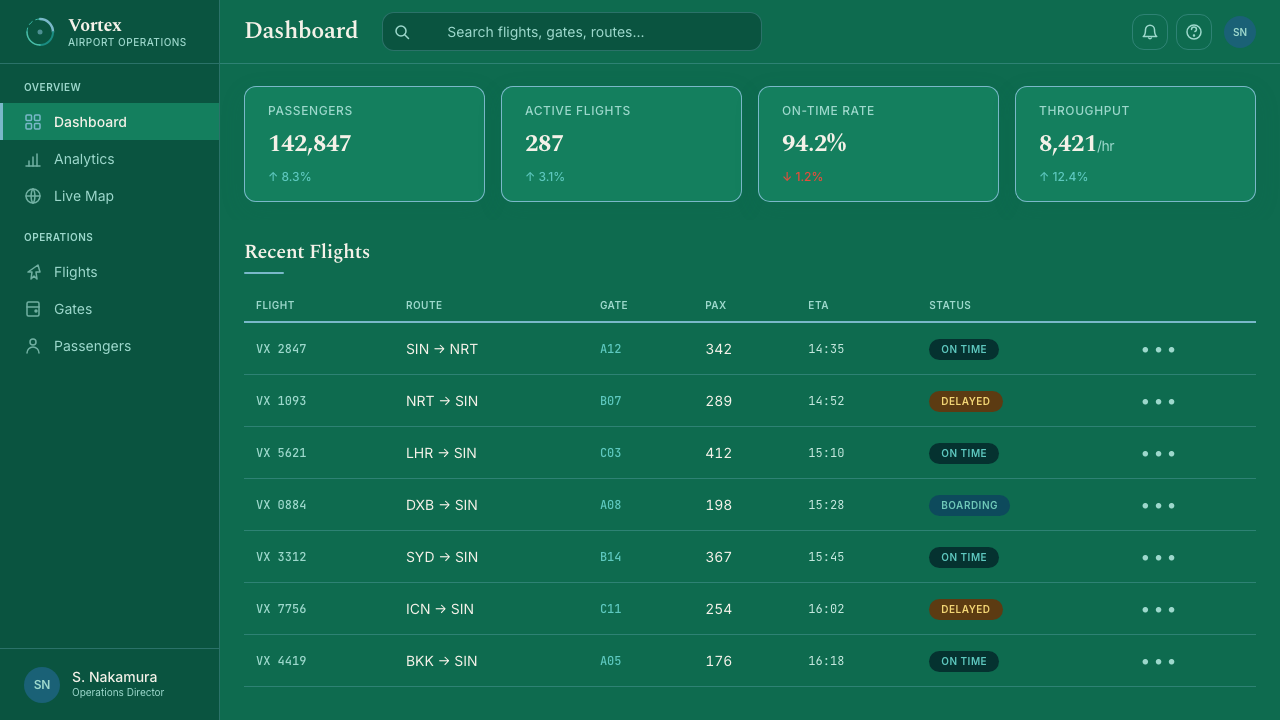
For web interfaces and digital product design, the system translates naturally into layered backgrounds, translucent overlay panels, and depth-through-color rather than depth-through-shadow. A dashboard or landing page in this language would use the deep forest green for primary navigation, the cool waterfall blue for interactive and hover states, and the warm stone neutral for content areas and cards. Typography should be set with generous line height and tracking to maintain the open, unrushed quality that distinguishes a destination identity from a transit interface. Avoid hard-edged dividers; use color gradation and spatial breathing to separate sections.
For editorial and marketing work, the system supports an editorial mode that is simultaneously informational and experiential. A feature article or marketing page in this language layers photography — close-cropped fragments of texture, light, or water — with typographic blocks set in the palette's range of greens and blues. Captions and secondary information can appear in the warm stone neutral, keeping the primary visual field clear. The ring motif works particularly well as a full-bleed section opener or as a transparent overlay that frames an image without obscuring it.
The most common mistake when working with nature-derived identity systems like Jewel is the temptation toward literal botanical illustration — adding leaf shapes, vein patterns, or floral motifs in the belief that this reinforces the natural theme. The Jewel system succeeds precisely because it abstracts nature into color and geometry rather than representing it. The ring is not a cross-section of a tree trunk; it is a mathematical curve that happens to share the dome's geometry and the water's motion. Keep the graphic vocabulary abstract, let the photography carry the naturalistic register, and resist every impulse toward decoration that the system itself would refuse.
Changi Jewel Airport — FAQ
Is the Changi Jewel identity a wayfinding system or a brand identity?
It is both, and their integration is what makes the system notable. Most large transit facilities separate these two functions: a wayfinding consultant develops the signage system, and a brand agency develops the marketing identity, and the two are loosely reconciled at the end. At Jewel, the decision to work from the architecture outward — using the rain vortex as a spatial anchor, the atrium's palette as the color vocabulary, and the dome's geometry as the primary motif — meant that the navigation logic and the brand logic were solved by the same formal moves. A visitor who learns to orient by color-coded floor levels is simultaneously learning the brand's visual language.
How does the system handle the tension between the airport's transit function and its destination ambition?
Through pace. Airport wayfinding typically uses urgency as a design principle — high contrast, large type, directional arrows that demand immediate response. The Jewel system dials back that urgency without sacrificing legibility. Type is set with space, signage is placed to invite reading rather than demand compliance, and the palette's depth and richness rewards a slower eye. The underlying message is that time spent in the Jewel is not time lost to transit — it is time in a designed destination. The graphic system enacts that message rather than merely advertising it.
Can this design language work for projects that have no connection to nature or architecture?
The underlying structural principles — deriving a palette from a dominant experiential reality, building a motif from the geometry of the core experience, using color as both spatial signal and brand marker — are transferable to any context. What does not transfer directly is the specific palette and motif, which are rooted in a particular place. Applying the Jewel's forest green and ring motif to an unrelated product would read as decoration rather than system. The lesson is not 'use these colors and this shape' but 'find the visual essence of the experience you are designing for and work outward from that.' The same method applied to a different starting point will produce a different but equally coherent result.
What makes the Rain Vortex visually significant beyond its engineering feat?
The Rain Vortex is significant as a designed image, not only as a structural achievement. A waterfall falling through the center of an enclosed space is inherently disorienting — water outdoors behaves according to recognizable landscape logic, but the same water indoors, falling through steel and glass, becomes something between natural phenomenon and installation art. This ambiguity is the experiential core of the Jewel, and it is what the graphic system is designed to preserve and extend: the sense that you are inside something that blurs the boundary between the engineered and the living, between the mechanical and the organic. The visual identity succeeds when it provokes the same productive uncertainty.
Does the Jewel system age well, or is it tied to a specific moment in design history?
The system's longevity rests on its architectural grounding rather than on trend alignment. Visual identities that derive from dominant aesthetic movements of their moment — the flat design wave, the brutalist web revival, the maximalist reaction — tend to feel dated within a decade as the trend passes. The Jewel identity is less legible as a trend than as a description of a specific place. As long as the building stands and the Rain Vortex falls, the palette and motif will remain accurate transcriptions of the physical reality they were derived from. The more interesting question is whether the building itself — a monument to indoor landscape engineering at a moment of heightened ecological consciousness — will read differently in twenty years. The graphic system is unlikely to outlast the building's cultural resonance.
Related design styles
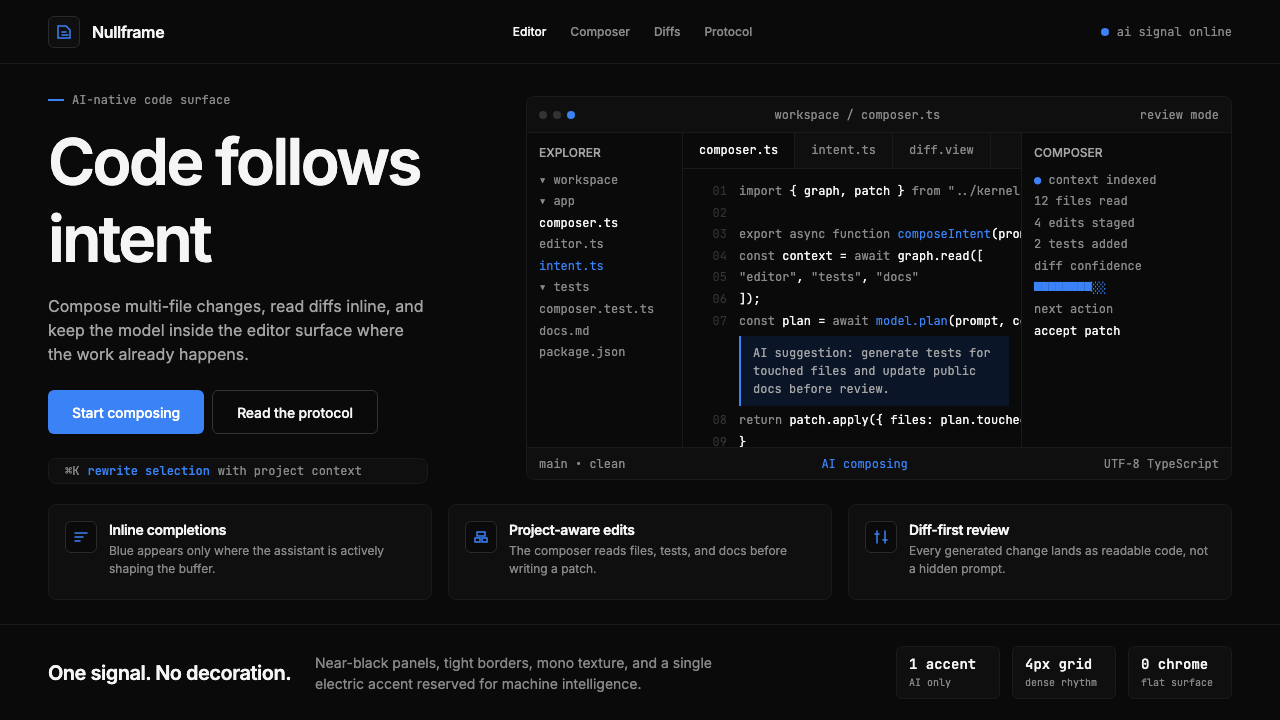 Cursor IDEAI-first code editor. Pure dark surfaces, off-white text, electric blue reser…
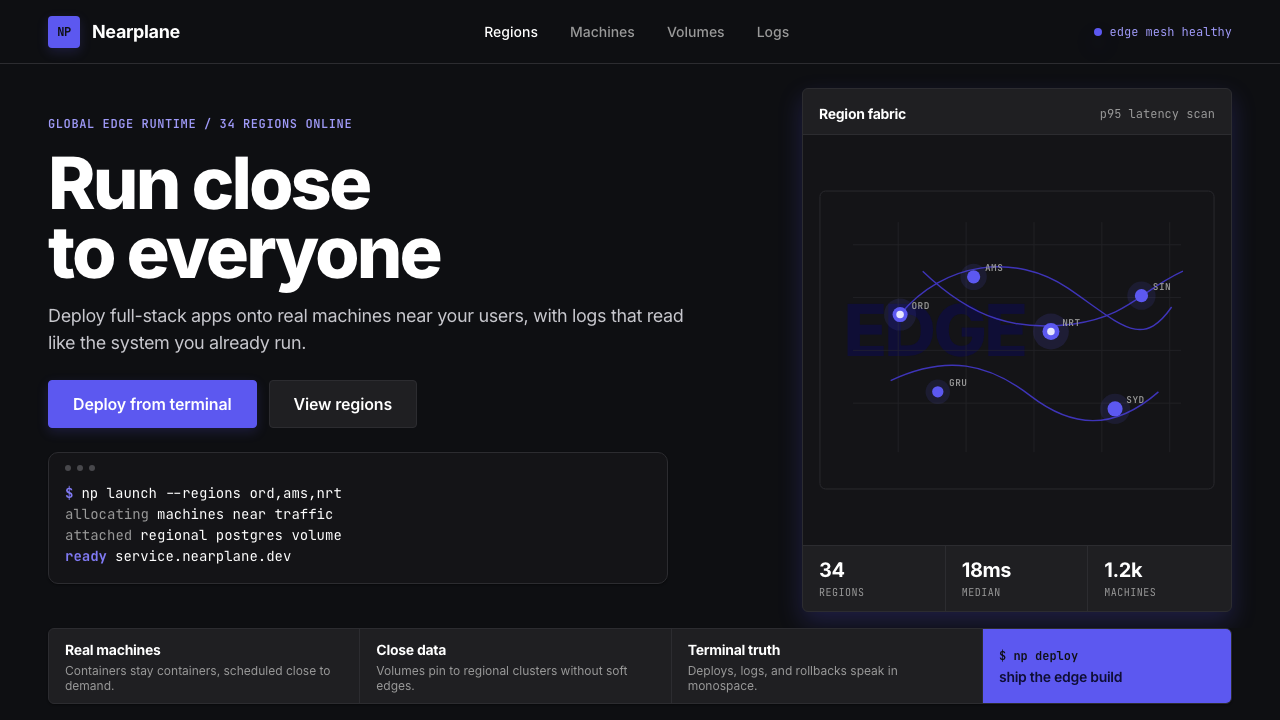 Fly.io Edge-Compute PurpleEdge-cloud with discipline. Electric purple nodes, Inter type, and terminal b…
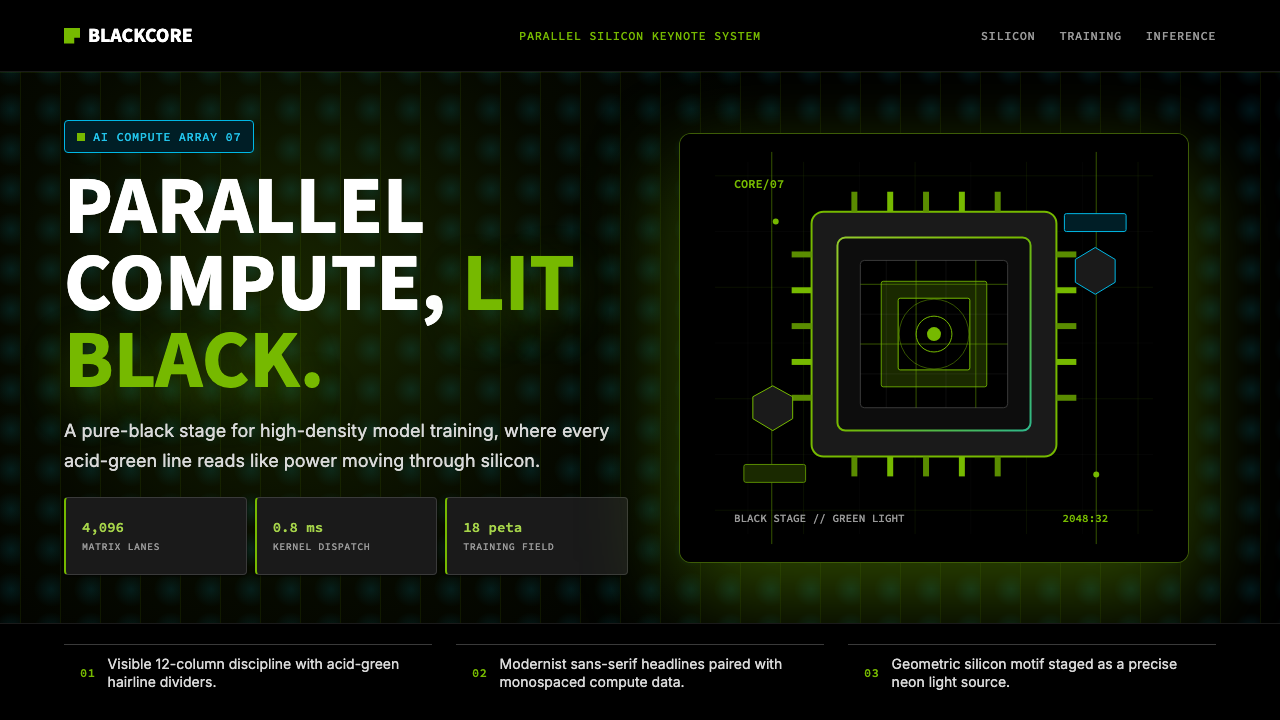 NVIDIA GPU Green-BlackPure black turns compute theatrical. Acid green hairlines and chip geometry s…
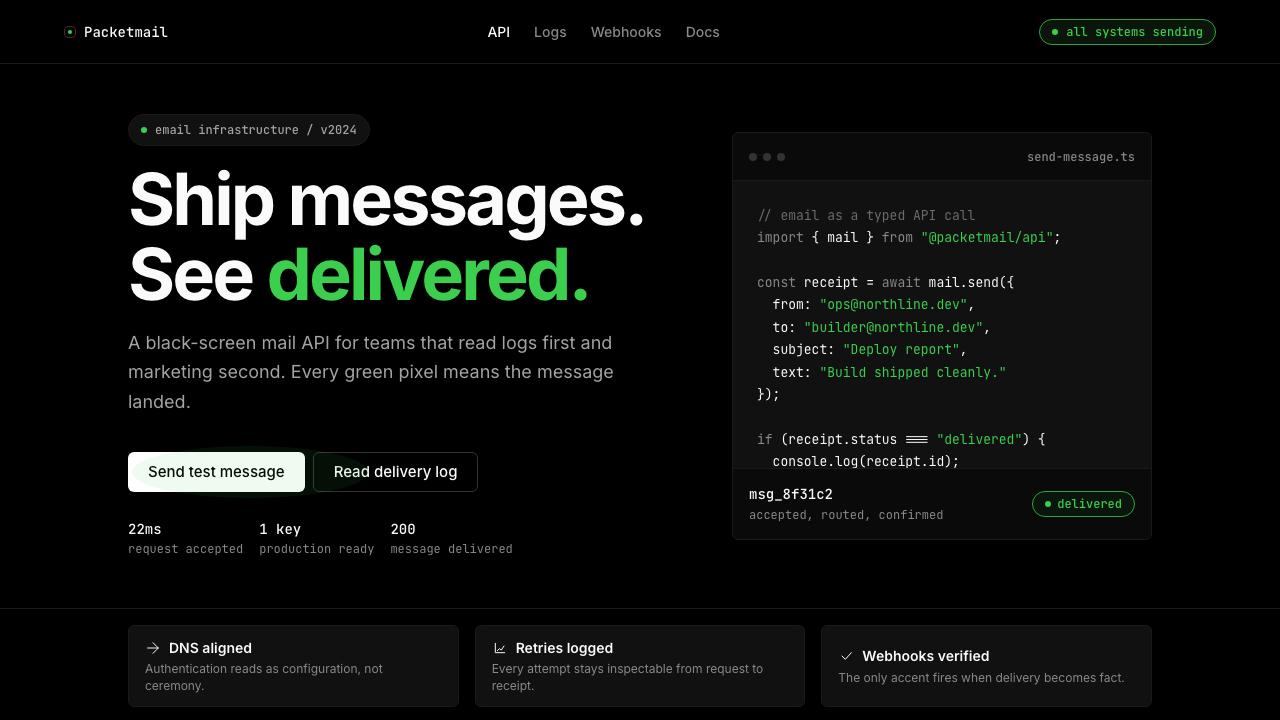 Resend 2024Clean code becomes brand. Pure black, JetBrains Mono, and one green delivered…
 Sky App Private Cloud (2024)Quietly frontier. Aurora purple on matte ink, italic serif meets mono proof.
 Vercel 2024Developer luxury by subtraction. Pure black, white Inter, rigid grid, triangu…