What is Shenzhen Huaqiangbei?
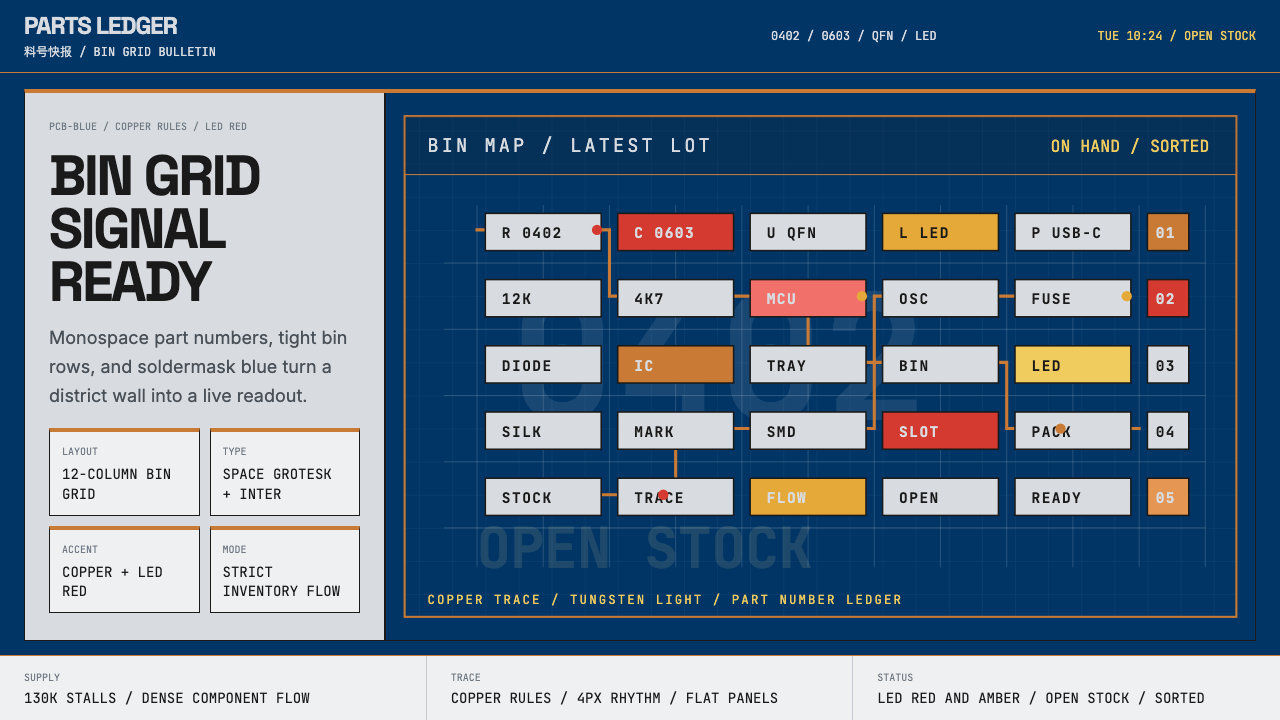
Shenzhen Huaqiangbei translates the world's densest electronics bazaar into a design language where every surface functions like a circuit board — organized, legible, and charged with industrial purpose.
Shenzhen Huaqiangbei in brief
Shenzhen Huaqiangbei is a design system born from one of the world's most extraordinary commercial ecosystems. Huaqiangbei — the electronics district straddling Huaqiang North Road in Shenzhen's Futian District — is not merely a market; it is an industrial nervous system where raw components, assembled modules, shanzhai prototypes, and finished consumer devices circulate within a few city blocks. The aesthetic that emerges from this environment is precise, dense, and unapologetically functional. It reads like the physical world it maps: part numbers stenciled in monospace type, status indicators blinking at the edge of panels, copper traces dividing space the way a printed circuit board divides its substrate.
The visual language draws directly from the material culture of electronics manufacturing. The dominant ground is the cool blue-green of soldermask — the protective coating applied to PCBs — interrupted by the warm gleam of exposed copper traces and the sharp white of silkscreen annotations. Nothing in this palette is decorative; every color existed first as a technical necessity before it became an aesthetic signature. Information is structured the way a component spec sheet structures it: taxonomic, right-aligned, using contrast and weight to communicate urgency, category, and state without relying on illustration or metaphor.
Where many design systems derive their authority from historical art movements or brand identity programs, Huaqiangbei's authority comes from the factory floor. Its grid is the grid of a bin organizer, its color logic is the color logic of LED status indicators, its typographic hierarchy mirrors the hierarchy of a component datasheet. The result is a system that feels both deeply specific — unmistakably rooted in a particular place and industry — and broadly applicable to any interface where density of information and clarity of state must coexist.
Where does Shenzhen Huaqiangbei come from?
Huaqiangbei's story begins with the Special Economic Zone that Deng Xiaoping designated in Shenzhen in 1980. The SEZ granted Shenzhen unusual freedoms — to attract foreign capital, experiment with market mechanisms, and build industrial capacity at a pace the rest of China could not yet match. Electronics manufacturing gravitated to the Pearl River Delta naturally: proximity to Hong Kong provided logistics infrastructure and access to international components markets, while the mainland's labor force provided the density of skilled assembly workers that the industry required. By the mid-1980s, Shenzhen's electronics corridor was already distinct from other Chinese manufacturing zones in its orientation toward component trade as much as finished goods production.
The 1988 opening of SEG Plaza — a ten-story tower built by Shenzhen Electronics Group on Huaqiang North Road — created the vertical archetype for what Huaqiangbei would become. SEG concentrated what had previously been scattered across the district: component traders, equipment suppliers, and the intermediary brokers who connected factories to assemblers to exporters. The building's floor-by-floor specialization — resistors here, connectors there, screens on another floor — established the taxonomic logic that still governs the district and that the design system inherits as grid and hierarchy. By the 1990s, dozens of similar buildings had risen around SEG Plaza, and Huaqiangbei was recognized internationally as the world's single-largest concentration of electronics components trade.
The shanzhai phenomenon — the culture of rapid reverse-engineering, disassembly, and creative recombination that flourished in Huaqiangbei throughout the 2000s — is as important to the district's character as its legitimate trade. Shanzhai manufacturers did not merely counterfeit; they iterated. A phone released by a major brand might be disassembled, improved for a specific regional market (louder speakers, longer battery life, dual SIM before dual SIM was mainstream), and shipped within weeks. This culture of radical informality and speed — of treating any existing design as a starting point rather than a fixed object — infuses the Huaqiangbei aesthetic with an energy that purely corporate industrial design lacks.
Figures like hardware hacker Bunnie Huang, who documented the shanzhai ecosystem extensively in his writing and open-source hardware projects, and Naomi Wu, whose maker projects and online presence brought Huaqiangbei to a global English-speaking audience, helped translate the district's culture into an internationally legible story. Seeed Studio, founded in Shenzhen and deeply embedded in the Huaqiangbei supply chain, formalized the connection between the district's component culture and the global open-source hardware movement — demonstrating that the same ecosystem that produced shanzhai devices could also produce carefully documented, community-oriented hardware projects. This dual identity — simultaneously informal and rigorous, chaotic and systematic — is the tension that makes the design system interesting.
What defines the Shenzhen Huaqiangbei look?
PCB-Ground Palette
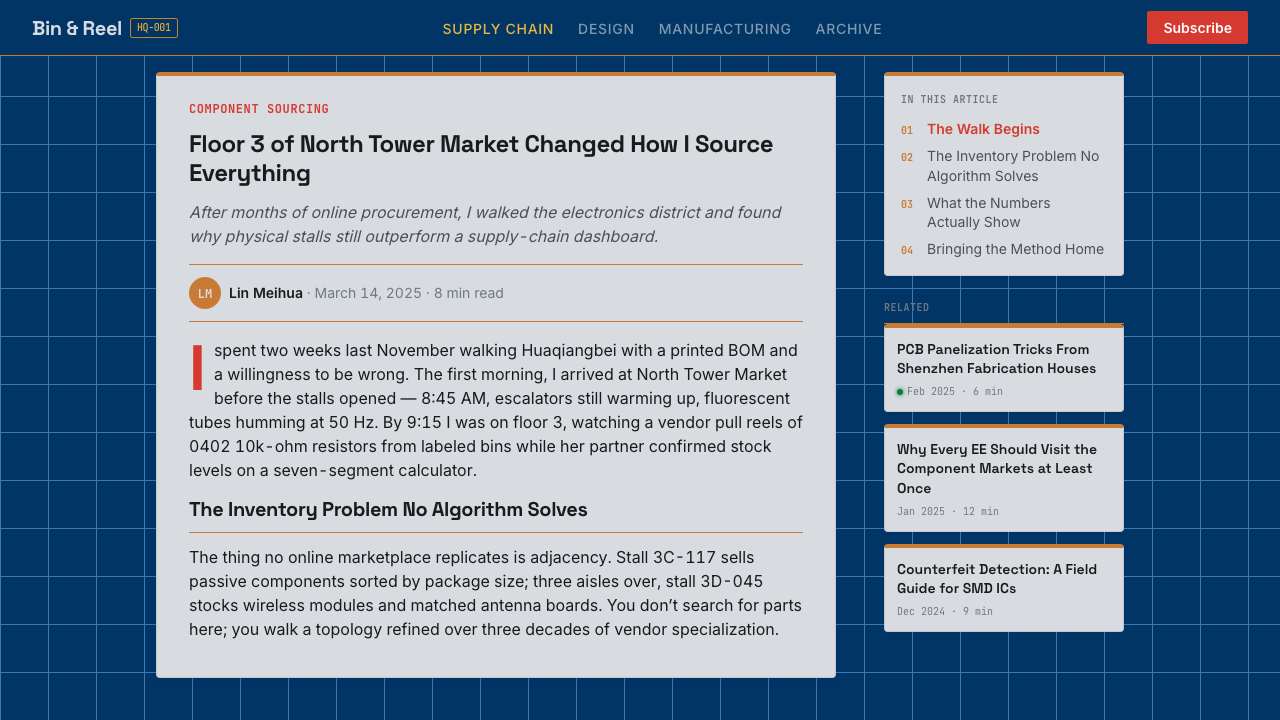
The foundational color is the cool, saturated blue-green of soldermask — the resin coating that protects circuit board copper from oxidation and short-circuits. This is not a blue chosen for brand neutrality or calming association; it is a blue that exists because of a manufacturing necessity, and its industrial authority is precisely what the design system appropriates. Against this ground, warm copper-toned accents trace dividing lines and connective paths the way etched traces carry current across a board. White silkscreen-register annotations mark labels and part identifiers. The palette has zero decorative colors; every hue earns its presence by performing a function.
Monospace Information Density
All primary labeling — part numbers, status codes, measurements, identifiers — is set in monospace type. This choice is not stylistic nostalgia for the terminal era; it is functional. Monospace letterforms maintain consistent horizontal rhythm across varying character counts, which is essential when columnar alignment of alphanumeric codes carries meaning. A resistor part number and a voltage specification must align to the same column margin because the alignment itself communicates relationship. Secondary text — descriptive copy, category headers — may depart from monospace, but the moment a string becomes a code or an identifier, it returns to fixed-width rendering.
Status-Indicator Accent Logic
Small, saturated accent colors appear in the system the way LEDs appear on a physical device: infrequently, at the margins of panels, and always carrying precise semantic meaning. A green accent signals active or passing state, corresponding to a power-on LED or a continuity tester reading. An amber or yellow accent signals warning or standby, matching the cautionary illumination of a charging indicator. A red accent signals fault or critical state. These colors are never used decoratively or for brand warmth — they are reserved exclusively for machine-state communication. Their sparing use is what gives them authority; overuse would collapse the signal.
Bin-Grid Layout
The layout grid is modeled on the physical organization of a component bin organizer — the rectangular grid of small labeled compartments in which surface-mount resistors, capacitors, and ICs are stored and sorted. Every content region is a discrete cell: bounded, internally consistent, labeled at its top-left corner or top-right corner depending on convention, and separated from adjacent cells by a defined gutter. Content does not bleed between cells; a card is a bin, and nothing about its contents is implied to extend beyond its edges. This creates a density of information that is navigable precisely because each unit is clearly bounded.
Copper-Trace Dividers
Section separators are rendered as fine lines in the copper accent — thin, precise, and at the boundary between sections rather than decorative elements floating in whitespace. Like the traces on a circuit board, these dividers are structural connectors as much as separators: they imply that what sits on either side is related by design, not merely adjacent by arrangement. Dividers never carry embellishment, shadow, or gradient. They exist at the minimum weight needed to register as a boundary, and their warmth against the cooler ground palette creates a visual hierarchy that requires no additional color differentiation.
Datasheet Typography Hierarchy
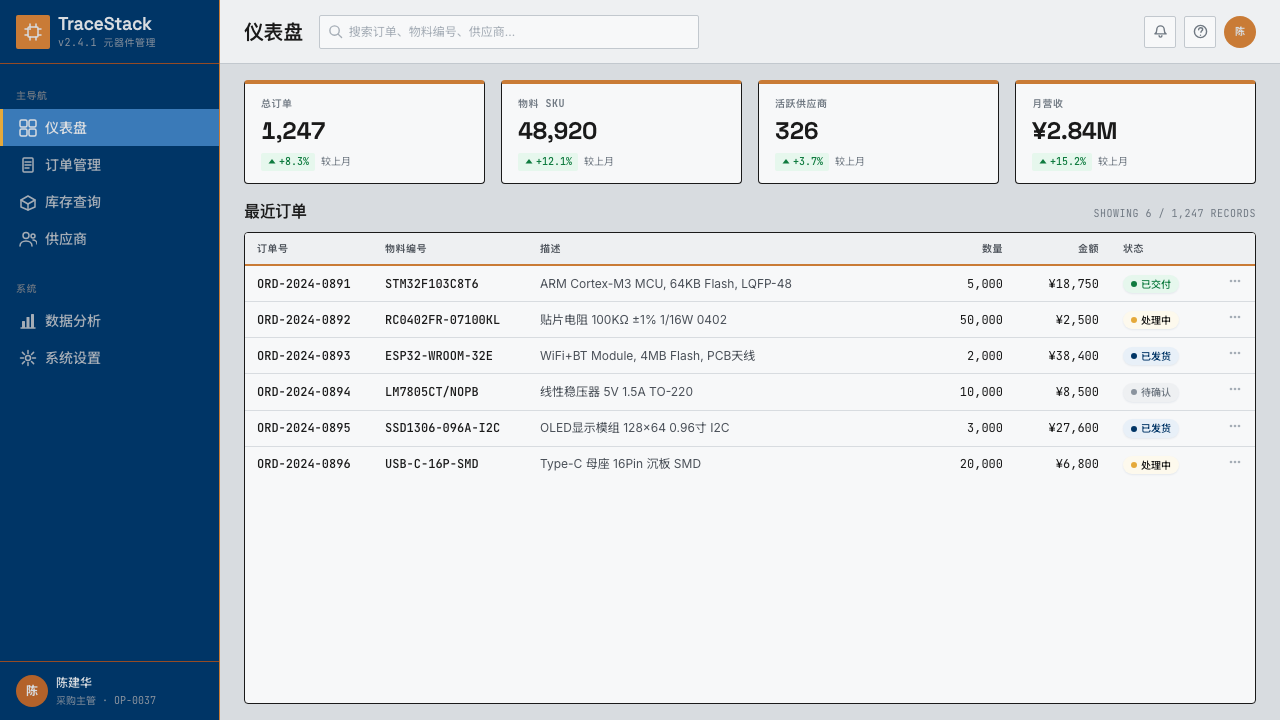
The typographic hierarchy of the system mirrors the hierarchy of an electronic component datasheet: a bold, large component name or category at the top; a secondary line for the specific model identifier or variant; then a dense body of specifications arranged in short, right-aligned label-value pairs. Headers are assertive and high-contrast; body text is tight and neutral. The convention of right-aligning values against left-aligned labels — so that the equals sign is implied by spatial alignment rather than character — creates a visual scanning path that works quickly under high information density. Columns of specs do not require decorative rules between them; the consistent left and right margins of the label-value pairs create their own order.
Functional Texture
Where texture appears, it references the physical surfaces of electronics manufacture: the faint grid impression of a PCB substrate, the stipple pattern of a solder paste stencil, the cross-hatch of a ground plane fill. These textures are never used for visual richness in a decorative sense; they appear at low opacity as background differentiation between functional zones, the way a PCB's ground fill distinguishes the power plane from the signal layer. The system permits no textures that lack an industrial referent — no organic grain, no paper, no fabric. Every surface in this aesthetic is a manufactured surface.
Who shaped Shenzhen Huaqiangbei?
The founders of Shenzhen Electronics Group, which built SEG Plaza on Huaqiang North Road in 1988, created the physical archetype for Huaqiangbei's organizational logic. By concentrating component trade in a vertically stacked, floor-by-floor specialized building, they established the taxonomic, compartmentalized hierarchy that defines the district and, by extension, the design system. SEG Plaza's structure is the original bin organizer; every grid layout in the Huaqiangbei aesthetic is descended from its floor plan.
Andrew 'Bunnie' Huang is an American hardware hacker and open-source advocate whose deep engagement with Shenzhen's electronics ecosystem — documented in his writing, talks, and the open-source Novena laptop project — gave the global maker community a rigorous, unsentimental account of how Huaqiangbei actually works. His work demonstrated that the shanzhai ecosystem was not merely counterfeit production but a genuinely innovative manufacturing culture, operating at a speed and flexibility that branded consumer electronics could not match. By taking the district seriously as an engineering and cultural phenomenon, he helped frame Huaqiangbei as a subject worthy of aesthetic and intellectual attention.
Naomi Wu, a Shenzhen-based maker and online presence known as Sexy Cyborg, brought Huaqiangbei to a global English-speaking audience through videos documenting her hardware projects, the local maker scene, and the district's component ecosystem. Her work translated the granular, technical reality of shopping for components in Huaqiangbei into accessible narratives, while simultaneously representing the district's integration of maker culture, gender, and Chinese urbanism in ways that received international attention. She is one of the clearest connectors between Huaqiangbei as a physical place and Huaqiangbei as a legible cultural identity.
Seeed Studio, founded in Shenzhen and closely integrated with the Huaqiangbei supply chain, occupies a distinctive position as a bridge between the district's component culture and the global open-source hardware movement. By producing documented, community-oriented hardware modules using the same supply chains that feed the shanzhai ecosystem, Seeed demonstrated that Huaqiangbei's speed and component density could serve rigorous engineering community goals as readily as informal product iteration. Seeed's house style — clean, schematic, documentation-oriented — is among the most considered institutional expressions of the Huaqiangbei aesthetic in a designed commercial context.
No individual founder created Huaqiangbei; the district is the emergent product of the Pearl River Delta's manufacturing networks — the interlocking web of component suppliers, tooling shops, PCB fabricators, assembly lines, and logistics hubs that formed across Guangdong Province following the Special Economic Zone designation. These networks created the supply-chain infrastructure that made rapid iteration possible: a design change could propagate from concept to physical prototype in days because every necessary production step existed within a small geographic radius. The visual density and taxonomic rigor of the Huaqiangbei aesthetic is inseparable from the geographic and economic density of the ecosystem that produced it.
How do you use Shenzhen Huaqiangbei today?
Applying the Huaqiangbei design system correctly requires accepting its core premise: information density is not a problem to be solved by reducing content, but a condition to be organized by building better taxonomic structure. The system is not a minimalist language — it is a dense language with rigorous internal logic. Attempting to apply it while simultaneously reducing content density will produce something that looks like a PCB pastiche rather than a coherent system.
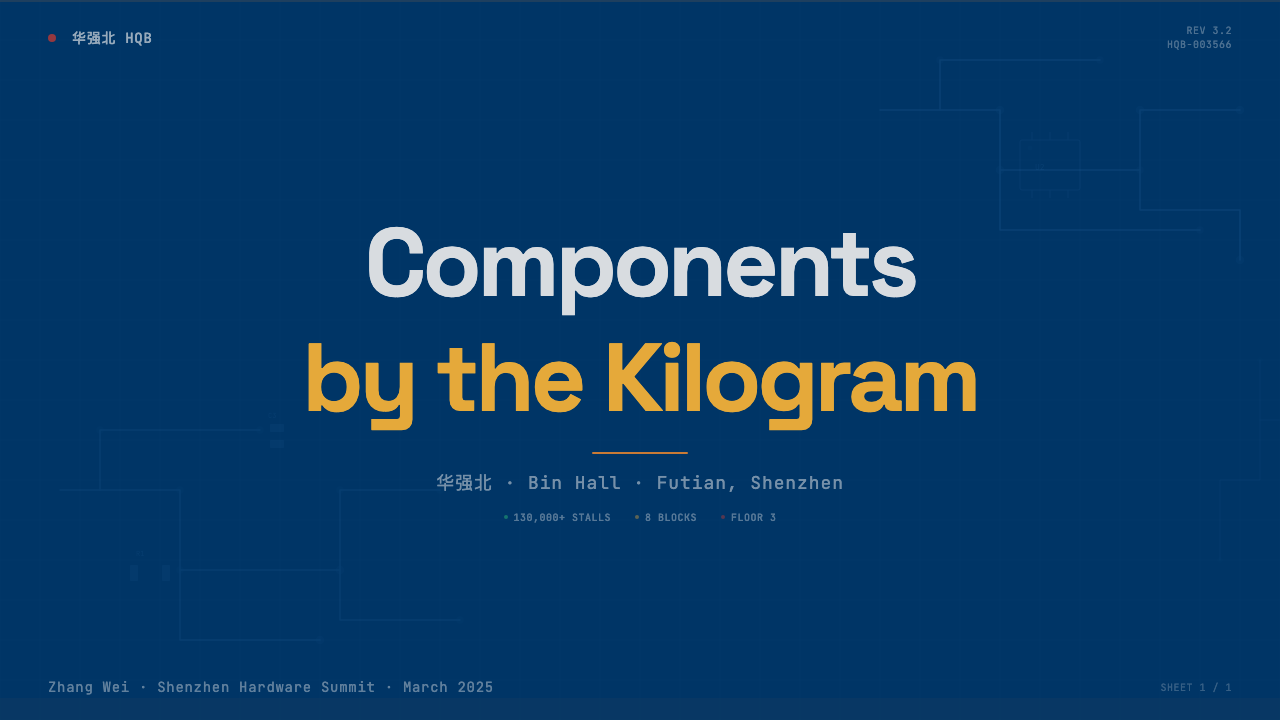
For presentation slides, the Huaqiangbei system works best in technical contexts where the audience expects information, not persuasion. Cover slides benefit from a high-contrast composition: a dominant PCB-blue ground, a component-style identifier in monospace as the deck's category label, and a large title in a contrasting weight and color. Content slides should be treated as component datasheets: label-value pairs for key metrics, monospace for all identifiers and codes, copper-accent horizontal rules as section breaks. Data slides become schematic diagrams — bar and line charts inherit the color logic of status indicators, with functional green for positive values and cautionary amber for thresholds.
For web interfaces, the system is particularly well-suited to developer tools, hardware dashboards, IoT monitoring interfaces, and any technical product where users are professionals who read dense information quickly. Define a strict column grid and commit to it; allow no organic or irregular column widths. Reserve the PCB-blue ground for primary panels; use near-white for secondary areas and deep near-black for high-attention zones. Interactive state changes should use the LED accent logic precisely: green for success, amber for pending or warning, red for error or fault. Navigation should be typographic and taxonomic — think of it as the floor directory of SEG Plaza, not a consumer app's hamburger menu.
For editorial and marketing contexts, the style carries associations with hardware documentation, open-source projects, and technical authority. A blog or documentation site applying this system should treat its sidebar as a component index — monospace labels, consistent indentation levels, no decorative icons beyond minimal geometric indicators. Marketing pages can use the system's poster-quality contrast: full-width blocks with PCB-blue grounds broken by large copper-accent headlines, with specifications listed below in tight label-value columns as proof of technical substance. The system is particularly effective for hardware product launches, technical community events, and maker culture contexts where authenticity and technical credibility are primary values.
A common mistake when applying this system is treating the PCB-blue and copper accent as a color palette in isolation — picking the hues but applying them with the structural logic of a different design system. The colors only work correctly when they are performing their semantic functions: ground, trace, annotation, status. Using copper as a decorative accent on a layout that has no taxonomic structure, no monospace identifiers, and no grid logic produces something that looks costumed rather than authentic. The other common error is over-texturing: adding PCB substrate textures at high opacity as decorative backgrounds rather than at the faint, functional levels where they belong.
Shenzhen Huaqiangbei — FAQ
Is the Huaqiangbei aesthetic limited to hardware or electronics contexts, or can it transfer to other industries?
The system transfers to any context where dense, structured information must be navigated quickly by professional or technically sophisticated users. Financial data terminals, logistics tracking interfaces, code review tools, and scientific instrumentation software all share the organizational challenge that the Huaqiangbei system addresses. The key condition for successful transfer is that the content actually has the taxonomic structure the system assumes — labeled categories, state indicators, identifier strings. Applying the aesthetic to consumer content (travel apps, food delivery, social media) produces visual dissonance because the content does not have the internal logic the design language is built to communicate.
How does this aesthetic relate to other industrial or technical design systems like NASA data visualization or terminal interfaces?
Huaqiangbei shares the functional-first premise of those systems but differs in its specific material referents. NASA data visualization and aerospace HMI design derive their authority from a tradition of engineering rigor and national institutional weight — their color systems and typography emerge from legibility research under operational conditions. Terminal interfaces derive their aesthetic from computing history and the physical constraints of CRT displays. Huaqiangbei's referents are commercial and tactile rather than institutional: the circuit board, the component bin, the stencil annotation. Where aerospace design tends toward austerity and suppression of color, Huaqiangbei's status-indicator logic is more permissive of saturated functional accents. The systems are conceptual cousins rather than the same tradition.
Does the shanzhai association create branding risk when using this aesthetic for a legitimate commercial product?
For most Western audiences, the shanzhai association is weak or absent — the aesthetic reads primarily as technical precision and industrial authority rather than informal manufacture. For Chinese audiences, the reference is more legible, and there the association carries a more complex set of values: not only informal copying but also creative energy, rapid iteration, and a particular kind of street-level ingenuity. Whether this is a liability or an asset depends entirely on the product. For hardware projects, maker tools, or technical communities, the association with Huaqiangbei's culture of rapid prototyping is a positive signal. For enterprise software or financial services, the informality could work against the desired positioning, and the system should be applied with greater restraint and institutional framing.
How should the system handle color when the interface needs a light mode and a dark mode?
The system's native mode is the one that most closely mirrors the physical PCB: a saturated blue-green ground that falls toward the medium-dark range of the value scale, with lighter annotations and copper-warm traces. A light mode adaptation requires promoting the near-white annotation color to the ground and pushing the blue-green to accent or panel-border roles. The copper accent survives the inversion well, as it reads warmly against both light and dark grounds. The status indicator colors — green, amber, red — are robust across both modes when used at their functional weights. The critical adjustment is that on a light ground, the grid and bin-divider logic must be reinforced with explicit rules or color fills rather than relying on the dark-ground contrast that the native mode provides.
Is Huaqiangbei appropriate for branding and identity work, or is it primarily a UI and layout system?
The system's identity applications are strongest when the brand itself is embedded in hardware, technology manufacturing, or maker culture. As a wordmark environment, monospace identifiers and PCB-ground color fields create immediate technical authority — effective for a component supplier, a hardware accelerator, or an electronics publication. For brands operating outside these sectors, the visual language may communicate the wrong set of values: precision and industrial function are not universally desirable brand attributes. As a UI and layout system, the Huaqiangbei language has broader applicability because the taxonomic, status-indicator logic it provides is genuinely useful in many information-dense professional interfaces regardless of the underlying industry. The system's best use cases are those where the design language and the product's subject matter reinforce each other, rather than one being imposed on the other.
Related design styles
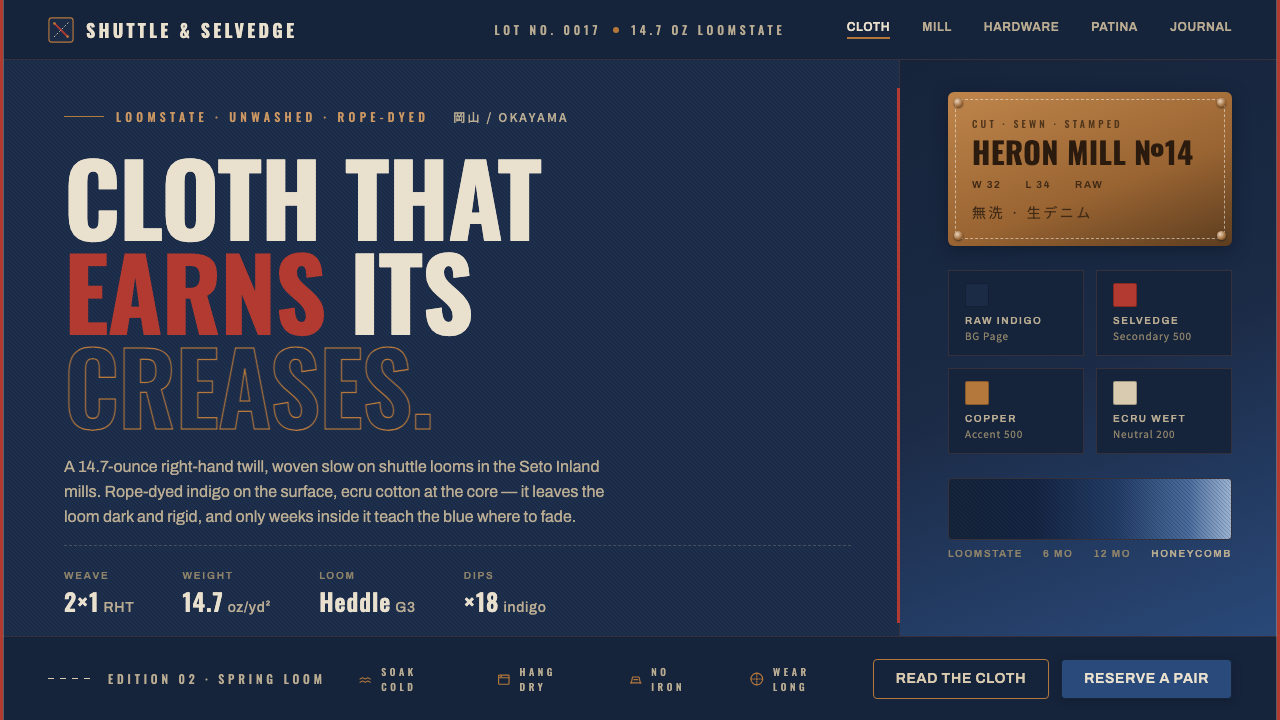 Selvedge DenimCloth that earns its creases. Raw indigo twill, a red selvedge edge, copper r…
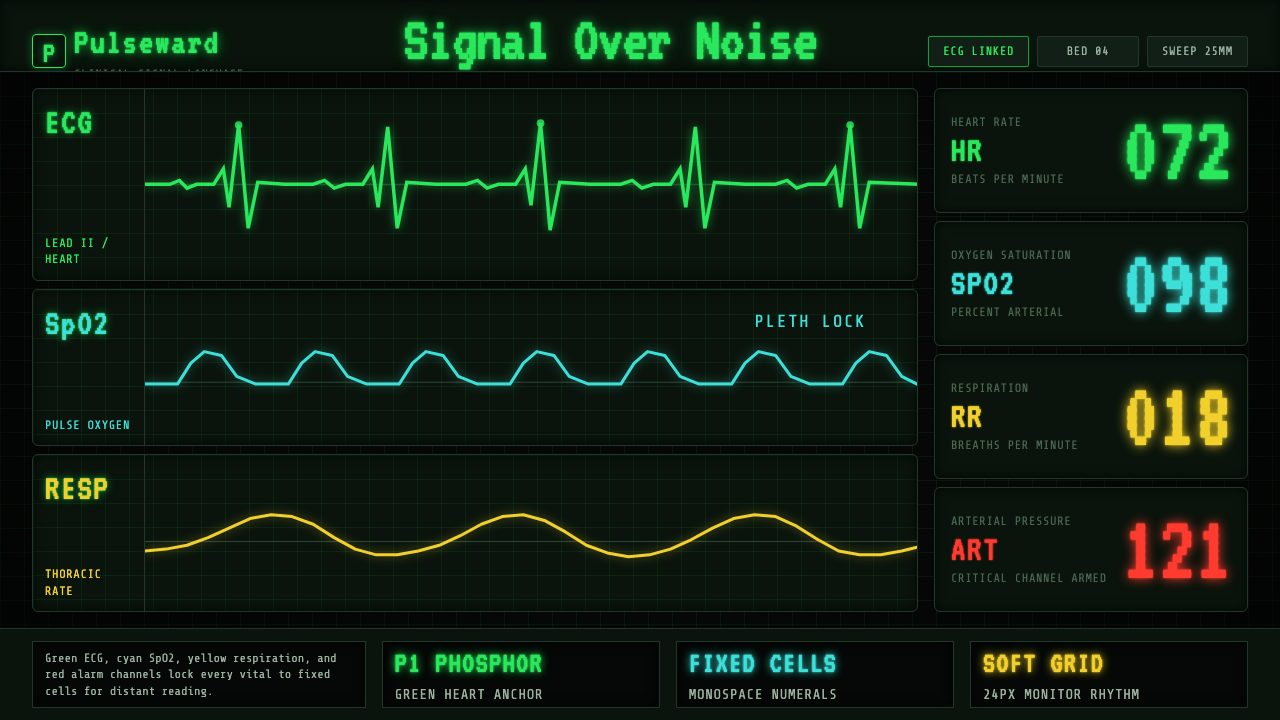 EKG Vital MonitorClinical clarity glows. Phosphor ECG green, cyan and yellow channels lock to…
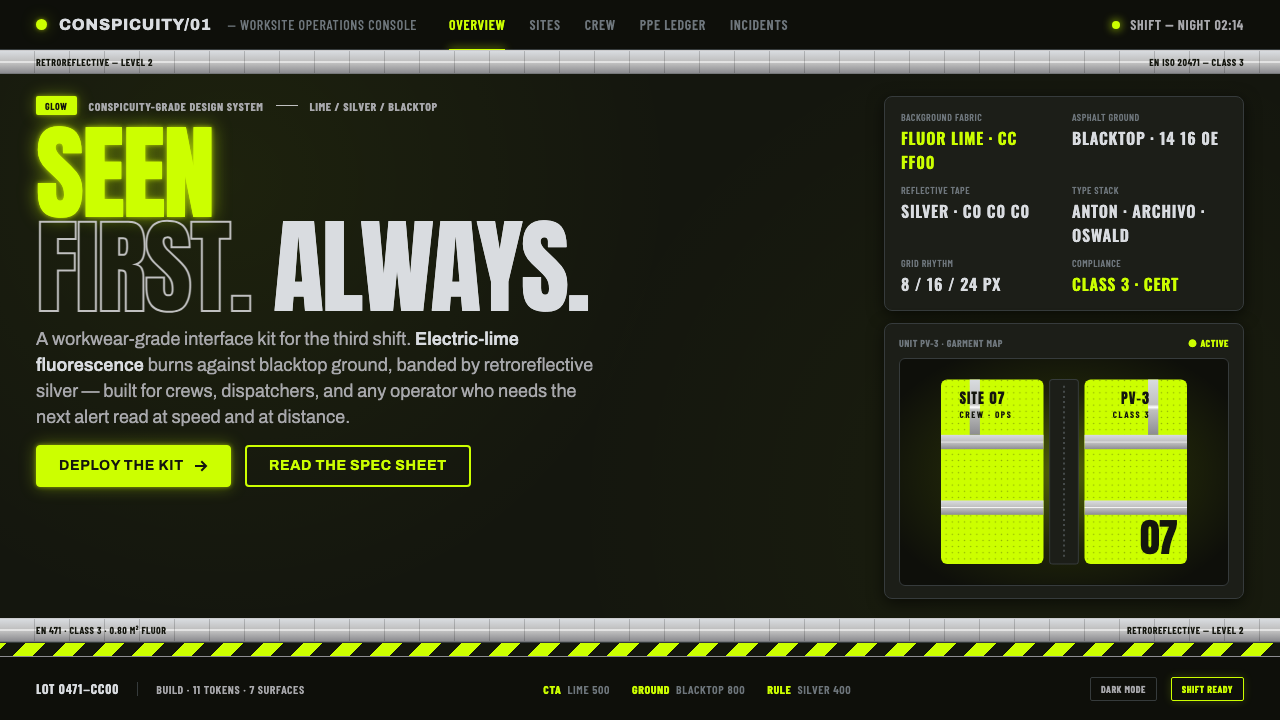 Hi-Vis Safety VestEngineered to be seen. Fluorescent lime on blacktop, silver reflective bands,…
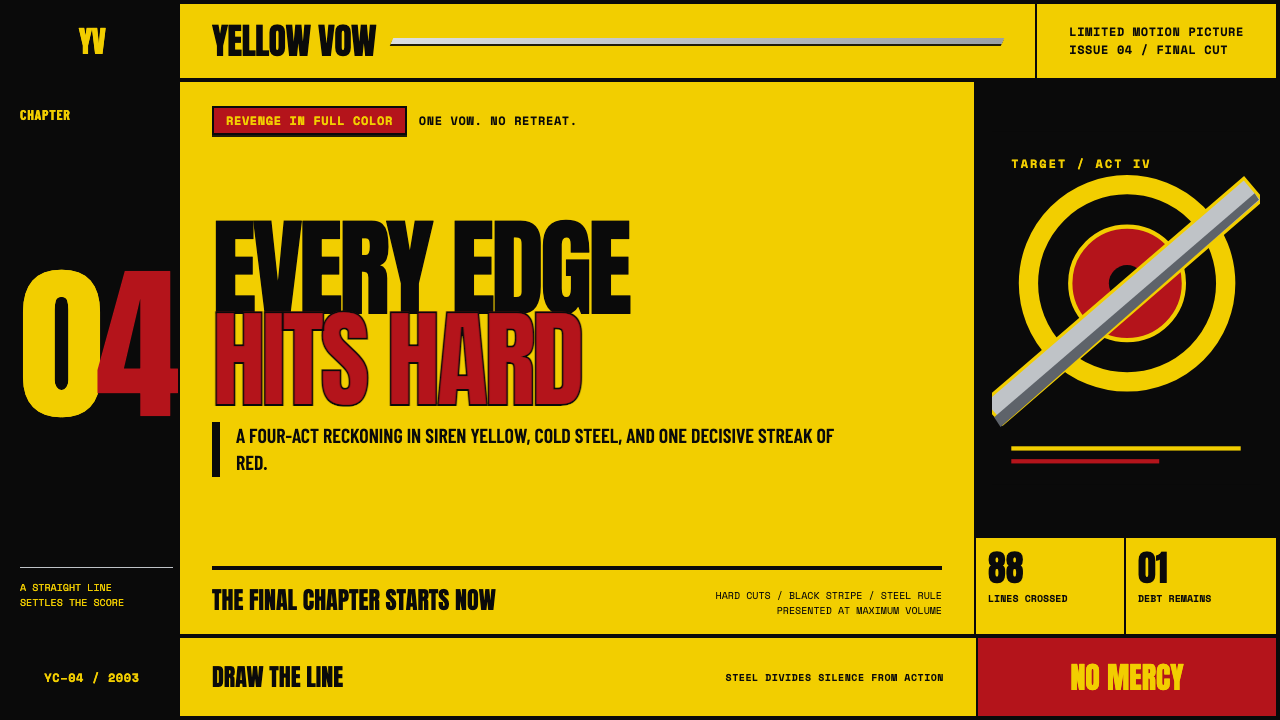 Kill Bill (2003)Revenge lands at full volume. Chrome yellow, slab type, and steel rules cut t…
 Muay Thai Camp BannerFight-poster physical. Blood-red and gold satin on near-black, heavy Anton ty…
 Nikon F Professional BlackMechanical precision as brand. Black-enamel ground, chrome rims, white-filled…