What is Revolut Black Finance?
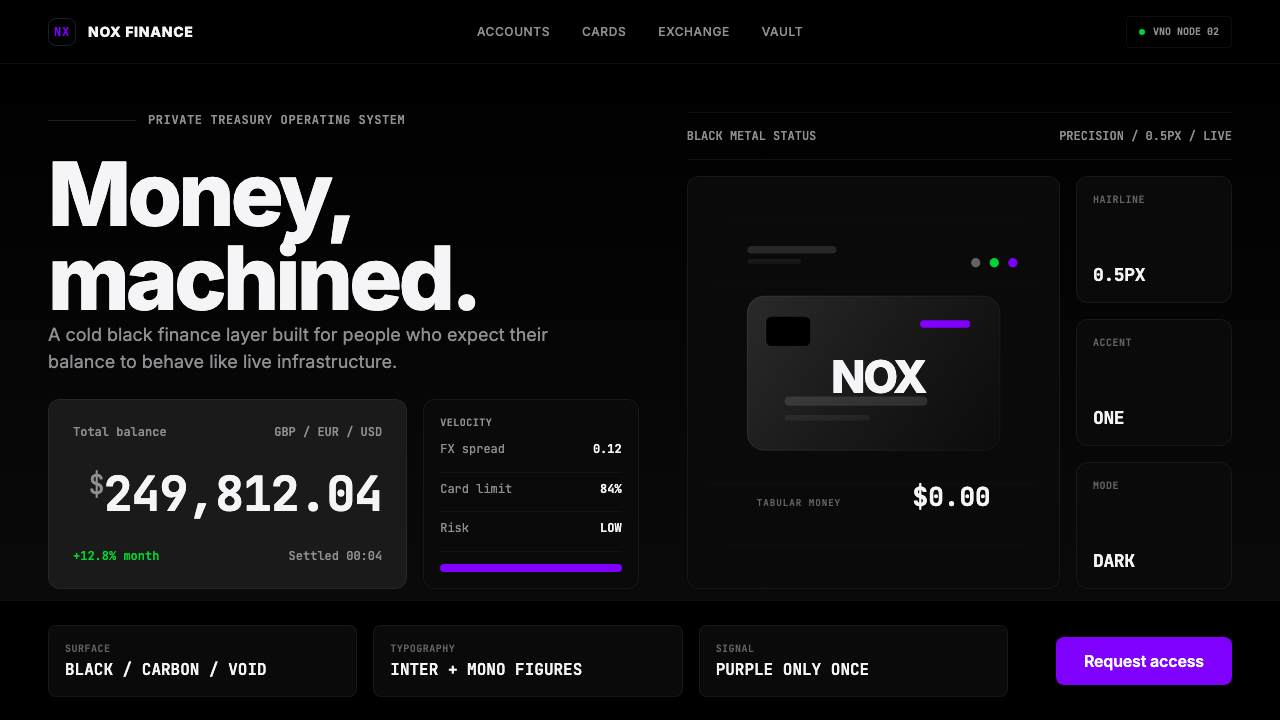
Revolut turned the black metal card into a design manifesto — cold monochrome surfaces, a single electric accent, and typography that reads like a precision instrument rather than a bank.
Revolut Black Finance in brief
Revolut Black Finance is the visual identity system codified by the London-based neobank around 2020, defining how a new generation of financial products could present itself: without the warm greens, rounded mascots, or reassuring pastels that traditional retail banking had trained consumers to expect. In their place: pure black grounds, hairline dividers, large-format numeric displays, and a single electric purple accent — every choice calibrated to read as a precision instrument rather than a friendly institution.
The aesthetic sits at the intersection of European fintech minimalism and the culture of the black metal card. Before Revolut, the matte black card was a luxury signal reserved for elite-tier credit products. Revolut democratized that status object, issuing it as a standard feature, and built an entire design language around the same values the card communicates: control, seriousness, and the expectation that your money deserves the same visual rigour as professional software.
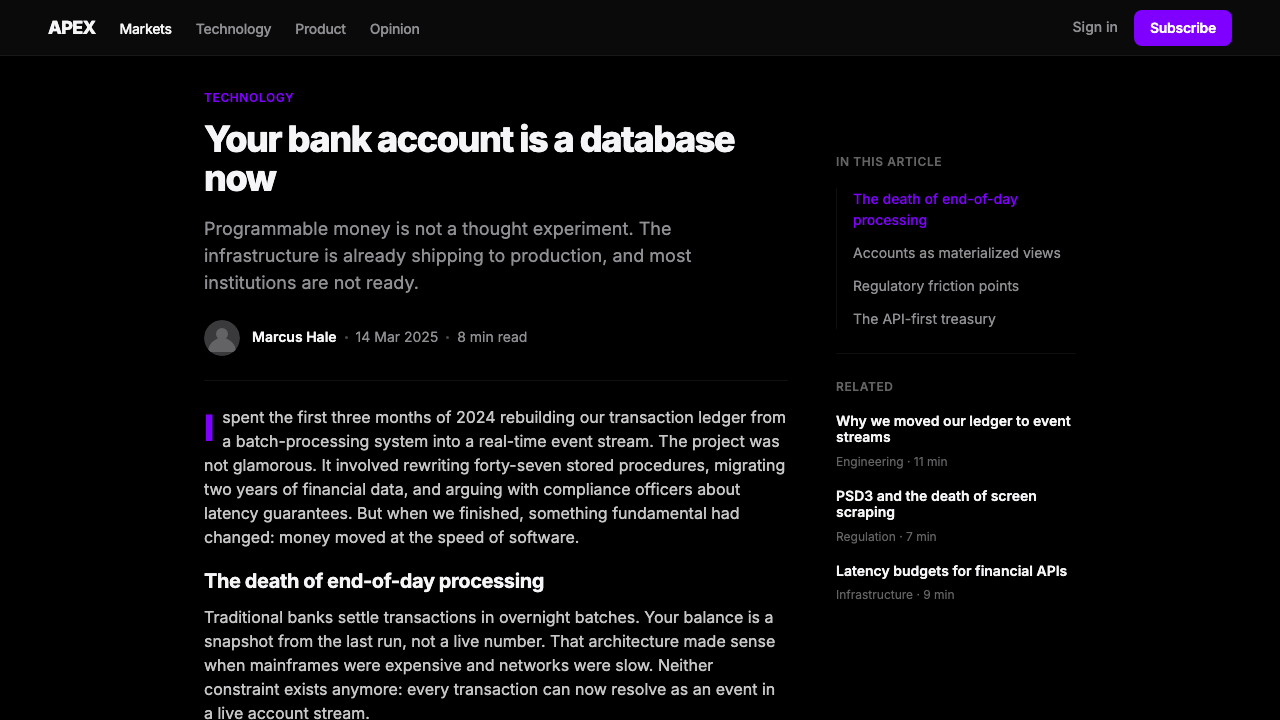
What distinguishes this system from generic dark-mode design is its restraint in the accent. Where many dark interfaces scatter color liberally across buttons, states, and decorative elements, Revolut's approach isolates the electric purple as a single signal — pointing, not decorating. Everything else is resolved in the monochrome range, from deep black through structured grays, with hairline borders replacing shadows as the primary spatial device.
Where does Revolut Black Finance come from?
Revolut was founded in London in 2015 by Nikolay Storonsky and Vlad Yatsenko, two former finance-industry engineers who built their first product — a multi-currency prepaid card with no foreign transaction fees — in months rather than years. The company was incorporated with a Lithuanian banking license, a deliberate structural choice that allowed it to passport services across the European Economic Area without separately negotiating with each national regulator. From the beginning, the brand presented itself as a technology company that happened to hold a banking license, not a bank that happened to build an app.
The early Revolut identity was relatively conventional for the fintech wave of the mid-2010s: a gradient-heavy wordmark, a purple that leaned toward violet, and visual language broadly shared with the Monzo and N26 generation of challenger banks. The design language hardened significantly as the company scaled. By the time the 2020 brand system was consolidated, the gradient was gone. The palette had collapsed to its essential components: pure black, pure white, and a single electric purple that had been cooled and brightened into something closer to a neon signal than a brand color.
The metal card itself was central to this evolution. Revolut introduced the black metal card as a premium tier product around 2018, and the physical object shaped the digital design language as much as any screen did. A matte black metal card has no room for gradient or warmth; it succeeds precisely because of its severity and material honesty. The 2020 digital system read the same lesson into every interface: surfaces should behave like the card — flat, cold, uncompromising.
The movement context was the broader European neobank wave, a cluster of well-funded challenger banks — Monzo, N26, Starling, Wise — that emerged from 2015 onward to compete against incumbent retail banks on user experience rather than branch count. Within this wave, each brand staked out distinct visual territory. Monzo chose hot coral and friendly roundedness; N26 chose Helvetica rigor and cool grey; Revolut chose the most severe position — the one that spoke not to the friendly novice but to the financially self-serious user who thought of their money as a tool to optimize.
What defines the Revolut Black Finance look?
Pure Black Ground
The foundational surface is absolute black — not charcoal, not dark navy, not off-black, but a total absence of surface color. This choice immediately separates the brand from the warm-dark palettes that consumer apps often use to soften the dark mode experience. The pure black ground asks nothing of the user emotionally; it simply declares that what appears on it will be precise.
Single Electric Accent
The electric purple operates as the sole color signal in the system. It appears sparingly — on a call-to-action, a balance highlight, an alert indicator — never as decoration. The hue has been pushed toward the cooler, more energized end of the violet range, reading closer to ultraviolet than to traditional purple. Because it appears against pure black, it carries maximum contrast with minimal area. One color, one meaning: pay attention here.
Hairline Borders as Spatial Logic
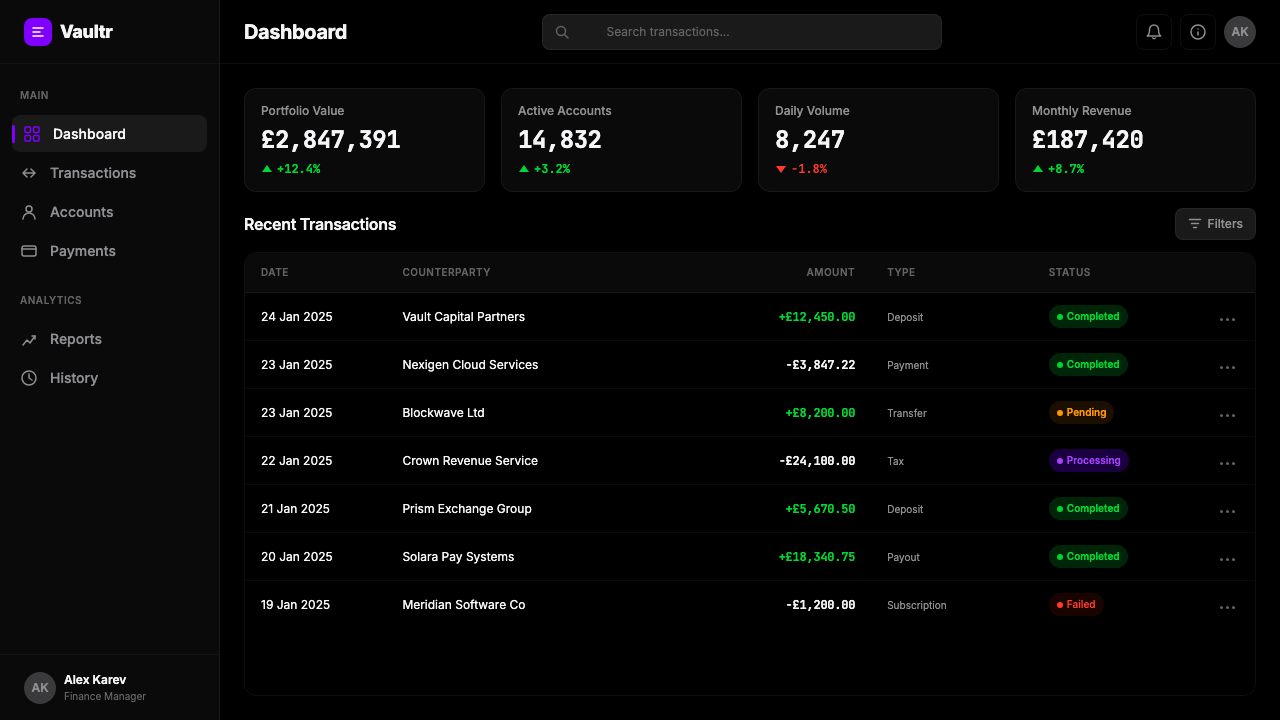
Where conventional interfaces rely on shadows or background color shifts to define component boundaries, Revolut Black Finance uses hairline borders — borders so thin they barely register as physical lines, yet they partition the space with absolute precision. The effect is architectural: a floor plan rather than a landscape. Sections are divided by lines, not by air.
Tabular Numeric Display
Numbers are treated as the primary visual content, not as secondary data. Balance figures, transaction amounts, and exchange rates are set at large scale in tabular-figure typefaces — where each numeral occupies the same horizontal space, ensuring that columns align precisely regardless of digit combination. This typographic choice is lifted directly from financial terminal culture and signals that the interface is built for reading numbers, not for reading prose.
Instrumentation Typography
The typeface system reads as instrumentation — clean, geometric sans-serifs chosen for legibility at all sizes rather than for warmth or personality. Labels are concise, uppercase in many contexts, and set with tight letter-spacing that evokes a cockpit readout or a trading terminal more than it evokes a consumer banking app. Hierarchy is established through scale and weight alone; color is not used for typographic differentiation.
No Decorative Layer
Illustration, icon art, mascots, and ambient background textures are absent by design. The interface contains only what is necessary for navigation, information, and action. This is not simply a stylistic choice — it is a values statement. Decoration in a financial product implies that the provider needs to work to earn your trust. Revolut Black Finance operates from the assumption that the numbers speak for themselves.
Monochrome Structural Hierarchy
Between the pure black ground and the white foreground typography, a structured range of grays carries all secondary and tertiary information — metadata, timestamps, secondary labels, disabled states. The range is narrow enough to maintain visual unity but wide enough to create clear reading hierarchy. No single gray is arbitrary; each occupies a specific position in the system's logic of importance.
Who shaped Revolut Black Finance?
Co-founder and long-serving CEO of Revolut, Storonsky shaped the company's positioning as a technology platform first and a financial institution second. A former derivatives trader at Lehman Brothers and Credit Suisse, he brought a quantitative sensibility to product philosophy that is legible in the design system: performance is the message, decoration is waste. His insistence on speed of iteration and numerical transparency established the cultural conditions in which the stark visual language could emerge and persist.
Co-founder and long-serving CTO, Yatsenko was responsible for the engineering architecture that made Revolut's real-time multi-currency infrastructure possible. The design language's emphasis on live data — balance figures updating in real time, exchange rates displayed at market precision — reflects a product philosophy shaped by engineers for whom the live number is the primary unit of meaning. The interface is built around the data feed, and the visual system serves that feed without distraction.
Credited as a key figure in the brand and design direction during the formative period of the Revolut identity, Khrenov was part of the team that moved the brand away from the warmer, gradient-heavy visual language of the early years toward the harder-edged, monochrome system associated with the post-2020 era. The consolidation of the palette, the decision to anchor the identity in the metal card aesthetic, and the adoption of the instrumentation typography register are associated with this period of leadership.
Revolut's design language did not emerge in a vacuum — it was defined partly in opposition to the other members of the European challenger-bank generation. Monzo's hot coral and friendly illustration style, N26's cool rational Helvetica system, Starling's teal and rounded approachability: each brand staked out a position, and Revolut's position was the most severe. The collective movement created the design discourse within which Revolut's choices read as deliberate rather than arbitrary — a statement made against a backdrop of known alternatives.
Before Revolut, the heavy matte-black metal payment card was a symbol reserved for premium tier products — American Express Centurion, high-limit travel cards issued to frequent flyers and corporate accounts. Revolut issued it as a tier-two or tier-three product, putting the status object into more hands while retaining its aesthetic vocabulary. This redistribution of the metal card was a product insight with direct design consequences: if the card that represents your brand is severe and instrumental, the app that represents the same brand cannot be warm and playful.
How do you use Revolut Black Finance today?
Revolut Black Finance is a disciplined system that transfers well to any context where precision, control, and financial seriousness are the primary values the design needs to communicate. Applying it correctly requires resisting the temptation to soften it — every accommodation toward warmth or playfulness degrades the core signal. Start from the pure black ground and add only what the content demands.
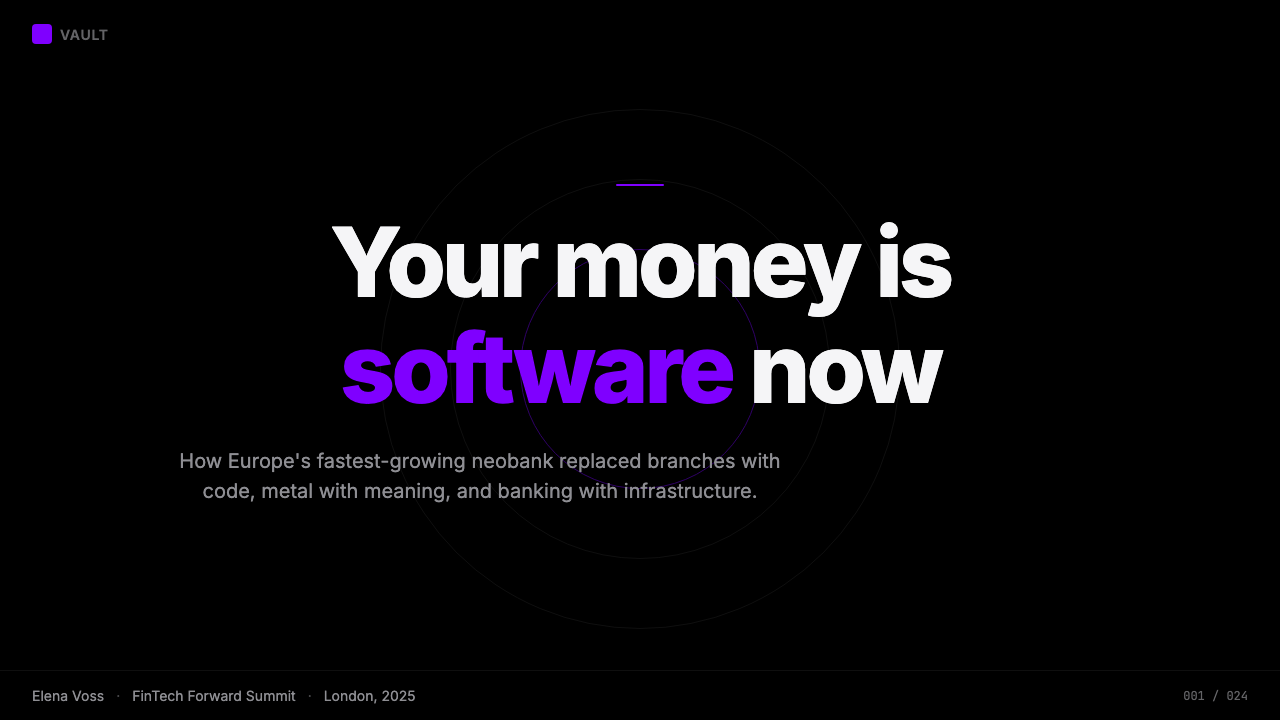
For presentation slides, the style excels on both cover and data pages. A cover built in this register uses a single large typographic element — a figure, a short phrase, a key metric — set in white against pure black, with the electric accent appearing once as a structural punctuation. Content slides should treat every number as a visual headline: set financial figures at the largest scale the slide permits, subordinate all prose labels, and use the accent color to indicate the one figure that matters most in the current argument. Data visualization slides take on a terminal quality — charts without rounded corners, bar fills in pure white or electric purple, gridlines rendered as hairlines rather than colored bands.
For web interfaces and dashboards, this system is purpose-built. Dashboard panels defined by hairline borders rather than card shadows; typography that scales down to metadata size while retaining the monochrome palette; interactive states signaled by the electric accent rather than by background fills. Pricing pages work particularly well: tier names set in large capitals, feature lists in tight prose, and the recommended tier distinguished by an electric accent border rather than a colored background card. Navigation should be wordmark-led with no decorative iconography.
For editorial and marketing applications, the style supports a poster-like boldness that reads well at large format. A marketing layout in this register alternates between full-bleed black panels with white type and white panels with black type, with the electric accent appearing only on the most important call-to-action per section. Photography, where used, should be treated as a flat element — high-contrast, tightly cropped, never overlaid with texture or gradient. The tone of copy should match the visual register: declarative, numeric where possible, no hedging language.
The most common failure when applying this system is importing warmth through the back door — soft shadows where hairlines belong, off-black backgrounds that read as gray rather than black, or multiple accent colors introduced to relieve visual monotony. The monotony is the point. A second accent color collapses the logic that makes the electric purple carry meaning. Similarly, rounded corners at large radius undermine the instrumental severity that the system communicates; corners should be minimal or absent. If the pure black ground feels too extreme for the context, consider whether this system is the right fit rather than diluting it.
Revolut Black Finance — FAQ
Is Revolut Black Finance a dark mode, or something different?
Dark mode is a display preference — it inverts a light interface to reduce eye strain in low-light conditions. Revolut Black Finance is a design identity: black is the designed ground, not an alternative to a light default. The distinction matters in practice. Dark mode systems maintain a light-mode equivalent and often make compromises that keep both versions functional — softer blacks, reduced contrast, accommodated shadows. The Revolut identity makes no such compromise; it was designed from black and has no comfortable light inversion. When adapting this style, treat the black ground as the primary surface and design everything to work against it.
How should data visualization work within this style?
Data visualization in this system should look like it belongs on a trading terminal, not in a consumer dashboard. Bar charts and line charts are the most appropriate forms; pie charts and donut charts risk becoming decorative. Fills should be white or electric accent, never a spectrum of colors. Grid lines are hairline, not colored bands. Axis labels are compact and typographically consistent with the rest of the interface. Animation, if used at all, should be linear and fast — a loading state that sweeps across the chart rather than one that bounces or eases in a way that implies playfulness.
Can this style work for a non-finance product?
Yes, but the context needs to share the underlying values the style communicates — precision, control, and the idea that the product is a serious tool rather than an entertainment experience. Developer tools, data analysis platforms, professional productivity software, and enterprise security products are all plausible fits. Consumer entertainment, food and beverage brands, children's products, wellness applications, and anything that depends on warmth, approachability, or sensory pleasure is a poor fit. The style will work against those products' goals regardless of how skillfully it is executed, because the visual language actively signals coldness and severity.
What is the relationship between this style and luxury design?
Revolut Black Finance borrows the material vocabulary of luxury — matte black surfaces, restrained palette, absence of visible effort — but deploys it with a different intent. Luxury design communicates exclusivity, craft, and sensory richness through restraint; the restraint itself becomes a form of abundance. Revolut Black Finance communicates instrumentation and precision; the restraint is a statement of function over feeling. In practice, the two can look similar at a glance but diverge in texture and editorial rhythm. Luxury design uses generous white space and slow typographic pace; Revolut Black Finance uses tight information density and fast scanning rhythm. One says 'rare'; the other says 'precise'.
How does the electric purple accent keep its meaning if it is used across many interface elements?
It keeps its meaning by being used as a state rather than as a category. The accent does not mark a type of information — it marks the currently active, currently important, or currently actionable element in any given view. When the view changes, the accent moves with the focus of attention. This is why using the accent decoratively — as a background fill, a pattern element, or a visual theme for a section — destroys the system's coherence. Once users learn that the accent means 'this is what matters now,' they rely on that mapping throughout the experience. Violating it, even once, introduces ambiguity that is difficult to recover.
Related design styles
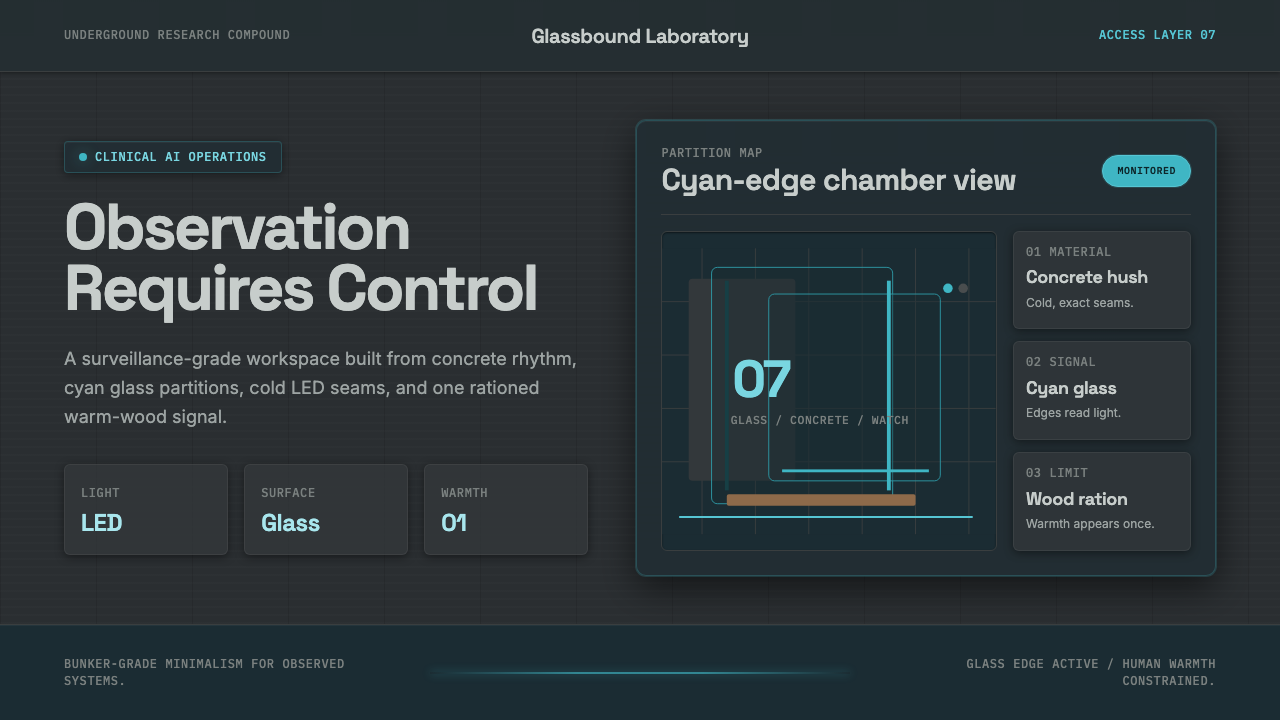 Ex MachinaClinical control, made visible. Concrete gray, cyan glass, LED seams, one woo…
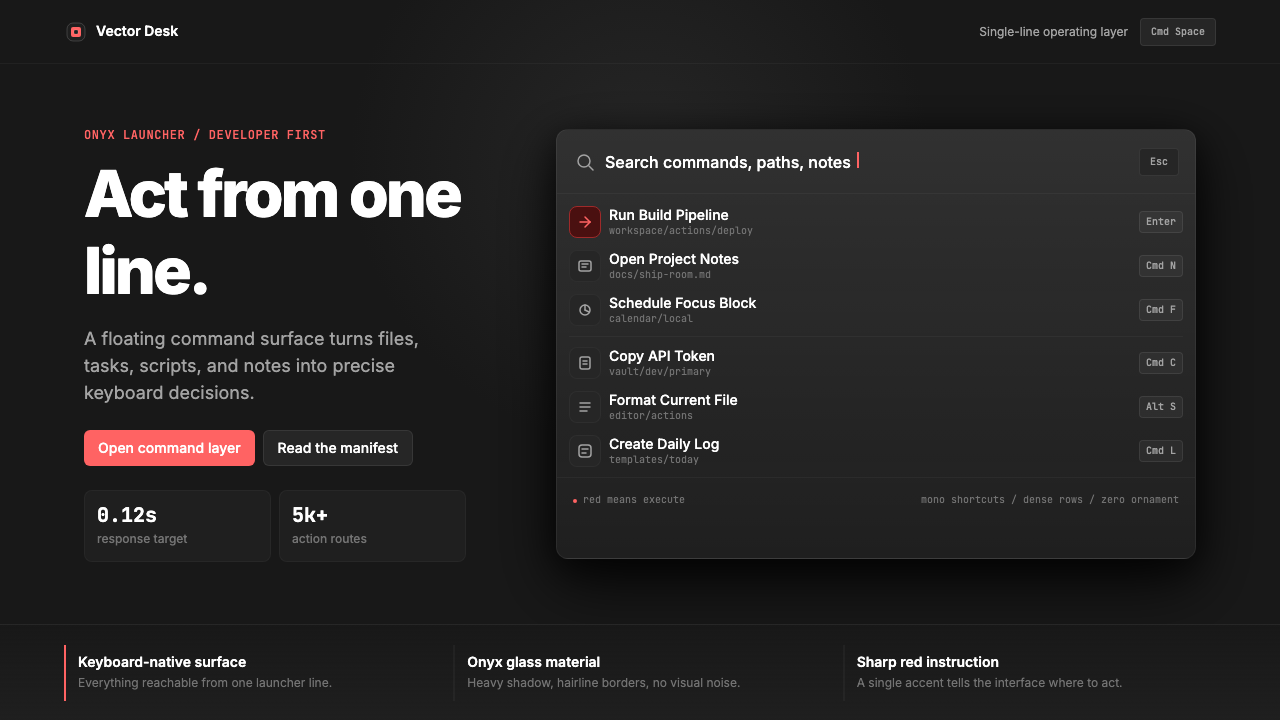 Raycast Spotlight Launcher (2023)Obsidian confidence. Sharp red cuts through Inter rows and mono shortcut chip…
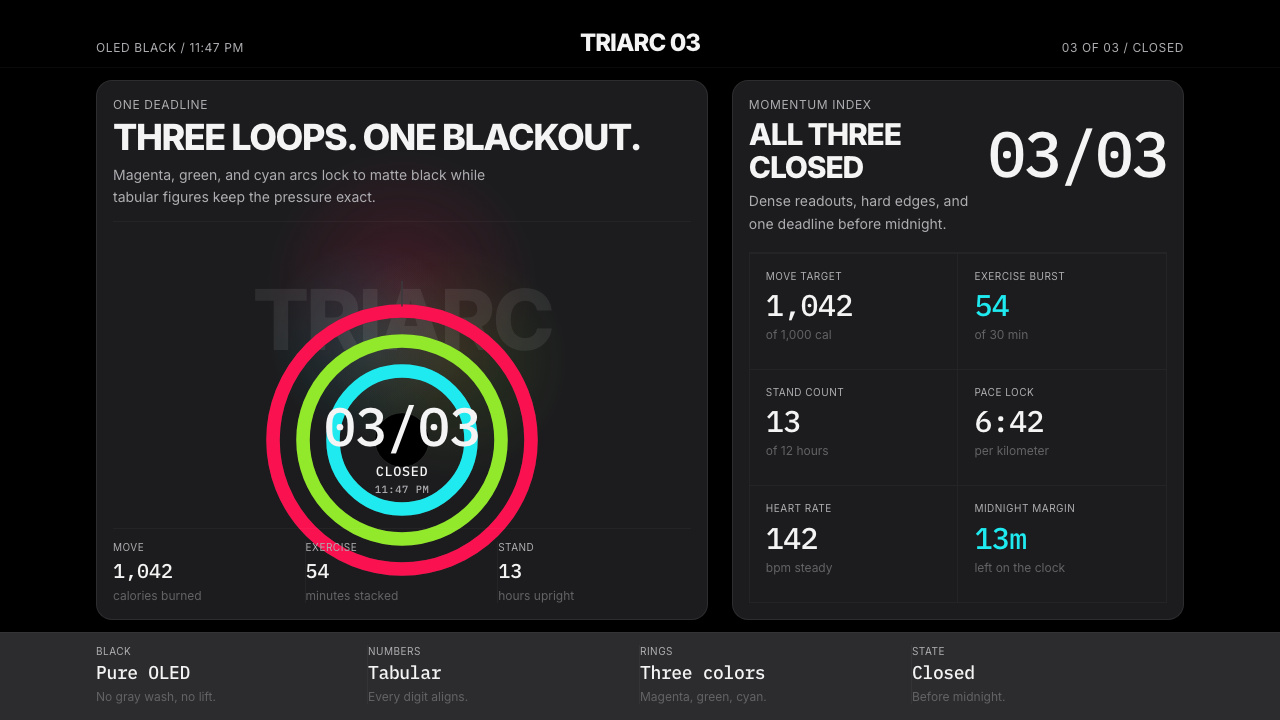 Apple Fitness Rings Closed (2024)Midnight feels exact. Magenta, green, and cyan rings lock onto OLED black.
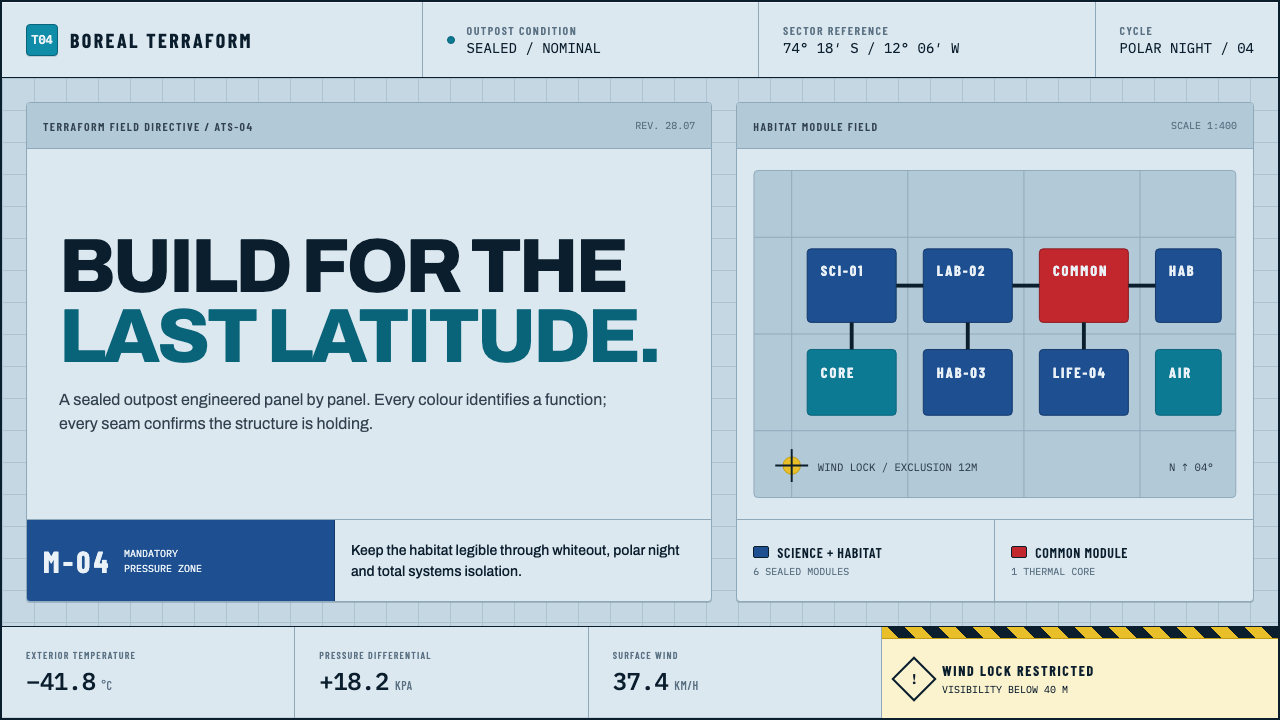 Arctic Terraform StationEvery colour carries a duty. Sky-blue panels, coded modules and hard seams en…
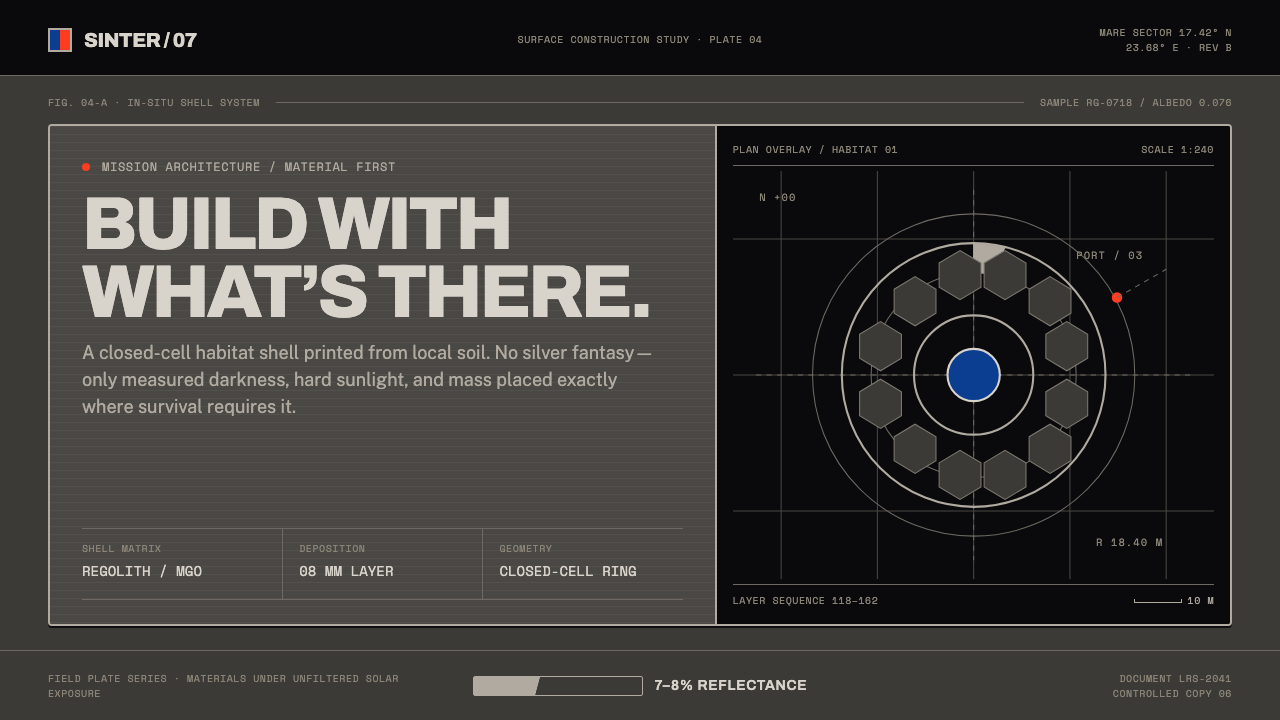 Lunar Regolith SettlementMoonlight without the myth. Regolith gray, hard terminators, and a strict tec…
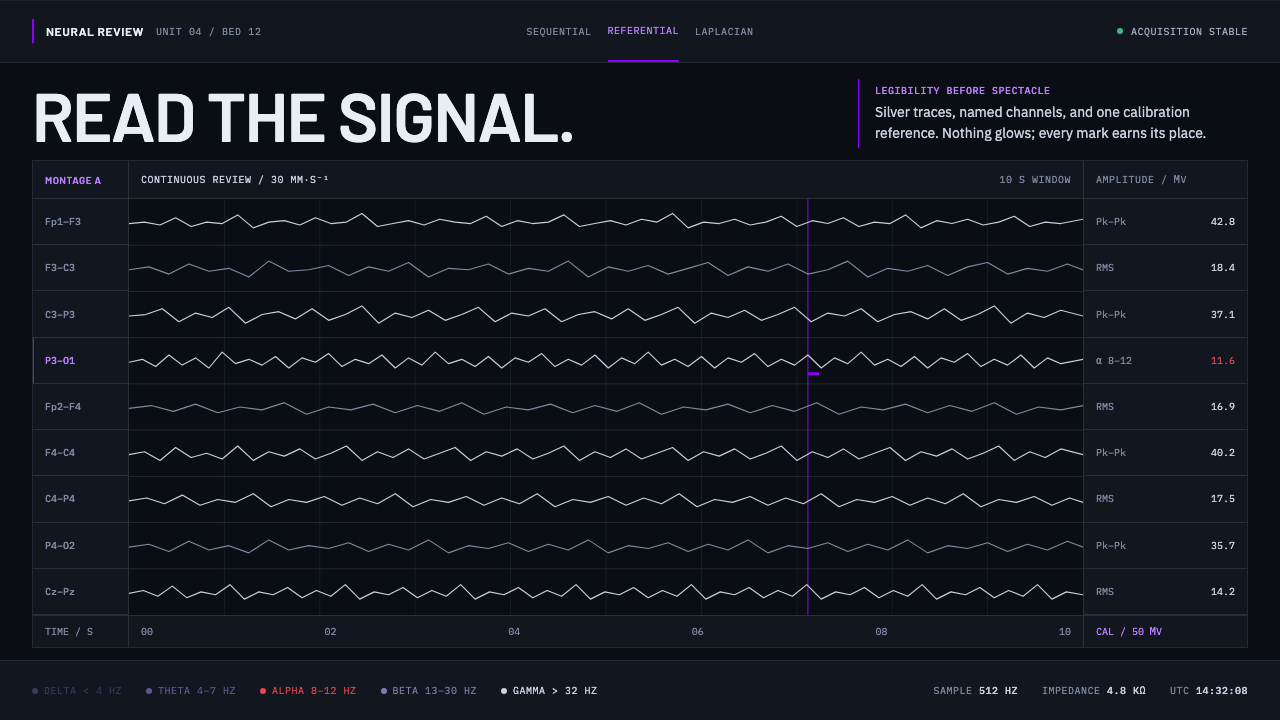 Neural Interface ClinicalClinical restraint makes signals legible. Silver traces cross near-black; vio…