What is Portuguese Azulejo Modern?
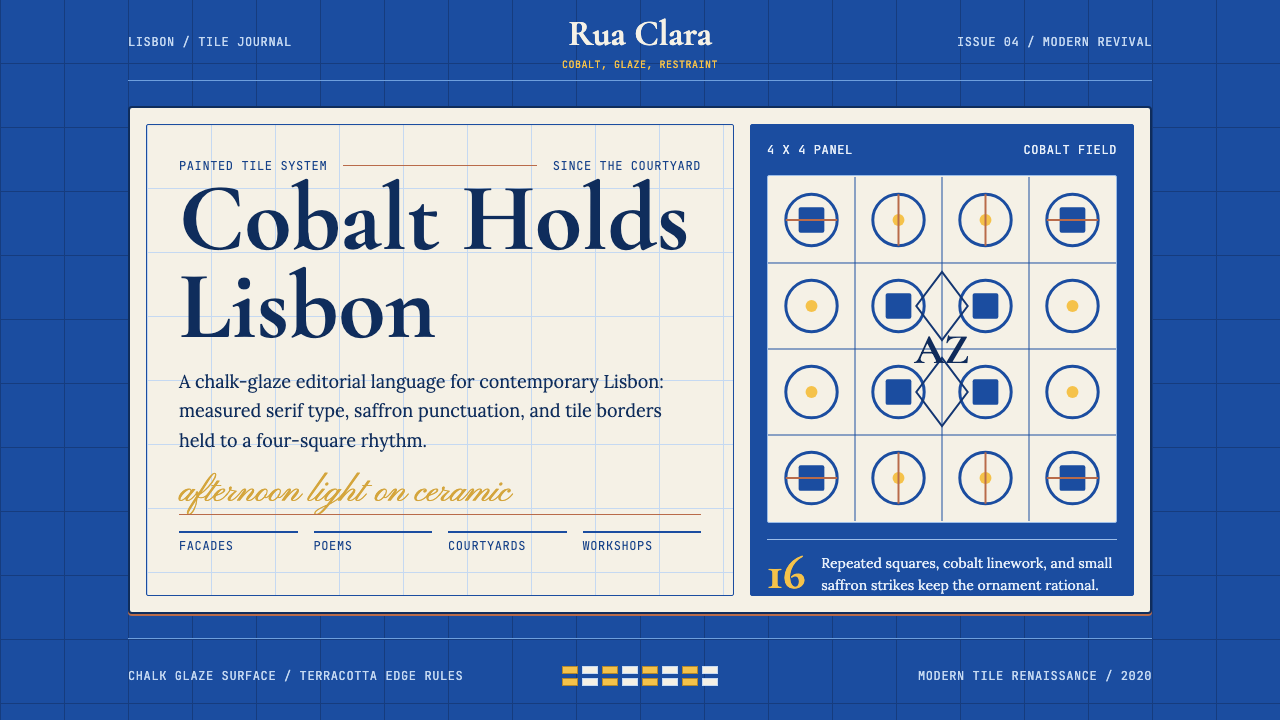
Portuguese Azulejo Modern translates five centuries of hand-painted ceramic tile into a rigorous editorial language — cobalt fields, cream panels, and the restrained warmth of Lisbon at afternoon light.
Portuguese Azulejo Modern in brief
Portuguese Azulejo Modern is a contemporary design system rooted in the azulejo — the tin-glazed ceramic tile that has covered the facades, interiors, and public squares of Portugal since the fifteenth century. The style extracts the defining visual logic of that tradition: the structured grid of individual tile panels, the saturated cobalt against chalk-white glaze, the carefully bounded repetition of geometric and figurative pattern — and translates it into a typographic and spatial system suited to screens, print, and branded environments.
The visual character sits at a distinctive intersection of deep historical memory and restrained modernism. Where many heritage-derived styles lean into nostalgic warmth or folkloric density, Azulejo Modern maintains editorial composure. Color is contained within a deliberate hierarchy: cobalt anchors the dominant field, cream or off-white holds the content panels, and saffron appears sparingly as a third accent echoing the polychrome moments of eighteenth-century tile programs. Nothing competes; everything is assigned a station.
The movement draws explicitly from the design renaissance visible in contemporary Lisbon — the museum-quality tile installations of institutions like the MAAT, the large-scale public murals by artists like Add Fuel, and the broader cultural moment in which Portugal's capital rediscovered azulejo as a living medium rather than a preserved relic. The result is a system that feels both rooted and forward-looking: unmistakably Portuguese without being archaeologically literal.
Where does Portuguese Azulejo Modern come from?
The word azulejo derives from the Arabic azzelij — 'small polished stone' — and the tradition arrived on the Iberian Peninsula with Moorish culture before the Portuguese conquest of Ceuta in 1415. Early Portuguese azulejos were geometric and abstract, closely related to Hispano-Moorish tile work from Seville: interlocking stars, lozenges, and bordered repeat patterns fired into hard tin-glaze, valued as much for moisture resistance as visual richness.
The decisive shift toward the blue-and-white palette came in the seventeenth century, when Portuguese traders encountered Chinese Ming porcelain and Dutch Delftware — both using cobalt-blue painting on a white ceramic ground. By mid-century, large-format narrative tile panels depicting battle scenes, hunting parties, and sacred episodes had become the prestige medium of the Portuguese aristocracy. The Igreja de São Lourenço in Almancil and the Palácio dos Marqueses de Fronteira in Lisbon contain intact programs representing the tradition's peak.
The eighteenth century brought the Pombaline reconstruction following the catastrophic earthquake of 1755. Pombal's rationalist rebuilding program favored simple, repeatable elements — and azulejos, manufacturable at scale, became central to the new urban fabric. Pombaline-era facade tiles are simpler in figurative ambition but consistent and orderly: blue geometric repeat patterns on white, applied across entire street elevations — the visual register that gave Lisbon its characteristic cobalt-and-cream streetscape.
The modern revival began in earnest in the 2010s, driven by Lisbon's rise as a European cultural destination and a generation of artists treating the tile panel as a contemporary medium. Diogo Machado (Add Fuel) brought graphic-novel aesthetics into large-scale public tile installations; the MAAT museum made contemporary tile central to its architectural identity; the Cortiço & Netos archive documented the full historical vocabulary and made it available to designers — establishing conditions for a codified modern azulejo system.
What defines the Portuguese Azulejo Modern look?
Color Hierarchy
The palette has three clearly ranked tones: a saturated cobalt as dominant field color, a warm chalk-white or cream as the primary content surface, and a concentrated saffron as the rarest accent. This hierarchy mirrors the actual tile compositions — the deep blue ground, the pale glaze where figures appear, and the occasional polychrome moment marking festive emphasis. Treating saffron as a background field tends to dissolve the system's sense of grounded authority.
Grid as Tile
The foundational structural metaphor is the tile grid: a matrix of equal-proportioned panels separated by consistent grouted lines. In layout terms, the gutter carries visual weight — negative space between panels is as deliberate as the panels themselves. Content blocks are individual tile panels, each self-contained with clear edges and consistent internal margin. This grid logic discourages full-bleed photography common in other editorial styles; images sit within their assigned panels.
Pattern as Border
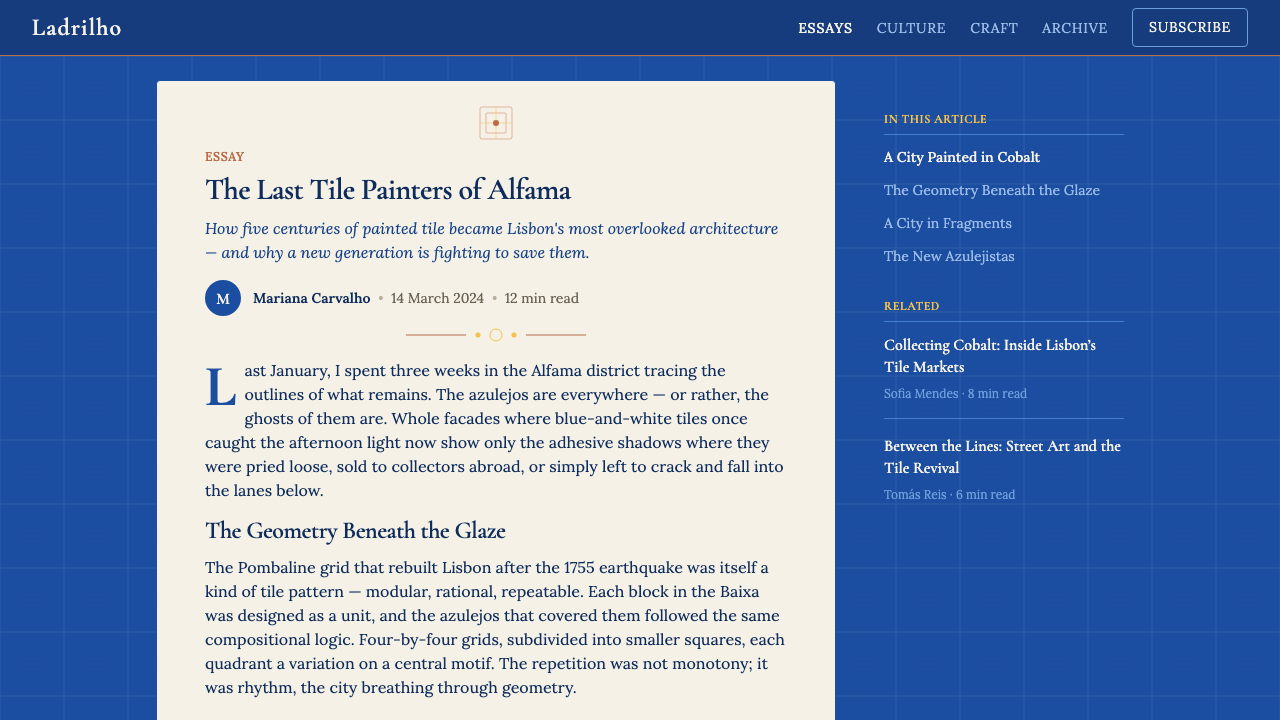
Traditional azulejo panels are framed by repeat-pattern border tiles that define the edge of each narrative or decorative program. In the modern system, this becomes a spatial convention: section headers, page margins, and dividing elements receive a patterned quality rather than a plain rule. A simple geometric repeat in the secondary color marks a boundary, framing the content panel the way a tile border frames an installation. The pattern element is used with restraint — borders rather than backgrounds — so patterned energy remains compositionally subordinate.
Typography with Serif Heritage
Unlike design systems that pair heritage palette with sans-serif type, Azulejo Modern honors Portugal's deep relationship with the printed serif. Headlines use a refined high-contrast serif — tall and elegant, recalling the calligraphic lettering on nineteenth-century azulejo panels and the tradition of Portuguese letterpress printing. Body text may use a more neutral face at small sizes, but display registers always carry the serif sensibility, anchoring the system historically without explicit period pastiche.
Glaze Quality
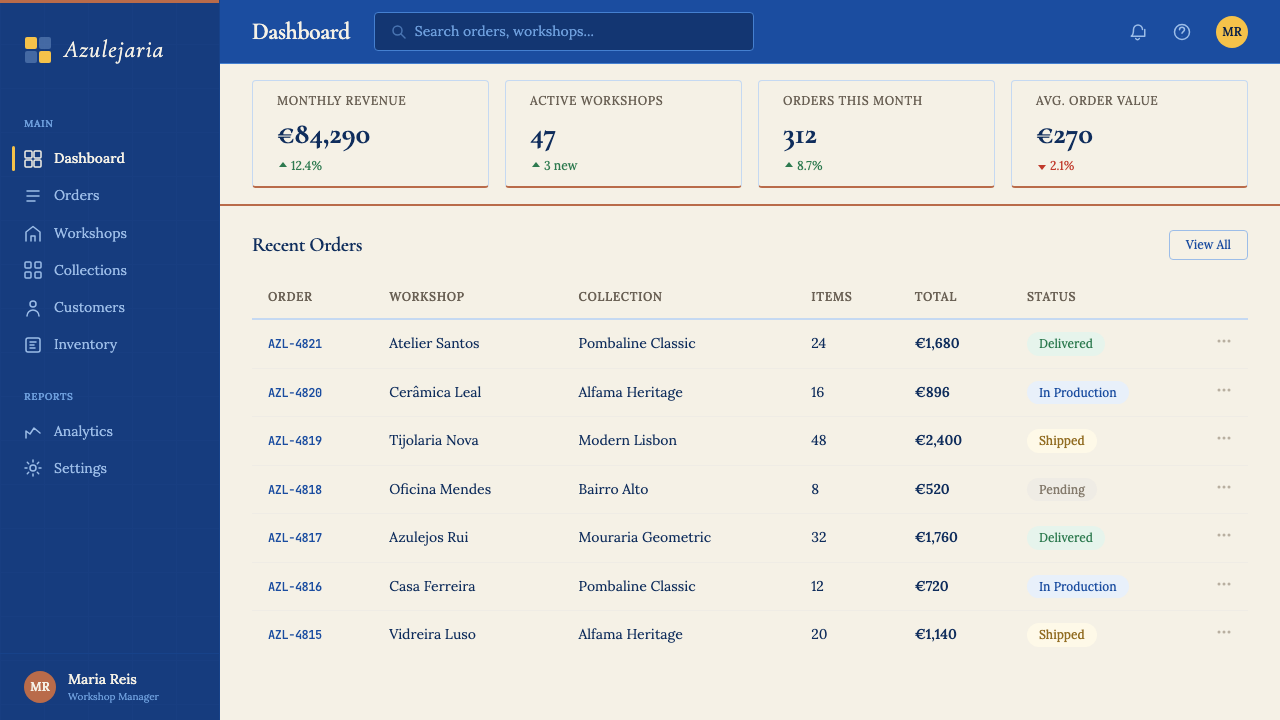
The ceramic tile achieves its visual depth from the slight luminosity of fired glaze — matte but not flat, with a subtle inner light that distinguishes it from painted surfaces. In the digital system, this quality is approached through careful tonal selection: the cobalt is chosen for depth rather than brightness, the cream for warmth rather than pure whiteness. The overall surface feel is quiet and composed — dignified rather than glossy, tactile rather than polished.
Narrative Sequence
Large azulejo installations tell stories across sequences of panels — historical scenes or episodic journeys that unfold tile by tile. This narrative logic carries into the modern system: multi-panel layouts and scrolling sections are structured to read as progressive episodes rather than isolated units. Each panel contributes one moment to a larger statement, giving the system a strong sense of directed pacing — less about individual impact, more about the cumulative effect of the whole.
Restraint and Repetition
The azulejo tradition achieves richness not through variety but through disciplined repetition of a limited formal vocabulary. A single geometric motif, repeated across hundreds of tiles, creates a meditative intensity no single complex image could produce. The modern system inherits this logic: narrow palette, few type choices, structural elements deliberately repeated across contexts. This restraint is not poverty of imagination — it is the recognition that consistency, held long enough, becomes its own form of depth.
Who shaped Portuguese Azulejo Modern?
Working under the name Add Fuel, Machado is the most internationally recognized contemporary artist within the azulejo tradition. His large-scale tile installations translate the visual grammar of classic Portuguese tilework — interlocking patterns, border frameworks, blue-and-white palettes — into graphic novel aesthetics and surrealist imagery, demonstrating that the tradition could sustain entirely new expressive programs while remaining visually coherent.
Lisbon's most celebrated literary figure, Pessoa does not belong to design history directly — yet his presence permeates the cultural temperament Azulejo Modern claims as its inheritance. His prose poems about Lisbon's particular quality of melancholy and beauty (especially 'The Book of Disquiet') define the emotional register the design system aspires to inhabit: introspective, layered, rooted in a specific place, yet universal in implication. The style's restraint and depth of feeling reflect the Pessoan disposition.
A Lisbon-based designer and researcher, Sousa Santos centers his practice on the contemporary application of Portuguese decorative arts, particularly the azulejo. His work demonstrates how traditional tile design principles — the grammar of borders, repeat-unit logic, the hierarchical relationship of ground and figure — can be extracted from historical context and applied systematically in contemporary design, establishing azulejo as a viable reference system for working designers.
A Lisbon tile archive and dealer, Cortiço & Netos documented the full formal vocabulary of Portuguese azulejo across five centuries — Moorish geometric patterns, Pombaline civic tiles, nineteenth-century industrial patterns, Art Nouveau pictorial tiles. By making this breadth legible and accessible, they reinforced the understanding that azulejo is not a single aesthetic but a rich, internally varied design language available as a living resource for contemporary practice.
Not a single figure but a foundational layer: Manueline style (under King Manuel I, c. 1490–1520) was Portugal's late-Gothic ornamental idiom, incorporating maritime motifs — ropes, armillary spheres, coral, shells — into elaborately carved stone. Its appetite for complexity and integration of the exotic defined a sensibility that reappears across Portuguese decorative arts, explaining why the framing element in azulejo design carries such symbolic weight: it descends from an architectural tradition of threshold and transition.
How do you use Portuguese Azulejo Modern today?
Azulejo Modern works best when the designer commits to its structural logic rather than borrowing only its surface palette. The signature combination — cobalt field, cream panel, serif type, patterned border — achieves coherence only when the grid discipline is held consistently. A layout that uses the cobalt and cream palette but ignores the panel-and-border structure reads as a color exercise rather than a systemic application of the style.
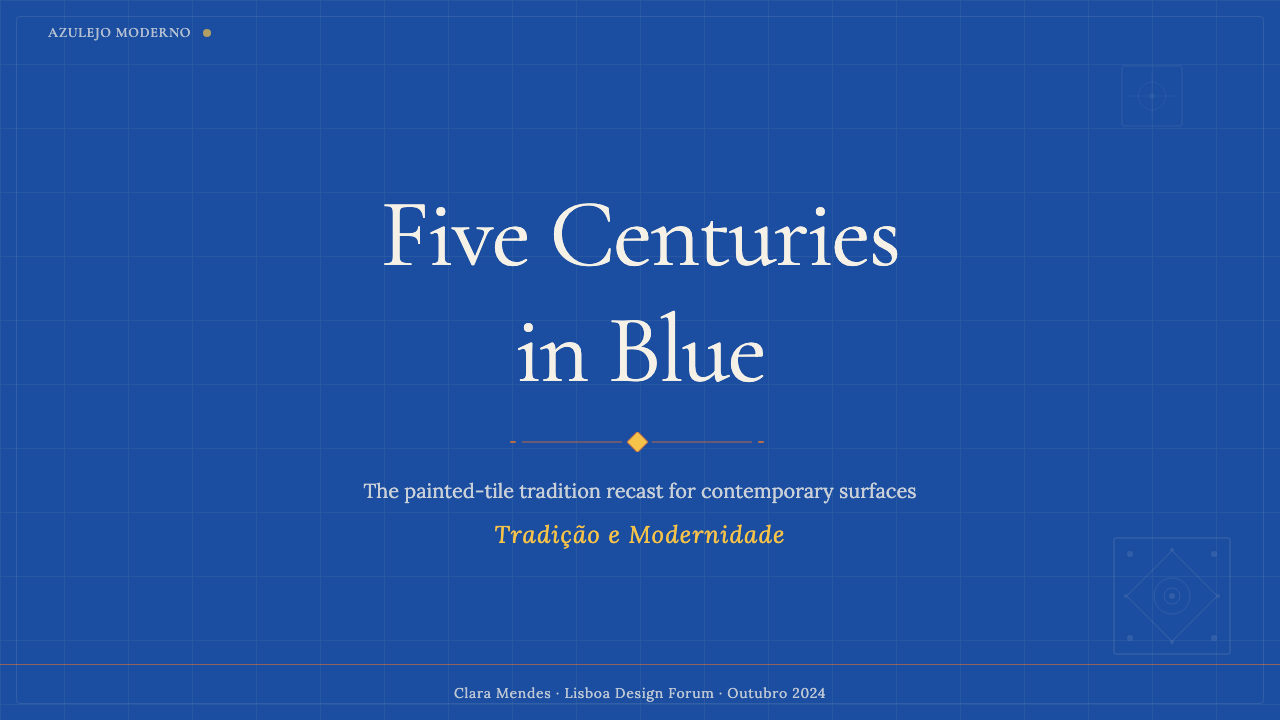
For presentation slides, the style suits formal presentations and cultural or institutional communications. A cover slide works well with a full cobalt background, a central cream panel containing the title in tall serif type, and a narrow geometric border at the panel's edge. Content slides should respect the tile-panel logic: each major point in its own bounded zone, with generous margins functioning as grout lines. Data slides lend themselves to geometric precision — charts as contained panels, legends set in clear hierarchy, cobalt marking the primary data series.
For web interfaces, the style suits editorial platforms, cultural institutions, tourism brands, and premium heritage products. Navigation should be typographic and dignified: wordmark in a refined serif, no icon-heavy navigation undermining the editorial register. Cards and content modules use the tile-panel structure — defined edges, internal margin, cobalt accent — rather than diffuse soft-shadow cards. The panel-and-border logic scales from wide desktop to narrow mobile without losing coherence.
For editorial and marketing work, the style creates immediate cultural associations with craftsmanship, travel, and European heritage — well-suited for food and wine brands, hospitality design, cultural tourism, and contexts where Iberian heritage associations carry value. Magazine layouts benefit from the strong vertical rhythm serif headlines establish against cobalt accent blocks. Marketing pages work well with alternating full-width sections: cobalt-ground feature followed by cream-ground content, with saffron reserved for a single call-to-action per page.
A common mistake is over-patterning: treating the geometric repeat as background texture rather than as a border or framing element. Traditional azulejos use pattern in bounded, purposeful ways — the border exists to frame, not to fill. Applied as wallpaper, the geometric repeat quickly becomes visually exhausting, erasing the breathing room that makes cobalt-and-cream contrast effective. Similarly, warm terracotta in place of precise saffron tips the palette toward generic Mediterranean pastiche rather than the cooler restraint of the Lisbon tradition.
Portuguese Azulejo Modern — FAQ
Is Azulejo Modern only suitable for Portuguese or Iberian contexts?
The style carries strong cultural associations with Portugal — and those associations are part of what it communicates. In a clearly Portuguese context (a Lisbon restaurant, a wine brand, a tourism campaign), it reads as authentic rootedness. In a neutral international context — a cultural institution, an artisan brand, an editorial publication — it communicates craftsmanship and restrained elegance without asserting geographical origin. Where it struggles is when those associations would be misleading: a product with no genuine connection to the tradition using azulejo patterning for purely decorative reasons would read as incoherent.
How does Azulejo Modern differ from generic 'Mediterranean' design styles?
The key distinction is structural specificity. Generic Mediterranean design deploys warm terracotta, turquoise, hand-lettered type, and rustic texture to evoke coastal warmth and folk craft. Azulejo Modern is colder, more ordered, and typographically disciplined. Its cobalt is a cool, saturated blue — not warm Aegean turquoise. Its cream is restrained — not sun-bleached plaster white. Its type is serif and editorial — not casual hand-drawn lettering. Its compositional logic comes from the tile grid — a rational, modular system — rather than organic folk-craft arrangement.
Can the style work in dark-background layouts?
Yes, with care. The historic azulejo is a light-ground tradition — cobalt painting appears against luminous white glaze. A dark inversion works for nighttime or premium contexts — hospitality menus, luxury brand materials — but requires adjusting cream panels to a slightly warmer near-white so they don't read as cold grey. The saffron accent loses contrast on a dark field and should be used even more sparingly, or shifted to a slightly deeper gold.
How should the geometric pattern element be used without overwhelming the layout?
Pattern serves frame, not field. In a historic azulejo installation, the main panels are the visual destination; border tiles define and elevate those panels, not compete with them. In contemporary design, the geometric repeat should appear at the margins — as a section border, a patterned rule between content blocks, a card-edge framing element — not as a full-bleed background. A useful test: if the pattern can be removed without the layout losing its primary visual logic, it is correctly deployed as accent. If removing it leaves a void, the grid structure needs to carry more weight.
Related design styles
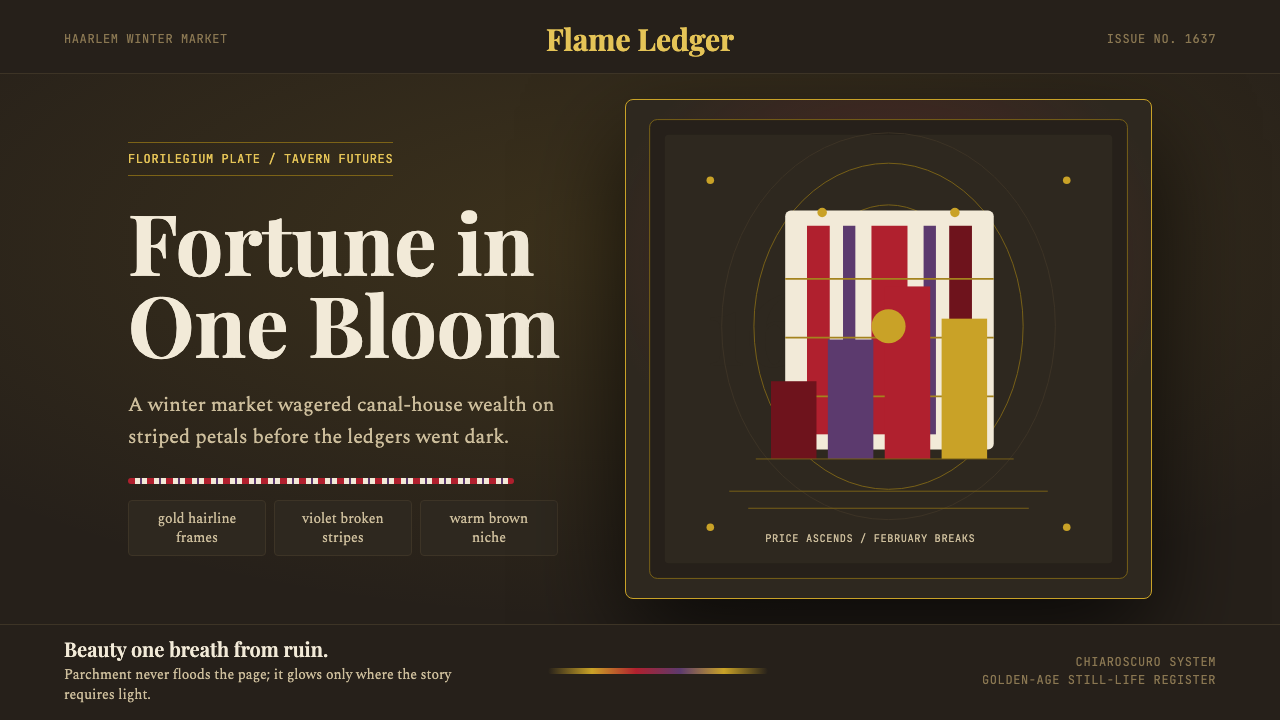 Dutch Tulip ManiaSpeculation burns in shadow. Flame red petals, violet stripes, gold frames on…
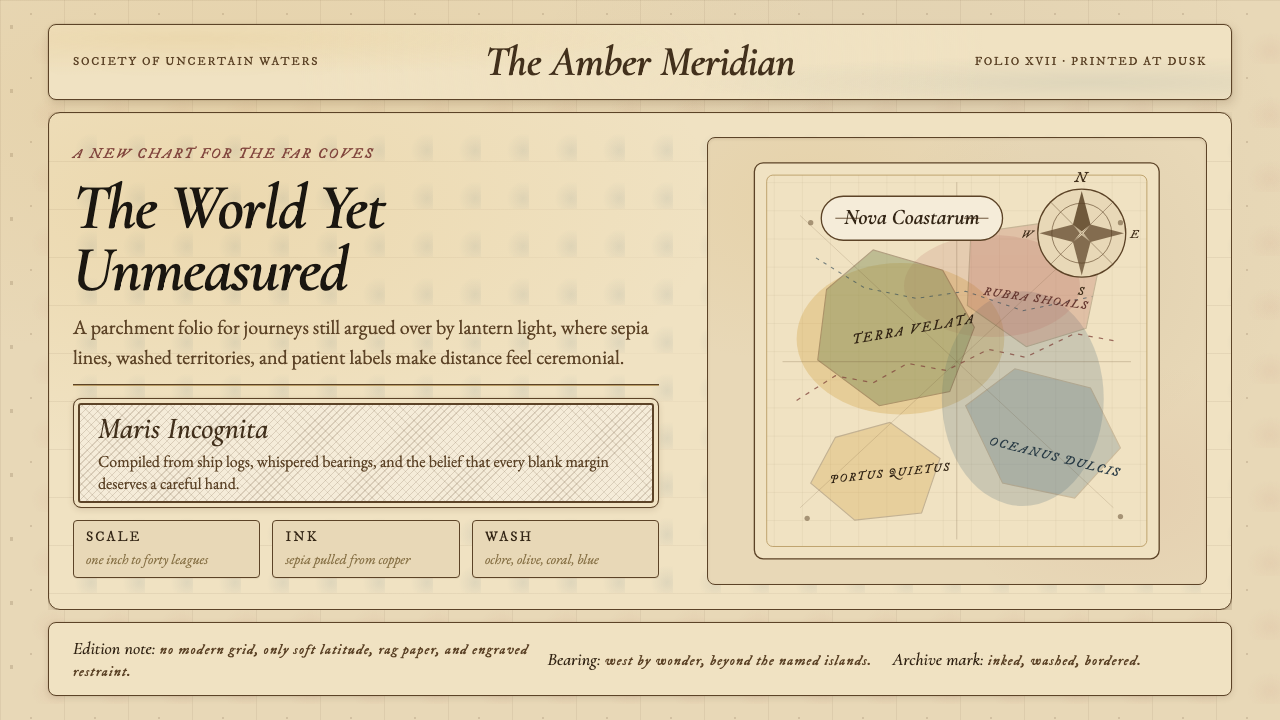 Vintage CartographyDiscovery feels ceremonial. Sepia copperplate on aged parchment, framed by co…
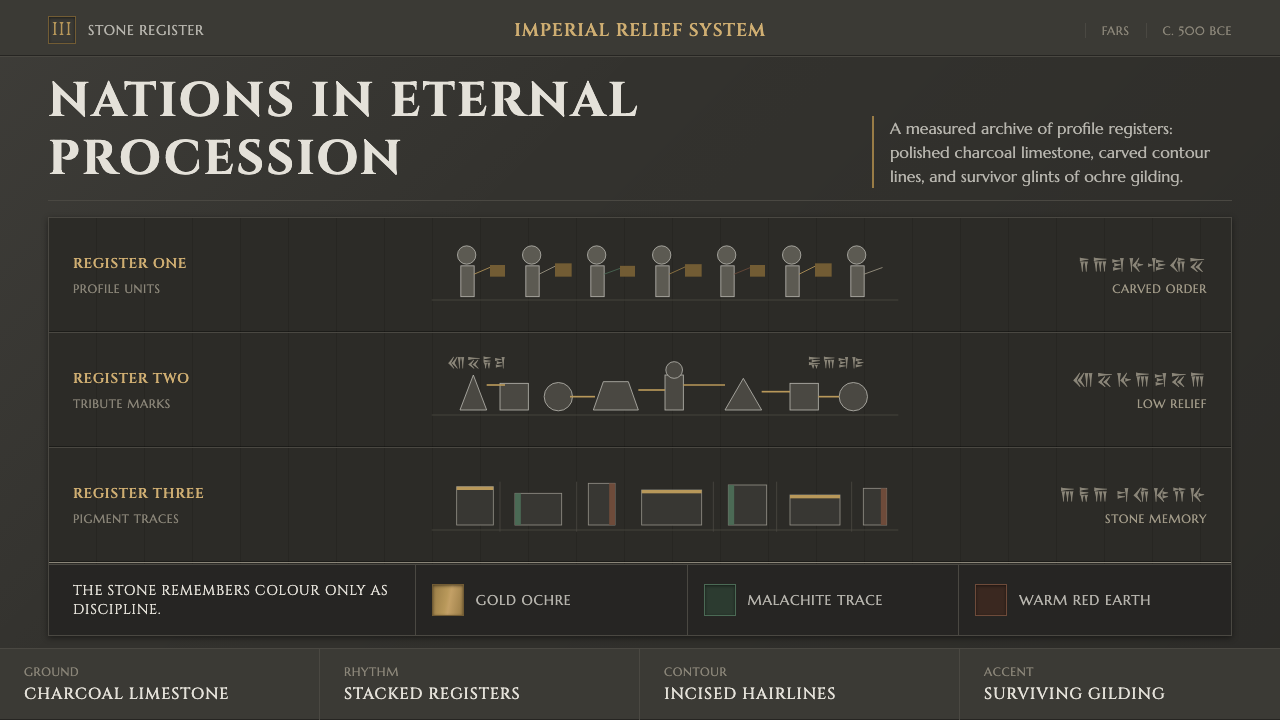 Achaemenid Persepolis ReliefImperial restraint in stone. Charcoal registers carry ochre, green, and red p…
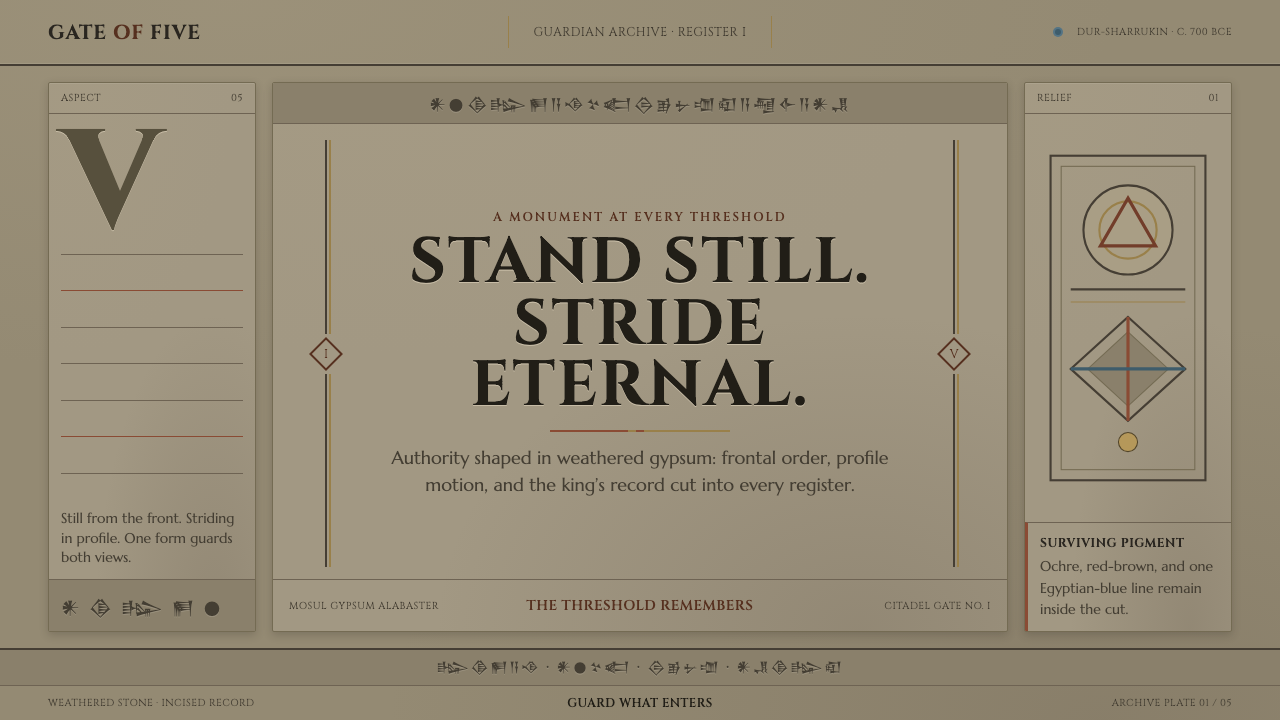 Assyrian Lamassu ReliefAuthority carved into silence. Buff-gray stone, monumental capitals, and cune…
 Bridgerton Regency (2020)Scandal wears lavender. Wisteria pastels and gilt rules frame a sharp letterp…
 Cambodian Angkor Bas-ReliefStone speaks in shadow. Olive registers and antique gold carve a torchlit arc…