What is Nairobi Silicon Savannah?
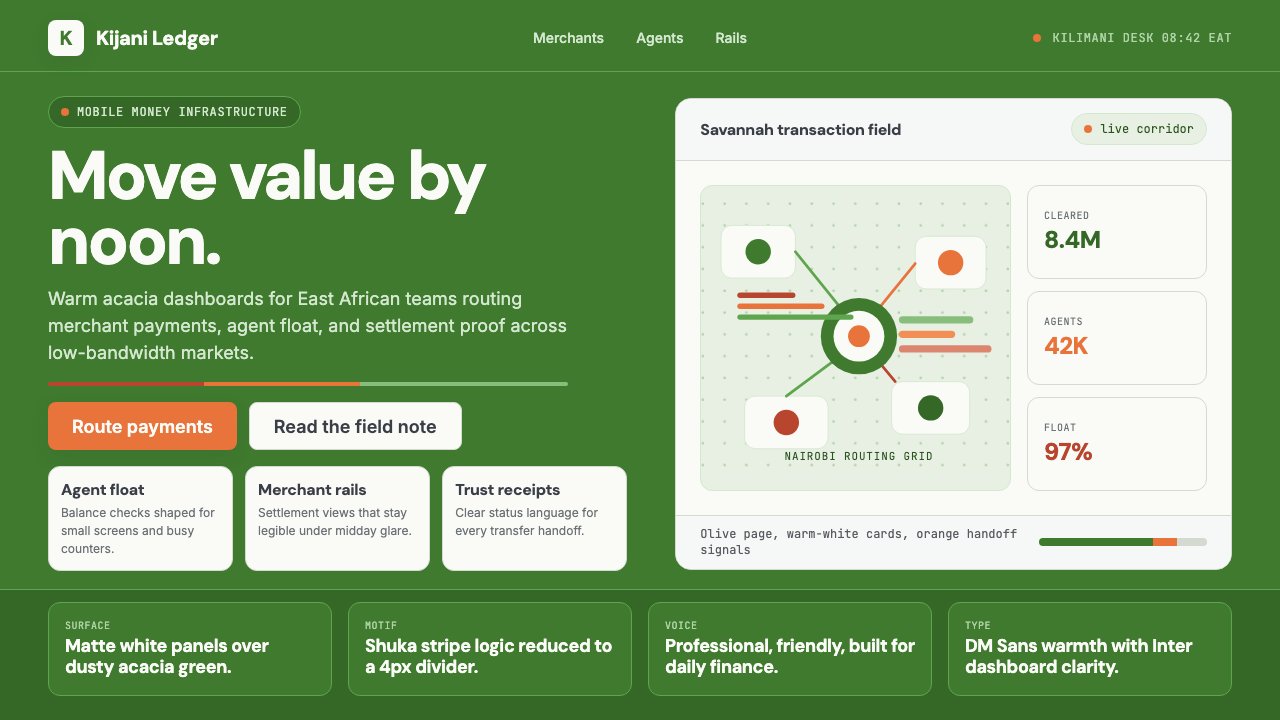
Nairobi's Silicon Savannah design language channels East Africa's mobile-money revolution into a warm, dashboard-ready visual system that balances professional confidence with genuine human warmth.
Nairobi Silicon Savannah in brief
Nairobi Silicon Savannah is a design aesthetic that emerged from East Africa's fintech ecosystem during the 2010s and reached its most coherent visual form between roughly 2018 and 2024. It translates the lived experience of mobile-first financial infrastructure — the confidence of sending money by phone, the clarity of a balance confirmation screen, the optimism of a continent building its own digital economy — into a design language suited to SaaS products, dashboards, and financial applications.
The palette draws on the natural and cultural landscape of urban Nairobi: a dusty acacia olive-green that reads as both organic and professional, a sun-warm Maasai-inspired orange that carries energy without aggression, and matte white surfaces that give the whole system space to breathe. These colors work together to produce interfaces that feel grounded rather than sterile — a quality that is deliberate, since many of the products built in this tradition serve users for whom trust and legibility carry real financial stakes.
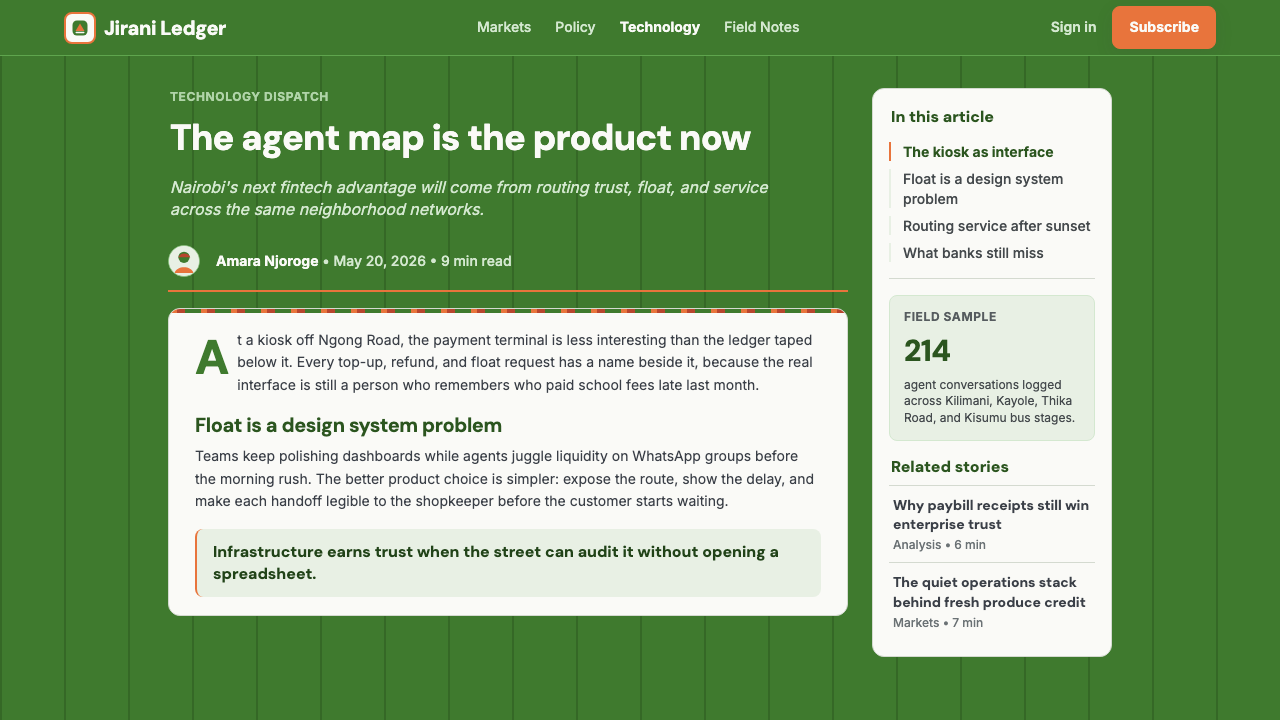
What distinguishes this style from generic fintech modernism is its relationship to local visual culture. The geometric stripe motifs of Maasai shuka cloth reappear as subtle structural dividers. Photography centers real African urban life rather than stock-image placeholders. The typographic choices favor clarity for multilingual contexts. The result is a system that signals global digital sophistication while remaining visibly, honestly rooted in its place of origin.
Where does Nairobi Silicon Savannah come from?
The roots of this design language stretch back to 2007, when Safaricom launched M-Pesa in Kenya, transforming how millions of people transacted money. M-Pesa did not merely create a mobile payment service; it created a visual and experiential vocabulary for financial trust on a mobile screen in a context where bank branches were scarce and SMS was primary. The interface conventions it established — clear numerals, high-contrast confirmations, simple sequential flows — became a template that subsequent fintech builders would inherit and refine.
Through the early 2010s, Nairobi's Kilimani and Westlands neighborhoods became dense with startups, investor offices, and innovation hubs. iHub, founded in 2010 by Erik Hersman alongside colleagues from the tech community, became the most visible anchor of this scene: a co-working and events space that hosted developers, designers, and entrepreneurs building products for African markets. The hub model spread, and with it came a shared design sensibility — products needed to work on low-bandwidth connections, render legibly on a wide range of handsets, and earn trust from users who were often transacting significant portions of their income digitally for the first time.
The phrase 'Silicon Savannah' — a deliberate echo of Silicon Valley, adapted for the East African context — gained currency around 2012 and was used both by local practitioners and international press to describe Nairobi's growing tech sector. By 2015 to 2018, a second wave of companies, including Andela (which trained software developers across Africa), Flutterwave (a pan-African payments infrastructure company), and a constellation of local agritech and healthtech startups, began building more sophisticated interfaces. These products aimed at both local and international audiences, which pushed their design toward a hybrid aesthetic: warm and locally resonant in its color and photographic choices, but clean and universally readable in its layout logic.
The consolidation of what can be recognized as a coherent Silicon Savannah visual style happened gradually across the late 2010s and early 2020s, as more design teams in Nairobi began sharing references, attending regional design conferences, and producing work that consciously articulated an East African design identity. Key figures such as Iyinoluwa Aboyeji, who co-founded Andela and later Future Africa, helped articulate the vision of a distinctly African digital economy with its own aesthetic character — professional, optimistic, and culturally grounded — rather than a derivative of Western tech design.
What defines the Nairobi Silicon Savannah look?
Color Palette
The foundational palette holds three registers in careful tension. An acacia olive-green — dusty and organic, closer to the savannah than to a corporate forest — serves as the primary brand color and is used for key actions, positive states, and navigational anchors. A Maasai-inspired warm orange occupies the accent register, deployed for calls to action, highlights, and data points that require human attention. Matte white provides the dominant surface, ensuring that both the olive and the orange read with full clarity without competing. Secondary neutrals — warm grays and light tans — soften transitions and support long-form content without introducing coldness.
Surface and Texture
Surfaces throughout this system are deliberately matte and flat. Cards sit on the white ground with gentle shadow lift rather than strong depth; the visual effect is of objects resting on a clean workspace rather than floating in digital space. There are no gradients simulating light or material — flatness is the default. Where texture appears, it is typographic or structural, not decorative: the subtle stripe of a section divider, the weight difference between a heading and a label, the deliberate emptiness of a margin that gives content room to land.
Structural Motifs
The geometric stripe patterns of Maasai shuka cloth — bold bands of color traditionally worn as wraps and blankets — appear in reduced, abstracted form throughout this design system. At the macro level, a page might use a thin warm-orange horizontal band as a section break or a navigational landmark. At the micro level, data tables or card borders adopt stripe rhythms that echo the same cultural source without literal reproduction. The motif works because it is structural rather than decorative: a divider that happens to carry cultural resonance, rather than a decorative flourish applied to a neutral layout.
Typography
The typographic approach prioritizes clarity across diverse contexts and screen sizes. Display settings favor humanist sans-serif typefaces — forms that carry warmth and approachability rather than the cold geometry of strict modernist grotesques. Body text is set with generous line height and comfortable measure, reflecting the need for legibility in financial contexts where misreading a number or a label has real consequences. Hierarchy is established through weight and size contrasts that are deliberate and wide — headline, subhead, label, and body each occupy clearly distinct registers, making the structure scannable without requiring decoration.
Photography and Imagery
Photography in this style centers real African urban life: Nairobi street scenes, people using mobile phones in everyday contexts, market activity, office environments in Kilimani or Upper Hill. The imagery is candid and specific rather than aspirational and generic. When people appear, they are identifiably local — not the ethnically ambiguous 'global professional' of international stock photography. This specificity is a deliberate act of visual representation: it signals to the user that the product was built for them and their context, not adapted from a template designed elsewhere.
Data Visualization
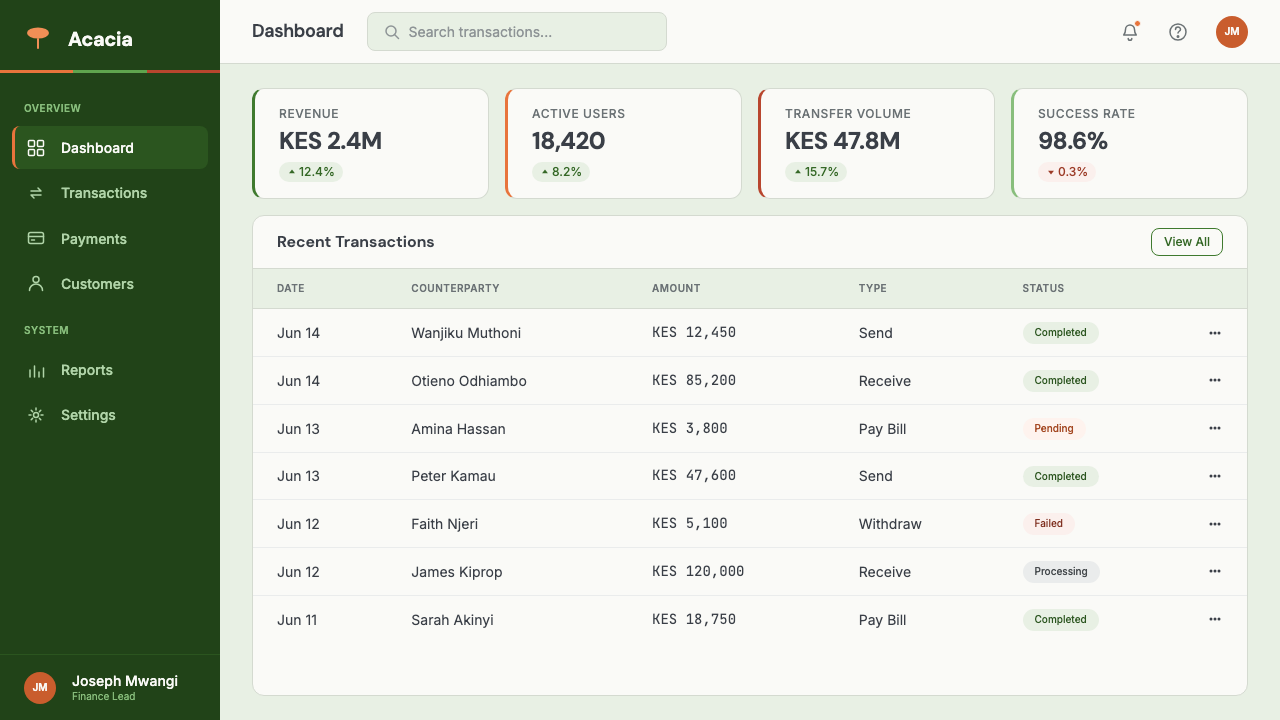
Transaction volume, growth metrics, and financial summaries are at the heart of many products built in this tradition, and the data visualization approach reflects this. Charts and graphs adopt the palette's olive and orange for primary data series, with neutral grays supporting comparison axes and secondary data. The orientation is practical rather than decorative: charts are legible at small sizes, consistent with the primary dataset labeled clearly and competing categories distinguished by value rather than hue. Pulse-like animations — green indicators rising and falling with live data — are used sparingly and purposefully, signaling activity without inducing anxiety.
Warmth as Function
Perhaps the most distinctive characteristic of this aesthetic is that warmth is not decorative — it is functional. In a financial product, user trust is a design material as real as color or type. The matte olive-green projects steadiness; the warm orange signals energy without alarm; the matte surfaces avoid the visual fatigue that high-gloss or high-contrast interfaces produce in extended use. This warmth-as-function approach means that Silicon Savannah design typically ages better than purely trend-driven fintech aesthetics: because its core choices are grounded in user needs rather than visual fashion, they remain appropriate as trends shift.
Who shaped Nairobi Silicon Savannah?
Hersman co-founded iHub in Nairobi in 2010, creating the most prominent physical node in East Africa's emerging tech ecosystem. By providing a shared space where developers, designers, investors, and entrepreneurs could work alongside each other, iHub catalyzed a generation of products built for African markets. His work — including the Ushahidi crisis-mapping platform, which he also helped develop — demonstrated that world-class digital products could be designed and built in Nairobi, not just adapted from products designed elsewhere. iHub became the practical context in which Silicon Savannah design sensibilities were developed and transmitted.
As Chief Executive of Safaricom from 2010 until his death in 2019, Collymore oversaw the period during which M-Pesa matured from a payments breakthrough into a full financial platform. Under his leadership, Safaricom's product design — the interface conventions, the trust signals, the visual language of mobile financial services in Kenya — reached its widest influence. His advocacy for digital inclusion and his emphasis on building products that genuinely served Kenyan users rather than imitating Western models contributed directly to the human-centered quality that distinguishes Silicon Savannah design from generic fintech aesthetics.
Aboyeji co-founded Andela, which trained software engineers across Africa and placed them with global technology companies, and later founded Future Africa, an investment platform focused on African startups. His work was instrumental in articulating a vision for African technology that was not derivative of Silicon Valley — one that had its own values, aesthetics, and relationship to local context. By building institutions that developed African design and engineering talent, he helped create the professional infrastructure that makes a recognizable Silicon Savannah design identity possible.
As co-founder of Twiga Foods, a Kenyan agritech and food distribution company, Njonjo built one of the most prominent examples of how Silicon Savannah design principles applied beyond fintech into adjacent sectors. Twiga's product and brand work demonstrated that the warmth, clarity, and local-cultural groundedness of East African digital design could serve supply-chain, agriculture, and logistics contexts as effectively as financial services. His work helped expand the design language's perceived applicability and influenced a broader generation of product builders across the region.
How do you use Nairobi Silicon Savannah today?
Silicon Savannah is a style with strong contextual specificity: it works best for products that sit at the intersection of financial trust, human warmth, and practical utility. Applied thoughtfully, it carries immediate signals of seriousness and care; applied carelessly, it risks looking like a generic warm-green SaaS palette without cultural grounding. The key is understanding which choices are culturally generative — the shuka-derived stripe, the photography of specific places and people — and which are universally structural, such as the grid logic and typographic hierarchy.
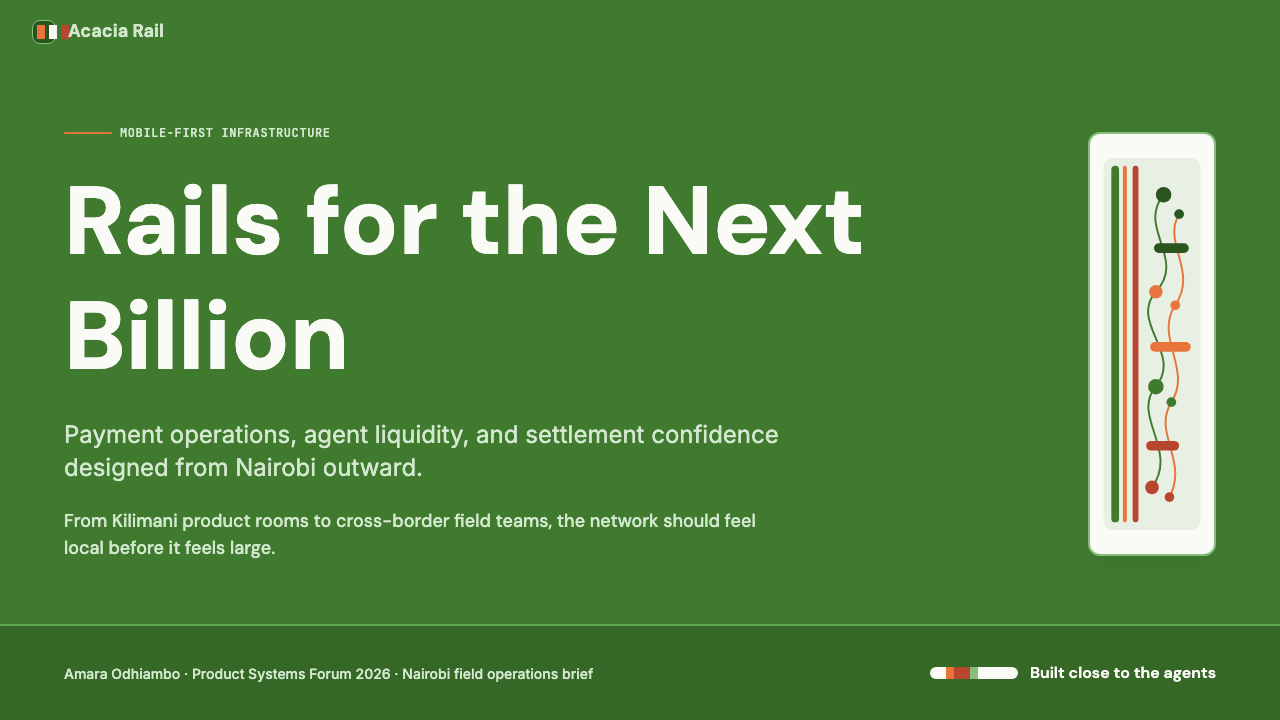
For presentation slides, this style works with particular strength in fintech, impact investment, and regional development contexts. A cover slide benefits from a strong asymmetric composition anchored in the olive-green, with a warm-orange accent framing a headline at generous scale. Section slides should maintain the matte surface ethos: one organizing stripe as a divider, typography doing most of the structural work, and data presented in clearly labeled charts that use the palette's green for growth indicators and orange for attention states. When photography appears on a slide, it should be candid and specific — a real market scene, a real phone in a real hand — rather than polished studio imagery.
For web dashboards and financial interfaces, the system translates directly. Define a column grid with comfortable gutters; anchor the primary navigation in olive-green or matte white with olive accents; use the warm orange exclusively for primary action buttons and alert states. Cards should carry very gentle shadow depth rather than flat borders — this is a style that values tactility even in its restraint. Data tables should apply stripe dividers at low contrast, echoing the shuka motif at a subtle register. Reserve animation for genuine data updates — a balance refreshing, a transaction confirming — rather than decorative motion.
For marketing and editorial work, the style supports confident, human-centered storytelling. A campaign layout might open with a full-bleed photograph of a Nairobi street scene, introduce the headline at large scale in a warm-neutral ground, and transition into content blocks that alternate the olive and the orange as accent colors. Editorial articles benefit from a wide left margin carrying pull-quotes in the olive-green, with body text set at a comfortable measure in warm near-black. The overall tone should avoid the clinical distance of pure white modernism — this is a style that invites the reader in rather than impressing them from a distance.
A common mistake when applying this style is over-saturating the palette or using all its elements simultaneously at full intensity. Authentic Silicon Savannah work is restrained: the olive and orange appear at measured weights, not competing loudly for attention. A second mistake is treating the shuka stripe motif as a decorative flourish rather than a structural element — thick decorative banding at the expense of content clarity undermines the system's purpose. The photography choices matter as much as the color: substituting generic stock imagery for specific, local, human-centered photography produces a result that borrows the color palette but loses the cultural honesty that gives this design language its authority.
Nairobi Silicon Savannah — FAQ
Is this style only appropriate for African markets?
No. Silicon Savannah's underlying visual logic — warm, confident, matte, structured with subtle cultural motifs — is not geographically restricted in the way that, say, a style dependent on specific script or iconography might be. Its palette and surface choices work well for any fintech, impact, or SaaS product that wants to project warmth without sacrificing professional authority. The cultural specificity is an asset rather than a limitation: in a global market saturated with cold modernist fintech interfaces, a design language that is visibly grounded in a real place and tradition reads as distinctive and trustworthy rather than niche.
How does this style differ from standard Material Design or generic fintech modernism?
Material Design is a universal system designed to be culturally neutral and infinitely scalable across products. Silicon Savannah is a specific aesthetic tradition rooted in a particular place, history, and set of user relationships. The surface differences are visible — Material Design permits elaborate elevation systems and shadow hierarchies, while Silicon Savannah keeps surfaces matte and shadow minimal; Material Design's color system is built around dynamic theming, while Silicon Savannah's olive-and-orange palette is culturally inflected and intentional. But the deeper difference is philosophical: Material Design asks 'what is universally correct?' while Silicon Savannah asks 'what is right for these users, in this place, with this history?'
Can the shuka stripe motif be used decoratively, outside its structural role?
Technically yes, but it produces a weaker result. The power of the shuka stripe as it appears in Silicon Savannah design comes from its dual function: it is simultaneously a structural element (a divider, a navigational landmark, a rhythm marker) and a cultural reference. When it is used purely decoratively — as a background pattern, a border embellishment, or a graphic element without structural purpose — it loses its structural contribution and becomes pastiche: a borrowed visual motif without the logic that gives it meaning. The best applications of the stripe use it where structure is already needed, letting the cultural resonance arrive as a secondary effect of a decision that was already justified on functional grounds.
How should this style handle dark mode?
Dark mode is an area of genuine tension for this style. The matte white surface is foundational to how the acacia olive and Maasai orange read — both colors were calibrated for warmth against a light ground. On a dark surface, the olive-green can shift toward a cooler, murkier tone, and the orange risks reading as overly aggressive. A successful dark variant requires deliberate recalibration: lightening the olive slightly toward a more luminous sage, softening the orange to a less saturated amber, and ensuring that the matte quality of surfaces is preserved by avoiding high-gloss or high-contrast dark backgrounds. The cultural warmth that defines the light-mode system should be preserved in the dark mode treatment rather than sacrificed to convention.
What makes this style feel trustworthy in a financial context?
Several interlocking choices produce the sense of trustworthiness. The matte surfaces signal restraint rather than glossy aspiration — they suggest a product confident enough not to need visual showmanship. The olive-green has an organic, grounded quality that reads as stable rather than volatile. The photography of real people in real places creates a sense that the product understands and respects its users' actual context. The typographic clarity — generous hierarchy, clean labels, no ambiguity between primary and secondary information — signals that the product has nothing to hide. And the cultural groundedness itself is trust-building: a design that is honest about where it comes from communicates, by analogy, that the product it represents is honest about what it does.
Related design styles
 Shopify ModernMerchant ally, not corporate SaaS. Emerald actions on bordered white cards ca…
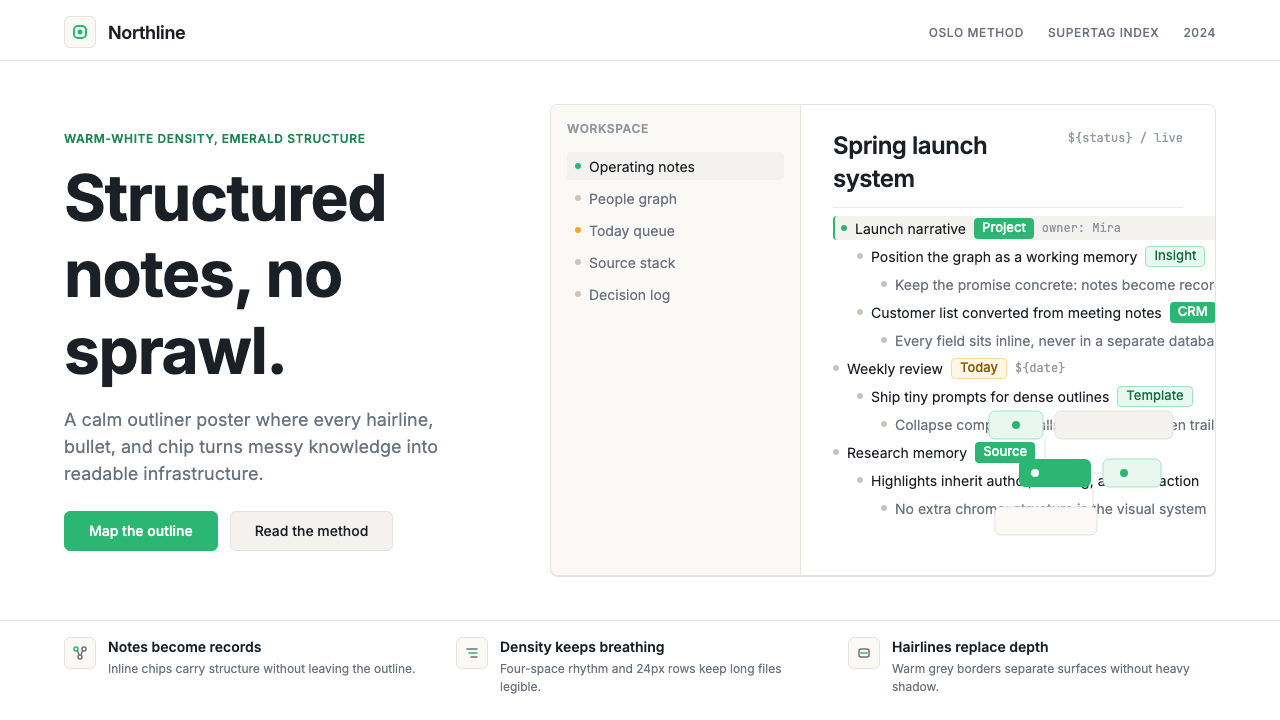 Tana SupertagsCalm density wins. Inter outlines and emerald chips punctuate pure white stru…
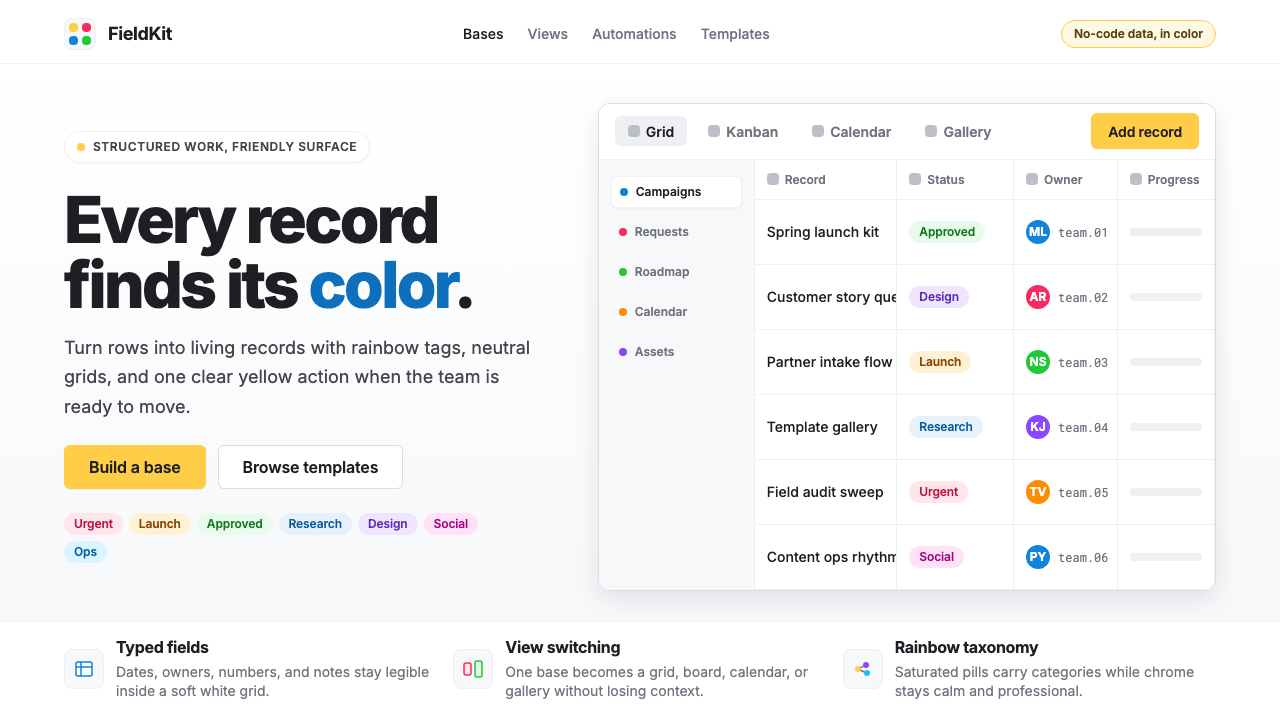 Airtable Spreadsheet-RainbowWork becomes celebratory. Inter grids stay white while rainbow pills and yell…
 Atlassian Jira BlueWarm enterprise teamwork. Saturated blue cards on cream make status feel huma…
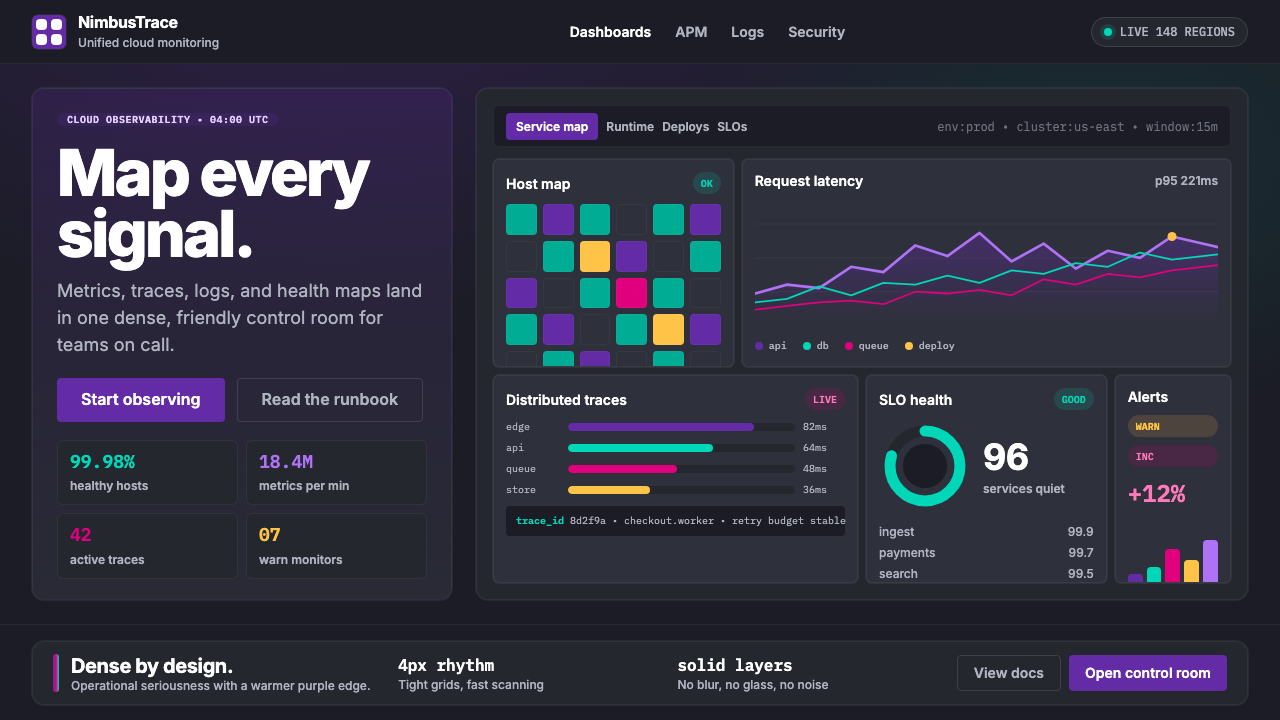 DatadogSerious telemetry, friendly pulse. Purple dark grids pack charts, badges, and…
 Discord Creator Dark UIQuiet until people speak. Gray-violet planes stack under one Blurple accent.