What is Petronas Twin Towers KL?
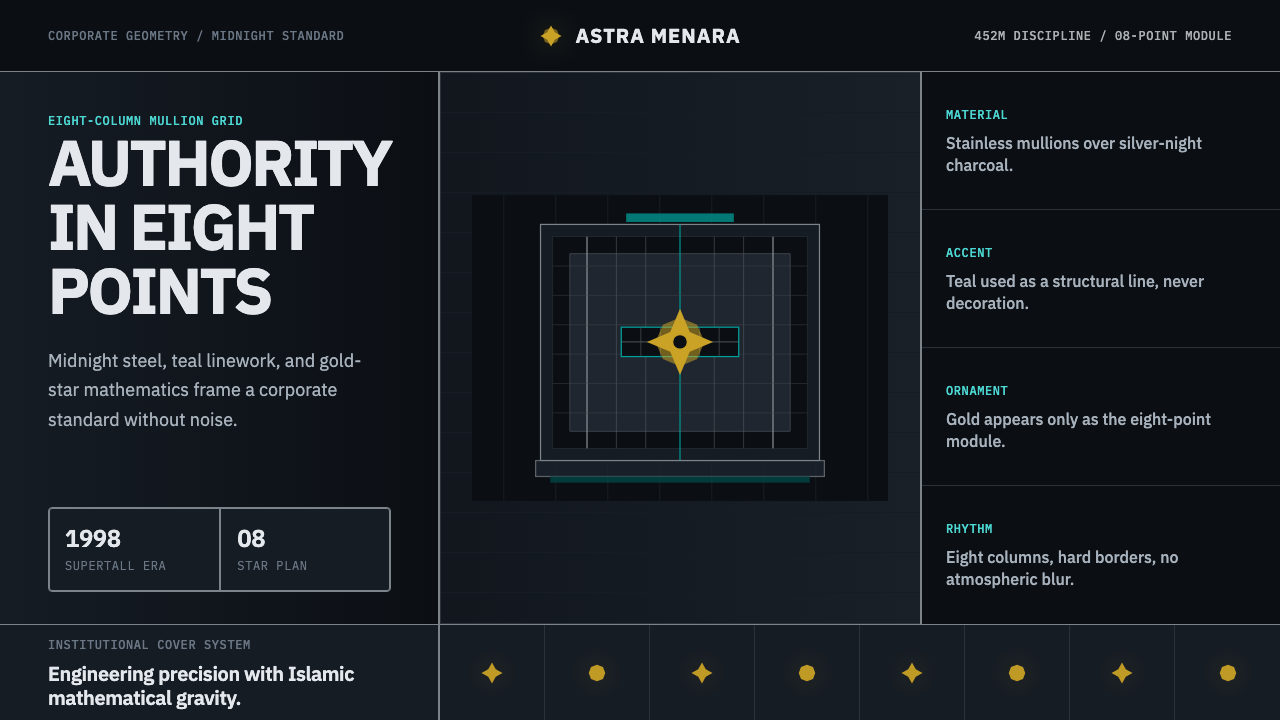
The Petronas Twin Towers transformed an eight-pointed Islamic star into a 452-metre corporate identity — fusing petrostate authority with centuries of geometric ornament.
Petronas Twin Towers KL in brief
The Petronas Twin Towers design system is a corporate visual language rooted in the floor plan of the towers themselves: the Rub-el-Hizb, an eight-pointed star formed by two overlapping squares, a motif central to Islamic geometric tradition. Architect César Pelli took this ancient pattern and extruded it upward into a supertall, then allowed its underlying geometry to govern every surface, ornamental band, and structural bay of the building. The visual identity that followed inherited the same discipline — teal, silver, and gold rendered with engineering-grade precision against dark grounds.
Where most corporate modernism of the late twentieth century reached for abstraction and neutrality, the Petronas system reaches for specificity and cultural gravity. The towers were conceived as a statement of Malaysian national ambition during the Mahathir era, and the design reflects that intention: nothing is incidental, nothing is soft. The palette reads as cool, authoritative, and slightly ceremonial — closer to a state seal than a tech logo.
The visual system operates primarily in a dark register. Deep midnight backgrounds — neither pure black nor the warmth of navy, but a precise shade between them — serve as the field against which teal mullion lines, gold geometric borders, and silver typographic elements are placed. The effect is one of illuminated precision: geometry glowing in controlled conditions, like the tower facades seen from the KLCC Park bridge at night.
Where does Petronas Twin Towers KL come from?
The story begins with a design competition held in 1991 and 1992, as Malaysia sought an architect to define the centerpiece of the Kuala Lumpur City Centre development — a massive urban redevelopment on the former site of the Selangor Turf Club. Prime Minister Mahathir Mohamad wanted a building that would announce Malaysia's arrival as a modern industrial nation while remaining unmistakably rooted in Malay and Islamic cultural identity. The brief effectively asked for a structure that could be seen from space and understood as Malaysian.
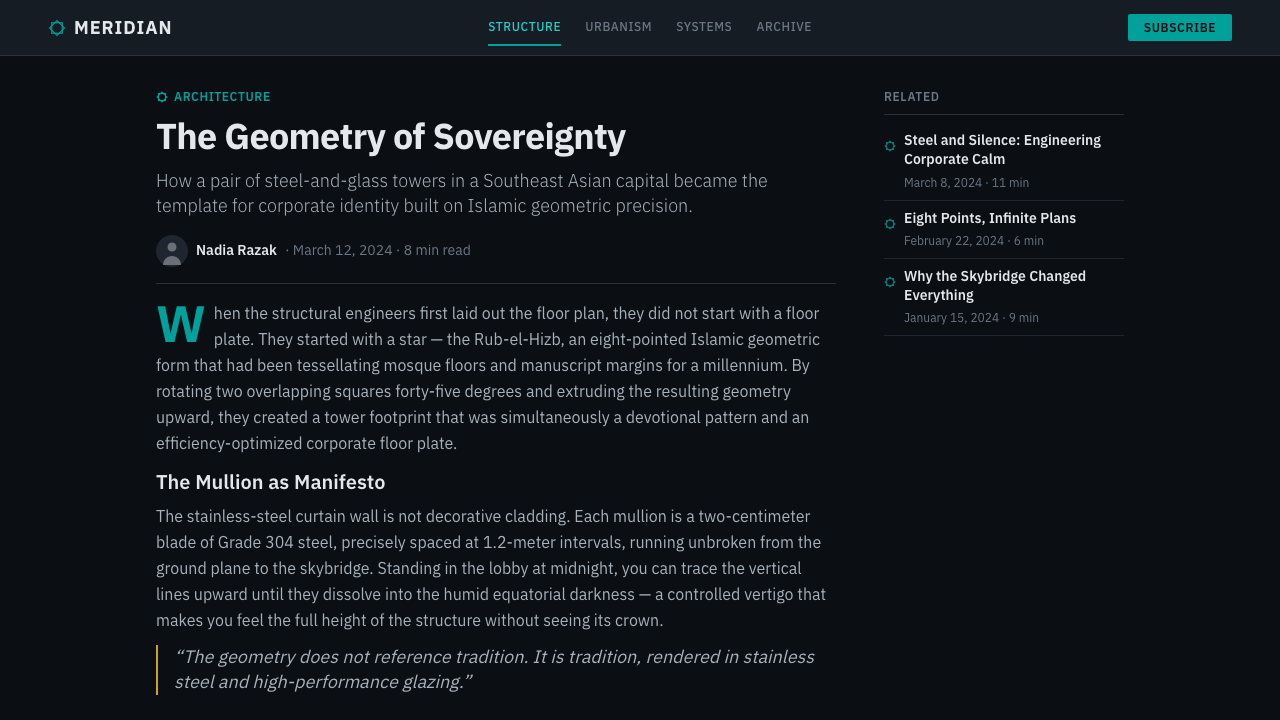
César Pelli, the Argentine-American architect then running his practice from New Haven, won the commission. His decisive move was the floor plan: rather than the rectilinear footprint standard to supertall construction, he proposed a Rub-el-Hizb — the eight-pointed star that appears in the geometric ornamental tradition of Islamic architecture from Persia to Andalusia. Two squares rotated forty-five degrees, overlapping, with the corners filled in to create a regular sixteen-sided polygon. This shape, generated from pure geometric logic, became the founding module of everything: the towers, the skybridge connector, the KLCC podium, and eventually the visual identity of Petronas itself.
Construction proceeded through the mid-1990s under the structural engineering leadership of Achmad Murdijat, who had to solve the problem of building supertall towers in Kuala Lumpur's notoriously difficult geology — the limestone karst and alluvial soil beneath the KLCC site required foundations driven to extraordinary depths on the eastern tower, a difference that contributed to the slight lean corrected during construction. The towers were topped out in 1996 and formally opened in August 1998, briefly claiming the title of world's tallest buildings before being surpassed by Taipei 101 in 2004.
The color choices that became the system's palette were not arbitrary. The teal — a color sitting between the blue-green of stainless steel under cool fluorescent light and the oxidized copper of Islamic architectural ornament — references both the engineering reality of the towers' cladding and the broader chromatic tradition of Malaysian mosque interiors. Gold recalls the gilded geometric banding that appears in Malay royal regalia and Islamic illuminated manuscripts. Silver connects to the structural honesty of the stainless steel curtain wall. Together they form a palette that is simultaneously industrial and ceremonial — the two registers that Malaysian corporate identity at its most ambitious has always tried to hold at once.
What defines the Petronas Twin Towers KL look?
Color palette
The system operates on three principal colors deployed against a deep midnight ground. Teal functions as the primary structural color — it appears in vertical mullion lines, geometric banding, and navigational elements, carrying associations with both engineered steel and Islamic tilework. Gold acts as the accent layer, reserved for borders, geometric ornamental nodes, and moments of hierarchy emphasis. Silver provides the typographic and secondary structural register, reading as cooler and more neutral than gold while maintaining the metallic quality of the overall palette. The midnight background is neither neutral nor decorative — it creates the controlled darkness against which the other three colors read as luminous rather than flat.
Geometric foundation
The Rub-el-Hizb — the eight-pointed star formed from two rotated overlapping squares — is not merely a decorative motif but the system's load-bearing structural module. It appears at every scale: as the tower floor plan itself, as ornamental panels on the facade, as sectional dividers in branded materials, and as the compositional anchor of any layout. This scalar consistency, where the same geometric form operates at building scale and at business-card scale, is rare in visual systems and gives the Petronas identity an unusual internal coherence. Subsidiary patterns include the sixteen-sided polygon (the filled star form), grid tessellations derived from it, and the interlocking arcs that appear in traditional Islamic geometric ornament.
Surface and material quality
The visual system translates the physical materials of the towers into a graphic register. Stainless steel reads as smooth, reflective silver with hard specular edges rather than soft gradients — the metal is cold and precise. The teal cladding, made from glass and steel panels, appears in graphic applications as a flat saturated field with crisp geometry rather than simulated translucency. Gold appears as a warm, matte-to-satin metallic rather than a reflective high-gloss — closer to anodized aluminum than polished brass. Together these material qualities produce a surface language that is simultaneously industrial (precision-engineered, hard-edged) and ceremonial (richly pigmented, formally ordered).
Typography register
Type in the Petronas system is formal, controlled, and hierarchical. Headlines favor letterforms with geometric clarity — strokes are even, proportions are regular, and there is a preference for faces that carry institutional weight without flourish. Body text is set compactly, often against the midnight ground in silver or white, with generous tracking in display contexts to reinforce the sense of engineering precision. Arabic script, when it appears alongside Latin letterforms, is treated with equivalent formality — proportioned to match visual weight, not subordinated in size or placement. The text block is a structural element, not a container of decoration.
Grid and compositional order
Compositions in this system are bilaterally symmetrical or radially symmetrical — reflecting the geometry of the star plan itself, which has eight axes of reflection. This is a significant departure from most corporate modern design systems, which favor asymmetric grids. The Petronas palette permits and even rewards formal symmetry when the geometric ornament at the center has sufficient visual weight to anchor it. Off-center compositions do appear, especially in editorial applications, but the overall formal tendency is toward centered authority rather than dynamic asymmetry. Margins are generous; the geometry is given room to breathe, much as the KLCC precinct is set within a public park rather than pressed against neighboring structures.
Ornament as structure
Unlike Bauhaus or Swiss Style, which eliminate ornament as a matter of principle, the Petronas system treats geometric ornament as structurally equivalent to layout. A teal diamond border is not decoration applied to a useful object — it is the object's organizing logic made visible, in the same way that the facade's vertical fins are both structural cladding and ornamental rhythm. This reflects the Islamic geometric tradition's core insight: that pattern, properly generated from mathematical rules, does not decorate space but defines it. The ornament in this system is therefore never applied — it is derived.
Dark-ground luminosity
The system's characteristic visual mood is produced by placing precise, saturated geometry against a very deep ground. This is the visual equivalent of the towers seen at night: the building's illuminated mullion lines become bright threads against the dark Kuala Lumpur sky, and the skybridge glows like a joining element between two lit forms. In graphic applications, this nighttime reading — light geometry on dark field — conveys authority, precision, and a degree of solemnity appropriate to a state-affiliated corporation. It also travels unusually well to screen contexts, where dark interfaces are increasingly standard.

Who shaped Petronas Twin Towers KL?
The Argentine-American architect who designed the Petronas Twin Towers, Pelli was already celebrated for large-scale commercial towers including the World Financial Center in New York when he entered the Kuala Lumpur competition. His decision to anchor the tower floor plan in the Rub-el-Hizb — rather than adopting the rectilinear footprint standard to supertall construction — was a defining cultural as well as architectural choice. The move gave the towers a formal identity that distinguished them from every other supertall of the late twentieth century and ensured that the geometry of Islamic ornament was literally the structural foundation of a building claiming to represent a new Malaysia.
Malaysia's Prime Minister from 1981 to 2003, Mahathir was the political architect of the Petronas Twin Towers project and the broader Kuala Lumpur City Centre development. His Vision 2020 program — which set the goal of Malaysia becoming a fully developed nation by the year 2020 — provided the ideological context for a building explicitly designed to signal national ambition. Mahathir's insistence that the towers reflect Islamic geometric heritage rather than generic international modernism was a direct brief to the architect and shaped the design system's cultural specificity.
The lead structural engineer on the Petronas Twin Towers project, Murdijat solved the complex geotechnical challenge of founding supertall towers on Kuala Lumpur's limestone karst and alluvial soil. The eastern tower required foundations driven to exceptional depths to reach stable rock, creating a construction challenge without precedent for structures of this height. His engineering decisions were inseparable from the architectural identity: the star-plan footprint, derived from the geometric ornamental module, also produced a structurally efficient core-and-perimeter system that made the supertall height achievable.
The internal design team responsible for translating the architectural identity of the towers into a corporate visual system for Petronas — Malaysia's national oil company and the towers' eponymous tenant. The Brand Office managed the extension of the teal-silver-gold palette from architecture into printed materials, signage, digital applications, and the company's global communications. The particular challenge they navigated was maintaining the ceremonial weight of the geometric system across mundane corporate contexts — annual reports, uniform programs, retail petroleum branding — without diluting the formal authority the palette carries in its most monumental applications.
Less a person than a millennium-long design lineage, the tradition of Islamic geometric ornament — developed across Persia, the Arab world, North Africa, Anatolia, and the Iberian Peninsula from roughly the ninth century onward — is the primary cultural source for the Petronas visual system. The key principles of this tradition include the generation of complex pattern from simple geometric rules (rather than drawing freehand), the treatment of pattern as mathematically continuous (capable of infinite extension in any direction), and the privileging of interlace and rotation over representational imagery. The Petronas system inherits these principles wholesale: its geometric ornament is rule-generated, scalable, and rotationally symmetric in ways that distinguish it sharply from decorative motifs borrowed without their underlying logic.
How do you use Petronas Twin Towers KL today?
The Petronas system is one of the most architecturally grounded corporate visual languages ever built, and applying it well requires treating the geometric module — the eight-pointed star and its derivatives — not as decoration but as the structural principle of any composition. Before choosing colors or arranging type, establish the geometric armature. Does the layout have a center? Does the geometry tile or radiate? The color and type should then be placed in service of that geometry, not alongside it.
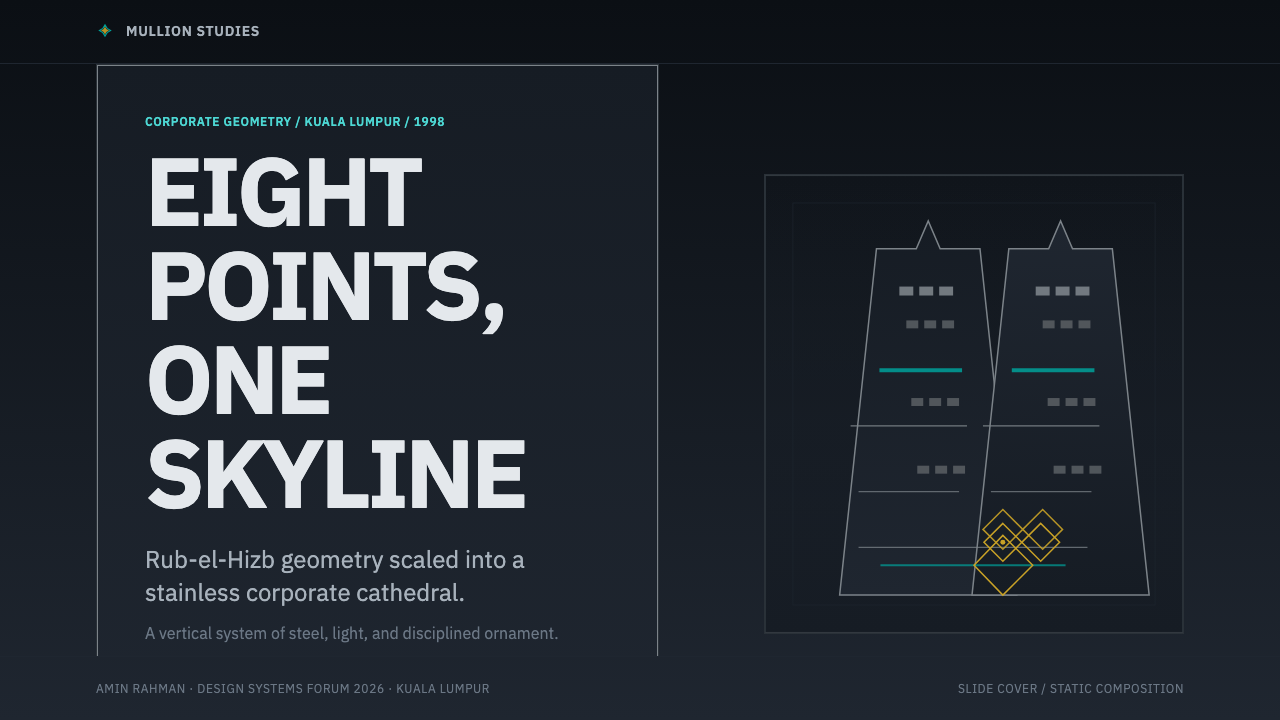
For presentation slides, the system suits cover pages designed around a single geometric focal point: the eight-pointed star at center, rendered in teal on a midnight ground, with the title set in silver above or below it with generous letter-spacing. Section divider slides work well with a single teal geometric band running the full width, separating the section title from the slide body. Content slides should be more restrained — the midnight ground with silver body text, teal used only for the most important data point or label, gold reserved for the session title or page reference. Avoid applying the full ornamental density to every slide; the system reads as more authoritative when the geometric richness is rationed.
For web interfaces and dashboards, the dark-ground palette translates directly to dark-mode UI with careful attention to contrast ratios for accessibility. Navigation and sidebar elements benefit from teal highlight states against the deep ground; data visualizations read well when the primary value is highlighted in gold against silver or teal secondary series. Pricing and tier pages suit the system's natural hierarchy: a central card in gold border for the featured tier, flanking cards in teal border for adjacent tiers, all on the midnight ground. The star-derived geometric element — even a small sixteen-sided polygon — can anchor a section header without feeling decorative.
For editorial and marketing applications, the system's poster quality should be embraced rather than softened. A full-bleed midnight background with a large teal geometric pattern in the upper portion and a product headline in oversized silver type below it will project the authority the system is built to convey. The danger in editorial contexts is over-ornament: the geometric bands and star motifs must serve the layout hierarchy, not crowd it. Use one strong geometric element per spread or screen; multiple competing ornamental bands flatten rather than reinforce hierarchy.
The most common mistake in applying this system is treating teal, gold, and silver as interchangeable accent colors that can be freely rotated through a layout. In the authentic system, each color has a specific structural role: teal is primary structure, gold is hierarchy emphasis, silver is text and secondary support. Using gold for body text or teal for a decorative flourish that carries no structural meaning misreads the system's logic entirely. A second common error is pairing the system's dark palette with warm-toned photography or illustrative imagery — the geometric coldness and the photographic warmth fight each other. If imagery is used at all, it should be treated in a cool, high-contrast register that the geometry can absorb rather than clash with.
Petronas Twin Towers KL — FAQ
Why does this system work on a dark background when most corporate visual systems use white or light grounds?
The dark ground is not a stylistic preference but a structural decision rooted in the architecture. The towers are experienced most powerfully at night, when the illuminated facade geometry — the teal mullion lines, the lit skybridge — glows against the dark Kuala Lumpur sky. A white-ground graphic application of the same palette would produce a very different emotional register: lighter, more approachable, but without the solemnity that the midnight backdrop provides. The dark ground also creates the luminosity effect — teal and gold on a deep dark field read as light-emitting, which is consistent with a brand narrative about a national energy company literally providing light and power.
How does Islamic geometric ornament differ from generic decorative pattern?
The distinction is generative logic. Decorative pattern is typically drawn to fill a space — it is applied to a surface. Islamic geometric pattern is generated from mathematical rules: a small set of construction operations (rotation, reflection, translation) applied repeatedly to a seed shape produces the full pattern. This means the pattern has no intrinsic boundary — it can theoretically continue to infinity in any direction, and cropping it at a frame edge does not violate its logic. In the Petronas context, this distinction matters practically: the eight-pointed star is not an image placed on the building — it is the rule from which the building is derived. Copying the appearance of the star without understanding its generative principle produces pastiche; applying the generative principle produces something with genuine coherence.
Can this system be adapted for smaller organizations without the petrostate authority behind it?
Yes, but the adaptation requires honest acknowledgment of what gives the system its weight. The Petronas visual language carries authority partly because of its architectural referent — there are actual 452-metre towers embodying this geometry — and partly because of the organization's scale and cultural significance. A smaller organization appropriating the full palette and ornamental density without that institutional backing risks looking aspirational in a way that reads as pretension rather than confidence. The most successful adaptations scale down the ornamental complexity and lead with one element — typically the dark ground and the geometric anchor — while using teal and gold more sparingly. The geometric principle travels better than the full palette does.
How should this system handle bilingual content for both English and Malay or Arabic?
The Petronas system was designed from the outset for a multilingual context — Malaysia's official communications operate in Malay, while English is the language of international business, and the Islamic geometric tradition has historical roots in Arabic-script cultures. The key principle is typographic equivalence: Arabic or Jawi script should be sized and weighted to carry the same visual authority as the Latin equivalent, not reduced in size to fit an assumed primary-language hierarchy. Geometric decorative elements serve as neutral connective tissue between scripts — a teal border band carries no linguistic bias. In practice, this means working with type foundries that have issued both Latin and Arabic families in the same weight range, and setting both scripts with equally generous spacing.
Is there a risk of cultural misappropriation when non-Muslim designers or organizations use this system?
The Islamic geometric tradition is a living design practice used across enormously diverse cultural contexts by Muslim and non-Muslim designers alike — it is not esoteric or restricted. The risk of misuse is not primarily about religion but about understanding: applying the superficial appearance of Islamic geometric ornament (star shapes, interlace) without the generative logic, the proportional discipline, and the cultural seriousness that gives it meaning produces something that reads as costume rather than design. The Petronas system specifically grounds its geometric use in an architectural referent with real historical, national, and cultural significance. Designers working in this system outside that context should be transparent about the reference, approach the generative principles with rigor, and avoid flattening a mathematically rich tradition into mere decoration.
Related design styles
 2001 — A Space OdysseyAbsolute restraint. Black void, white monolith geometry, one HAL-red signal.
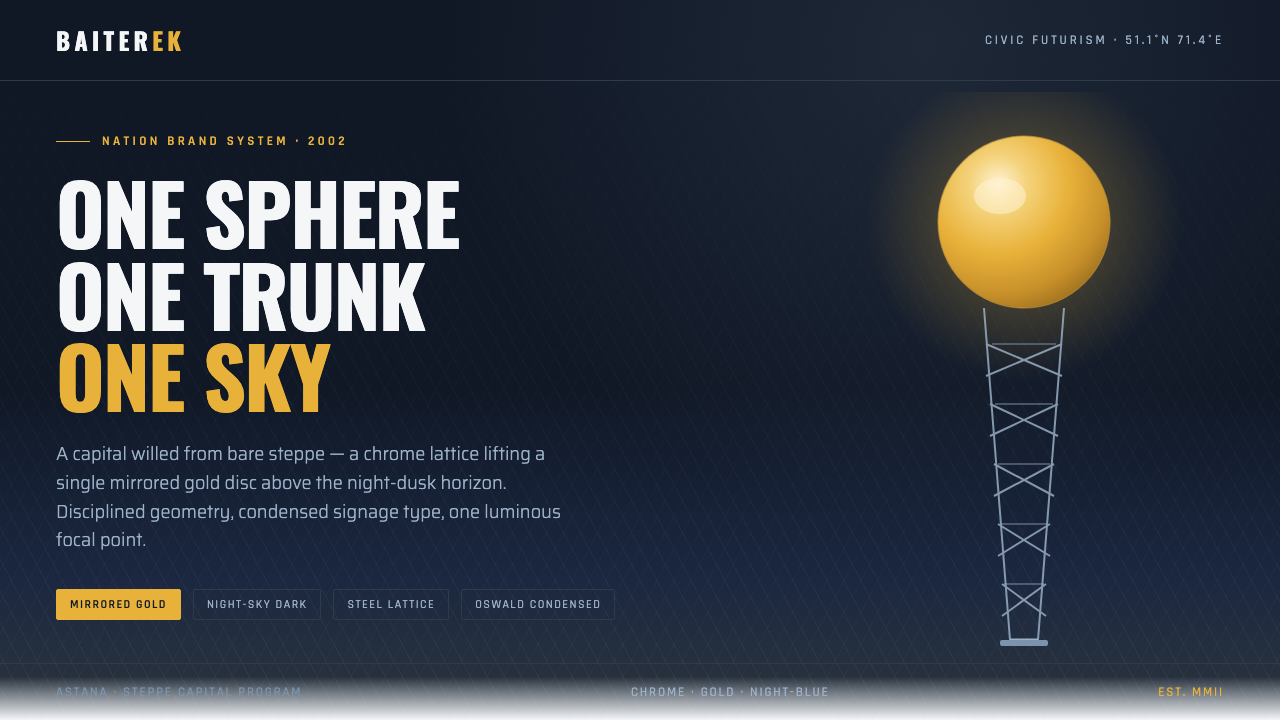 Astana Baiterek TowerCivic optimism in chrome and gold. A mirrored sphere crowns a white lattice t…
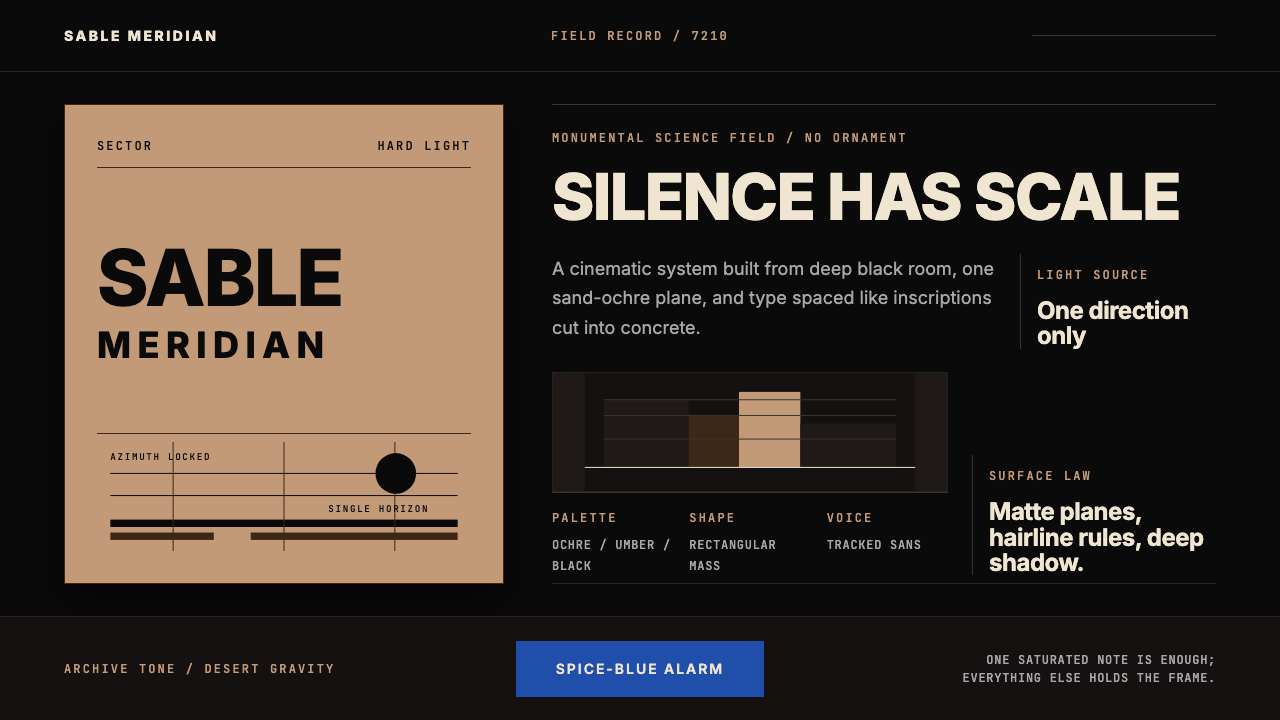 Dune Arrakis (Villeneuve)Silence has scale. Sand-ochre slabs, spice-blue alarm, and tracked Inter on b…
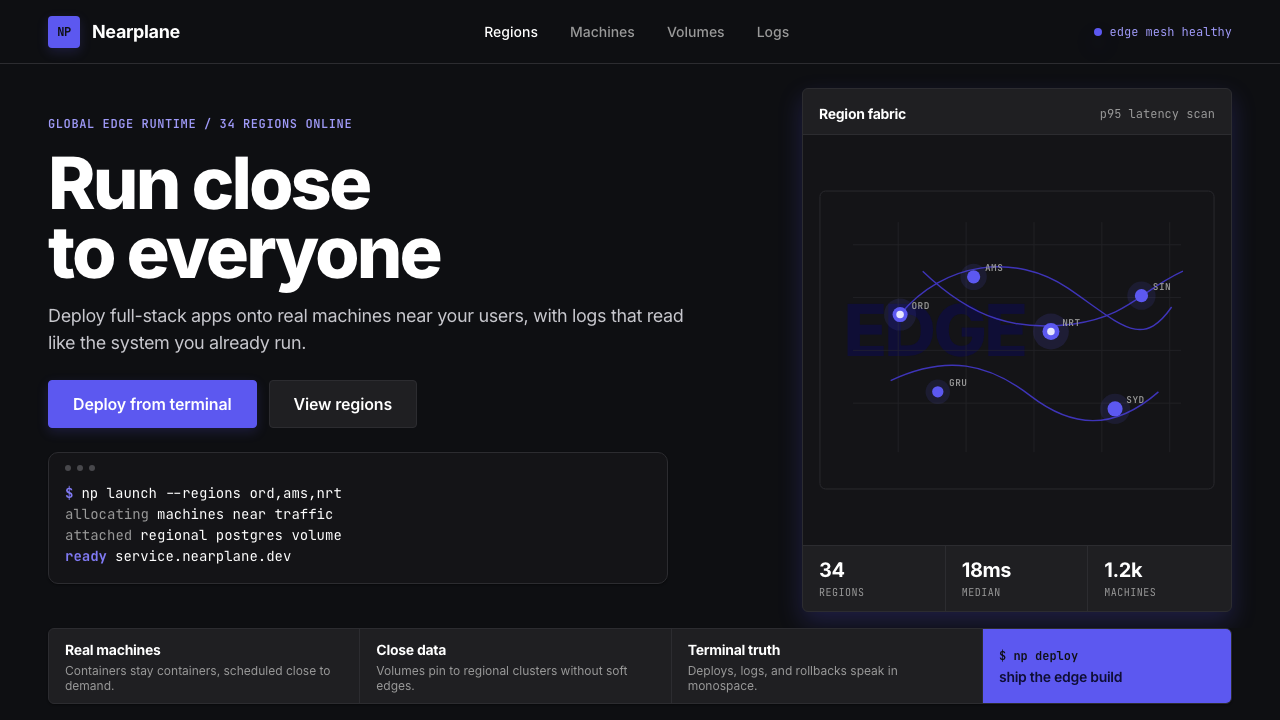 Fly.io Edge-Compute PurpleEdge-cloud with discipline. Electric purple nodes, Inter type, and terminal b…
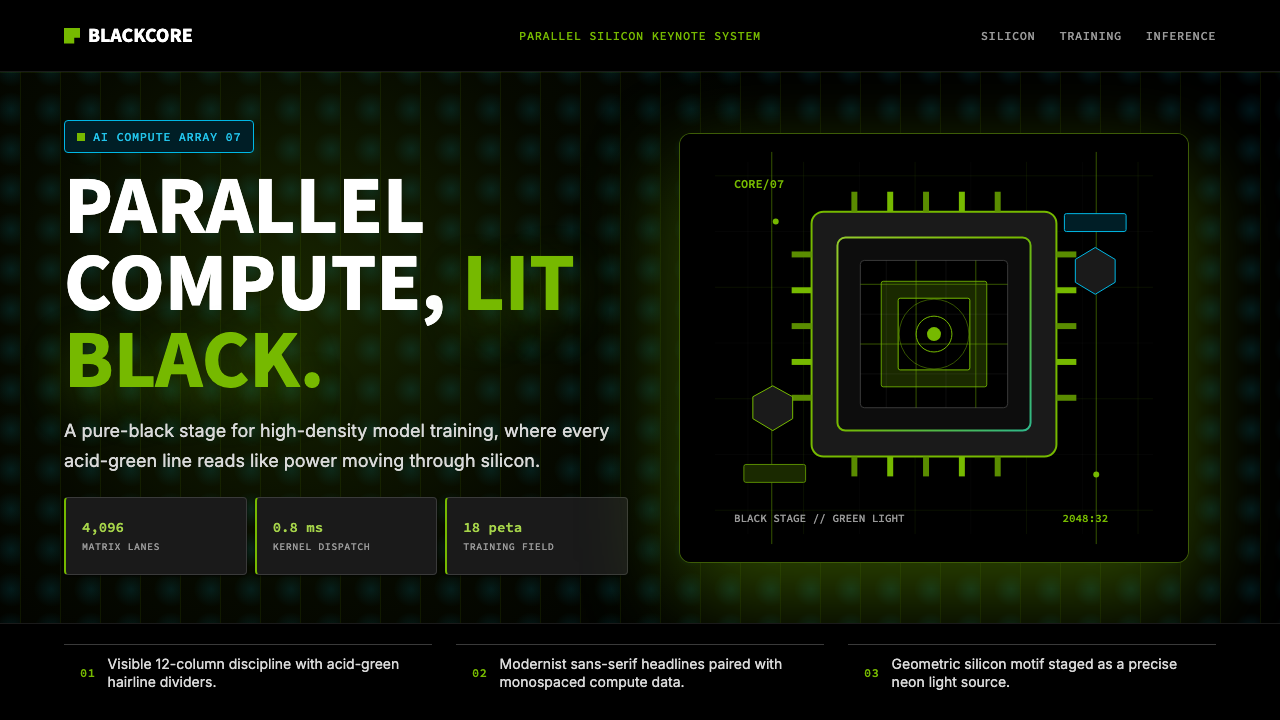 NVIDIA GPU Green-BlackPure black turns compute theatrical. Acid green hairlines and chip geometry s…
 Pantone Ultra VioletCosmic authority. Ultra Violet glows through chip blocks, Montserrat, and dee…