What is TeX Academic Paper?
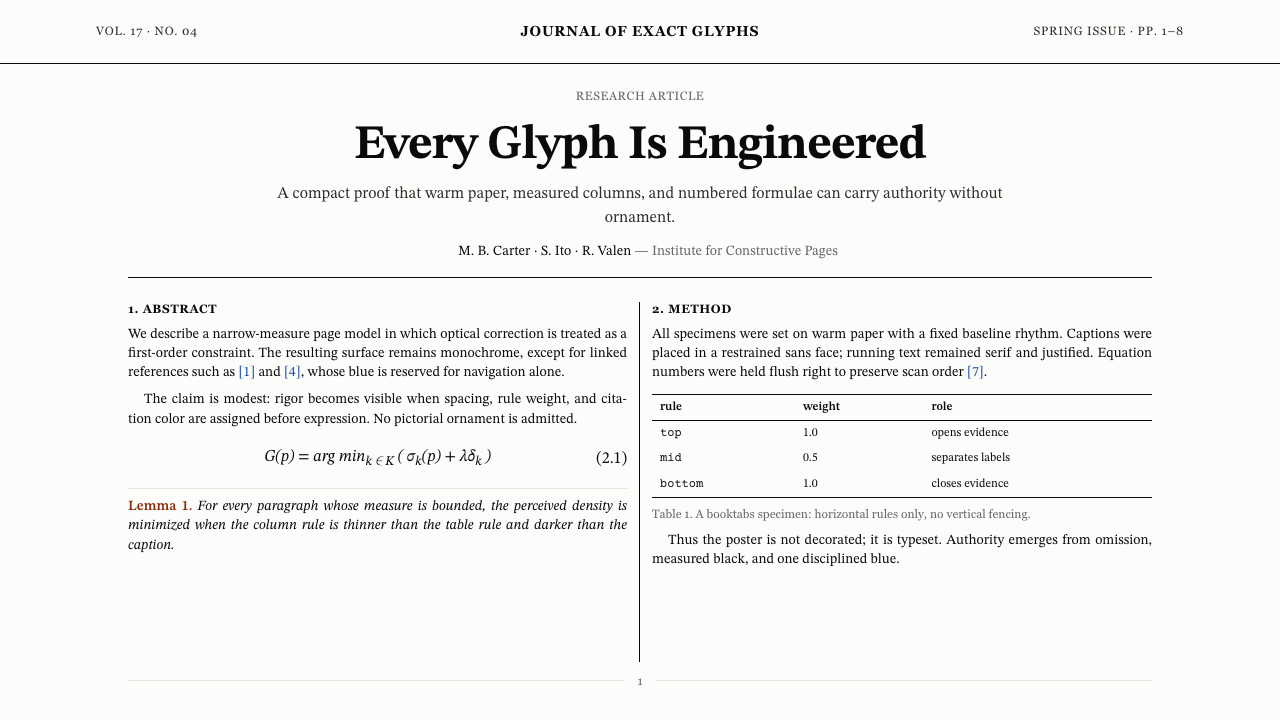
TeX academic typography is Donald Knuth's 1978 act of engineering rage — a complete typesetting system built from scratch because no existing tool was good enough for mathematics.
TeX Academic Paper in brief
TeX academic paper style is a typographic discipline that grew out of Donald Knuth's TeX system and Leslie Lamport's LaTeX macro layer. Its visual language — warm off-white paper, a classical serif typeface engineered glyph by glyph, a tight two-column layout divided by a hairline vertical rule, centered display equations with flush-right numbering, and no decoration of any kind — has become the universal signal of mathematical rigor across physics, computer science, and pure mathematics.
The aesthetic is defined as much by what it refuses as by what it does. No display typefaces, no colors beyond a single restrained accent for hyperlinks, no ornamentation at margins or headers, no drop shadows, no gradient backgrounds. What remains is a document whose every spacing decision was derived from optical geometry rather than convention, and whose authority rests entirely on the precision of its glyph construction and the exactness of its equation typesetting.
Because arXiv — the preprint server that distributes nearly every significant paper in mathematics, physics, and theoretical computer science — defaults to TeX output, this aesthetic has become one of the most widely read typographic systems in the world. A generation of researchers encounters it daily, and its conventions — the theorem-proof-remark rhythm, the bracketed citation, the equation number in parentheses at the right margin — carry the authority of an entire scientific tradition.

Where does TeX Academic Paper come from?
The story begins in 1977 when Donald Knuth, one of the foundational figures of computer science, received galley proofs for the second volume of his landmark work 'The Art of Computer Programming.' The proofs were typeset using phototypesetting technology that had replaced the older hot-metal Monotype system, and Knuth was appalled by the result. Equations that had looked crisp and authoritative in the first edition now appeared degraded — the spacing relationships that give mathematical notation its legibility had been destroyed. Knuth, characteristically, decided the correct response was to write a new typesetting system from scratch.
He spent the next decade building TeX — first released as TeX78 in 1978 and refined into its stable form in 1982 — along with the Computer Modern typeface family, a set of serif and mathematics fonts designed according to metafont, Knuth's parametric font description language. Computer Modern was not adapted from any existing typeface; it was specified mathematically, with every glyph defined by a system of geometric parameters. The result is a face that reads as classical and authoritative but whose underlying construction is unlike anything produced by earlier punchcutters or phototypesetting designers.
Leslie Lamport introduced LaTeX in 1984, building a document markup layer on top of Knuth's TeX engine. Where TeX required authors to manage low-level typographic primitives directly, LaTeX provided semantic markup — commands like 'theorem,' 'proof,' 'bibliography' — that automated the structural conventions of academic paper formatting. The combination of TeX's engine and LaTeX's document model rapidly displaced competing systems in physics, mathematics, and eventually computer science, partly because it produced visibly superior equation rendering and partly because it was free.
The style's reach expanded dramatically in 1991 when Paul Ginsparg established arXiv, initially as a physics preprint server at Los Alamos National Laboratory. Scientists uploading papers submitted TeX source files; arXiv compiled them. As arXiv grew to encompass mathematics, computer science, economics, and quantitative biology, the TeX visual language traveled with it. By the early 2000s, the two-column article class with its warm white background and Computer Modern text had become the default visual register of serious quantitative research — recognizable at a glance as a signal of intellectual content rather than visual performance.
What defines the TeX Academic Paper look?
Paper Tone
The background is not pure white but a warm, slightly yellowed off-white that recalls the surface of quality book paper. This warmth reduces the harshness of black text against background, allowing dense columns of mathematics and prose to be read for long stretches without eye fatigue. On screen, the effect is muted but present — a softness that distinguishes the style immediately from the cold white of modern web interfaces.
Serif Typeface Engineering
The text typeface central to this style is classical in overall impression — upright, balanced, with the optical refinements of a text face designed for sustained reading — but its origin is computational rather than calligraphic. Every glyph was specified through mathematical parameters rather than traced from historical models. The result reads as authoritative and legible at small sizes while carrying a slight mechanical regularity that distinguishes it from typefaces with calligraphic roots.
Two-Column Layout with Hairline Rule
The standard article format divides the page into two text columns of equal width, separated by a column rule so thin it is almost invisible — present as a structural marker rather than a decorative element. Wide margins frame the columns, providing space for the reader's eye to rest. This layout packs substantial content density onto each page while maintaining readability, and the narrow columns create a line length ideal for sustained mathematical reading.
Display Equations
Equations that are too important or too complex to sit inline with prose are set on their own lines, centered within the column or spanning both columns, with the equation number parenthesized at the right margin. This treatment gives major results the visual weight they deserve and allows readers to scan a paper's mathematical spine without reading the surrounding prose. The equation environment is one of the most distinctive typographic signatures of the style.
Theorem Environments
Definitions, theorems, lemmas, propositions, corollaries, and remarks are each typeset in a named block with a consistent internal structure: a bold or small-caps label, a number, and body text that is often italicized to distinguish the formal statement from surrounding commentary. Proofs are marked with a closing filled square — the tombstone — at the right margin of the final line. This typographic ritual encodes the logical architecture of mathematical argument directly into the layout.
Restrained Color: One Accent Only
The entire document is black text on warm paper, with a single color permitted for hyperlinks and cross-references. This accent — a restrained, medium-toned blue — is the only chromatic element in an otherwise achromatic system. It functions purely as a navigational signal, never as decoration. In printed form, documents rendered in this style contain no color at all, which is not a limitation but a statement: the mathematics speaks for itself.
Bibliographic Precision
Citations appear either as bracketed numbers — [14], [3, 7] — or in author-year form, and they are handled by a dedicated bibliographic processing tool that ensures consistent, machine-readable output. The reference list at the end of the document follows strict typographic conventions: author names in small caps or abbreviated first names, journal titles italicized, volume numbers in bold, year in parentheses. This discipline reflects the same philosophical commitment as the rest of the style: every element is placed where it is for a functional reason.

Who shaped TeX Academic Paper?
Knuth is the author of TeX and the Computer Modern typeface family, and the foundational figure of this entire aesthetic tradition. A professor emeritus at Stanford and the author of 'The Art of Computer Programming,' he developed TeX not as a design exercise but as an engineering response to a concrete problem: the degraded quality of mathematical typesetting in late-1970s phototypesetting. His decision to define typefaces through mathematical parameters rather than visual templates was unprecedented and shaped every aspect of the style's appearance. He declared TeX's version number asymptotically approaching pi as a statement that the system was essentially complete — a characteristic blend of mathematical humor and perfectionist commitment.
Lamport is the architect of LaTeX, the document-preparation system built on top of TeX that made the style accessible to scientists who were not typographic programmers. His contribution was semantic: where Knuth's TeX exposed typographic machinery, Lamport's LaTeX introduced the concept of logical document structure — sections, theorems, figures, bibliographies as semantic units rather than raw formatting commands. LaTeX's article class defined the visual template that virtually every academic paper in physics and mathematics has followed since 1984. Lamport later received the Turing Award, though primarily for his work on distributed systems and the formal specification language TLA+.
Zapf was one of the twentieth century's most celebrated type designers, and his influence on the TeX ecosystem is indirect but significant. Knuth consulted with Zapf when developing Computer Modern, and Zapf's typeface Palatino later became the basis for the widely used TeX typeface variant that brought a warmer, more humanist feel to academic documents. The availability of Palatino-derived variants within TeX demonstrated that the system's approach to typeface definition could accommodate classical designs alongside Knuth's geometrically specified originals, broadening the style's expressive range while preserving its structural rigor.
Ginsparg's contribution to this style's reach was logistical rather than typographic. When he founded arXiv in 1991 as a preprint distribution system for high-energy physics, he required submitters to upload TeX source files. This decision — made partly for storage efficiency and partly to ensure consistent rendering — meant that arXiv's expanding catalog became a vast archive of TeX-typeset documents. As arXiv grew beyond physics into mathematics, computer science, economics, and biology, the TeX aesthetic traveled with it, becoming the visual common language of quantitative academic communication worldwide.
How do you use TeX Academic Paper today?
Applying the TeX academic paper style to contemporary design work requires understanding its underlying logic: every visual decision in this system exists because it serves the communication of dense, precise information to readers who will spend long periods with the document. The style is not a costume — it is a set of principles about information density, typographic hierarchy, and the suppression of decoration in service of content. Import those principles, not just the surface appearance.
For presentation slides, the style translates most directly when the subject matter involves data, technical depth, or an audience of specialists who associate the aesthetic with intellectual credibility. A cover slide works best with a single, narrow column of text positioned with deliberate asymmetry against a warm off-white field — no full-bleed imagery, no decorative typefaces. Content slides should behave like typeset pages: a clear heading hierarchy established by size and weight alone, body text at a comfortable reading size, and equations or code blocks treated as display elements centered within their available space. Data slides should feel diagrammatic rather than polished: charts with thin axes, no rounded corners, no gradient fills on bars, annotation in a serif typeface that matches the running text.
For web interfaces, the aesthetic is best suited to tools and platforms where the user is engaged in analytical, research-oriented, or technical work: dashboards for scientific or financial data, documentation sites, academic publication viewers, developer tools, or pricing pages for products aimed at technical buyers. The approach: a warm neutral background, a classical serif typeface for body text and headings, a strict column grid with generous margins, and a restrained single accent color reserved for links and active interface states. Navigation should be typographic, not icon-heavy. Interactive elements — buttons, inputs, tabs — should be bordered rather than ghost-styled, with no soft drop shadows.
For editorial and marketing applications, the style provides authority and seriousness that can distinguish a brand in categories prone to visual noise. A white-paper or research-report layout following these conventions — narrow text columns, wide outer margins for pull quotes and annotations, section breaks marked by a thin horizontal rule rather than large decorative headers — reads as substantive rather than promotional. Marketing pages can borrow the structural confidence of academic layout: a narrow centered text column for hero copy, display equations or data visualizations as anchor elements, and a tonal restraint that treats color as information rather than atmosphere.
The most common mistake when applying this aesthetic is conflating 'academic' with 'boring' and compensating with elements the system explicitly rejects — background textures, display fonts, gradient accents, or oversized imagery. The style's authority comes precisely from its refusal to perform. A second common error is applying the two-column layout to screen widths where it produces line lengths too short or too long for comfortable reading; column count should always be driven by the available measure, not copied mechanically. The single accent color must remain singular — introducing a second accent color, however subtle, breaks the system's core logic and makes the result look like an imitation rather than an application of the style.

TeX Academic Paper — FAQ
Is this style only appropriate for scientific or technical content?
Not exclusively, but it carries strong connotations of rigorous, evidence-based communication that should be considered before applying it outside technical contexts. The style works wherever the implicit message 'this content has been carefully derived and precisely stated' is an asset — legal documents, financial research, policy papers, data journalism, high-end developer tools. It works less well where warmth, sensory richness, or emotional connection are primary goals. A food brand, a children's platform, or a wellness application would likely find the style's severity counterproductive.
How does TeX academic style relate to other clean, serif-based typographic systems?
The style is distinct from other classical serif systems in a specific way: it is engineered rather than calligraphic in its origins. Traditional book typography — whether English, French, or Dutch in tradition — traces its letterforms back through centuries of punchcutting and calligraphic precedent. The TeX style's typeface was specified computationally, producing a face with the visual rhythm of classical typography but a slight mechanical regularity that sets it apart. The style is also more functionally specialized than general book typography — it is designed for documents with heavy mathematical notation, not for continuous literary prose, and its layout conventions reflect that priority.
Can this style work for dark-mode interfaces?
A dark inversion is technically possible but requires care, because several of the style's core qualities depend on the warm light-paper tone. The warm off-white background is not merely aesthetic — it reduces the harshness of long reading sessions in a way that pure white or dark backgrounds do not. An inverted dark version works best when the background remains warm in tone rather than cold and desaturated, when the text color is a warm near-white rather than pure white, and when the accent color is adjusted — a cool blue accent tends to read as cold against dark backgrounds where it read as neutral against light ones. The structural conventions — column layout, equation display, theorem environments — translate without modification.
Why does the style use a serif typeface when most modern interfaces use sans-serif?
The serif typeface in this style serves two distinct functions that modern sans-serif systems do not address in the same way. First, it provides superior rendering of mathematical notation — the stress variation and fine details of serif letterforms allow inline mathematical symbols to sit coherently alongside Latin text at the small sizes common in academic paper columns. Second, it carries a typographic signal: a document set in a well-made classical serif typeface reads as authored and deliberate, in contrast to the neutral efficiency of a sans-serif interface. The style's serif is not a heritage affectation — it is a functional decision that also communicates something about the seriousness of the content.
Does the style require actual TeX or LaTeX to produce correctly?
No — the style's visual principles can be applied in any design or layout tool. The key decisions are tonal (warm paper background, black text, single blue accent), structural (two-column grid, wide margins, display-centered equations), and typographic (a classical engineered serif for body text, restrained hierarchy). What TeX produces automatically — correct optical spacing in mathematical expressions, consistent kerning across glyph pairs, precise column alignment — requires more careful manual attention in other tools, but the visual result can be approached faithfully. The goal is to reason from the same principles Knuth reasoned from: every spacing decision should have a functional justification, and anything that cannot be justified should not appear.
Related design styles
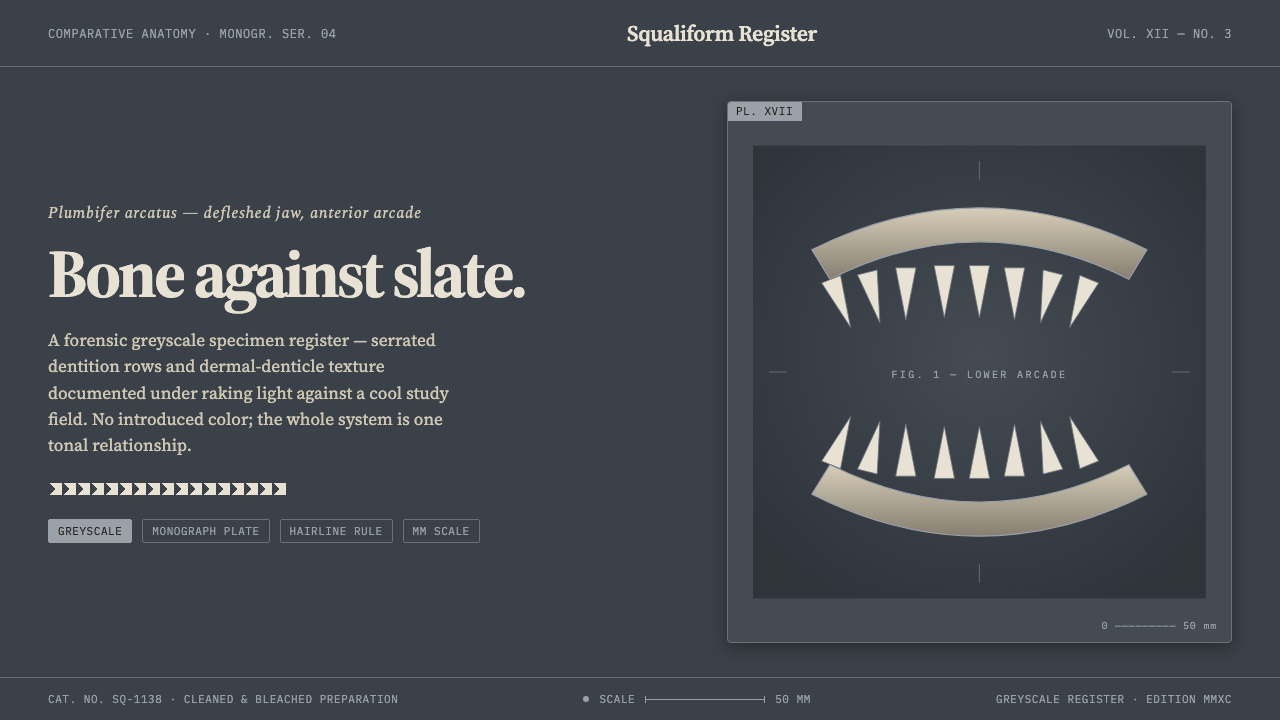 Shark Jaw & DentitionForensic and strictly greyscale. Bone-white serrated dentition floats on a co…
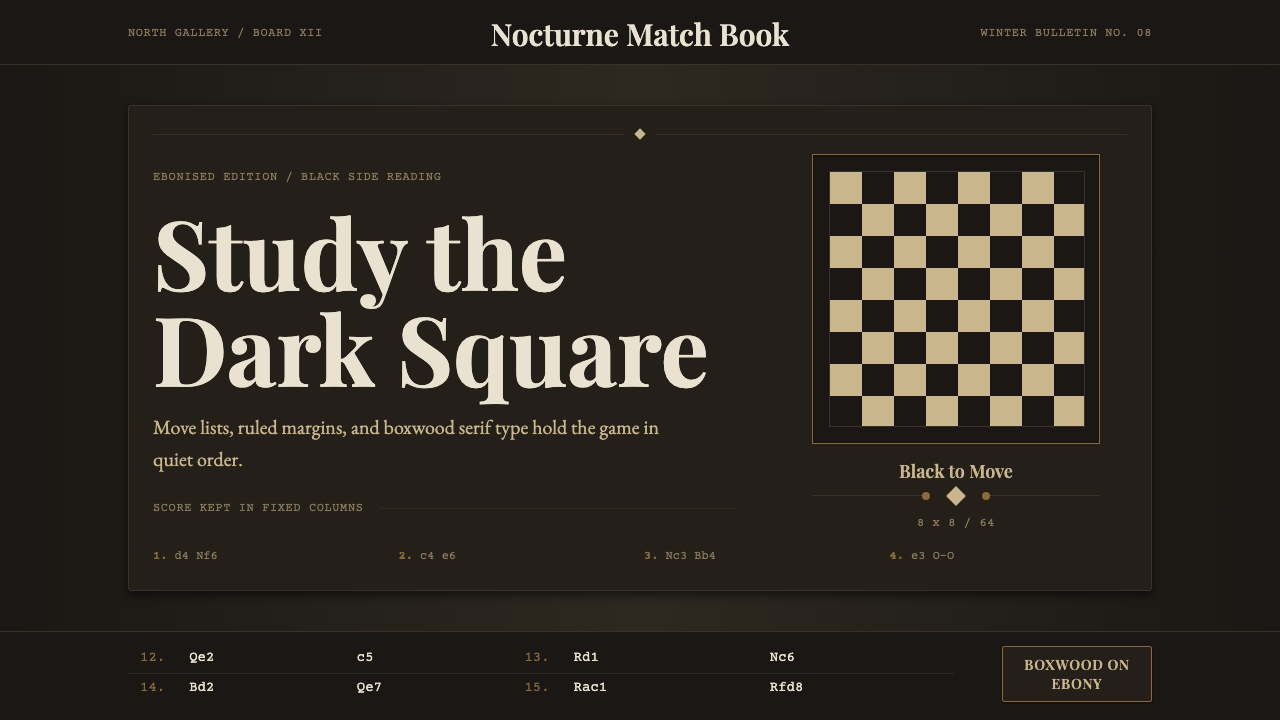 Chess TournamentQuiet intellect. Cream Playfair type, walnut rules, and notation glow on ebon…
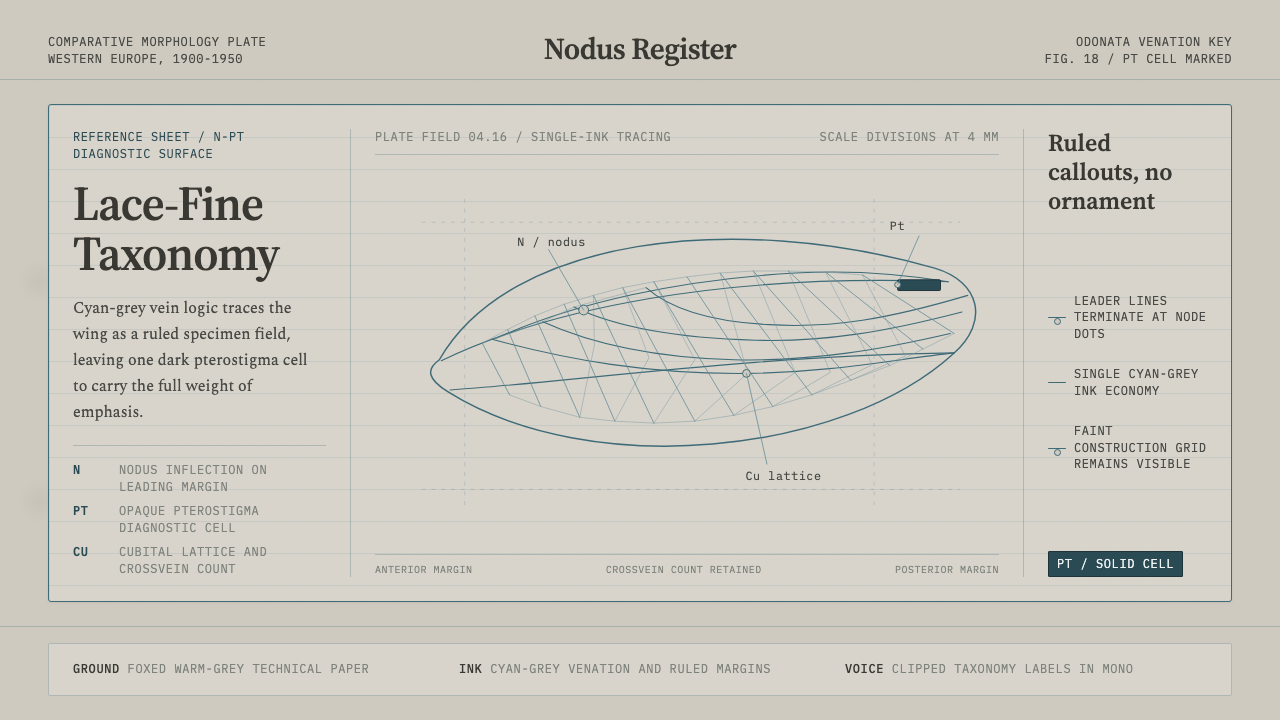 Dragonfly Wing VenationPrecision, nearly weightless. Cyan-grey veins rule a foxed paper taxonomy pla…
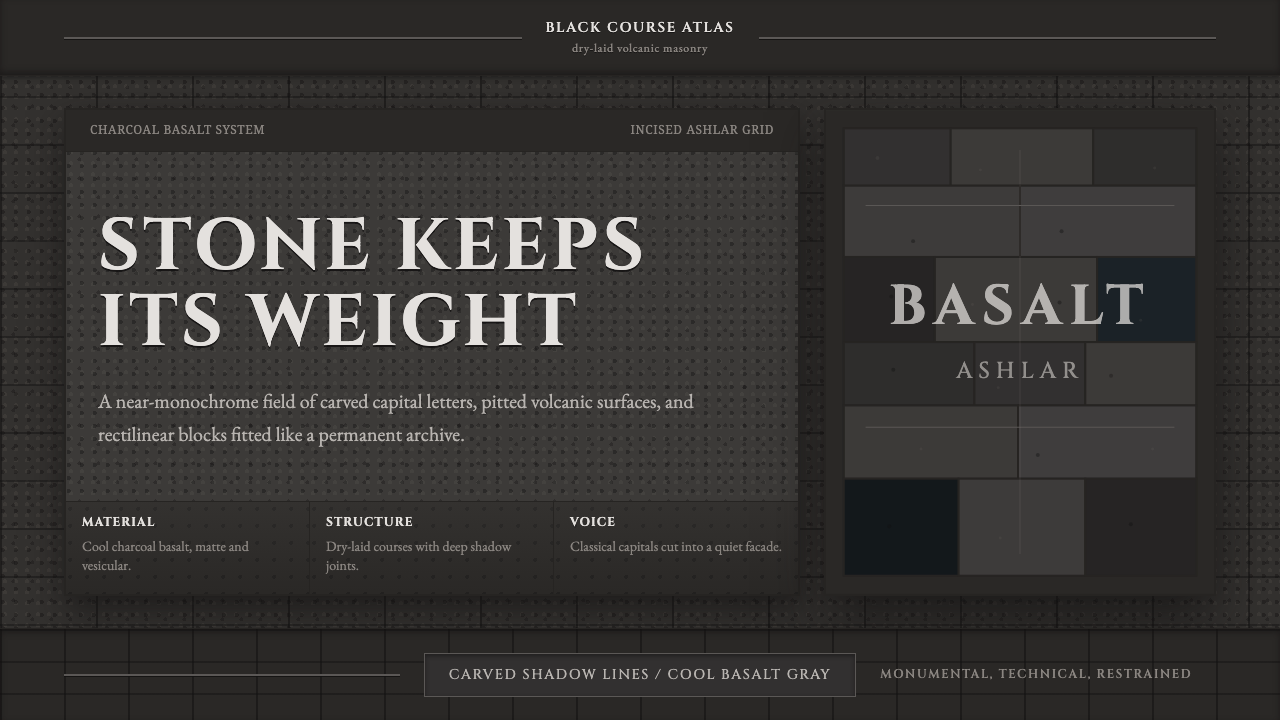 Hauran Basalt StoneMonolith refuses shine. Charcoal Cinzel capitals lock into dry-laid basalt gr…
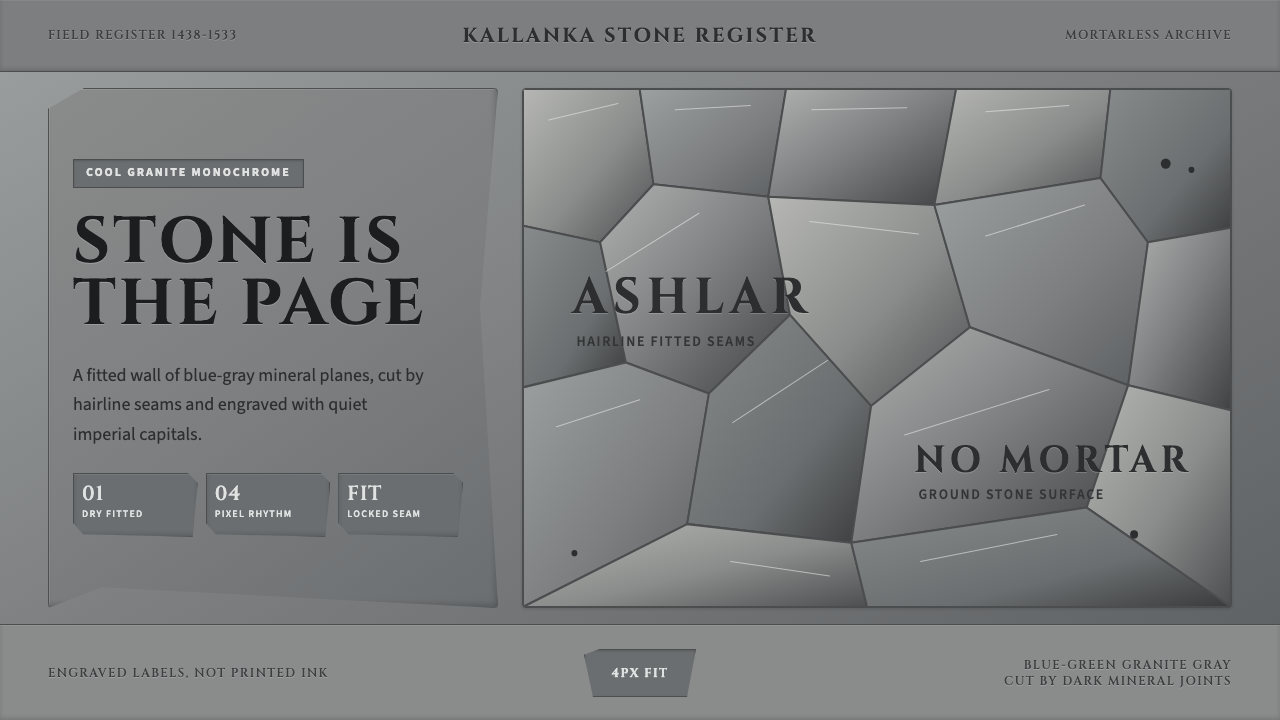 Inca Ashlar StoneworkStone becomes the page. Granite-gray planes lock into hairline ashlar seams.
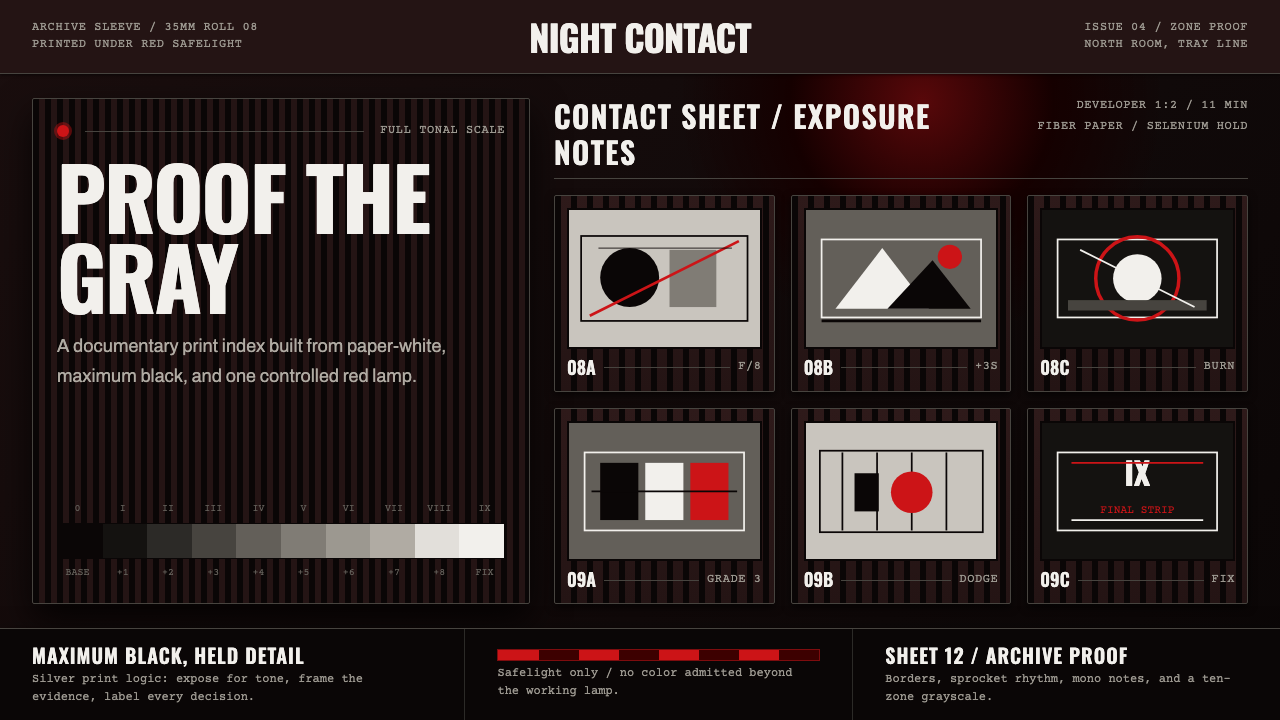 Silver Gelatin DarkroomTonality is the craft. Safelight red, contact grids, and ten-zone grays hold…