What is Druze Mount Lebanon Dress?
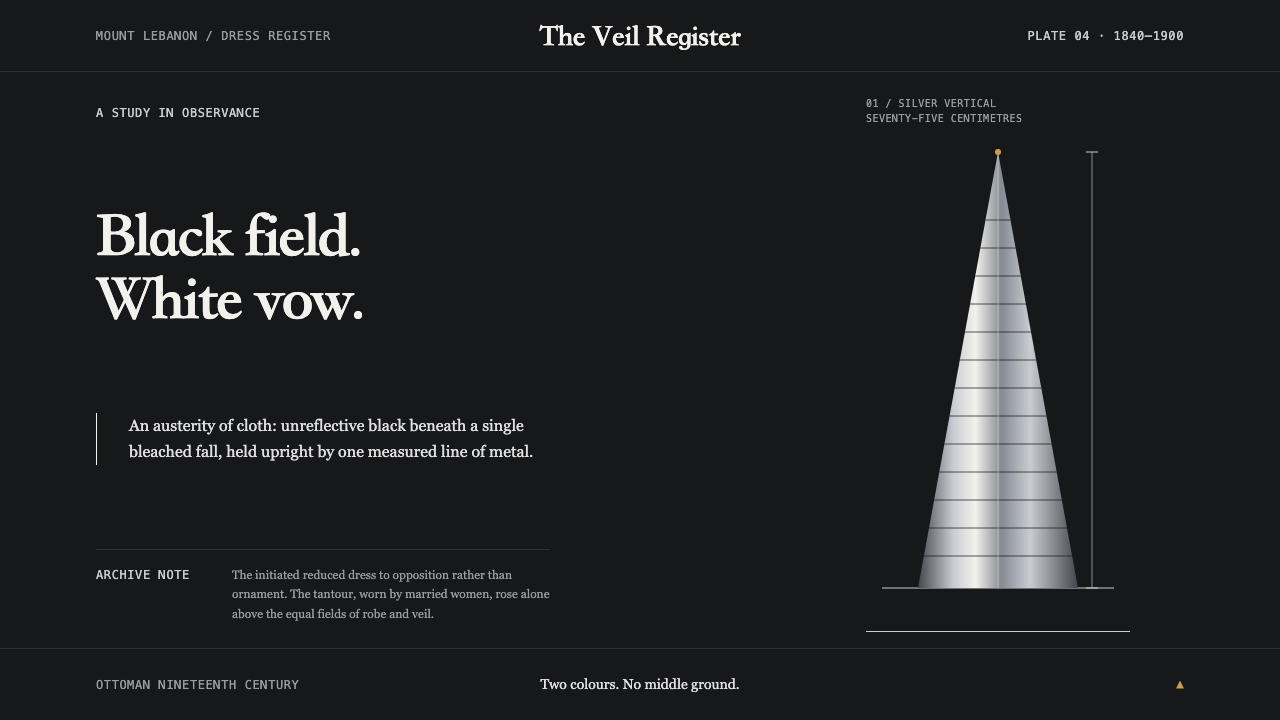
Among the initiated Druze of Mount Lebanon, dress was reduced to two colours, a dense matte black and one bleached-white fall of cloth, and austerity itself became the luxury.
Druze Mount Lebanon Dress in brief
Druze Mount Lebanon Dress is a design style based on the dress code of the initiated among the Druze of Mount Lebanon, the 'uqqāl. The rule was simple and absolute: two colours and no more. A woman wore a black jumper and skirt under a white veil; a man shaved his head and wound a white laffa around the tarbush. Colour belonged to the uninitiated.
The visual result is a dense matte black field carrying a single bleached-white mark. Through the nineteenth century that white veil hung from the tantour, a cone of silver, copper or gold worn by married women, which in its grandest form stood well over half a metre tall. The cone is the only vertical in the picture. Everything else is dark, flat and quiet.
As a design system the style is subtraction made visible. There is no pattern to read; the rule is restraint. Between black and white there is no mid-tone. The frame is held by a large dark ground, a bleached-white element that falls from above, and one silver vertical. It is a dark theme in which poverty of colour is the form that richness takes: austerity becomes luxury.
Where does Druze Mount Lebanon Dress come from?
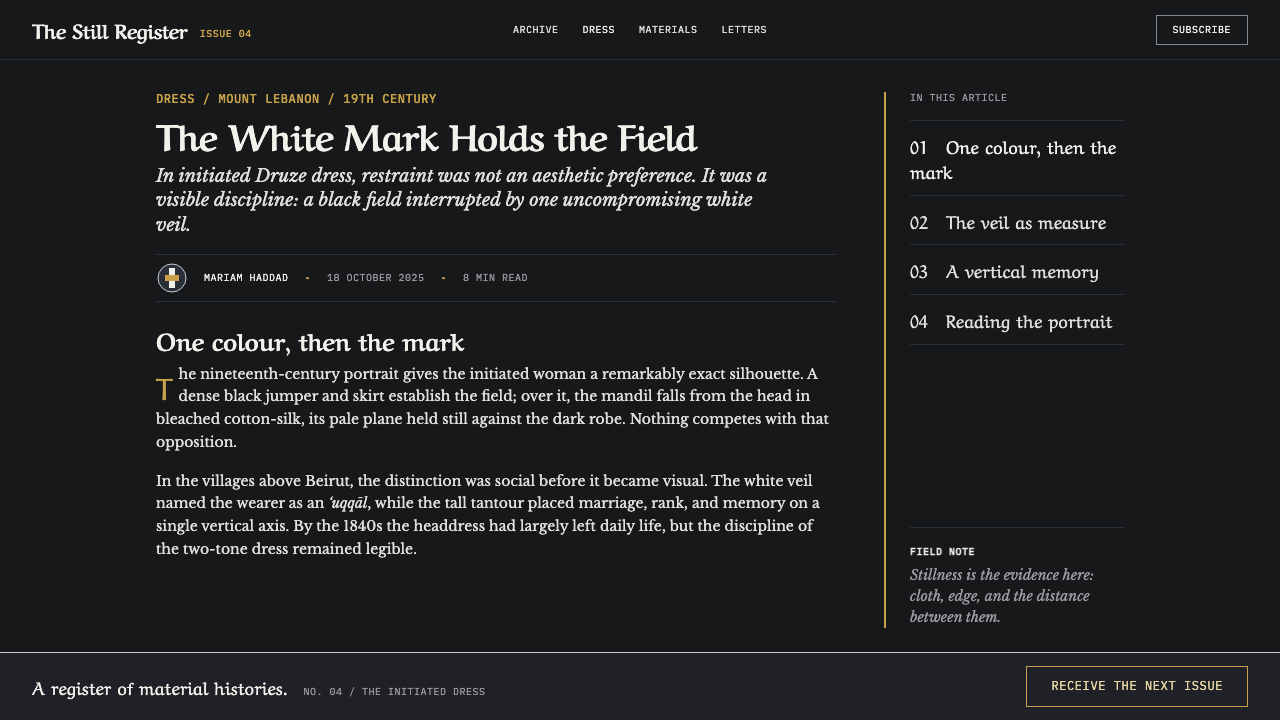
The dress belongs to Mount Lebanon and western Syria and is dated to before 1900: mainstream through the Ottoman nineteenth century, with the tantour gone by that century's close. The clothing was part of a religious distinction. The initiated of both sexes, the 'uqqāl, dressed in two colours, while the uninitiated were free to wear colour. Dress therefore worked as a sign readable at a glance. The white veil was how a Druze woman was recognised, and what the eye registered first was the absence of colour.
The tantour was the most dramatic piece. Worn only by married women, it was a cone of silver, copper or gold, in the grandest versions well over half a metre high, and the white veil fell from it. Families of standing wore it in gold set with jewels. After the 1840s it dropped out of use quickly, and by the end of the century it was effectively gone.
Three strands feed the lineage: Druze religious dress together with the kutub al-ḥikma, the book tradition of the community; the wider costume of the Ottoman Levant; and nineteenth-century Mount Lebanon silverwork. Broadly, the first supplies the discipline, the second the garments and their setting, and the third the cone. The two groups at the centre of the lineage are the 'uqqāl themselves and the emiral households of Mount Lebanon, the families of rank with whom the finest versions are associated.
What survives as a design source is the logic, not the garment. A community that could afford colour declined it, and made the refusal clear and beautiful. That is a very particular kind of luxury: not abundance but control. The tantour's short life, set against the lasting meaning of the veil, is a reminder that a visual rule can outlast the object that first carried it. This article describes the visual logic of a dress code only; it makes no claim about belief, and a design built on it should keep the same respect for the tradition.
What defines the Druze Mount Lebanon Dress look?
Two colours, no more
The palette is black and white and nothing else. This is not a minimalist taste but a rule that belonged to the initiated, since colour was for the uninitiated. In design terms there are no accent hues, no tints and no brand colour sneaking in at the edges. Every other tone is absent by principle.
The matte black field
The black is dense and matte, with no sheen. It is not a glossy black-glass look. Large stretches of the page are given over to it, and it reads as cloth: deep, absorbent, flat. Because it does not reflect, it makes the white appear to hover in front of it.
The bleached-white fall
The white is bleached and clean, a single fall of cloth coming from above. It is the mark that identifies the wearer: a woman's white veil, a man's white laffa wound around the tarbush. It should appear once, or in very few places, with the quality of a decision rather than a decoration.
No middle tones
Between black and white there is no grey ramp. Elements are either the dark ground or the white mark. Soft transitions, tints and translucent overlays have no place. Hierarchy comes from placement and scale, not from gradations of shade, which is why the system feels so absolute.
One silver vertical
The tantour, a cone of silver, copper or gold, is the only vertical in the picture, and the rest is horizontal mass. In a layout this means one vertical accent, a rule, a column or a tall element, rising from a broad dark base. The metal is cool and restrained rather than gleaming. It holds the frame instead of decorating it.
Restraint as the rule
There is no ornament to describe. The visual rule is subtraction: large areas left black, a single white element, a single vertical. The richness lies in proportion, in the amount of black left alone, and in the confidence of leaving it. A busy version of this style is a contradiction in terms.

Who shaped Druze Mount Lebanon Dress?
The initiated Druze of Mount Lebanon, women and men alike, are the keepers of the dress code at the centre of this style. Their two-colour rule, with colour left to the uninitiated, is the whole system in miniature. The style takes the rule's visual consequence, a black field with a white mark, and none of its doctrine.
Families of rank, whom the lineage names alongside the initiated, are associated with the most costly versions of the dress, such as the gold, jewel-set tantour. Their presence shows that the restraint of the style sat comfortably with wealth: luxury here was expressed through material and form, never through colour.
The silverwork of nineteenth-century Mount Lebanon gave the tantour its metal form, the cone from which the veil fell. Their craft supplies the style's one silver vertical. It was a tradition of short-lived but striking objects: the cone was in use through the century and effectively abandoned after the 1840s.
The lineage names the kutub al-ḥikma, the book tradition of the community, alongside Druze religious dress. It is the textual world in which the dress code lived. The design style draws on it only as context for the discipline of the dress, and makes no claim about its content.
How do you use Druze Mount Lebanon Dress today?
Druze Mount Lebanon Dress is among the most severe styles in any library: black, white, one vertical. It gives a design immediate gravity, and it punishes decoration. Use it when a page needs to feel serious, expensive and unhurried.
For slides, a cover works as a large matte black field with the title in bleached white and one thin silver vertical. The white should read as one mass, perhaps a single large title block falling from the top edge. Content slides keep nearly the whole page black, with white text and one vertical rule setting off a narrow column; avoid colour-coding altogether. Data slides must find their hierarchy without hue: show a series in solid white, draw the others as outlines, and tell categories apart by fill versus outline, line weight or position rather than by colour. The silver rule can serve as the axis.
For web interfaces, the style fits luxury, fashion, jewellery, high-end hospitality, cultural institutions and editorial-led products. Navigation is white text on black, and one thin silver vertical line can become a signature. Buttons are outlined white rectangles or solid white blocks with black type, and states change by inversion, not by tint, so that hover swaps black and white. Dashboards are only suitable where users can accept extreme restraint: a black field with white data, status shown by words and symbols instead of coloured dots. On a pricing page, one white card on the black field marks the recommended tier.
For editorial and marketing work, long-form pieces suit white type on matte black, wide margins and a single tall element beside the text column, with photography in black and white or strongly desaturated. Campaign visuals can set a product on a deep black field with one bleached-white element above it. The more confident the emptiness, the more the style works.
The most common mistake is to add just one accent colour, which breaks the rule the whole style is built on. Others include using a glossy black with reflections, introducing grey ramps and translucent layers, and filling the page with white elements until the single mark becomes many. A last mistake is tonal: the style is a dignified dress code, and it should not be exoticised or turned into costume. Keep it grave, plain and respectful.
Druze Mount Lebanon Dress — FAQ
Why only black and white?
Because among the initiated Druze of Mount Lebanon that was the rule: two colours and no more, with colour left to the uninitiated. The design style keeps the rule intact. If you add a third hue, you are no longer borrowing the dress code, only its mood, and the strictness that gives the style its authority is gone.
Does the style ban grey completely?
The source dress has no mid-tone between black and white, and the style follows it. Hierarchy should come from scale, position, outline versus fill and spacing. The one exception is the silver vertical, which is a metal, not a tint. If accessibility needs a secondary level of emphasis, use size and weight of white type rather than reducing its brightness.
How is it different from an ordinary dark mode?
An ordinary dark mode is usually a ramp of greys with a brand accent colour on top. This style has no ramp and no accent: a matte black field, a bleached-white mark and one silver vertical. It is a composition rule, not a colour scheme applied to an existing interface, and it will look empty if you try to port a full app UI into it unchanged.
Does the tantour cone have to appear in the design?
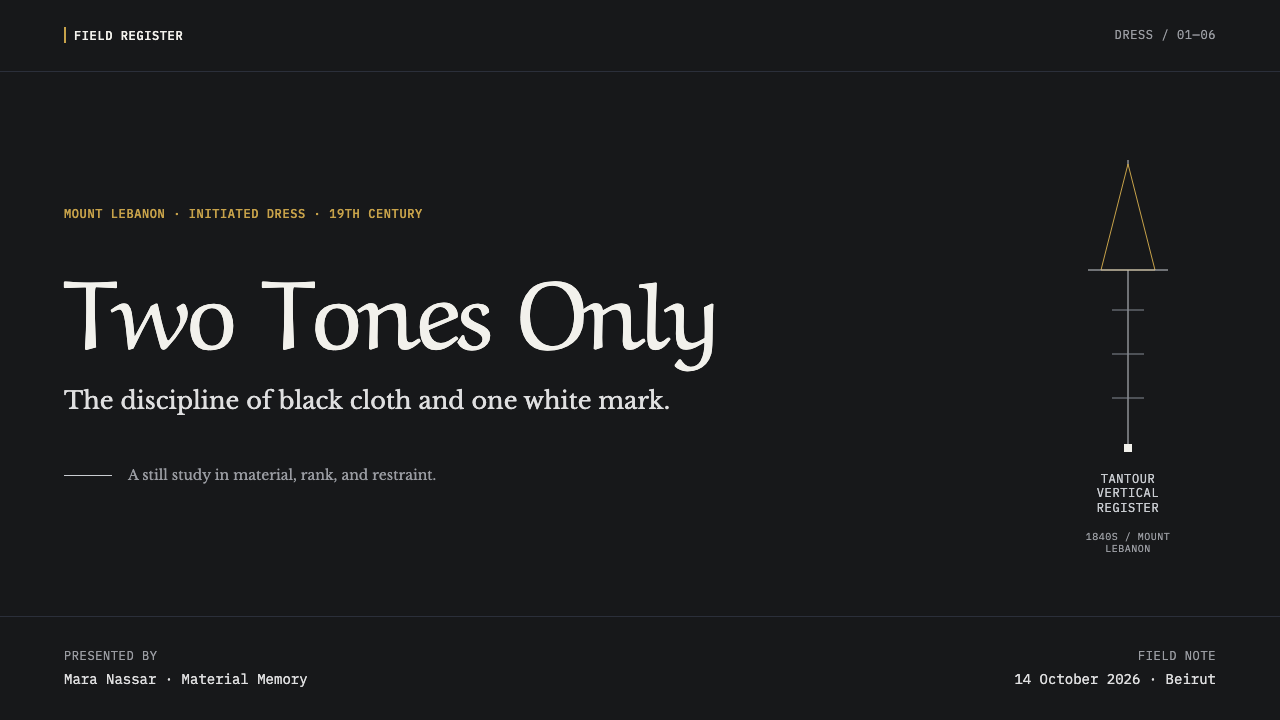
No. The cone was effectively gone by the end of the nineteenth century, and the style does not need a literal copy. What it needs is its function: a single vertical element rising from a broad dark base. That can be a rule, a column, a tall wordmark or a narrow image. A literal cone icon would be a costume, not a design.
Is it appropriate to use a religious dress code in commercial design?
It calls for care. The style borrows only the visual logic of a dress code, a black field, a white mark and a single vertical, and makes no statement about belief. Keep the tone dignified, avoid using it for novelty or costume, do not attach claims about the community to your product, and let the austerity speak for itself.
Related design styles
 Carrara MarbleLuxury in restraint. Cool stone-white fields, feathery gray veins, and Cinzel…
 Milk Glass OpalineCool opacity holds one warm secret. Bluish milk-white relief catches a red-or…
 Paris Zinc RooftopsEvery shade of grey. One weathered zinc palette, set in high-contrast Playfai…
 Pounamu Greenstone MonoOne stone, many depths. Tonal kawakawa greenstone, carved koru grooves catchi…
 Pyrite Crystal HabitFool's gold under the loupe. Striated brass pyritohedra on slate, serif names…
 Song Ru Ware 宋汝窑Stillness made visible. Celadon ground, crab-claw crackle, one vessel in narr…