What is Carhartt Work Jacket Brown (1889)?
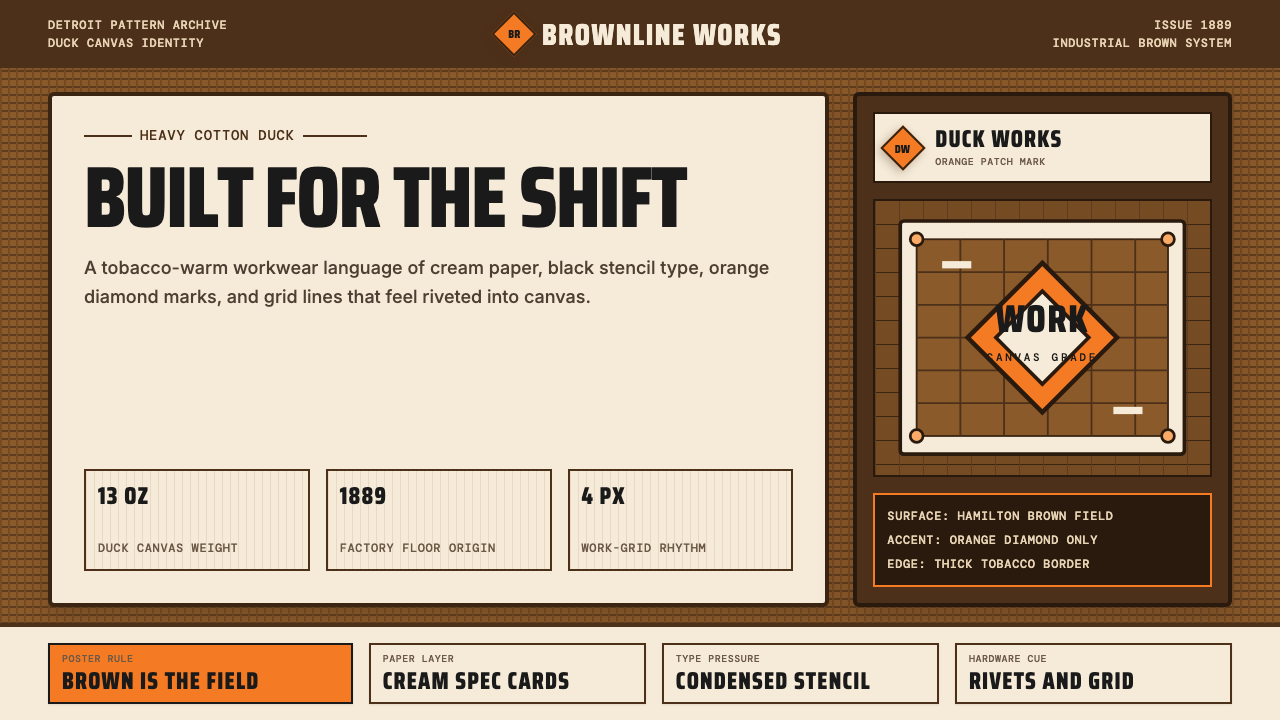
Hamilton Brown — Carhartt's tobacco-warm signature — carries the weight of duck canvas, railroad grit, and a century of American labor into every layout it touches.
Carhartt Work Jacket Brown (1889) in brief
Carhartt Work Jacket Brown is a design system rooted in the visual identity of one of America's oldest surviving workwear brands. Founded in Detroit in 1889 by Hamilton Carhartt, the company outfitted railroad workers, construction crews, oil-field roughnecks, and factory hands with garments built for durability above all else. The brand's color identity — a deep, saturated tobacco-brown paired with a vivid orange accent and a cream ground — was never designed by a studio. It emerged from material reality: the natural color of heavyweight duck canvas, the orange of railroad safety equipment, and the off-white of work shirt lining.
As a digital design language, the system translates those material facts into a visual vocabulary that feels earned rather than invented. The dominant surface is the brown of the jacket itself, dense and warm, used the way a canvas coat wraps a body — enveloping, load-bearing, protective. Against it, cream provides a breathing ground for content, and Carhartt orange functions as a single chromatic accent: bright enough to stop the eye, disciplined enough never to compete with the brown.
Typography in this system is condensed and stencil-bold, referencing the stamped lettering on industrial crates and the patch text sewn onto chore coats. Geometry favors rectilinear forms and the diamond motif drawn from the brand's iconic logo patch. Every surface, every edge, and every element carries the implied weight of cotton-duck canvas — nothing feels light, airy, or provisional. This is design that communicates reliability the way a well-worn jacket does: through accumulated material presence.

Where does Carhartt Work Jacket Brown (1889) come from?
Hamilton Carhartt arrived in Detroit in the mid-1880s with a modest amount of capital, a set of sewing machines, and a conviction that American railroad expansion represented an underserved market for durable workwear. He began by selling directly to railroad companies — not to retailers — pitching overalls and jackets he could guarantee would outlast whatever cheaper competitors offered. The brand's first major customer was the Michigan Central Railroad. By the early twentieth century, Carhartt was operating mills and factories across the United States and had expanded into Britain and France.
The brown duck canvas that became the brand's signature material was not an aesthetic choice but an engineering one. Heavyweight duck — a tightly woven plain-weave cotton fabric — resisted tearing and abrasion far better than lighter alternatives. The tobacco-brown color, which Carhartt called Hamilton Brown in honor of the founder, served partly as a practical camouflage for the oil, grease, and soil that workwear inevitably accumulates. Cream-colored lining provided a contrasting interior that showed wear and signaled when a garment needed replacement. The orange diamond patch, introduced as a brand identifier on jacket backs and chest pockets, was visible at distance on a job site and became one of the most recognized brand marks in American labor contexts.
The brand's design language remained almost entirely unchanged through the mid-twentieth century. Post-World War II industrial uniform standardization locked in what had already become convention: the brown field, the orange diamond, the condensed stencil type. Unlike fashion brands that refresh their visual identity on seasonal cycles, Carhartt treated its appearance the way it treated its garments — built once, correctly, to last. This conservatism, which might have read as stagnation in another context, instead accumulated into authority.
The late 1980s and 1990s brought an unexpected development: the workwear-as-fashion crossover. Carhartt's utilitarian identity, unchanged for nearly a century, became desirable precisely because it had never tried to be desirable. Hip-hop artists, skateboarders, and subsequently streetwear and luxury-adjacent consumers adopted the jacket for its visible authenticity — a garment that had never performed toughness because it was toughness. By the 2000s, Carhartt WIP (Work In Progress), the brand's European licensee, had built an entire parallel line around this cultural translation. The design system thus carries two inheritances simultaneously: the original industrial utility and the layered cultural authority that accrued when those utilitarian codes were read back through fashion.
What defines the Carhartt Work Jacket Brown (1889) look?
Color
The palette is built around three tones that function as distinct roles rather than decoration. Hamilton Brown — a deep, warm tobacco hue — serves as the primary surface color, used for backgrounds, large blocks, and any element that needs to feel structural and load-bearing. Cream, the color of unbleached cotton, provides the ground for readable content and brings tactile warmth without competing with the brown. Carhartt orange is the sole chromatic accent: saturated and high-visibility, reserved for calls to action, logo marks, and the diamond motif. No other colors belong to the system; every additional tone dilutes the jacket-and-patch logic.
Typography
Typefaces are condensed and structurally heavy, referencing the compressed stencil lettering stamped onto industrial packaging and the bold patch text sewn directly onto garments. Headlines are set wide and tight, commanding space the way a chore coat logo commands a chest pocket. Body text is set at a comfortable weight with generous line spacing to suggest the legibility of a printed work order rather than editorial refinement. No script, no decorative face, and no lightweight variant belongs here — every typographic choice should feel like it could be stenciled onto a crate.
Geometry
The diamond is the system's primary geometric motif, drawn directly from the Carhartt logo patch. It appears as a framing device, a section marker, a bullet stand-in, or a decorative terminal — always referencing the fabric patch rather than abstract decoration. Secondary geometry is strictly rectilinear: right angles, horizontal rules as thick as a stitch line, and rectangular blocks that evoke cut canvas panels. Curves and circles are foreign to this vocabulary; even the label patch corners are sharp. Every geometric choice should feel like something a pattern-maker or factory floor would recognize.
Texture and Surface
Unlike design systems that insist on perfectly smooth digital surfaces, Carhartt Work Jacket Brown embraces a sense of physical material — not through literal texture filters, but through compositional choices that evoke weight and grain. Large color blocks feel thick rather than flat; borders feel stitched rather than drawn; type feels stamped rather than set. The system tolerates a degree of roughness in execution that most digital styles would smooth away, because that roughness is itself part of the brand's claim to authenticity.
Contrast and Hierarchy
Hierarchy in this system is communicated through tonal contrast rather than color variety. Brown-on-cream and orange-on-brown are the two primary contrast pairs; everything else is a variation within those relationships. Headlines differ from body text through scale and weight, not color. Interactive elements are distinguished by the orange accent, not by shape change alone. The system's limited palette means that hierarchy must be established through the precision of tonal relationships — the difference between a cream that reads as background and one that reads as foreground is entirely a matter of how much brown surrounds it.
Logo and Patch Logic
The Carhartt orange diamond patch is not simply a logo — it is the system's compositional anchor. In any layout, the diamond element occupies the position that the patch occupies on a jacket: a fixed, high-recognition marker that the eye finds immediately and that establishes the identity of the entire piece. Layouts that lack a clear diamond anchor tend to feel unmoored in this system, as if the jacket is missing its label. Brand marks should be treated as structural elements, not decorative afterthoughts placed wherever space permits.
Restraint
The system's authority comes precisely from what it refuses to include. No gradients soften the transitions between brown and cream. No ambient shadows blur the edges of elements. No secondary palette introduces visual variety for its own sake. No decorative illustration lightens the tone. The orange accent is used once per composition, never twice. These refusals are not minimalism — they are the design equivalent of a garment that has exactly the pockets it needs and no more. Every absence is a decision about function.

Who shaped Carhartt Work Jacket Brown (1889)?
The founder arrived in Detroit in the mid-1880s and built his first workwear business on a simple premise: sell directly to railroad companies, not to middlemen, and guarantee that the product would outlast competitors. His decision to use heavyweight duck canvas — a material chosen for structural performance, not appearance — established the brand's material identity before any visual one existed. Hamilton Brown, the color that defines the system, bears his name directly. His insistence on industrial distribution channels rather than retail kept the brand embedded in actual labor contexts for decades, which is why its visual codes carry genuine rather than performed authority.
Edwin Faeh was the Swiss-born designer who established Carhartt's European presence in the 1980s through what became Carhartt WIP (Work In Progress), operating first as a licensed distributor and later as a creative entity with significant design autonomy. Faeh's contribution was recognizing that Carhartt's unchanged visual language — its brown, its orange, its diamond, its condensed type — was not a liability in fashion-adjacent markets but an asset. His approach preserved the original system's integrity while deploying it in contexts — streetwear, music, youth culture — where its authenticity became a form of cultural currency. The dual inheritance of the design system, both utilitarian and culturally charged, is substantially his creation.
Carhartt remained family-controlled through successive generations — an unusual fact in American manufacturing, where most comparable workwear brands were absorbed by conglomerates during the twentieth century. This continuity of ownership is directly relevant to the design system's character. Unlike brands that undergo periodic visual rebranding as ownership changes, Carhartt's identity was stewarded by people with long institutional memory and no incentive to modernize for its own sake. The visual language that emerged from Hamilton Carhartt's original material choices was never subjected to the kind of design-agency rationalization that tends to soften, lighten, and render brands more broadly palatable. The family's conservatism is structurally encoded in the system's density and refusal of compromise.
From its base in Regensburg, Germany, the Carhartt WIP creative direction — operating under license but with genuine design latitude — has been responsible for translating the original industrial system into contexts far removed from its railroad origins. WIP's lookbooks, retail environments, and collaborations with artists and musicians demonstrated that the visual system was robust enough to operate across a wide tonal range without losing its core identity. The condensed type could anchor a skate zine as readily as a worksite supply catalog; the brown-and-orange palette held its authority in a Berlin concept store as clearly as on a Michigan factory floor. WIP's work proved that the system's power was structural, not contextual.
How do you use Carhartt Work Jacket Brown (1889) today?
Carhartt Work Jacket Brown is one of the more demanding historical systems to apply correctly in digital work, because its authority depends on consistency of density rather than visual variety. The temptation is to soften it — to introduce a lighter brown, a more muted orange, a rounded corner here and there — and each individual softening seems reasonable. Collectively, those compromises remove the very quality that makes the system distinctive. Apply it fully or reconsider the choice.
For presentation slides, the system works best when the brown is committed to as a full-bleed surface on cover slides rather than used as an accent or header bar. A cover benefits from a bold, asymmetric composition: the orange diamond anchoring one quadrant, the title in condensed heavy type against the brown, and no more than one secondary element in cream. Content slides should treat the cream ground as the primary surface, with brown used only for structural blocks — a sidebar, a header band, a footer rule — and orange reserved exclusively for the single most important call-out per slide. Data slides work well in this system because the restricted palette forces clarity: bars are brown or orange, backgrounds are cream, and labels are dark enough to read without a legend.
For web interfaces — dashboards, pricing pages, tool UIs — the system performs best when the brown is used for navigation, sidebar, or header zones that need to feel fixed and structural, with cream as the primary content surface. Card components should have visible, heavy borders rather than soft shadows; the border communicates stitch-line construction rather than digital floating. Pricing tiers work well with the orange accent marking the recommended or featured option. Interactive states — hover, focus, active — should shift to orange on brown or brown on orange, maintaining the two-color discipline. Do not introduce any additional accent colors for alert states or secondary actions; use tonal shifts within the existing palette instead.
For editorial and marketing work, the system's poster-like density suits full-width feature sections where a strong visual statement is required. A Carhartt-derived editorial layout uses the brown as a full-bleed section background for feature blocks, cream for body text sections, and orange used once per section as a pull quote background or section label. Marketing pages benefit from the alternation of brown-surface and cream-surface sections with consistent typographic treatment across both: same condensed headline type, same weight hierarchy, different ground color. The orange diamond used as a section break or decorative terminal ties the composition back to its source.
A common mistake is using the orange accent too frequently, treating it as a general highlight color rather than a high-value signal reserved for the single most important element per layout. When orange appears on every interactive element, every section header, and every pull quote simultaneously, it loses its stop-sign function entirely — the eye has nowhere to go. The correct discipline is closer to the original patch: one orange element per composition, used where it would be sewn onto a jacket. A related mistake is introducing warm grays or mid-browns as intermediary tones to ease transitions between the system's three values. Intermediary tones dilute the contrast that gives the system its weight; the transitions should be direct, the way canvas meets thread rather than fading into each other.

Carhartt Work Jacket Brown (1889) — FAQ
How is this system different from general earth-tone or brown palettes?
Most earth-tone palettes use brown as one tone among many — paired with sage, terracotta, warm gray, or sand to create a layered naturalistic feeling. Carhartt Work Jacket Brown uses brown as the dominant structural surface, cream as a single contrast ground, and orange as a single chromatic accent. The system has exactly three values, and each has a fixed role. The result is not naturalistic warmth but industrial authority. If your reference palette has more than three tones, or if the brown is warm and yielding rather than deep and saturated, you are building something adjacent to this system but not this system.
Can the system work on a dark or black background?
The system's canonical ground is either the brown itself or the cream — not black or near-black. A dark inversion is possible but requires significant adjustment. On a black ground, Hamilton Brown reads as a mid-tone accent rather than a dominant surface, which inverts the system's fundamental logic. If a dark mode is required, the most workable approach is to darken the brown further — toward near-black with a warm undertone — and use cream for body text, with orange retained as the accent. The system's identity will survive this if the diamond and condensed type are maintained; it will not survive if a neutral cool dark replaces the warm-toned ground.
Is this style appropriate for digital products aimed at a general consumer audience?
The system works best for products where heaviness, durability, and no-nonsense authority are desired values: professional tools, B2B platforms, outdoor and workwear commerce, logistics and supply chain applications, and any product positioning itself as built rather than designed. It is poorly suited to consumer contexts that require warmth, approachability, or sensory delight — food delivery apps, children's products, wellness platforms, social networks. The style communicates a specific value proposition that must match the product's actual positioning. Using it on a product that needs to feel gentle, playful, or inviting will create a friction the user will feel but not be able to name.
How should the orange be used to avoid it looking generic or accidental?
The orange works only when it is used with the same logic that governs the placement of the patch on the jacket: in a fixed, predictable position that the eye learns to seek out. In a slide deck, that means the same quadrant every slide. In a web interface, that means the same element type — the primary action button, the tier badge, the logo mark. In an editorial layout, that means one designated role per composition — section label or pull quote, not both. When orange appears in a different position or role each time it is used, it loses its reference to the patch and becomes an arbitrary highlight color indistinguishable from any other system's use of orange. The patch is always in the same place on the jacket; the orange should always be in the same role in the layout.
What makes this system feel authentic versus a generic vintage-brown aesthetic?
Generic vintage-brown aesthetics typically layer multiple warm tones, introduce aged textures or distressed finishes, use serif or hand-drawn type to signal heritage, and deploy warm amber tones that feel nostalgic rather than industrial. Carhartt Work Jacket Brown does none of these things. Its brown is not aged or distressed — it is the actual color of new duck canvas, dense and solid. Its type is condensed and mechanical, not rustic or calligraphic. Its geometry is rectilinear and diamond-sharp, not organic or hand-crafted in feel. The system feels authentic because it references a specific object — the chore coat — with material precision rather than nostalgic suggestion. Authenticity here is a matter of specificity: if the visual choices could be equally attributed to any number of vintage or heritage brands, the system has drifted into generic territory.
Related design styles
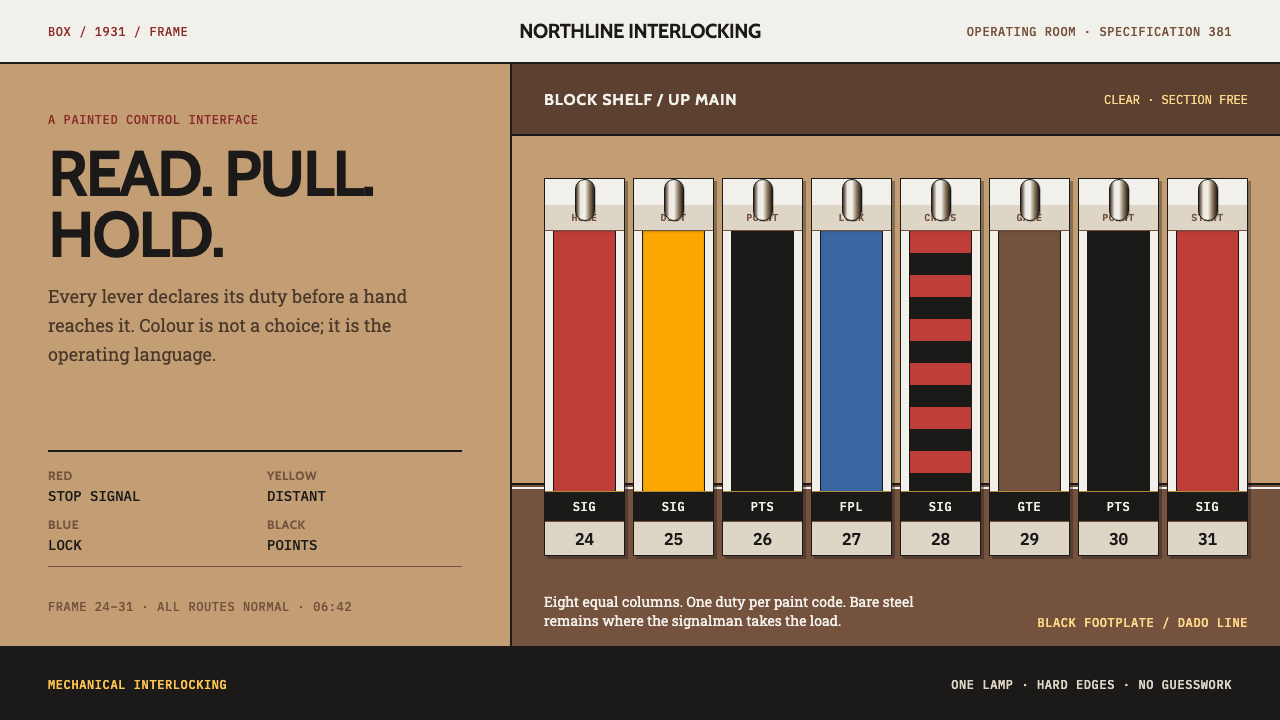 Signal Box Lever FrameColour carries consequence. Red, yellow and blue levers stand in a hard-ruled…
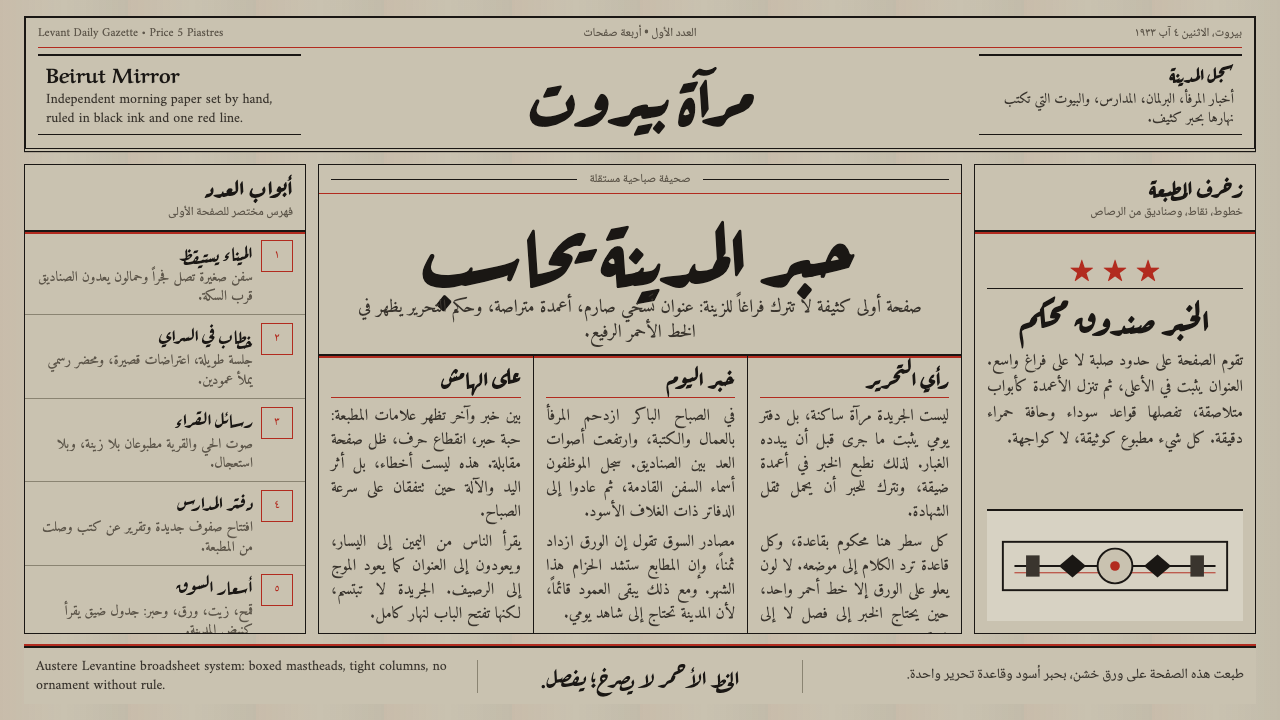 An-Nahar Beirut PressDense authority. Aged newsprint, black naskh columns, and one red rule hold t…
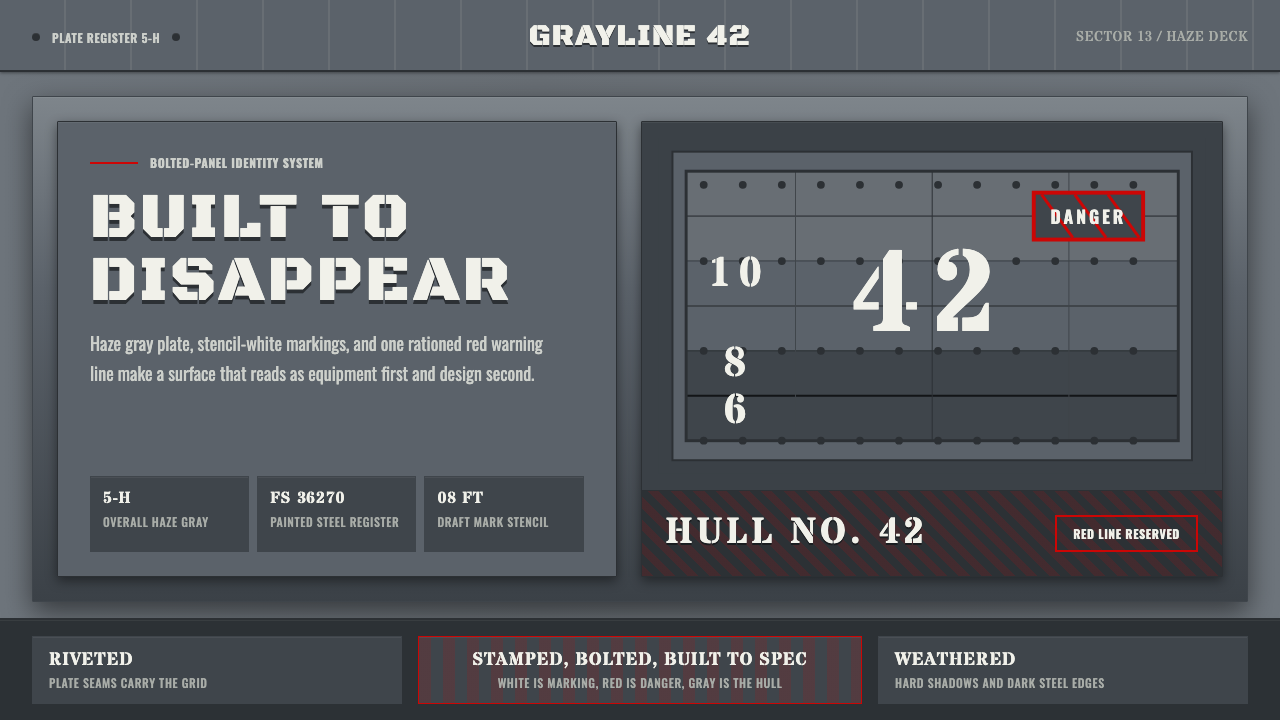 Battleship Naval GrayBuilt to spec. Haze gray steel, rivet grids, stencil white, and one danger-re…
 Caterpillar Construction Yellow (1925)Maximum visibility, zero softness. 109 yellow ground and black slab type.
 Fire Brigade ShieldEarned civic armor. Gold leaf numerals, fire-red borders, black leather symme…
 Ordnance Survey One-InchPrecision has a paper trail. Buff margins, red contours and engraved black ru…