What is Cairo Downtown Art Deco?
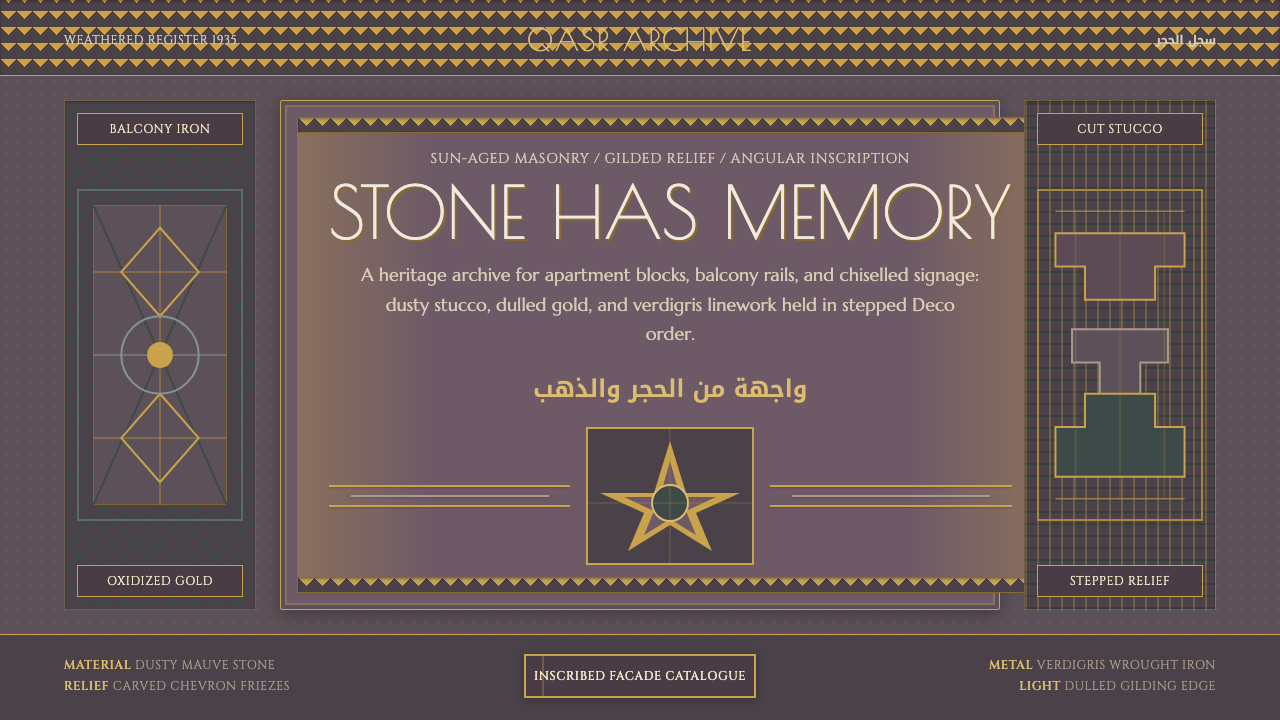
Cairo Downtown Art Deco is built from the weathered stone and gilded ironwork of 1930s khedival Cairo — glamour with real dust and real age on it.
Cairo Downtown Art Deco in brief
Cairo Downtown Art Deco is a design system distilled from the apartment blocks built during the 1930s in khedival downtown Cairo — the planned, European-influenced district at the heart of the city, developed under the khedives and expanded through a building boom that produced landmark structures like the Yacoubian Building on Mazloum Street in 1937. These were residential and commercial buildings clad in stone and stucco, decorated with gilded wrought-iron balconies and zig-zag relief friezes running along their facades.
The defining choice this system makes is to treat that surface as it actually exists today, not as it looked on opening day: a dusty, mauve-grey limestone-and-stucco ground, worn by nearly a century of Cairo sun and city dust, rather than a clean, freshly rendered surface. Gilding gold, deep mauve shadow, and a weathered verdigris green — the color bronze and iron turn as they age outdoors — sit on top of that ground as the system's accent colors, standing in for the gilded ironwork and oxidized metal details that survive on these buildings today.
Typographically and ornamentally, the system pairs three registers at once: geometric Art Deco display lettering for headline moments, inscriptional incised capitals for a more architectural, carved-in-stone feel, and geometric Kufi Arabic signage for bilingual or Arabic-language content. All three share the same angular, stepped geometry, so Latin and Arabic lettering read as part of one consistent system rather than two unrelated typographic worlds bolted together.
Where does Cairo Downtown Art Deco come from?
Downtown Cairo — the district built under the khedives from the mid-19th century onward and expanded through the early 20th — was laid out with wide boulevards and European-style apartment blocks, deliberately modeled on the planned boulevards of European capitals as part of a modernizing push. By the 1930s, that district was absorbing the era's dominant international style, Art Deco, into its residential architecture, producing a wave of apartment buildings that combined European Deco vocabulary with local materials and, often, Arabic lettering on shopfronts and building signage.
The Yacoubian Building at 1 Mazloum Street, completed in 1937, stands as this period's best-known landmark — a residential block whose gilded wrought-iron balconies and geometric relief ornament made it, and buildings like it, the visual signature of khedival downtown's Deco boom. Deco architecture in Cairo was shaped substantially by French-influenced architects working in the city at the time, who brought European Deco vocabulary — geometric massing, stepped forms, stylized ornament — and adapted it to Cairo's climate, materials, and street patterns.
What distinguishes this Cairo building stock from Deco architecture elsewhere is exactly what this design system chooses to foreground: the material is real limestone and stucco, not a rendering of limestone, and nearly a century of desert sun, urban dust, and uneven maintenance has left it dusty, mauve-toned, and unevenly weathered rather than crisp and white. The gilded ironwork on balconies has tarnished in places to a verdigris green, and incised stone lettering has softened at its edges — all of it still legible, still elegant, but visibly aged.
This system treats khedival downtown urbanism — the wider tradition of planned, European-influenced city-building that produced this district — as inseparable from the Art Deco style layered onto it. The building boom of the 1930s wasn't decoration applied to a blank canvas; it was ornament applied to an already-established, already-aging urban fabric, and that layered history — European planning, Deco style, Cairo weather, and Arabic-Latin bilingual signage — is what the design system reconstructs.
That layering also explains why the district's Deco never looks quite like Deco anywhere else. A boulevard building in downtown Cairo carries French-style ironwork balustrades, geometric relief patterns imported from the same design language circulating through Paris and New York at the time, and shopfront lettering in Arabic naskh or geometric Kufi script beneath or beside the building's Latin signage. None of these elements were added as an afterthought; they were built into the district from the start as a working, bilingual commercial streetscape, and it is that lived-in, layered condition — not a stylized period reconstruction — that this design system is trying to preserve.
What defines the Cairo Downtown Art Deco look?
Color
The ground is a dusty, mauve-grey stone tone, never crisp white or freshly rendered. Gilding gold marks ironwork and ornament, deep mauve carries shadow, and a weathered verdigris green stands in for oxidized bronze and iron — a palette read directly off aged material rather than an idealized Deco showroom color scheme.
Weathered Surface
Texture reads as genuinely aged limestone and stucco — worn, uneven, sun-bleached in places — rather than a smooth, evenly applied surface. The imperfection is structural to the system, not a filter laid over a clean design; a crisp, unweathered version would misrepresent the source entirely.
Ironwork Ornament
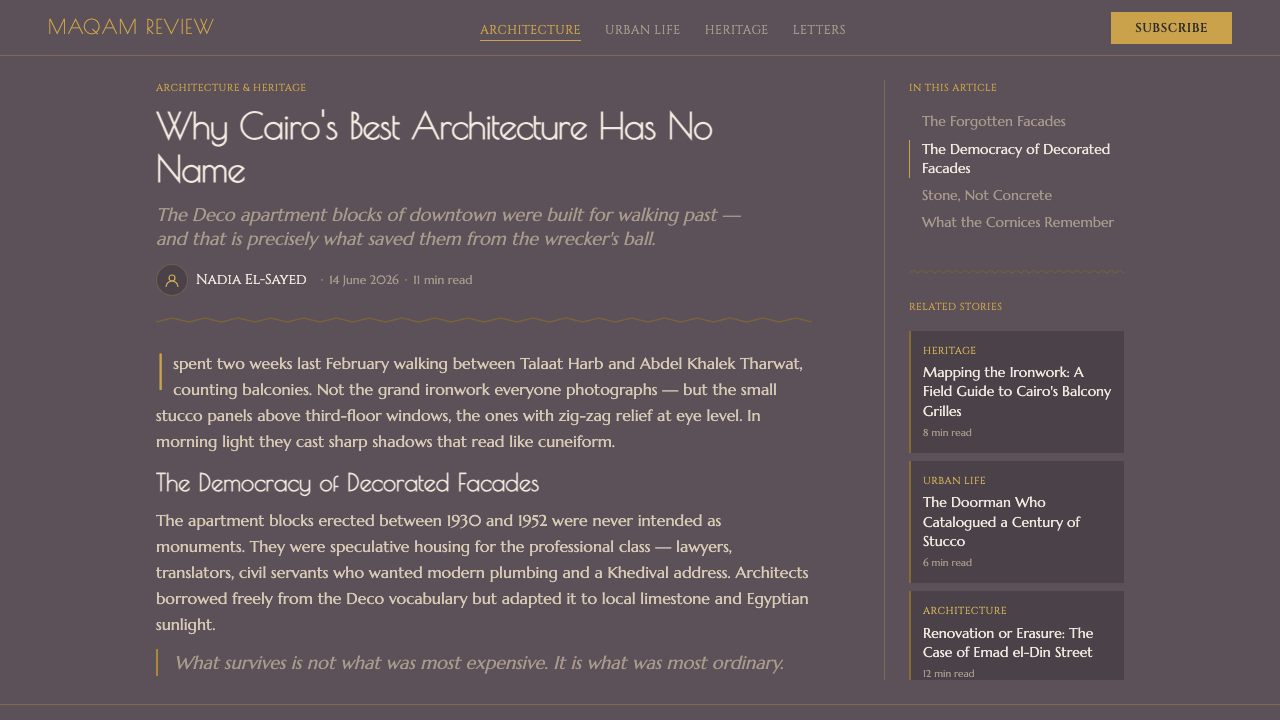
Zig-zag relief friezes and wrought-iron balcony grille patterns supply the system's geometric motif source. Ornament repeats in angular, stepped sequences rather than curving or flowing lines, drawing directly on the balcony grillwork found on buildings like the Yacoubian.
Typography Layering
Geometric Deco display lettering, inscriptional incised capitals, and geometric Kufi Arabic signage all share the same stepped, angular geometry, letting Latin and Arabic lettering sit side by side as visual equals rather than one language treated as a secondary translation.
Stepped Geometry
Massing and ornament are built from setbacks, steps, and zig-zags rather than smooth curves — the architectural Deco vocabulary of stepped facades and terraced forms translated directly into flat layout structure, panel divisions, and border treatments.
Bilingual Signage Logic
Content is composed to hold Latin and Arabic lettering side by side at equal visual weight, following the era's actual shopfront and building-signage convention, rather than treating Arabic as a smaller secondary label beneath a dominant Latin headline.

Who shaped Cairo Downtown Art Deco?
This collective of architects, working in Cairo during the 1930s building boom, brought European Art Deco vocabulary — geometric massing, stepped forms, stylized ornament — into the city and adapted it to local material, climate, and street pattern, producing the specific Cairo-inflected Deco this system draws from.
Completed in 1937 in khedival downtown Cairo, the Yacoubian Building is the era's best-known landmark, its gilded ironwork balconies and geometric relief friezes standing as the visual signature this system draws its ornament and weathering from.
The broader international Art Deco movement supplied the geometric, stepped, ornamental vocabulary that khedival downtown Cairo absorbed and localized during the 1930s building boom, giving this system its underlying formal grammar.
This is the wider tradition of planned, European-influenced city-building that produced downtown Cairo's boulevards and apartment blocks in the first place — the urban framework that the Art Deco building boom of the 1930s was layered onto, rather than a separate style applied to a blank site.
How do you use Cairo Downtown Art Deco today?
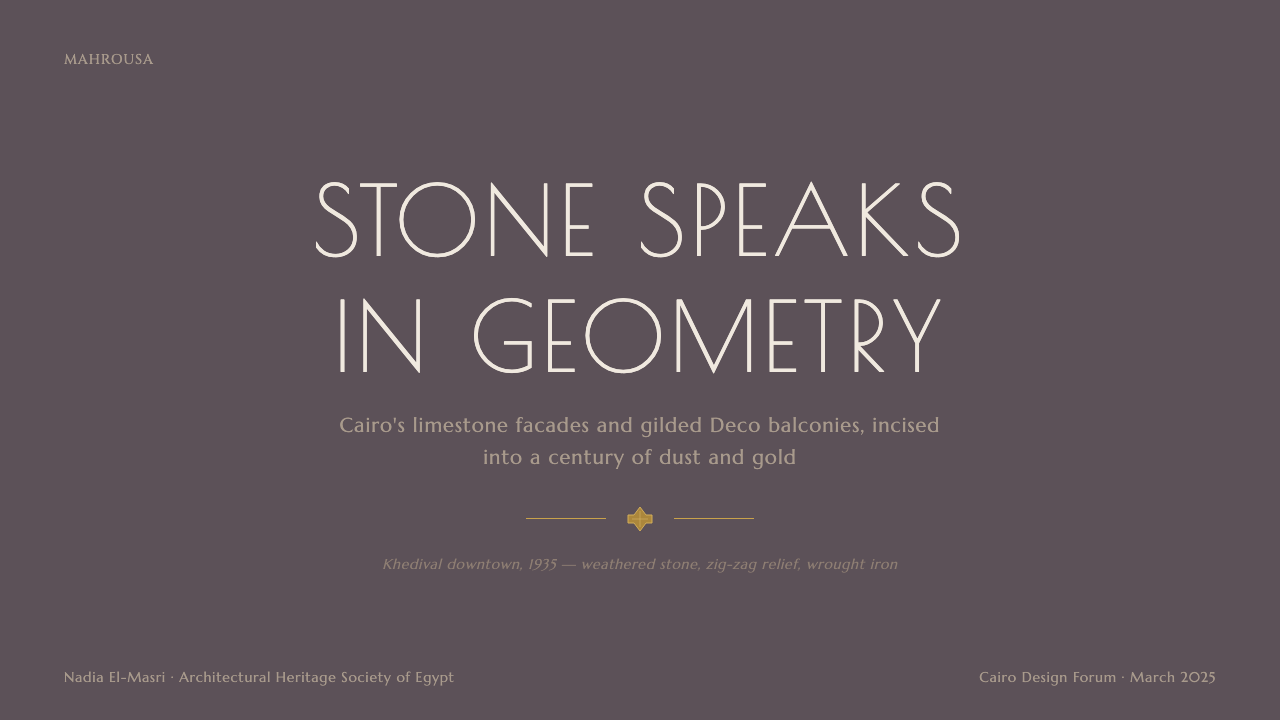
On a presentation cover, this system rewards a full-bleed treatment of the weathered mauve-grey stone ground, with a gilding-gold title framed by a stepped or zig-zag border motif that echoes the balcony ironwork, and verdigris used sparingly as a secondary accent along an edge or corner rather than spread evenly across the frame.
Content and data slides should keep the weathered stone texture at the margins or as a frame, leaving the content area calmer and more legible. Data bars and charts read well with gilding gold as the highlight color for the standout figure and verdigris as a secondary category color, with panel divisions and chart frames built from the same stepped, angular geometry as the ornament rather than soft rounded corners.
In web interfaces, this system suits heritage, luxury, hospitality, and cultural brands — boutique hotels, museums, high-end real estate, regional tourism platforms. Card borders can carry an incised-stone frame treatment, a featured tier or listing can be marked with a gilding-gold line rather than a solid fill, and layouts should be built bilingual-ready from the start, holding Latin and Arabic content at equal visual weight rather than treating one as an afterthought.
In editorial and marketing work, full-width panels of weathered mauve-stone texture behind a headline, pull-quotes framed like a carved stone plaque, and gilding gold reserved consistently for calls to action all suit heritage tourism writing, architecture and design editorial, and luxury real estate marketing well. The style photographs convincingly precisely because it doesn't try to look clean — a slightly worn, dusty texture is the point, not a flaw to correct.
A common mistake is cleaning the texture up into a crisp, unweathered geometric Deco look — that produces a generic international Deco style and erases the specific, real-Cairo identity this system is built on. A second common mistake is treating the Arabic Kufi signage as decorative filler rather than co-equal content; the system's bilingual logic only works when both scripts carry comparable size, weight, and prominence.
Cairo Downtown Art Deco — FAQ
What makes this different from generic Art Deco?
Generic Art Deco tends toward a clean, idealized presentation — crisp geometry, unweathered surfaces, often a black-and-gold palette drawn from showroom or poster references. This system instead models a specific, real building stock as it exists today: dusty mauve-grey stone, tarnished verdigris ironwork, and a bilingual Latin-Kufi Arabic signage convention drawn from an actual downtown Cairo streetscape rather than an idealized Deco archetype.
Is the Yacoubian Building a real place?
Yes — it is a real residential building at 1 Mazloum Street in downtown Cairo, completed in 1937, and it is widely cited as one of the most recognizable examples of the city's 1930s Deco apartment-block architecture, with gilded wrought-iron balconies and geometric relief ornament typical of the period.
Does the layout need Arabic text to work?
No — the stepped geometry, weathered stone palette, and gilding accents all function on their own in a Latin-only layout. But the system is designed with bilingual content in mind from the start, and it holds up best when Arabic Kufi signage is treated as a co-equal typographic register rather than added later as an afterthought.
Why mauve and verdigris instead of the black-and-gold most people associate with Art Deco?
Because this system is grounded in what the actual buildings look like today rather than an idealized showroom palette. Nearly a century of Cairo weather has turned the stone dusty mauve-grey and oxidized the ironwork toward verdigris green; those are observed material colors, not a stylized reinterpretation, and they are what give this system its specific, place-based identity rather than a generic Deco look.
What kinds of brands or products suit this aesthetic?
Heritage hospitality and boutique hotels, museums and cultural institutions, high-end regional real estate, tourism content about the Middle East and North Africa, and any brand that wants to project old-world glamour with a specific, verifiable sense of place rather than a generic vintage aesthetic. It suits editorial and marketing contexts more naturally than fast, high-density product interfaces.
Related design styles
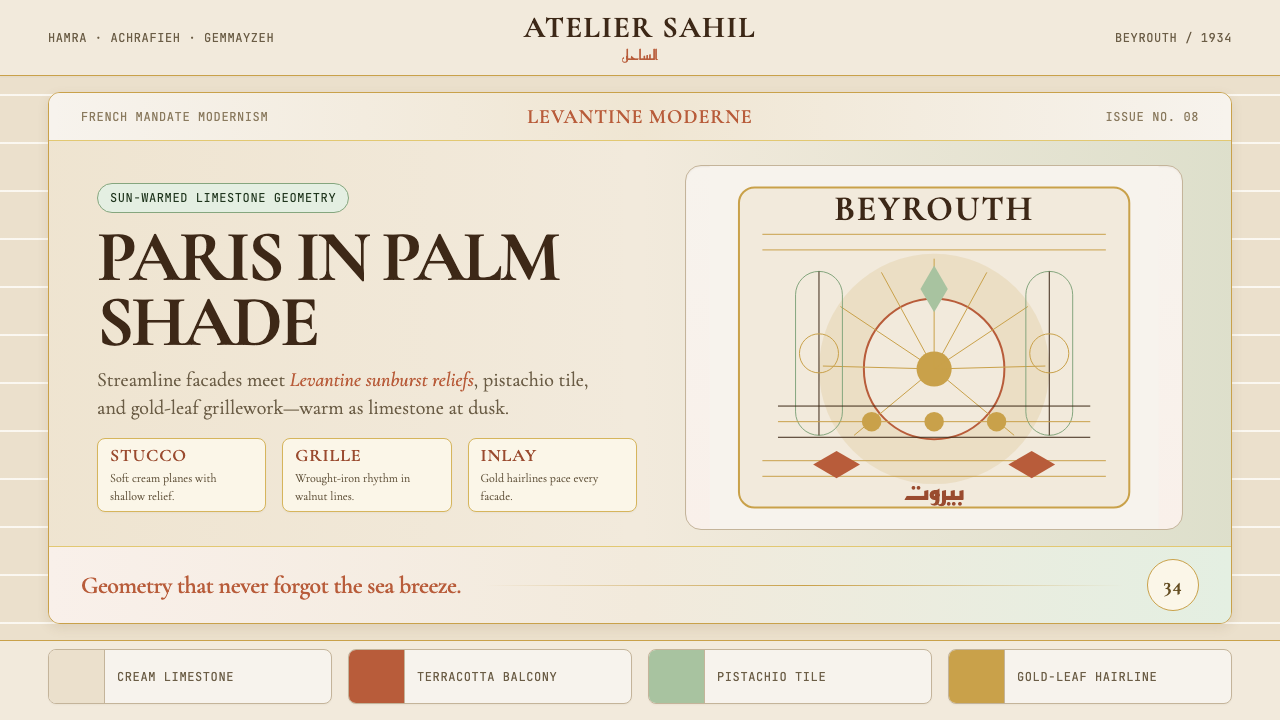 Lebanese Art Deco (Beirut)Cosmopolitan warmth. Cormorant friezes, gold hairlines, terracotta-pistachio…
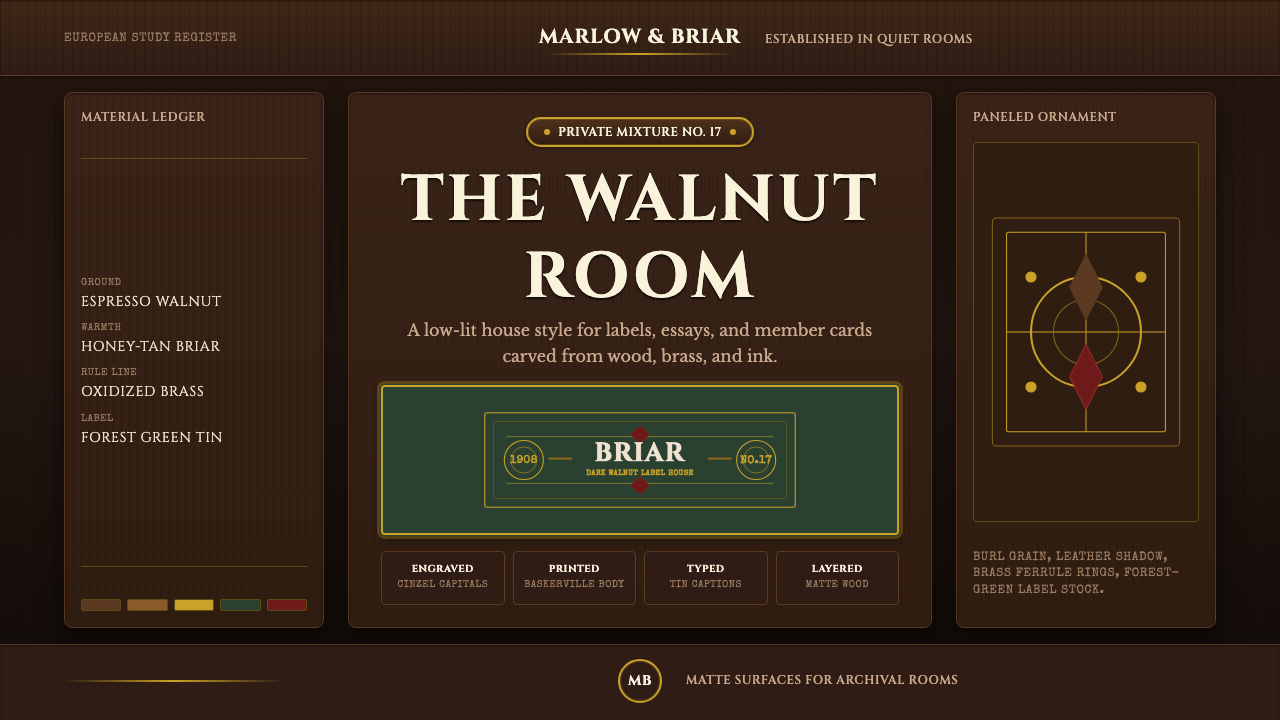 Briar Pipe & TobaccoWarm gloom, precisely aged. Brass rules and Cinzel capitals sit on espresso w…
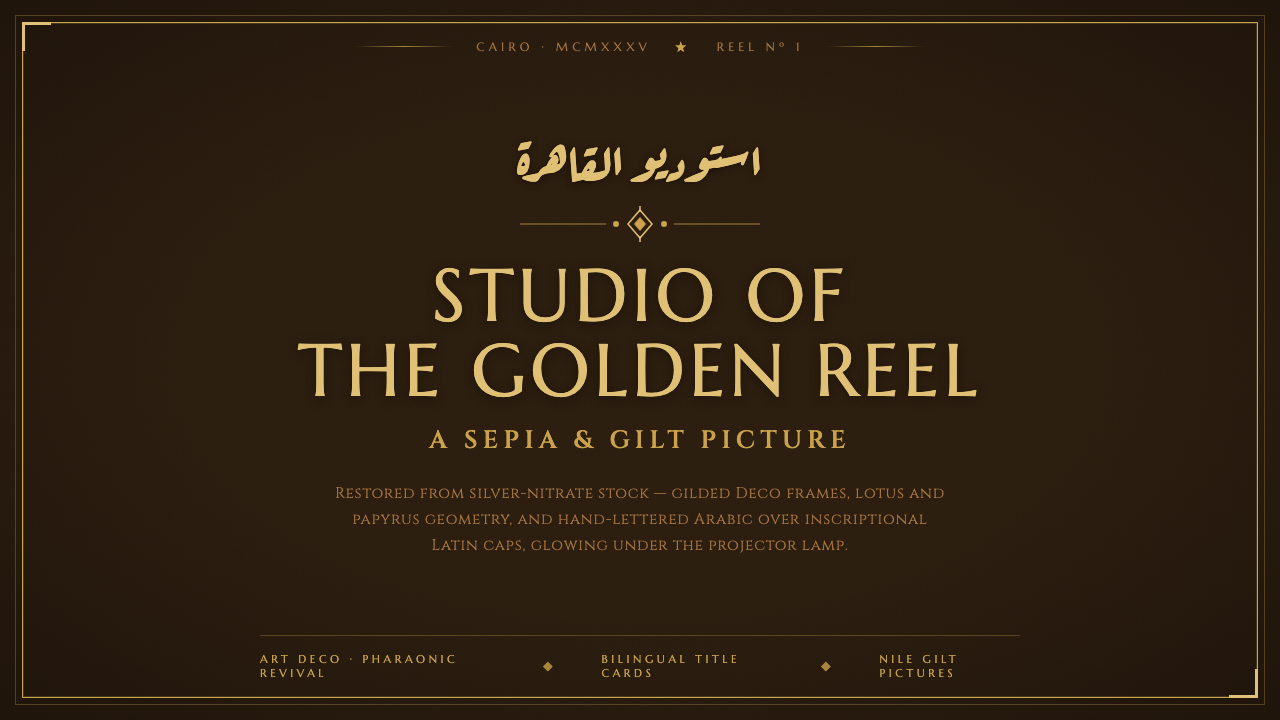 Studio Misr CairoEgyptian cinema's golden age, gilded. Silver-nitrate brown, Deco gold frames,…
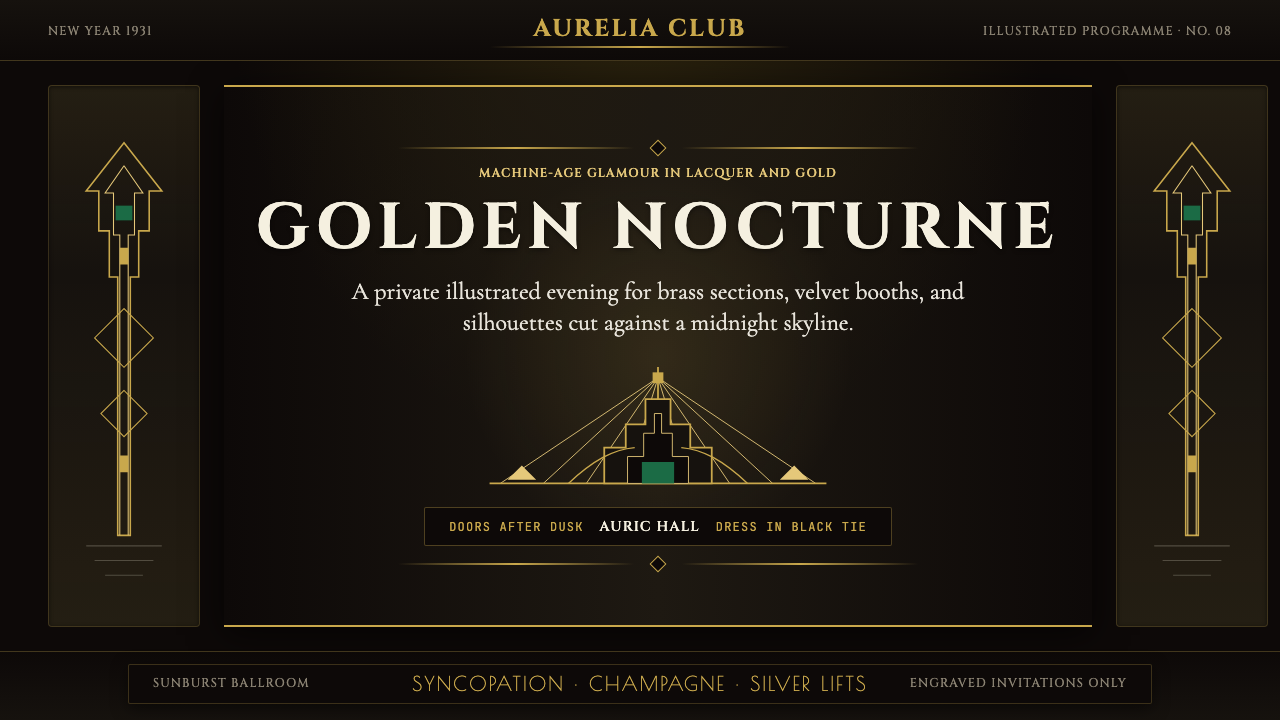 Art Deco Jazz AgeJazz Age glamour. Sunburst rays, stepped ziggurats, gold on black — Chrysler…
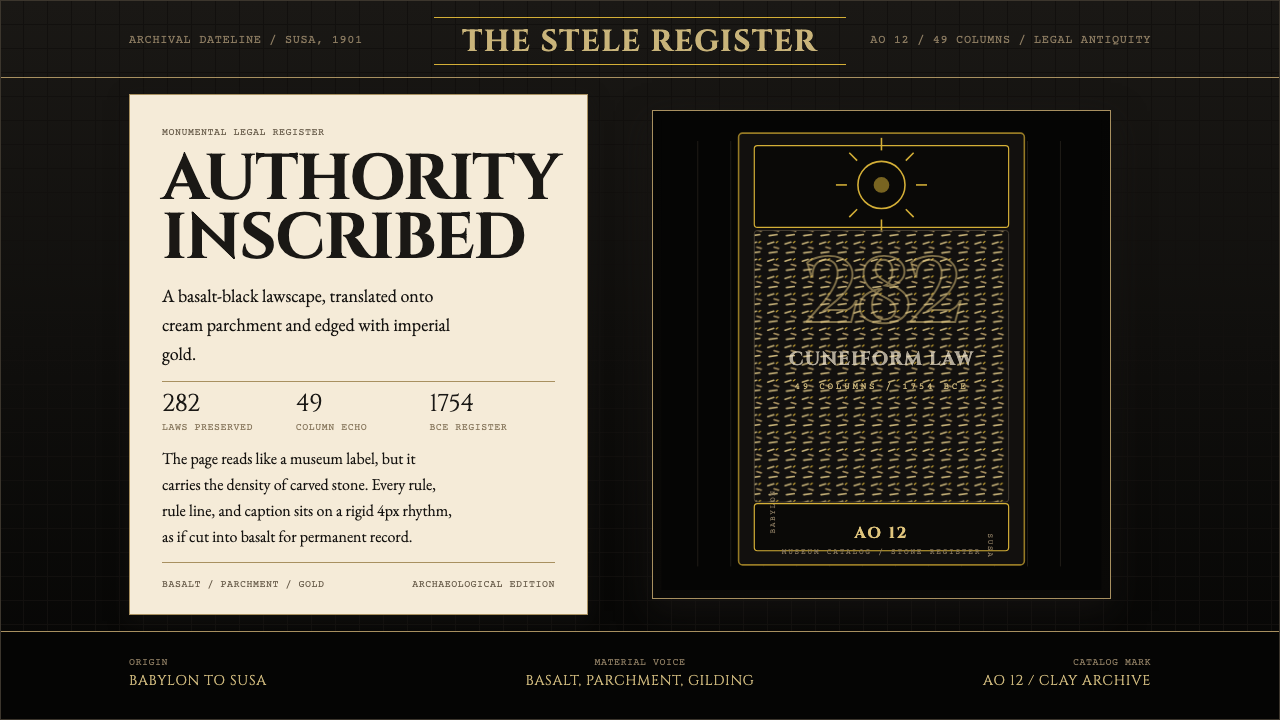 Babylonian Hammurabi SteleAuthority carved in stone. Basalt-black grids, parchment panels, and imperial…
 Dior New Look (1947)Couture speaks softly. Cream ground, navy Didot capitals, and gold hairlines…