What is Burmese Shan Lacquer Brown?
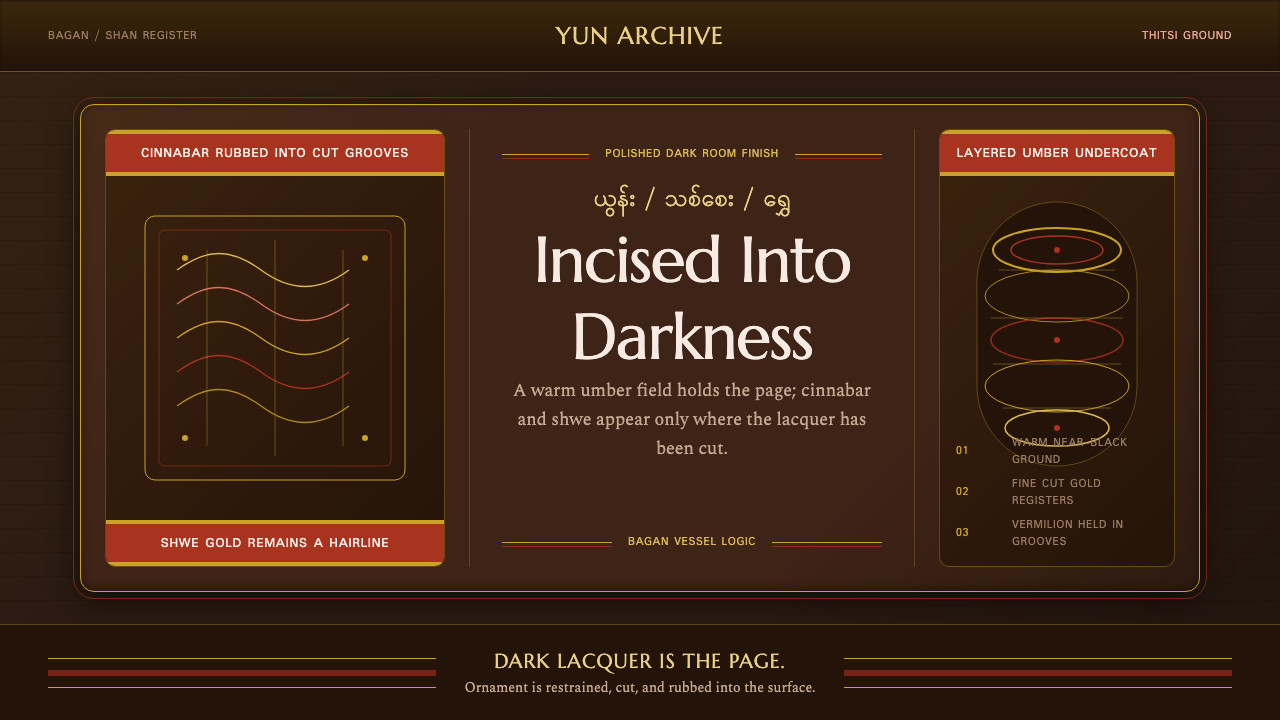
Burmese yun lacquerware is drawing scratched into liquid darkness: a woven-bamboo vessel drowned in glossy umber-brown resin, then incised — never painted — with fine linework and bands of cinnabar red and gold.
Burmese Shan Lacquer Brown in brief
Burmese yun lacquerware begins not with wood or metal but with a vessel woven from fine strips of bamboo, sometimes reinforced with horsehair, which is then primed with a paste of ash and coated, layer upon layer, with thitsi — the sap of a native lacquer tree. Each coat is left to cure and is polished before the next is applied, and as the sap oxidizes and dries it darkens into a deep, glossy umber-brown, verging on black, that becomes the object's base color rather than a surface finish applied over something paler.
Decoration is not painted onto this dark ground — it is incised into it. A craftsman uses a fine metal stylus to scratch a design directly through the top layers of cured lacquer, and pigment is then worked into those incised grooves so the pattern sits physically below the surface rather than sitting on top of it. This technique, called yun, is what gives the tradition its name and its defining visual signature: linework so fine and so consistent it can only be produced by a practiced hand working directly into resin.
The signature accent colors are a bright cinnabar-vermilion red and an incised gold known as shwe, both used as bands or fine linework against the dark ground rather than as broad fields of color. The result is glossy, layered, and precise: a warm near-black surface with a wet-looking sheen, cut through by thin, deliberate red-and-gold detailing that never overwhelms the dark field it sits within.
Where does Burmese Shan Lacquer Brown come from?
Lacquerware has a long history across Buddhist Southeast Asia, and Burmese lacquer craft is generally understood to have developed through centuries of contact with neighboring lacquer traditions before settling into the distinctly Burmese forms — including yun incising — that are well documented from the early twentieth century onward. The city of Bagan, already renowned for its dense field of medieval Buddhist temples, became and remains the country's principal center of lacquerware production, with the nearby Shan States supplying much of the fine bamboo weaving used for vessel cores.
The core material discipline behind yun lacquerware is agricultural and artisanal at once: thitsi sap is tapped from a native lacquer tree and refined before use, while bamboo strips are woven, sometimes with horsehair reinforcement, into vessel shapes light enough to be practical and flexible enough to survive repeated coats of resin without cracking. Multiple thin coats of lacquer, each cured and polished before the next is applied, build up the deep, glossy undercoat that the incised decoration is later cut into — a process that can take weeks per piece even before any decorative work begins.
Among the several decorative techniques used on Burmese lacquerware, yun incising is generally regarded as the most demanding and most prestigious, since the pattern is cut freehand into cured resin rather than painted or stamped, leaving no room to correct a mistake once the stylus has cut the surface. The cinnabar-red and incised-gold (shwe) palette documented on Bagan and Shan yun ware in this period became strongly associated with the technique's highest-quality output, distinguishing it from other Burmese lacquer traditions that favor brighter, multicolor palettes.
The craft has continued as a living tradition into the present, transmitted through workshop apprenticeship in Bagan rather than formal academic training, with makers producing both traditional ritual and domestic vessels and pieces for a broader collector and tourism market. Its documented history through the first half of the twentieth century is treated by craft historians as the clearest record of yun technique at its most refined, even as the underlying practice of Burmese lacquer-making reaches back considerably further.
What defines the Burmese Shan Lacquer Brown look?
Umber-Brown Ground
The dark, near-black brown of cured thitsi lacquer is the object's actual base material, not a finish applied over something lighter. It should be treated as warm rather than cool — closer to dark tea or aged wood than to charcoal or ink — and always paired with real gloss rather than a matte or chalky surface.
Glossy Layered Sheen
The surface shine comes from many thin coats of lacquer built up and polished one at a time, which gives the finish a wet, almost liquid depth rather than a single flat coat of gloss varnish. A design drawing on this tradition should aim for that sense of accumulated depth — light seeming to sink into the surface rather than simply bouncing off it.
Incised Linework (Yun)
The defining decorative technique is not painting but incising: fine lines are scratched directly into the cured lacquer and then filled with pigment, so the pattern sits physically below the gloss surface rather than raised or printed on top of it. Linework in this tradition should read as precise, continuous, and hand-cut, never as a soft brushstroke.
Cinnabar Red Banding
Bright cinnabar-vermilion appears as bands, borders, or fine incised linework rather than as a large field of color, giving the dark ground a controlled jolt of warmth. It is used the way a single ribbon marks a much larger dark surface — a precise accent, never a dominant background choice.
Incised Gold (Shwe)
Gold, worked into incised grooves in the same manner as the linework, appears as fine hairline detail rather than filled or block-colored areas. Its role is to catch light along a thin, deliberate path across the dark ground, functioning closer to a drawn line than to a metallic surface treatment.
Woven Silhouette
Because many finished forms began as a woven bamboo core, the underlying silhouette tends toward light, rounded, basket-like profiles rather than heavy or rectilinear shapes — a curved bowl or box form even once fully coated and rigid with lacquer. Compositions can echo that woven origin with subtle curvature or radial structure rather than hard right angles.
Who shaped Burmese Shan Lacquer Brown?
The most senior lacquer craftsmen — those who cut the final incised linework freehand into cured resin — hold the highest-status role in the craft's traditional hierarchy, since yun incising allows no correction once the stylus has scored the surface. Their skill is judged on the fineness, continuity, and confidence of a single unbroken line.
Craftsmen in the Shan States supply the fine woven bamboo — sometimes reinforced with horsehair — that forms the structural core of many lacquer vessels, a separate specialized skill from the lacquer application and incising stages that follow. The quality of this initial weave determines how well the finished object will survive years of handling.
Beyond the master carvers, a broader community of incising artisans works across the stages of pigment-filling and polishing that follow the initial cut, refining a scratched design into the crisp, filled linework that defines finished yun ware — a collaborative production process rather than the work of a single hand.
As the country's principal lacquerware center, Bagan's workshops organize the full production chain — weaving, priming, layered lacquering, and incising — under one roof, and remain the primary place the yun tradition is taught today, largely through hands-on apprenticeship rather than formal schooling.
How do you use Burmese Shan Lacquer Brown today?
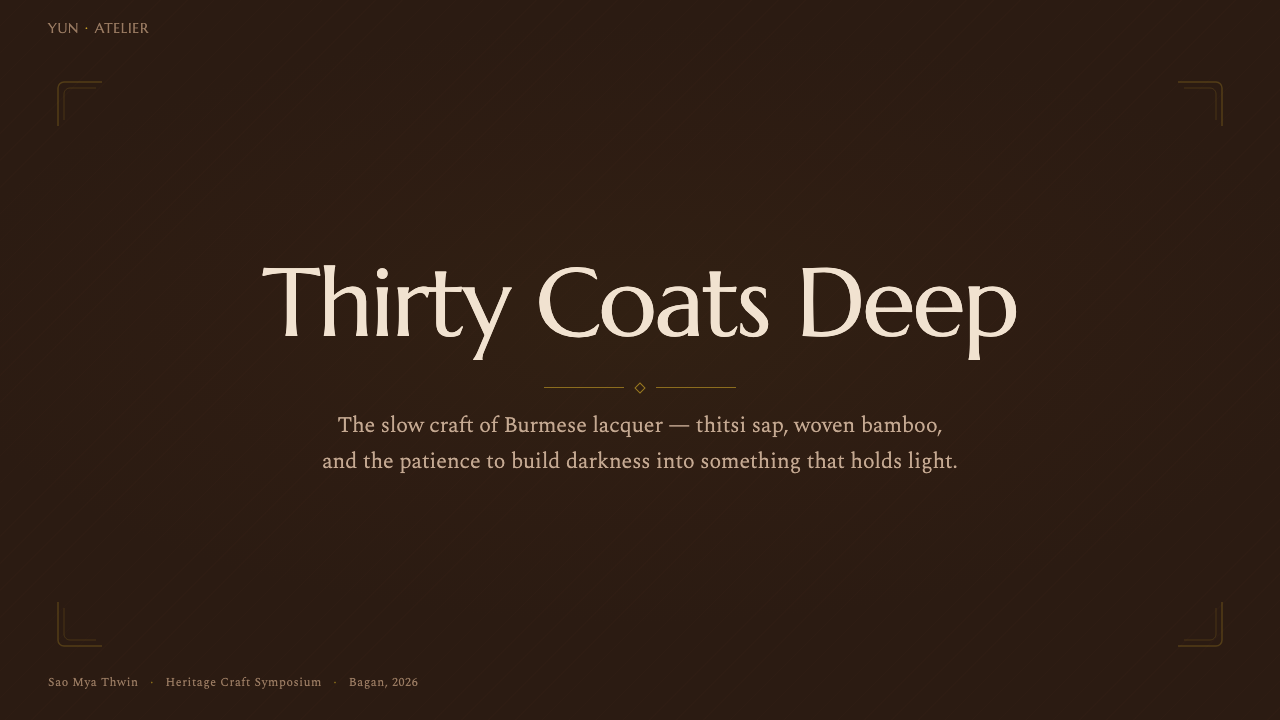
A cover slide built on this palette should lean fully into the glossy dark ground, letting a single fine line — in cinnabar red or incised gold — trace a wordmark or a simple curved motif rather than filling a large shape. The effect should feel precise and a little precious, evocative of a handmade object rather than a mass-produced one, which suits decks about craftsmanship, travel, hospitality, or boutique products.
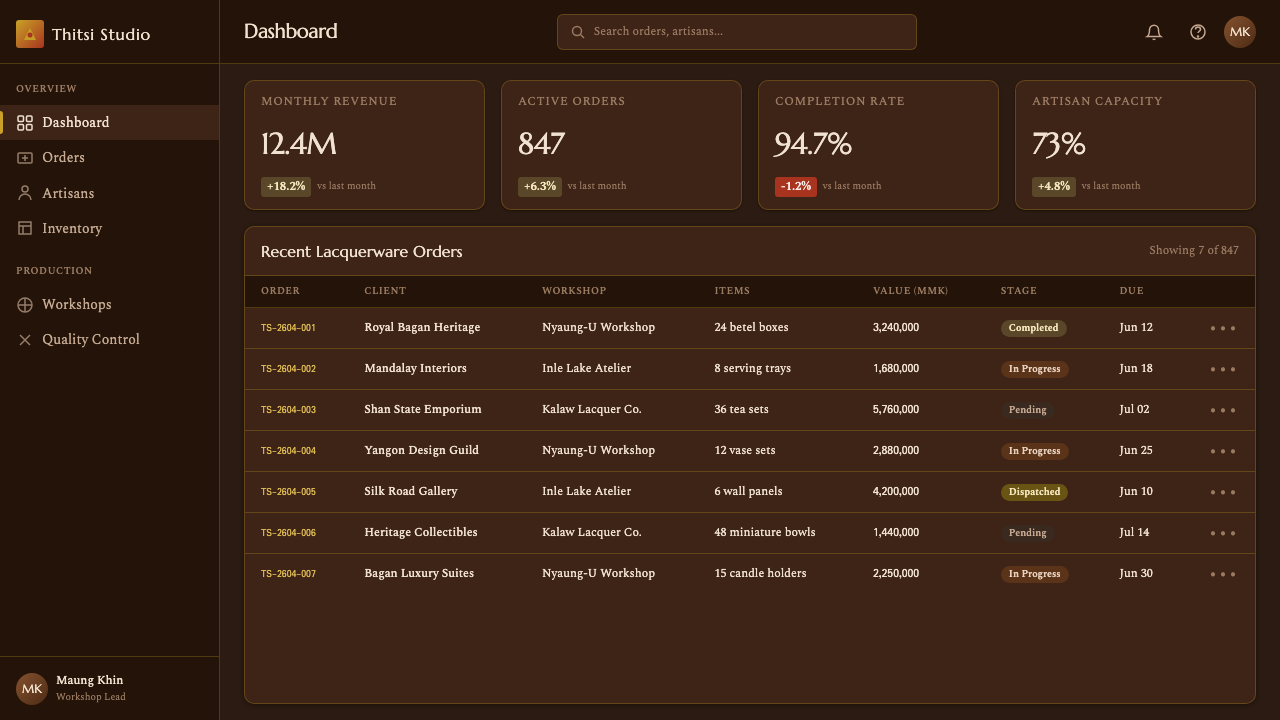
Content and data slides can borrow the incising logic directly: thin, confident lines for chart axes and dividers rather than thick bars or blocks, with cinnabar red reserved for the single data point or headline number that most needs attention. Because the source material treats gold as hairline detail rather than a filled color, data visualizations should avoid large gold-filled shapes — a thin gold outline around a key figure reads as far more faithful to the tradition than a solid gold bar.
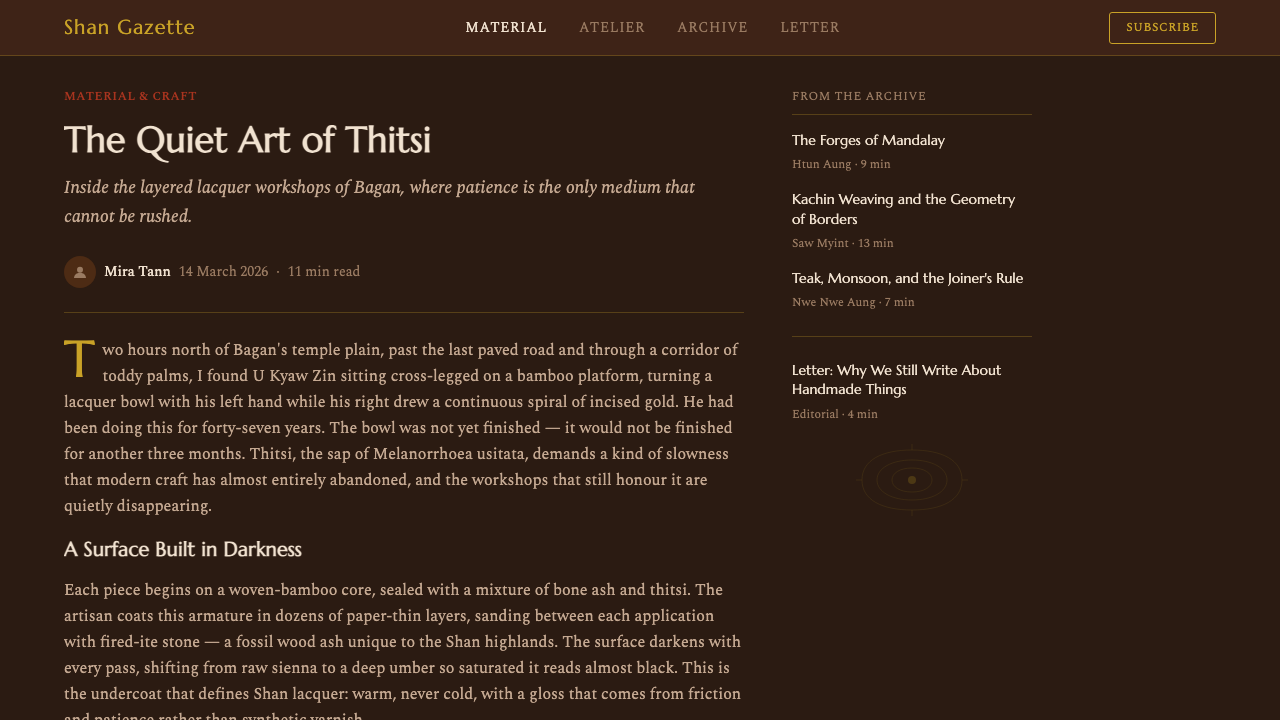
In web interfaces, the style suits dashboards and product pages for craft marketplaces, boutique hospitality and travel brands, and premium home-goods or lifestyle products that want to signal handmade precision rather than mass production. Buttons and interactive states can use the thin red-and-gold banding idea directly — a fine colored line or border rather than a filled colored button — with the dark glossy ground carried through as the primary background rather than reserved for a single dark-mode toggle.
For editorial and marketing work, the palette rewards long-form travel writing, craft documentaries, and luxury goods marketing where photography of the actual lacquerware or comparable handmade objects can sit against the dark ground and let its own gloss do the visual work. Pull quotes and section markers should use thin rules in the accent colors rather than heavy colored blocks, matching the restraint of the incised original.
The most common mistake is defaulting to a bright, dominant red — the 'generic lacquerware red' most people picture — instead of keeping red as a thin, sparing accent against a genuinely dark, glossy brown ground. A second common error is rendering the surface flat and matte rather than glossy, which loses the sense of liquid depth that makes the dark ground feel rich rather than simply dim; without that gloss, the whole reference collapses into an unremarkable brown.
Burmese Shan Lacquer Brown — FAQ
Is Burmese lacquerware always this dark umber-brown, or are there brighter versions?
There are brighter, multicolor Burmese lacquer traditions that use different decorative techniques and are not the focus here. This system is built specifically on the dark, near-black brown ground and incised cinnabar-and-gold detailing documented in the Bagan and Shan yun tradition of the early twentieth century — a deliberately restrained, dark palette rather than the more colorful lacquerware some visitors to the region may also encounter.
What does 'yun' actually refer to?
Yun refers to the incising technique itself — scratching a design directly into cured lacquer and filling the resulting grooves with pigment — rather than to a specific color or shape. It is what distinguishes this tradition from painted or stamped lacquer decoration, and it is demanding precisely because a scratched line, unlike a painted one, cannot be corrected once cut.
Why is the vessel core woven from bamboo rather than carved from wood?
Woven bamboo, sometimes reinforced with horsehair, produces a core that is light and flexible enough to survive the repeated coats of lacquer, curing, and polishing needed to build up the deep glossy undercoat without cracking — a rigid solid-wood form would be more prone to splitting under that process. The Shan States' established tradition of fine bamboo weaving made the region a natural supplier of these cores to Bagan's lacquer workshops.
Does a design need literal Burmese imagery — temples, mythical animals — to read as drawing on this tradition?
No, and leaning on literal cultural iconography outside its original context often reads as costume rather than genuine reference. The stronger approach borrows the material logic instead: a genuinely dark, glossy ground; fine incised, not painted, linework; cinnabar red and gold used as thin bands rather than filled shapes. Those structural choices carry the reference more convincingly than literal temple or animal motifs would.
How does this differ from East Asian lacquer traditions like Japanese maki-e?
The core techniques differ. Japanese and Chinese lacquer traditions often build gold decoration by sprinkling or applying metal powder onto wet lacquer before it fully cures, producing a raised or dusted gold surface. The Burmese yun tradition instead cuts a design into fully cured lacquer and works pigment or gold into the resulting incised grooves, so the decoration sits recessed rather than raised. The woven bamboo core is also distinctive — East Asian lacquerware more often uses a wood or wood-composite base.
Related design styles
 Indian Brinjal Temple TextilePalace silk, systematised. Brinjal violet ground edged in zari gold, korvai g…
 Kuchi Nomad Silver JewelryWeight becomes protection. Matte silver frames carnelian and teal stones on b…
 Lao Sinh Silk WeaveCeremonial Lao silk on screen. Dark aubergine ground threaded with gold mat-m…
 Thai Mangosteen SilkOne cloth, many colours. Mangosteen-dyed mauve ground, layered red and blue-v…
 Banarasi Brocade SareeBridal maximalism, woven dense. Crimson silk grid carries raised antique-gold…
 Cuban Habano CigarLuxury sleeps in shadow. Tobacco brown, antique gold rules, and burgundy seal…