About Istalif Pottery
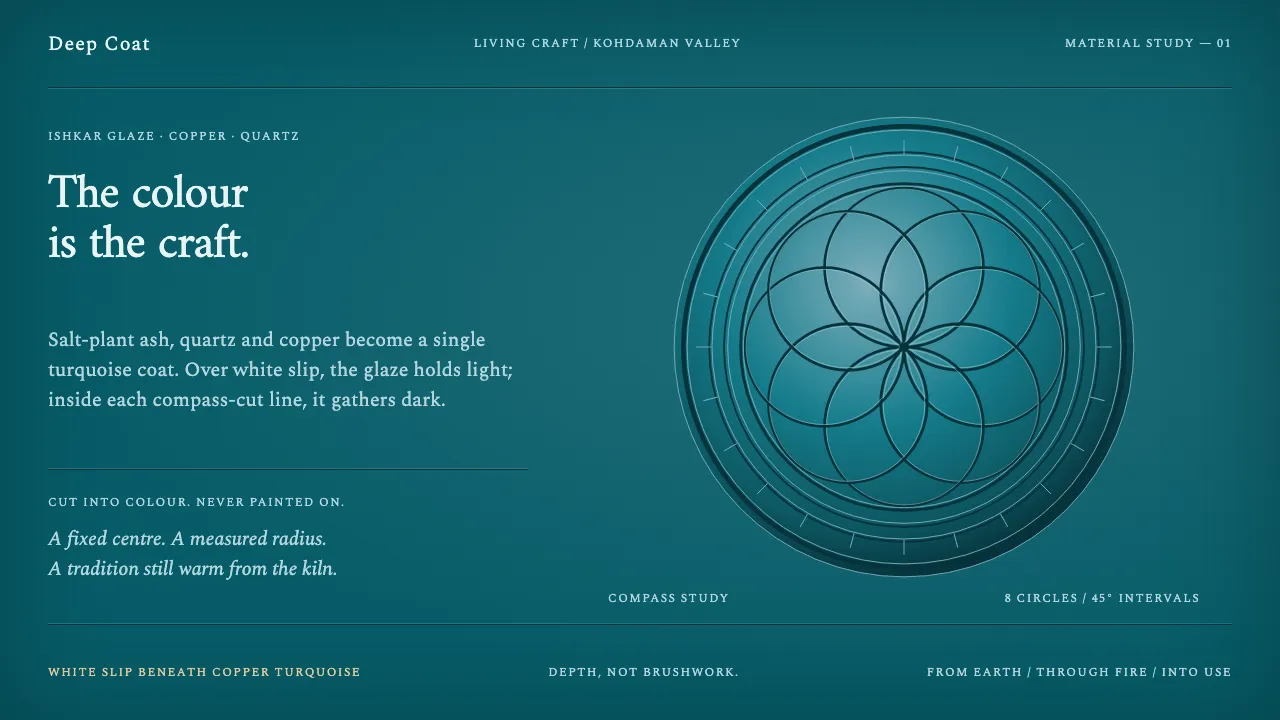
Istalif potters cook their glaze from ishkar — the ash of a salt-plant — with crushed quartz, copper oxide and sunflower seed, then flood it over a white Ghorband slip. The pattern is not painted. It is cut through the coat with a compass and a needle, so the drawing reads as depth: dark where the glaze pools in the incision, pale where it thins over the slip.
This system treats the glaze as the ground. Fields drift in tone, edges pool darker, rules are cuts rather than lines, and every ornament is struck from a fixed centre and a fixed radius.
- Origin
- Istalif, Kohdaman valley, Parwan / Kabul province, Afghanistan
- Era
- pre-1900 village tradition, continuous; kilns destroyed 1998, revived from 2002
- Key figures
- Ustad Matin Malikzada · Malikzada potter families · Turquoise Mountain Foundation
- Movements
- Central Asian ishkar-glazed earthenware · Persianate copper-turquoise and cobalt glaze traditions · sgraffito incising
Istalif Pottery design spec
Colors
Typography
The other 11 sections — buttons, cards, spacing, motion, techniques and more — open once you unlock. Download the DESIGN.md or send it to your AI in one click. Unlock once, yours forever.
Sign up nowStyles similar to Istalif Pottery
Also inspired by crafts & folk art, with a close feel.
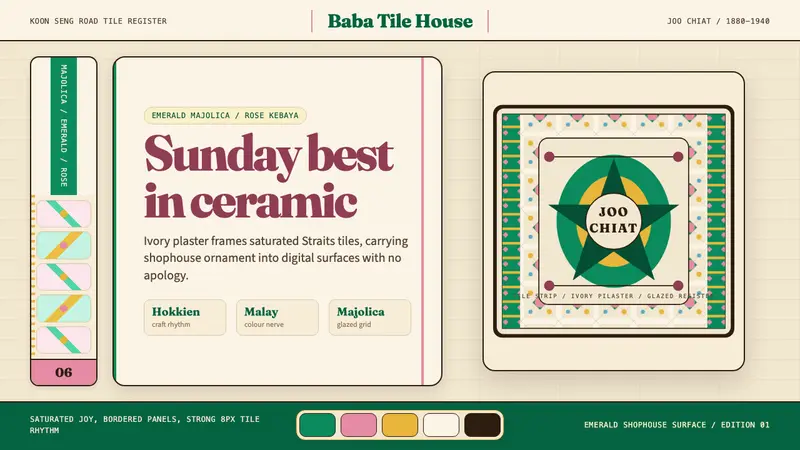 Peranakan Shophouse Tile (Joo Chiat)Ornament without apology. Emerald tile grids and Fraunces shopfront type carry the joy.
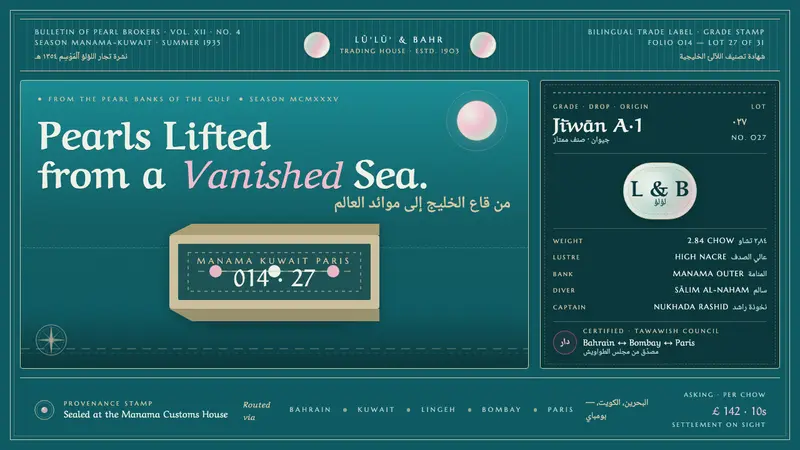 Gulf Pearl Trade EraA vanished maritime economy, stamped. Sea-teal water, dhow silhouettes, nacre seals beside Naskh.
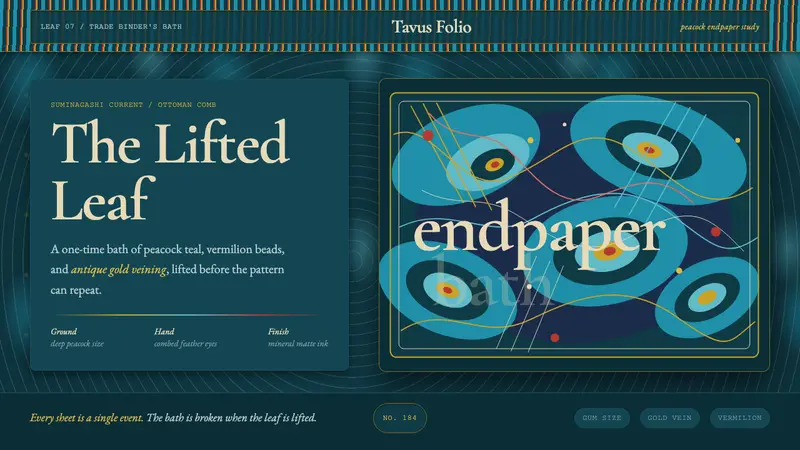 Marbled EndpaperInk refuses repetition. Peacock teal, vermilion beads, and gold veins drift like lifted paper.
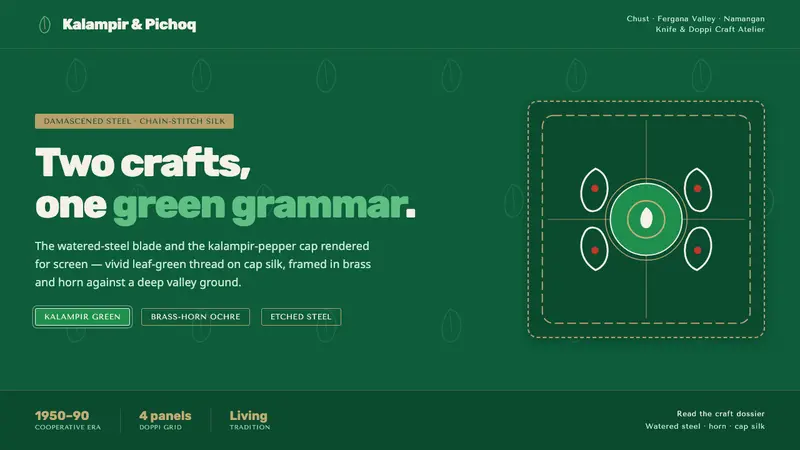 Chust Pichak Knife CraftTwo crafts, one green grammar. Vivid kalampir chain-stitch on cap silk, brass-framed on deep green.