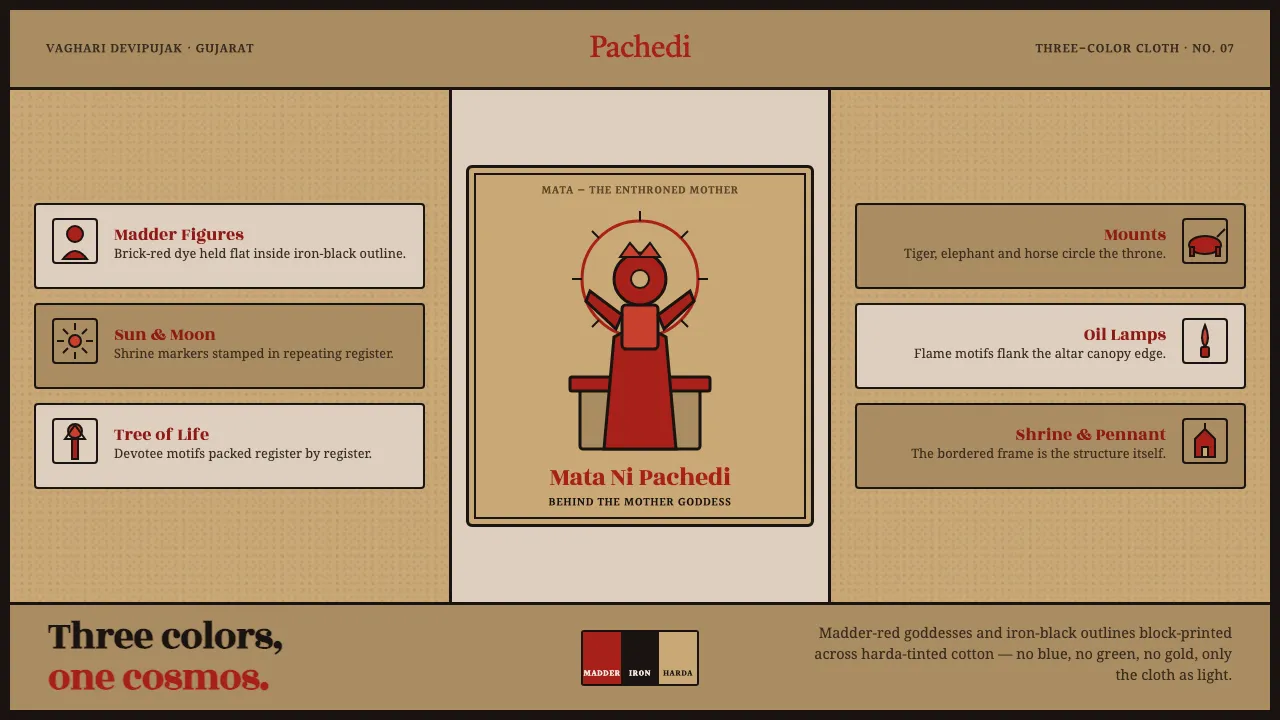
About Mata Ni Pachedi Temple Cloth
Mata-ni-Pachedi is the block-printed and hand-painted mother-goddess shrine cloth of the Vaghari community of Gujarat. It is a strictly three-color textile: madder-brick red figures, iron-black outlines, and the de-starched cotton itself — soaked in harda (myrobalan) to a warm tan — serving as the "white."
This design system distills that ritual textile into digital form: a harda-tinted tan ground, bold block-printed red figures, iron-black outlines, dense narrative registers framing a central enthroned goddess, and matte hand-printed texture. No blue, no green, no gold — only red, black, and the natural cloth.
- Origin
- Ahmedabad and Saurashtra, Gujarat, India
- Era
- 1900–1950 (centuries-old ritual tradition; current revival ~2000s)
- Key figures
- Vaghari (Devipujak) shrine-cloth artisans · Chitara family painters of Ahmedabad
- Movements
- Indian temple-cloth painting · Kalamkari-related mordant dyeing · Block-printed devotional textile
Mata Ni Pachedi Temple Cloth design spec
Colors
Typography
The other 11 sections — buttons, cards, spacing, motion, techniques and more — open once you unlock. Download the DESIGN.md or send it to your AI in one click. Unlock once, yours forever.
Sign up nowStyles similar to Mata Ni Pachedi Temple Cloth
Also inspired by crafts & folk art, with a close feel.
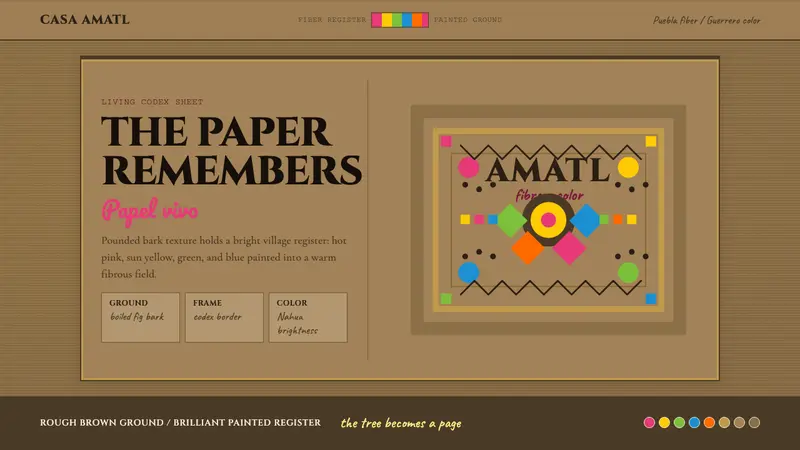 Mexican Amate Bark PaperLiving craft, not nostalgia. Bark-brown fiber carries hot pink and sun-yellow codex geometry.
 Miʼkmaq QuillworkColour never blends. Bright quill bands step across dark birchbark toward an eight-point star.
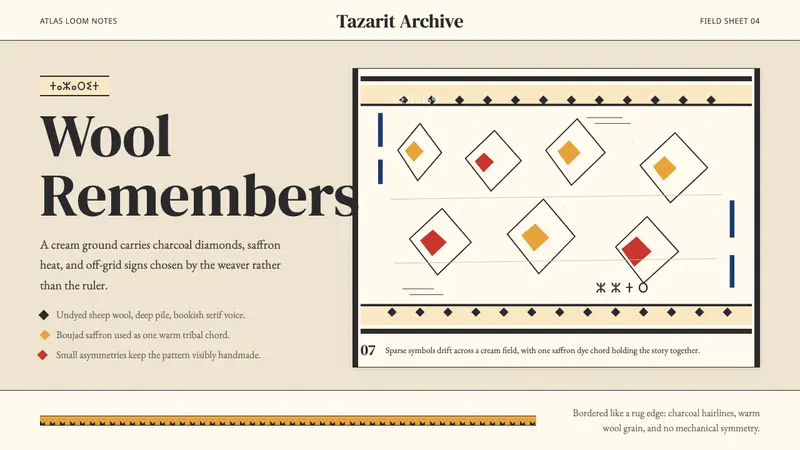 Moroccan Amazigh Berber RugAutobiography in wool. Cream ground, charcoal diamonds, saffron bands drift off-grid.
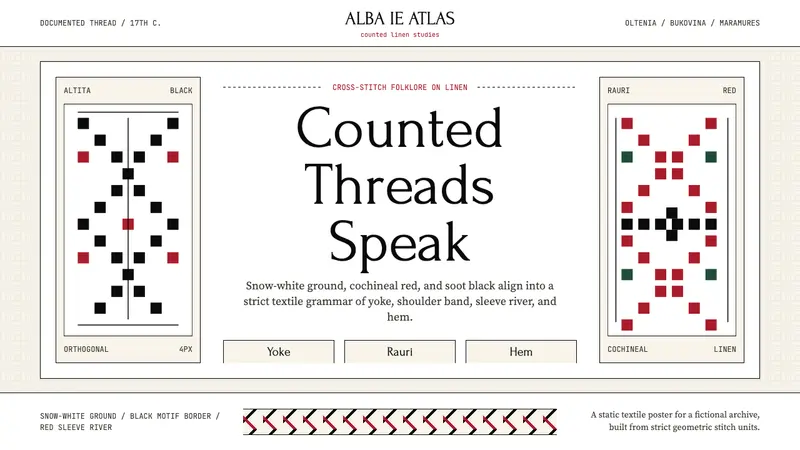 Romanian Ie (folk embroidered blouse)Folklore becomes grid. Cochineal red and soot black stitch strict bands on linen white.