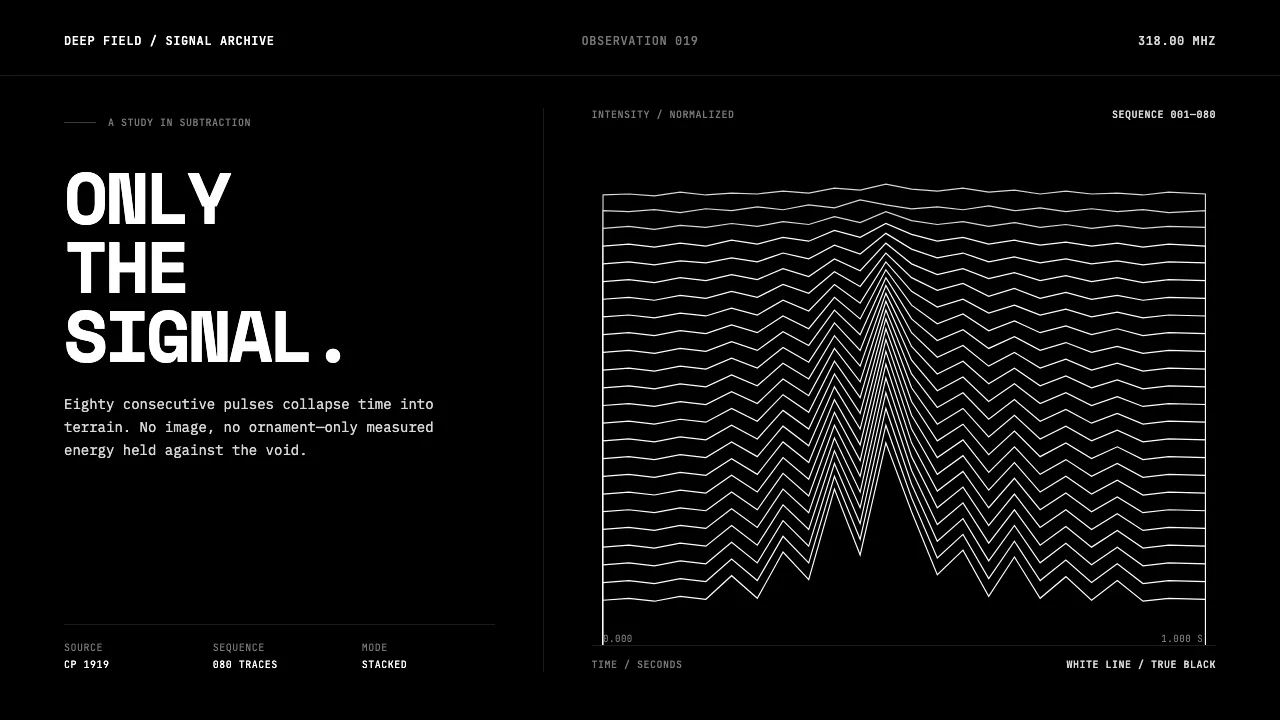
About Pulsar CP1919 Stacked Plot
In 1970 Cornell doctoral student Harold D. Craft Jr. stacked 80 consecutive radio pulses from pulsar CP1919 into a single ridge-line plot, front waves occluding those behind — a data figure buried in a PhD thesis. Nine years later Peter Saville lifted it, inverted it to white-on-black, and stamped it on Joy Division's Unknown Pleasures. This system is that totem: pure white line on true black, vast negative space, no ornament — pure signal.
- Origin
- England (Joy Division / Factory Records) via Cornell / Arecibo, USA
- Era
- 1970 (thesis figure); 1979 (Unknown Pleasures cover)
- Key figures
- Harold D. Craft Jr. · Peter Saville · Jocelyn Bell Burnell
- Movements
- Scientific data visualization · Post-punk graphic design · Minimal data-graphic iconography
Pulsar CP1919 Stacked Plot design spec
Colors
Background
Surface
Primary
Secondary
Accent
Text
Typography
Space MonoHeadings
IBM Plex MonoBody
JetBrains MonoMono
Unlock for 1 credit
The other 11 sections — buttons, cards, spacing, motion, techniques and more — open once you unlock. Download the DESIGN.md or send it to your AI in one click. Unlock once, yours forever.
Sign up nowHave an account? Sign in
Styles similar to Pulsar CP1919 Stacked Plot
Also inspired by film, games & music, with a close feel.
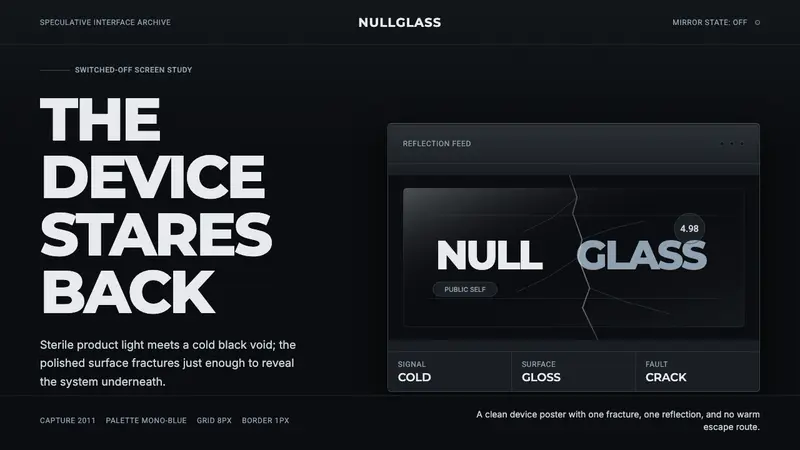 Black MirrorSterile tech turns accusatory. Screen-black, cold Montserrat, and a single glass crack.
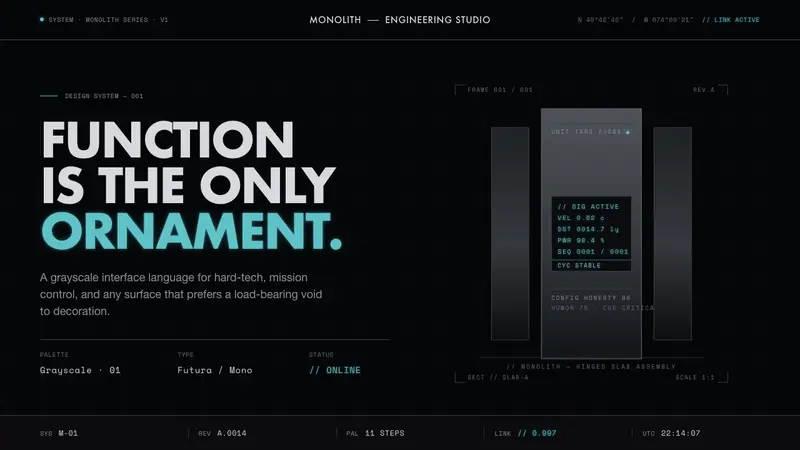 Interstellar TARSIf Mies built a robot. Brushed-aluminum grays on deep-space black, lit by one cold cyan readout.
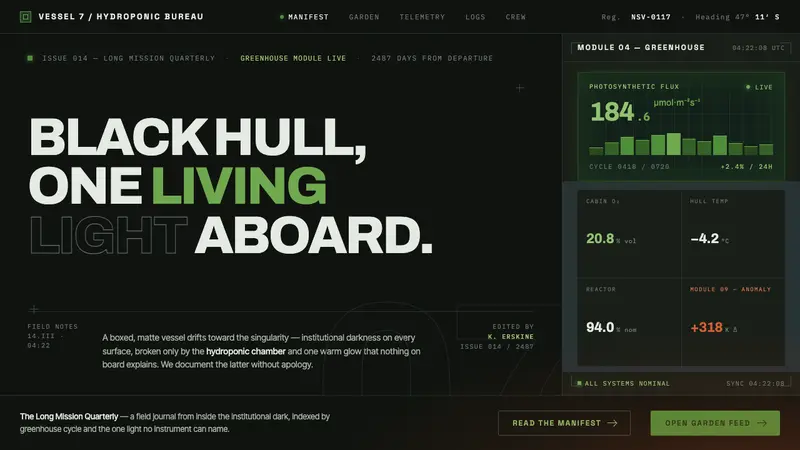 High Life (2018)Institutional dark, one living light. Matte-black hull, hydroponic green, one terracotta zone.
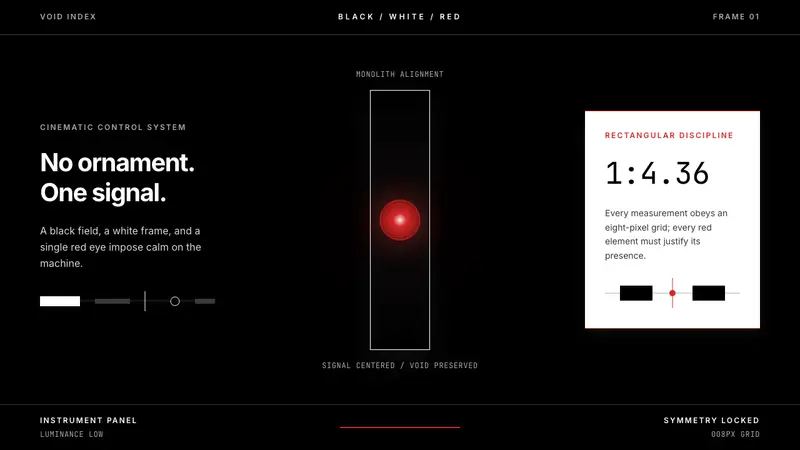 2001 — A Space OdysseyAbsolute restraint. Black void, white monolith geometry, one HAL-red signal.