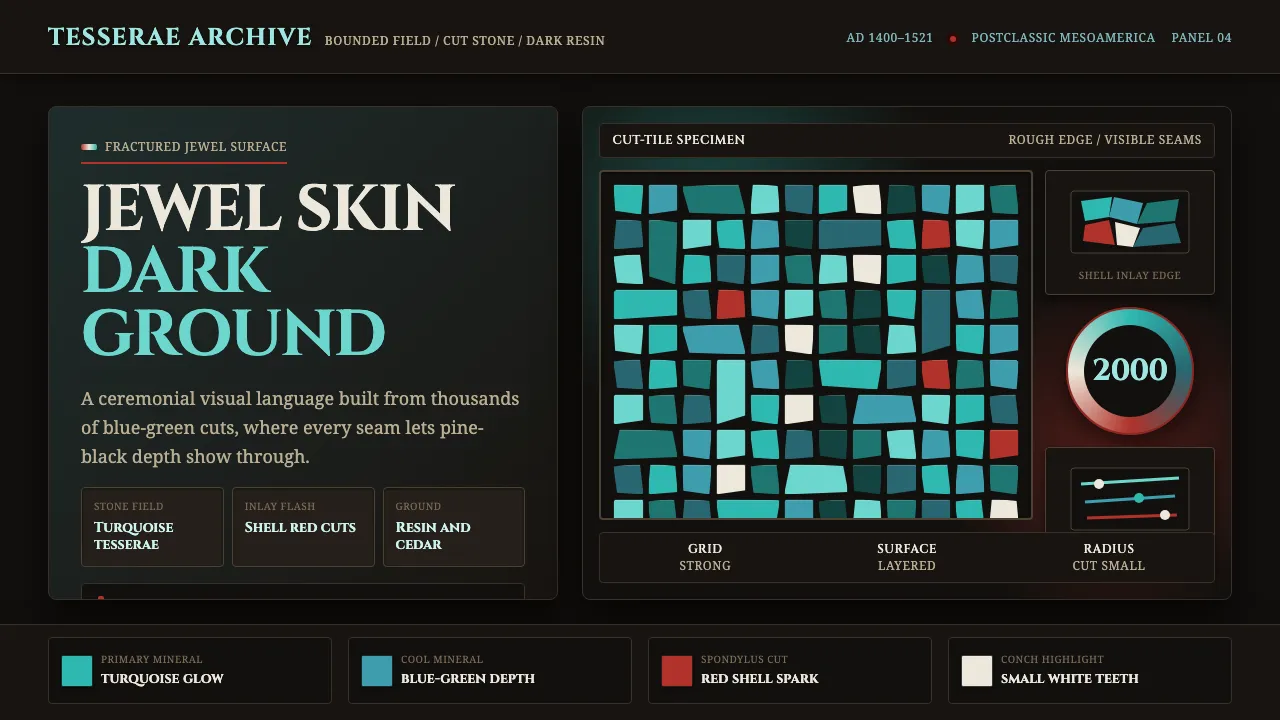
About Mixtec Turquoise Mosaic
Among the treasures of Postclassic Mesoamerica, few objects rival the turquoise mosaic masks and effigies produced by Mixtec lapidaries and passed into Aztec ritual use. The British Museum's double-headed serpent is the exemplar: a carved cedar body sheathed in roughly 2,000 individually cut turquoise tesserae, set tile by tile in pine resin, with red thorny-oyster shell marking the gums and white queen-conch shell forming the teeth. This design system channels that object directly — a near-black substrate reading through fractured seams of blue-green stone, broken only by flashes of shell-red and shell-white. It is ornament built from thousands of small, deliberate decisions, not a single smooth surface but a jewel skin stretched taut over darkness.
- Origin
- Mixteca region, Mexico, Latin America / Mesoamerica
- Era
- AD c.1400–1521 (Postclassic Mesoamerica, into the Aztec period)
- Key figures
- Mixtec lapidary mosaic craftsmen · Aztec ritual-regalia workshops
- Movements
- Mixtec-Aztec turquoise mosaic · Mesoamerican ritual regalia
Mixtec Turquoise Mosaic design spec
Colors
Typography
The other 11 sections — buttons, cards, spacing, motion, techniques and more — open once you unlock. Download the DESIGN.md or send it to your AI in one click. Unlock once, yours forever.
Sign up nowStyles similar to Mixtec Turquoise Mosaic
Also inspired by crafts & folk art, with a close feel.
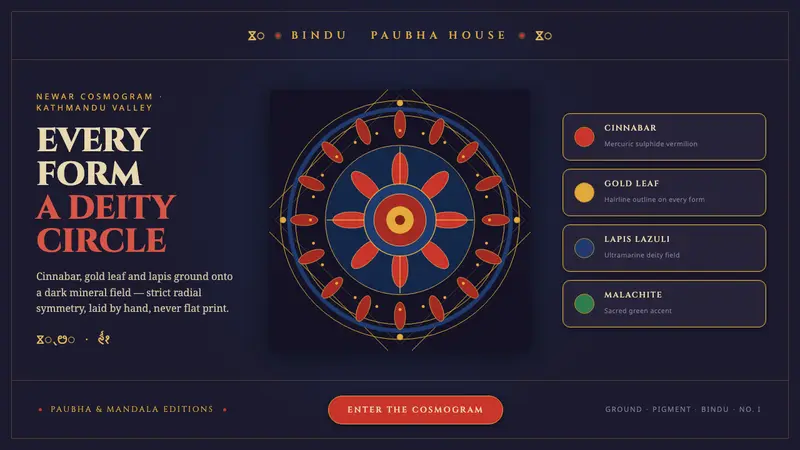 Kathmandu Tantric MandalaSacred geometry as interface. Cinnabar, gold and lapis rings radiate from one bindu on dark ground.
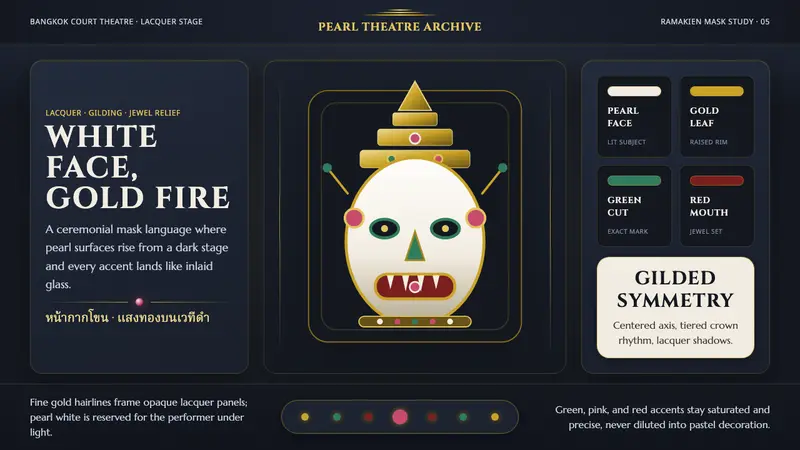 Thai Khon Hanuman MaskThai court theatre, digitized. A pearl-white mask and gilt coronet rise from dark lacquer.
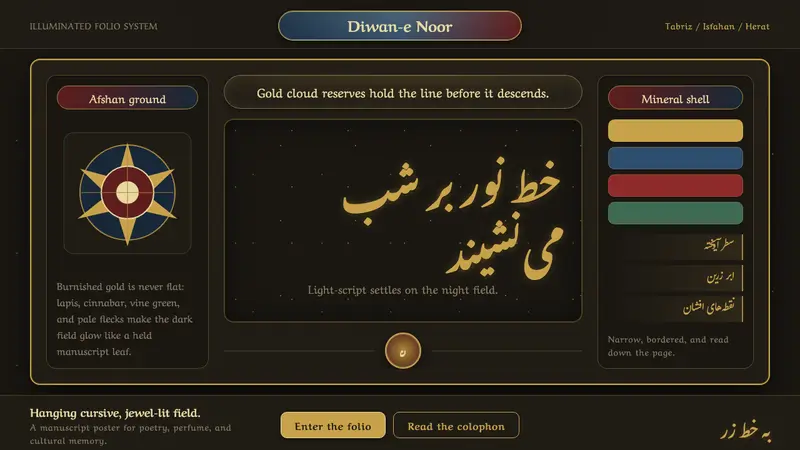 Persian Nastaliq CalligraphyGold script breathes in darkness. Afshan flecks, lapis cartouches, and sloped Nastaliq glow.
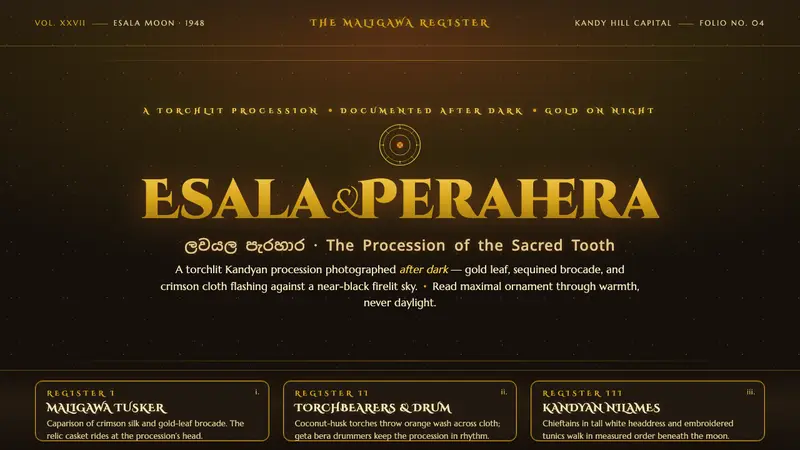 Kandy Esala PeraheraA torchlit night procession, not a poster. Gold flecks and crimson brocade flash on warm near-black.