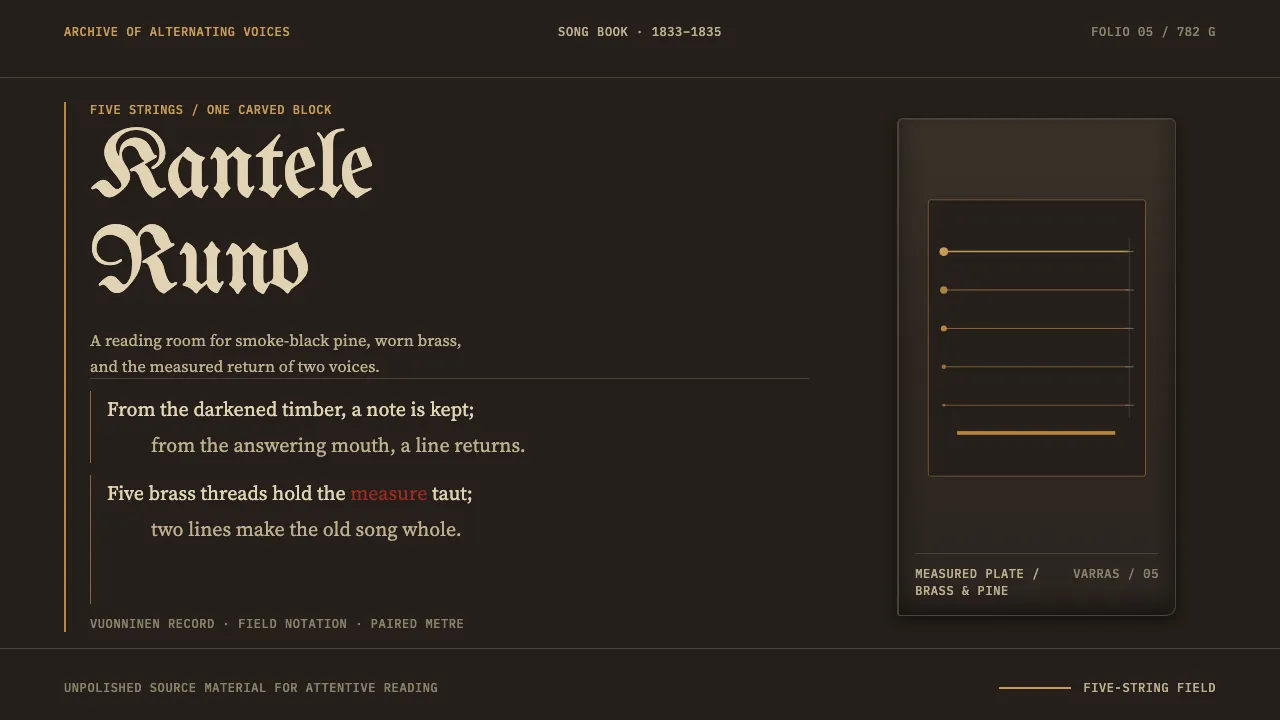
About Karelian Kantele & Runo
The old Karelian five-string kantele is one block of pine hollowed from below, its soundboard three to five millimetres thick, its body black from years hanging in the smoke cabin. Ontrei Malinen's instrument carries 1833 cut into its short side and weighs 782 grams. Elias Lönnrot met him the next year and wrote him down.
This system takes the instrument literally. Soot-black pine is the ground, worn brass is the working colour, five hairlines run the field like strings, and text falls in paired trochaic lines because that is how the songs were sung. Fraktur for the 1835 title page, Garamond for verse, Source Serif for the archive.
- Origin
- Viena Karelia and the Karelian isthmus, village of Vuonninen, on both sides of the present Finnish–Russian border
- Era
- 1833–1835 (Malinen kantele dated 1833; Lönnrot's notebooks 1834; Kalevala preface 28 February 1835); tradition pre-1900
- Key figures
- Ontrei Malinen · Elias Lönnrot
- Movements
- runolaulu and the Kalevala metre · 19th-century folk-song collecting · Karelianism
Karelian Kantele & Runo design spec
Colors
Typography
The other 11 sections — buttons, cards, spacing, motion, techniques and more — open once you unlock. Download the DESIGN.md or send it to your AI in one click. Unlock once, yours forever.
Sign up nowStyles similar to Karelian Kantele & Runo
Also inspired by crafts & folk art, with a close feel.
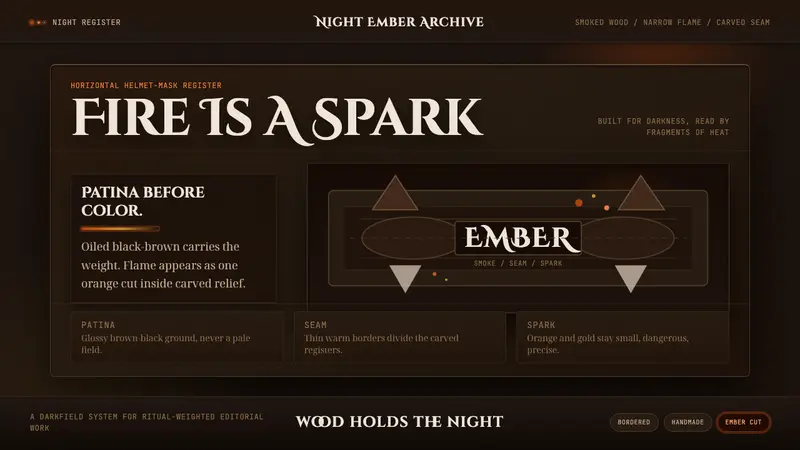 Senufo Firespitter MaskRitual darkness has heat. Smoked wood tones hold back tiny orange-gold sparks.
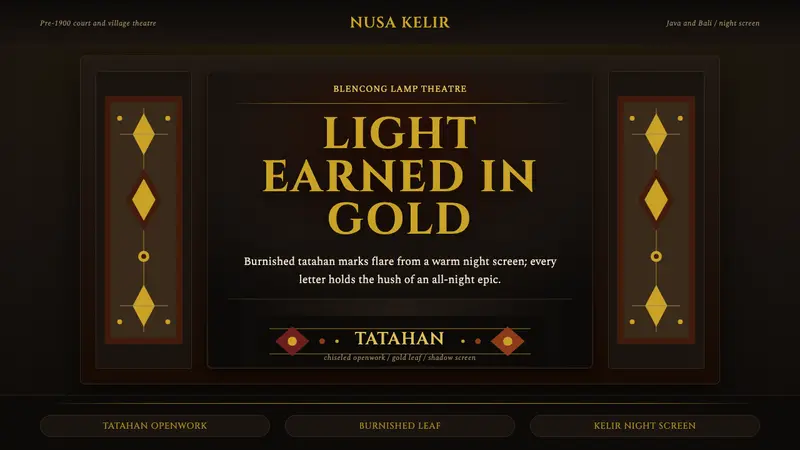 Wayang Kulit ShadowNight makes gold sacred. Cinzel capitals and perforated ochre frames glow like lamp-cut hide.
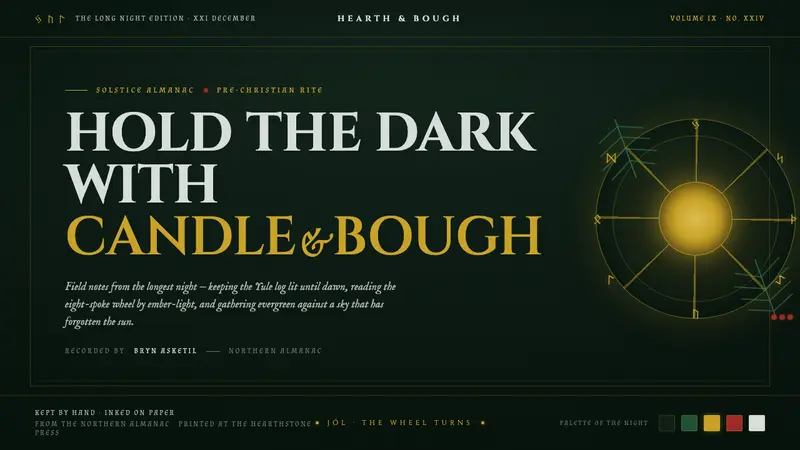 Yule SolsticeHolds the longest night. Pine-dark ground, carved Cinzel gold, an eight-spoke sun wheel.
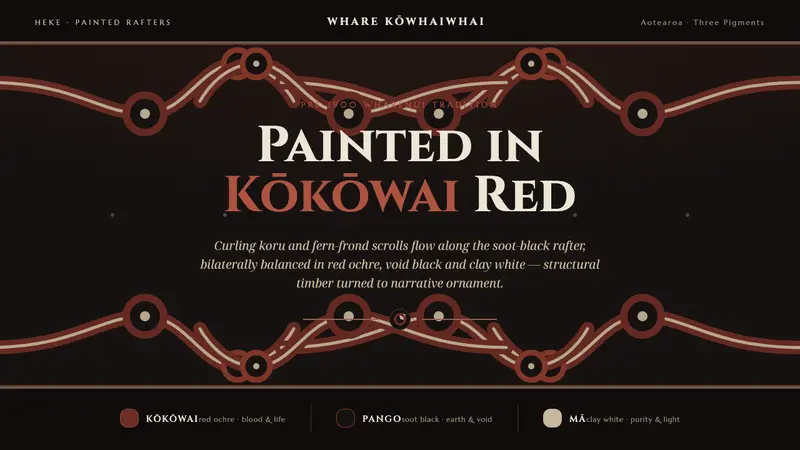 Māori Kōwhaiwhai RafterPainted timber, not pixels. Kōkōwai-red koru scrolls in mirrored balance on black, cut in Cinzel.