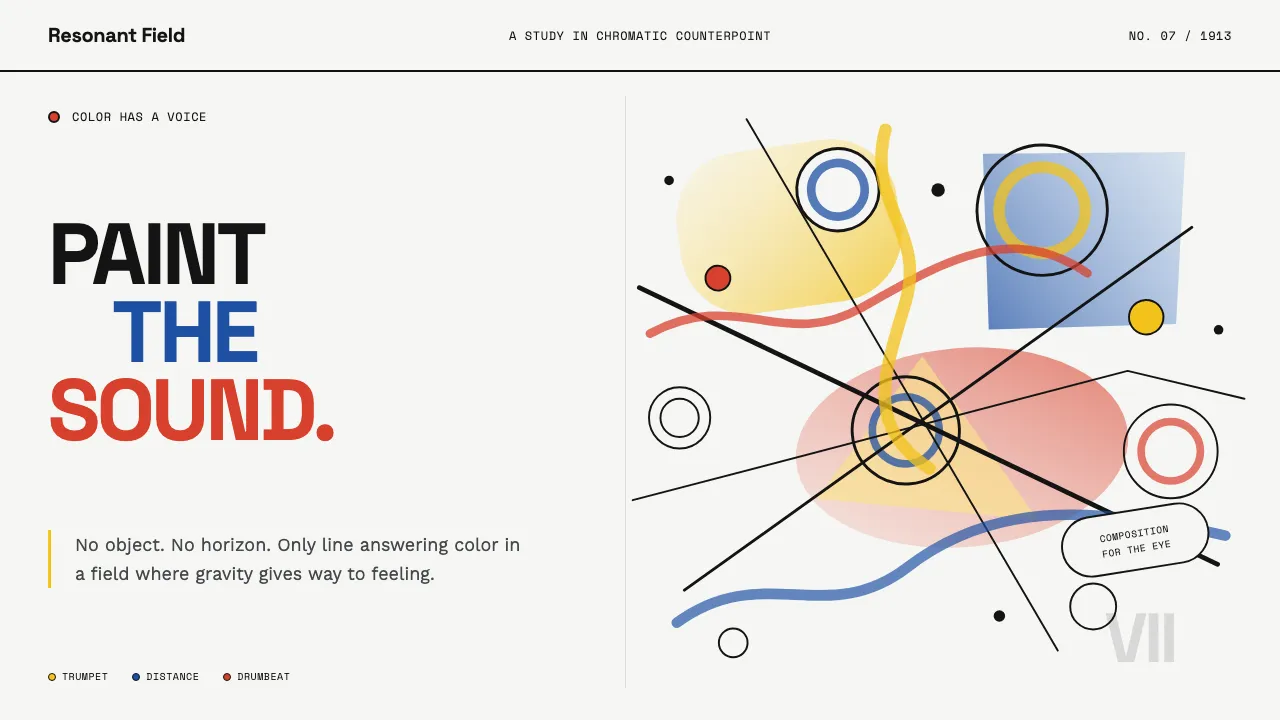
About Kandinsky Composition (1913)
In 1913 Munich, Wassily Kandinsky painted the first canvases with no subject at all — only floating circles, slashing black diagonals, and clanging chords of yellow, blue, and red set loose across a luminous pale ground. This is that moment: painting cut free from the visible world, where color and line become a spiritual language and every mark answers another in counterpoint.
The system treats a webpage like Composition VII exploded across a screen. A cool near-white canvas holds hovering hollow circles, gestural black whip-lines, and translucent color washes that collide and overlap like brushed oil. Nothing is centered, nothing is symmetrical, everything is alive — controlled chaos tuned to feeling, not to the thing it belongs to.
- Origin
- Munich, Germany — the Der Blaue Reiter circle in Bavaria (Murnau)
- Era
- 1911–1914 (peak: Composition VI & VII, both 1913, Munich)
- Key figures
- Wassily Kandinsky · Franz Marc · August Macke · Gabriele Münter · Paul Klee · Alexei Jawlensky
- Movements
- Der Blaue Reiter · German Expressionism · early lyrical abstraction
Kandinsky Composition (1913) design spec
Colors
Typography
The other 11 sections — buttons, cards, spacing, motion, techniques and more — open once you unlock. Download the DESIGN.md or send it to your AI in one click. Unlock once, yours forever.
Sign up nowStyles similar to Kandinsky Composition (1913)
Also inspired by art & artists, with a close feel.
 CoBrA (Asger Jorn, 1948)Paint refuses polish. Ultramarine ground, blood red slabs, and marker type thrash in black.
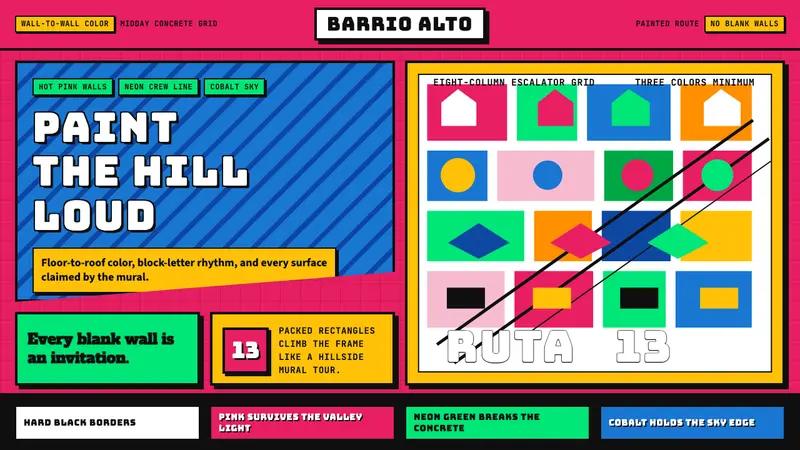 Medellín Comuna 13 MuralsRefuses blank walls. Hot pink, neon green, and cobalt blocks pack the grid like murals.
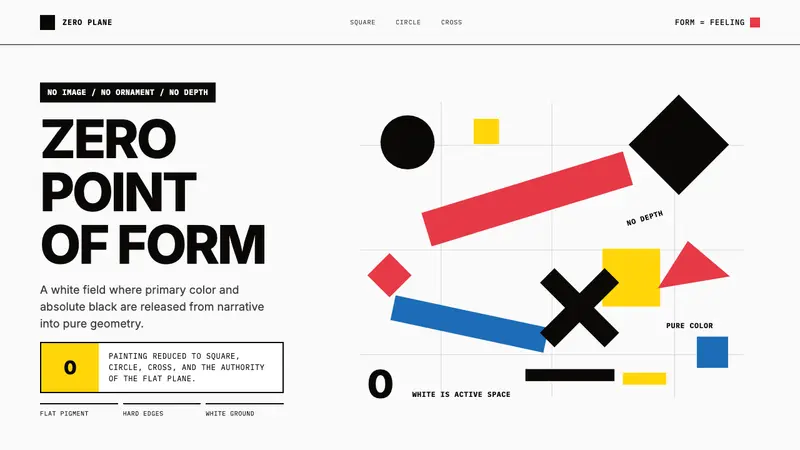 Malevich SuprematismGeometry declares zero. Red, yellow, blue and black blocks float on active white.
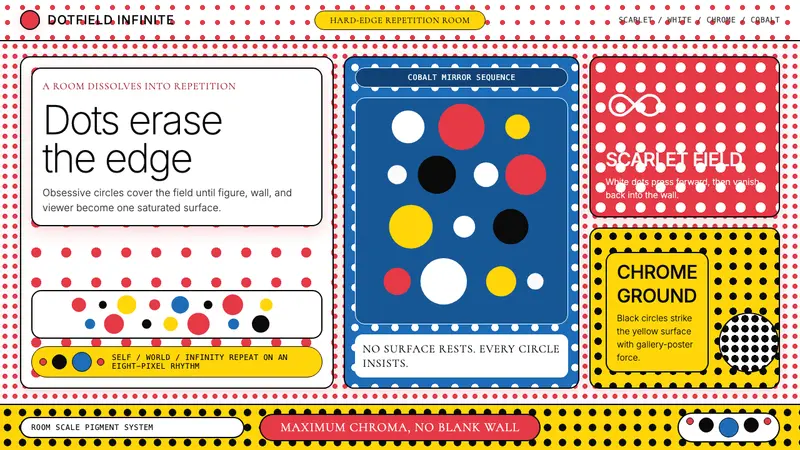 Yayoi Kusama Polka DotInfinity eats the wall. Scarlet-white dots and chrome-yellow panels repeat without rest.