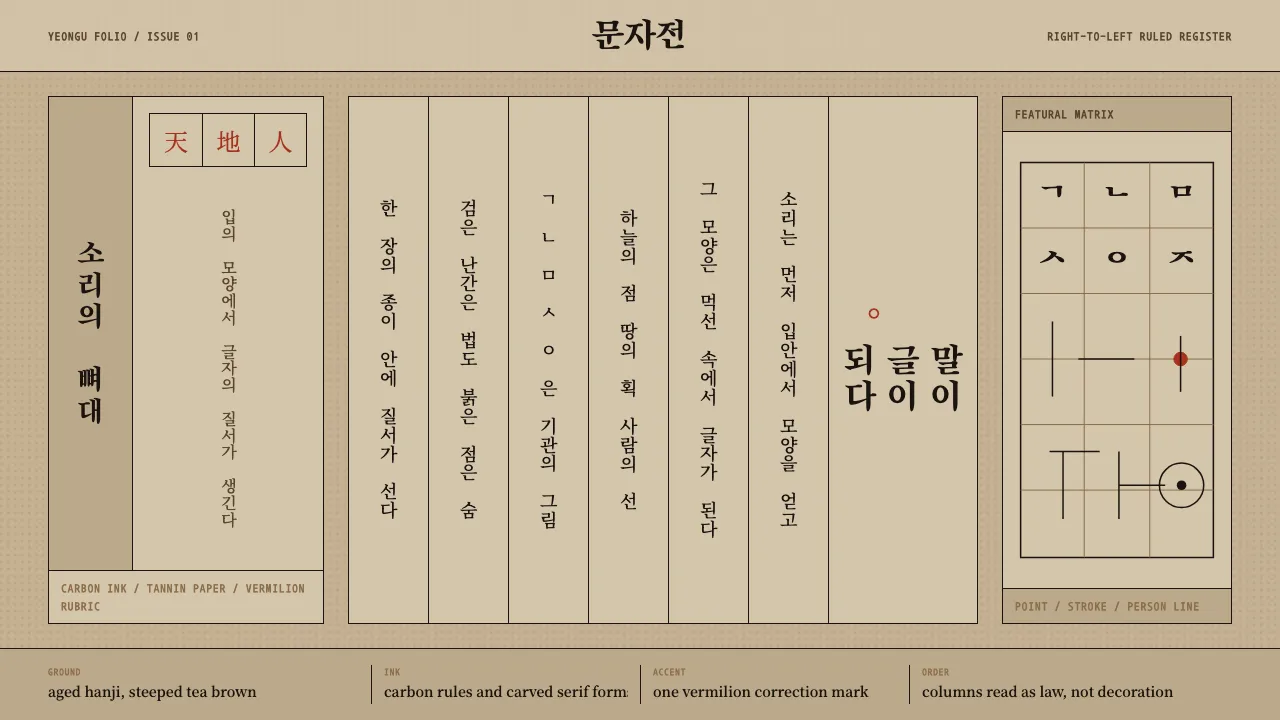
About Hangul 訓民正音
Hangul 訓民正音 is the carbon-black voice of the Hunminjeongeum Haerye — the 1446 woodblock treatise in which King Sejong gave Korea a writing system built from the shapes of the speaking mouth and the 天地人 cosmology. It reads as a Joseon xylograph: vertical right-to-left columns ruled by black frames, set on aged mulberry-bark hanji the color of steeped tea.
This system honours that printed page. Tannin-brown paper carries carbon ink; vermilion appears only as rubrication. Letterforms stay geometric and featural, never softened. The grid is law, the column is the unit, and every accent earns its place.
- Origin
- Korea (Joseon)
- Era
- Promulgated 1446 (Joseon dynasty); Haerye edition National Treasure No.70, UNESCO Memory of the World 1997
- Key figures
- King Sejong the Great · Jiphyeonjeon (Hall of Worthies) scholars
- Movements
- Joseon woodblock xylograph printing · Featural/phonetic script invention · Hanja-Hangul mixed manuscript tradition
Hangul 訓民正音 design spec
Colors
Typography
The other 11 sections — buttons, cards, spacing, motion, techniques and more — open once you unlock. Download the DESIGN.md or send it to your AI in one click. Unlock once, yours forever.
Sign up nowStyles similar to Hangul 訓民正音
Also inspired by print & type, with a close feel.
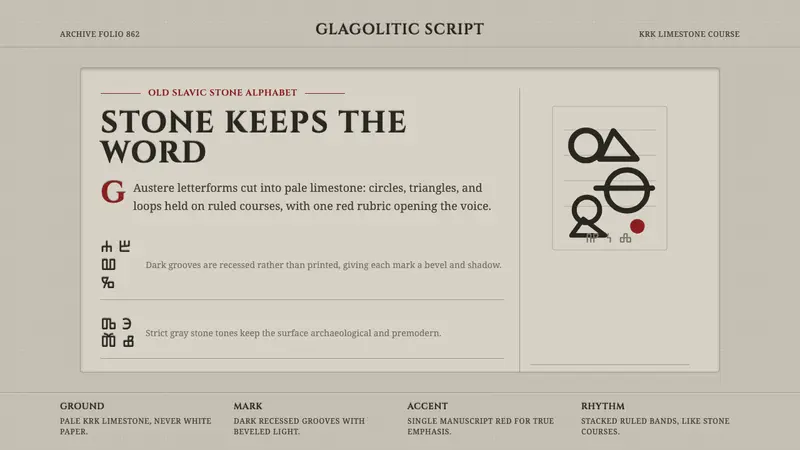 Glagolitic ScriptCarved faith in limestone. Cinzel capitals and red rubrics sit in shadowed grooves.
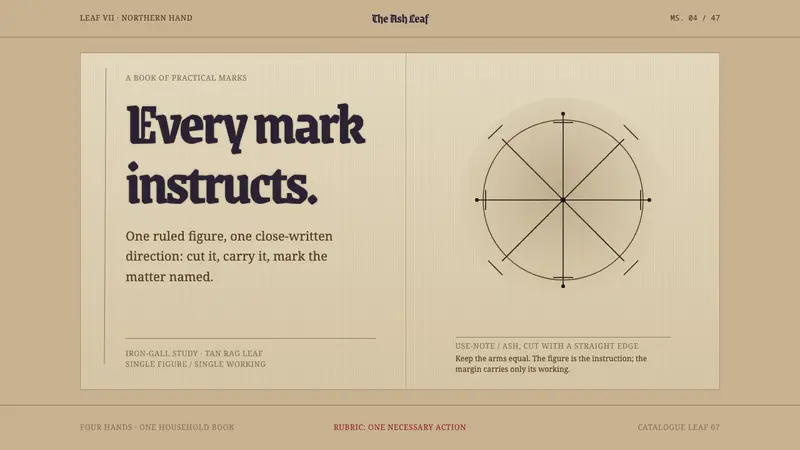 Icelandic GaldrabókEvery mark instructs. Iron-gall geometry stands alone on a smoke-darkened tan leaf.
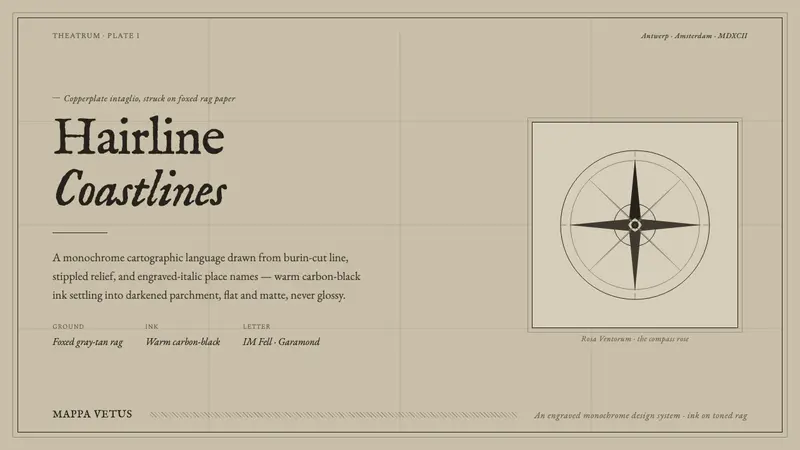 Engraved Monochrome MapThe gravity of an old printed sheet. Warm carbon-black ink on foxed rag paper, hairline coastlines.
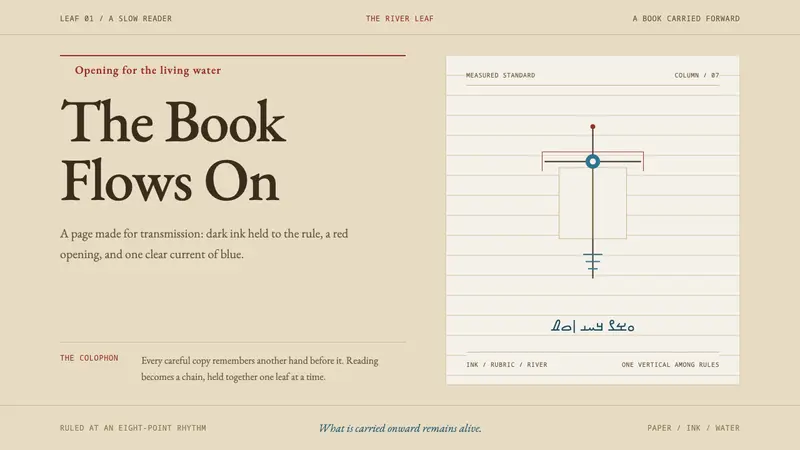 Mandaean Ginza RbaTransmission, held in a leaf. Buff paper, red rubrics, ruled ink, and river blue keep the measure.