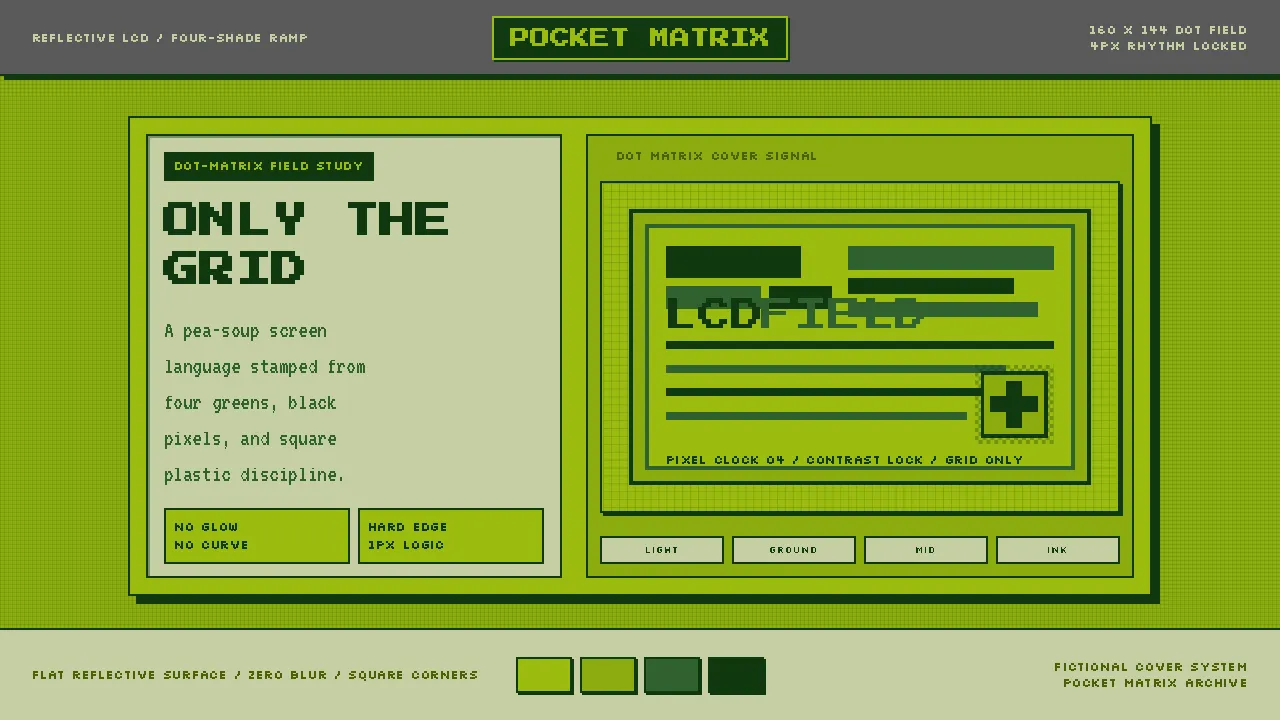
About Game Boy DMG Green Screen
The original Nintendo Game Boy (DMG-01, 1989) rendered its world on a reflective dot-matrix LCD whose lit field reads as a pea-soup olive-green, framed inside a gray plastic shell. Because the screen reflected ambient light rather than glowing, the field never read as white — it sat at a muted olive with near-black pixels stamped over it in a strict four-shade ramp.
This design system distills that handheld into an interface language: an olive ground, four quantized greens, hard 1px pixel borders, blocky bordered panels, and dot-matrix pixel typefaces. No gradients, no glow, no rounded corners — just the grid.
- Origin
- Kyoto, Japan (Nintendo R&D1)
- Era
- 1989 (DMG-01, released April 1989, Japan); 8-bit handheld era 1950–1990
- Key figures
- Gunpei Yokoi · Satoru Okada · Nintendo R&D1
- Movements
- 8-bit / dot-matrix handheld gaming · Pixel-art aesthetics
Game Boy DMG Green Screen design spec
Colors
Typography
The other 11 sections — buttons, cards, spacing, motion, techniques and more — open once you unlock. Download the DESIGN.md or send it to your AI in one click. Unlock once, yours forever.
Sign up nowStyles similar to Game Boy DMG Green Screen
Also inspired by brands & products, with a close feel.
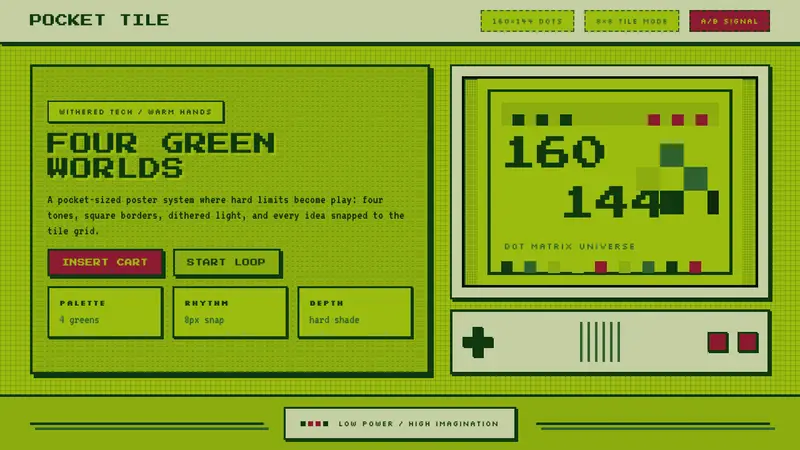 Nintendo Game BoyConstraint becomes play. Four swamp greens, pixel type, and an 8×8 grid do the work.
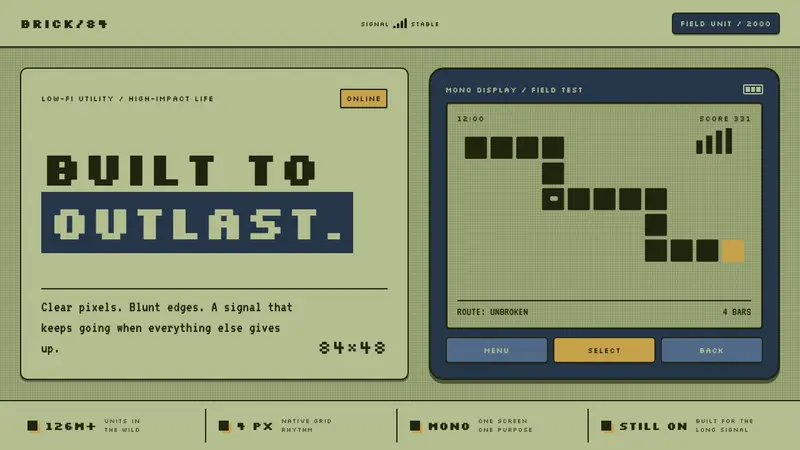 Nokia 3310 (2000)Built to outlast. Dark pixels march across olive glass inside a matte navy frame.
 MSN Messenger (2001)Dial-up optimism, online. Luna-blue chrome and bright status dots keep every chat buzzing.
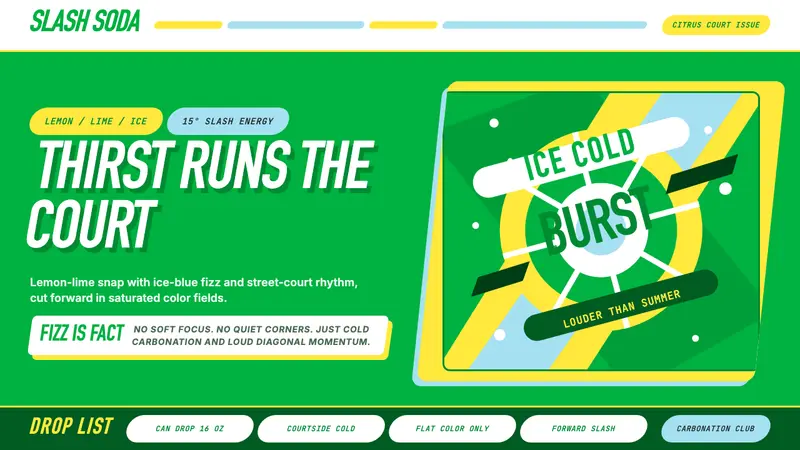 Sprite — Obey Your ThirstCitrus hits like asphalt heat. Saturated green, lemon yellow, and 15° slashes drive the poster.