About Cryosleep Transit Ward
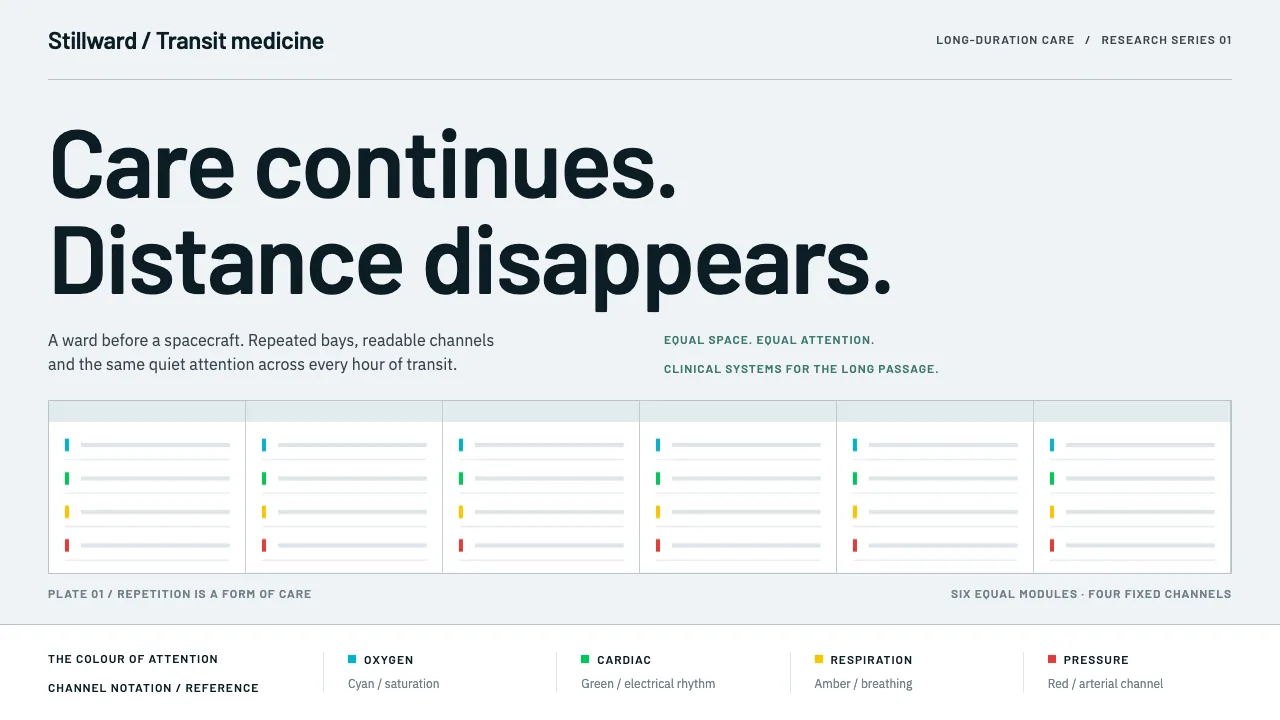
A torpor ward is a ward before it is a spacecraft. SpaceWorks' 2013 NIAC study put a Mars crew in torpor for 90 days to six months and shrank the habitat from roughly 8.2 × 9 m to 4.3 × 7.5 m, from about 31 t to 15 t. What that buys, visually, is rows: matte white pod shells in identical bays under diffuse, shadowless light.
The surface language comes from the equipment, not the fiction. Core temperature is walked down about 1 °C per hour to 32–34 °C, and every number in that descent is read off a monitor whose colours are convention — cyan for SpO2, green for ECG, amber for respiration, red for pressure and alarms. This system reads as a ward chart: legible, evenly lit, and quiet about itself.
- Origin
- Aerospace medicine, United States; ICU and operating-theatre practice
- Era
- 2013 onward (NASA NIAC torpor habitat studies), over a 1960s–present clinical-hypothermia lineage
- Key figures
- John Bradford · SpaceWorks · Medivance/BD Arctic Sun
- Movements
- Therapeutic hypothermia and targeted temperature management · Swiss medical-device labelling in the Frutiger/Univers lineage
Cryosleep Transit Ward design spec
Colors
Typography
The other 11 sections — buttons, cards, spacing, motion, techniques and more — open once you unlock. Download the DESIGN.md or send it to your AI in one click. Unlock once, yours forever.
Sign up nowStyles similar to Cryosleep Transit Ward
Also inspired by science & nature, with a close feel.
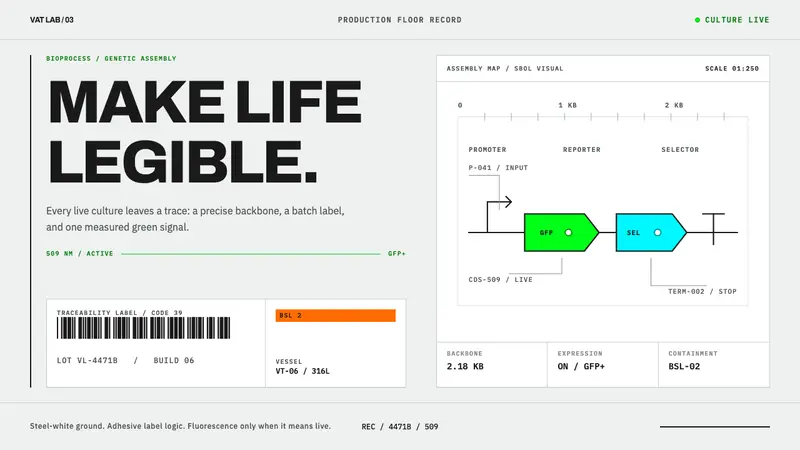 Synthetic Biology Vat LabLife is legible. GFP green traces a steel-white SBOL backbone and barcode record.
 Salt Crystal EvaporiteCrystalline and cold. Salt-white cubes float over turquoise brine in a hard lattice.
 Ice Core Climate DataPaleoclimate, instrument-grade. Cyan curves and monospaced ticks glowing on deep ice-blue.
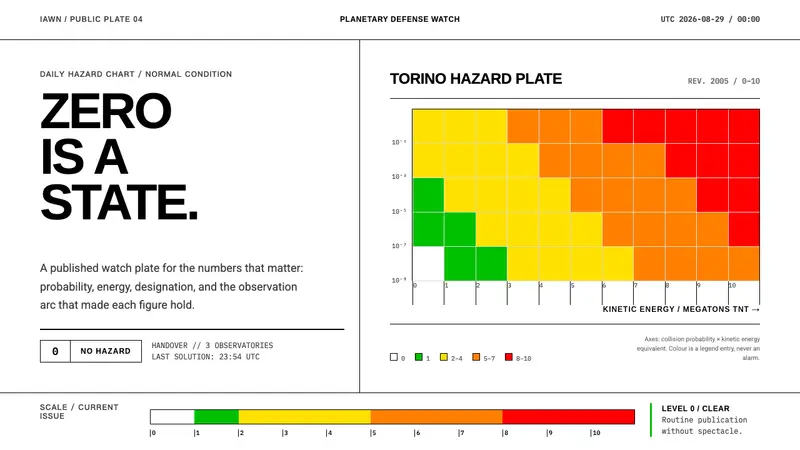 Planetary Defense WatchNothing to report is the point. Torino bands and monospace columns make risk legible.