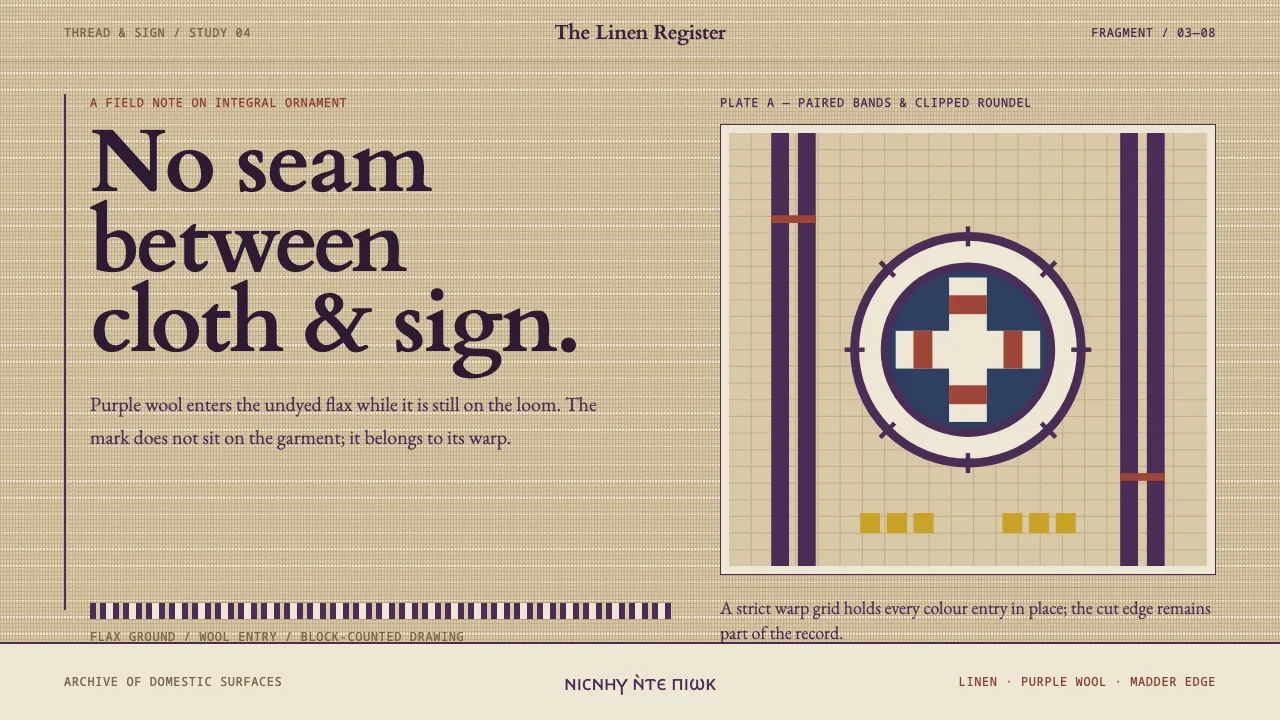
About Coptic Tunic Weave
A Coptic tunic was woven in one piece and its ornament was woven with it. The clavi running shoulder to hem, the shoulder roundels, the neck and sleeve bands — all tapestry-woven in wool on the same warp as the linen ground. There is no seam between decoration and garment because there is no join.
The linen stays undyed: a warm yellowish flax. The wool is a dark blue-purple, murex where a household could afford it and madder over woad where it could not, with madder red, woad indigo, weld yellow and an overdyed green entering in small quantities. The drawing is blocky because warp and weft decide it.
- Origin
- Egypt — Akhmim, Antinoöpolis, the Fayum, al-Bagawat in the Kharga Oasis
- Era
- 3rd–8th century AD; purple clavi ornament at its height 3rd–5th century
- Key figures
- Marie-Hélène Rutschowscaya · The Metropolitan Museum of Art Egyptian Expedition (1930–31)
- Movements
- Coptic art · late-antique Egyptian textile production · Hellenistic iconography in Christian use
Coptic Tunic Weave design spec
Colors
Typography
The other 11 sections — buttons, cards, spacing, motion, techniques and more — open once you unlock. Download the DESIGN.md or send it to your AI in one click. Unlock once, yours forever.
Sign up nowStyles similar to Coptic Tunic Weave
Also inspired by crafts & folk art, with a close feel.
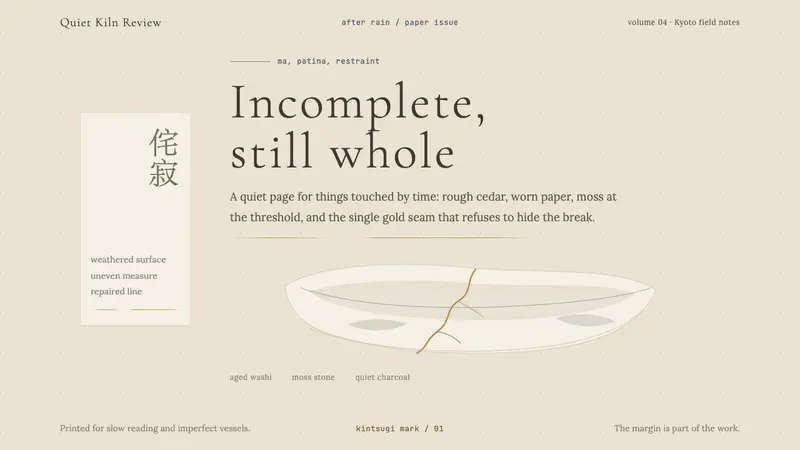 Wabi-SabiStillness makes imperfection whole. Washi beige, moss sage, and a spare gold seam hold the page.
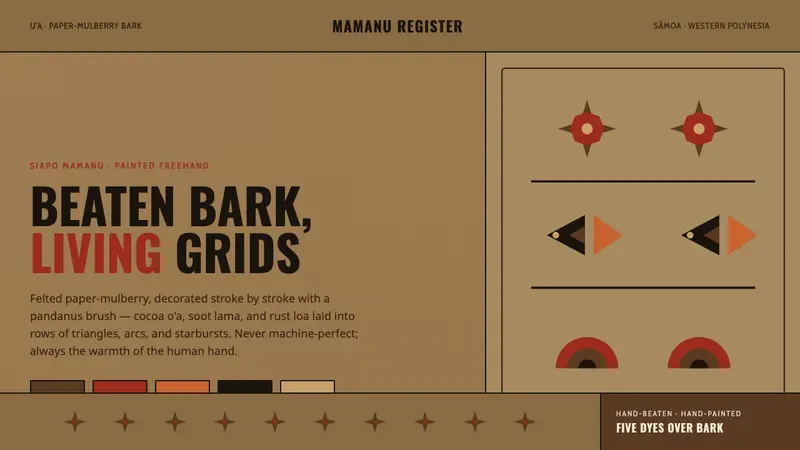 Samoan Siapo MamanuBeaten bark, never white. Five natural dyes paint freehand grids of fish, shells, starbursts.
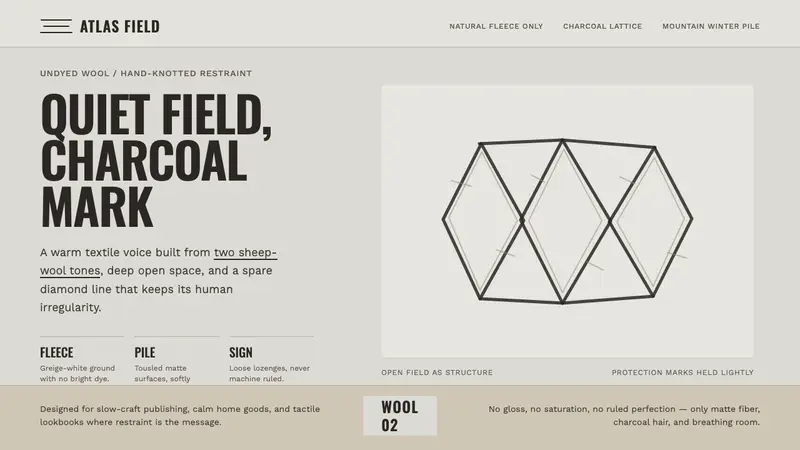 Beni Ourain Berber CarpetRestraint feels tactile. Greige wool field, Oswald type, and a loose charcoal lattice.
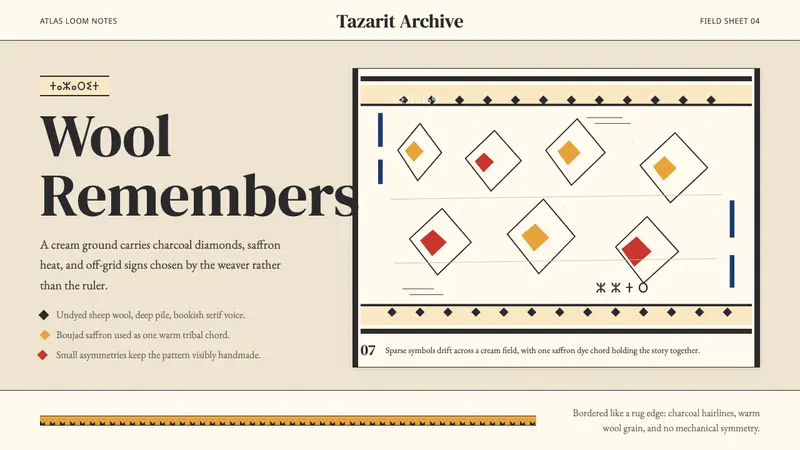 Moroccan Amazigh Berber RugAutobiography in wool. Cream ground, charcoal diamonds, saffron bands drift off-grid.