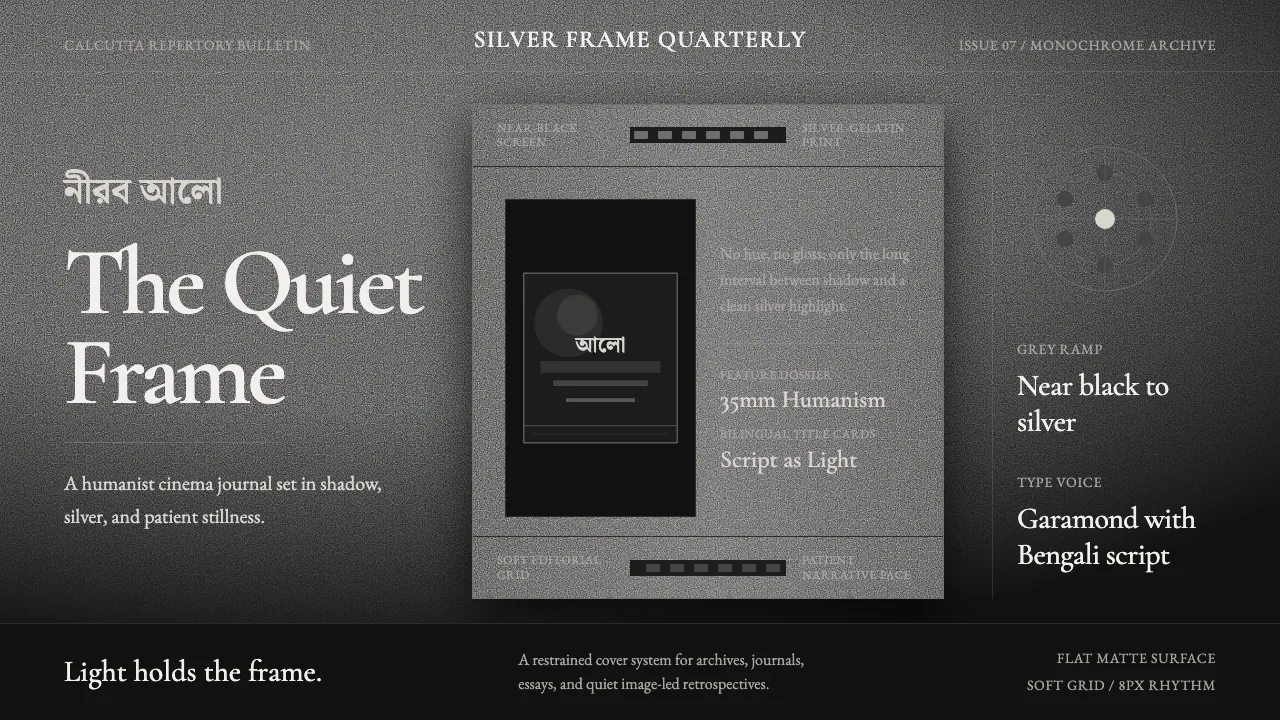
About Bengali Art-House Cinema
Bengali art-house cinema of the Satyajit Ray era is a humanist monochrome world: high-contrast black-and-white 35mm frames and Ray's own hand-drawn calligraphic title cards. The "colour" is a grey ramp running from a near-black screen to a silver-gelatin highlight.
This system distills that chiaroscuro into an interface — a near-black cinema ground, a silver-leaf highlight, a disciplined grey ramp, and Caslon-Garamond serifs paired with Bengali calligraphic script. No hue, no gloss; only light, shadow, and restraint.
- Origin
- South Asia — Bengali cinema, Calcutta (Kolkata), India
- Era
- 1950–1990 (Apu trilogy: Pather Panchali 1955, Aparajito 1956, Apur Sansar 1959)
- Key figures
- Satyajit Ray · Subrata Mitra
- Movements
- Indian parallel/art-house cinema · Humanist neo-realism · Art-deco Calcutta typography
Bengali Art-House Cinema design spec
Colors
Typography
The other 11 sections — buttons, cards, spacing, motion, techniques and more — open once you unlock. Download the DESIGN.md or send it to your AI in one click. Unlock once, yours forever.
Sign up nowStyles similar to Bengali Art-House Cinema
Also inspired by film, games & music, with a close feel.
 Raised by WolvesBleached neo-religious silence. Ash-gray tundra, austere Cormorant serif, one rust-earth accent.
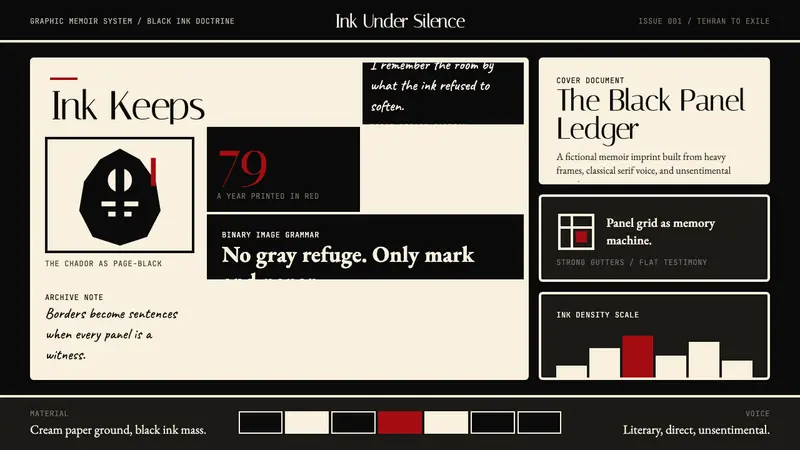 Persepolis (Marjane Satrapi, 2000)Stark memory, pure ink. Cream panels, heavy black borders, one revolution-red strike.
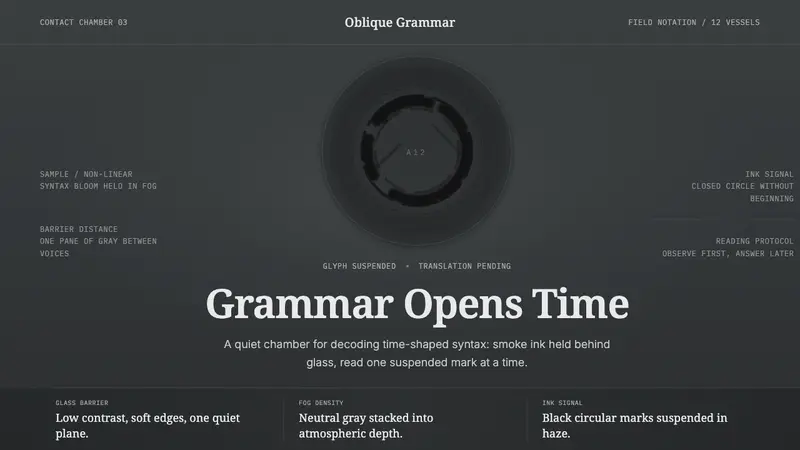 Arrival LogogramFirst contact turns quiet. Fog gray, serif notes, and smoke-black rings decode the unknown.
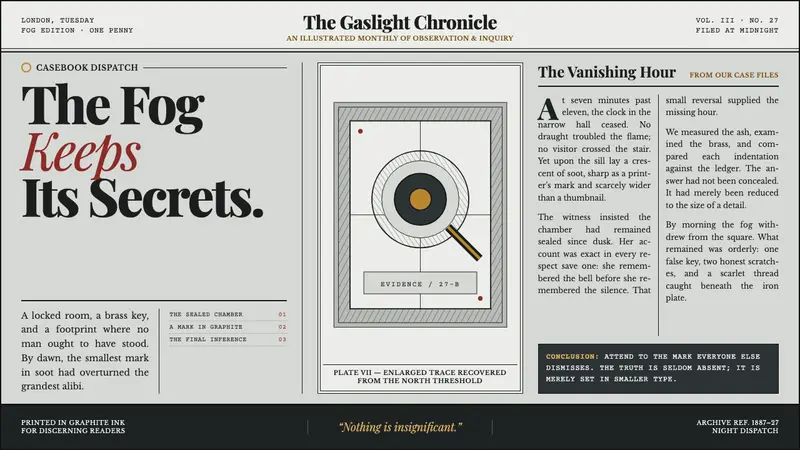 Sherlock Holmes — Baker Street (1887)Mystery, printed in ink. Fog-gray columns and cross-hatched plates glow with gaslight brass.