About Barniz de Pasto
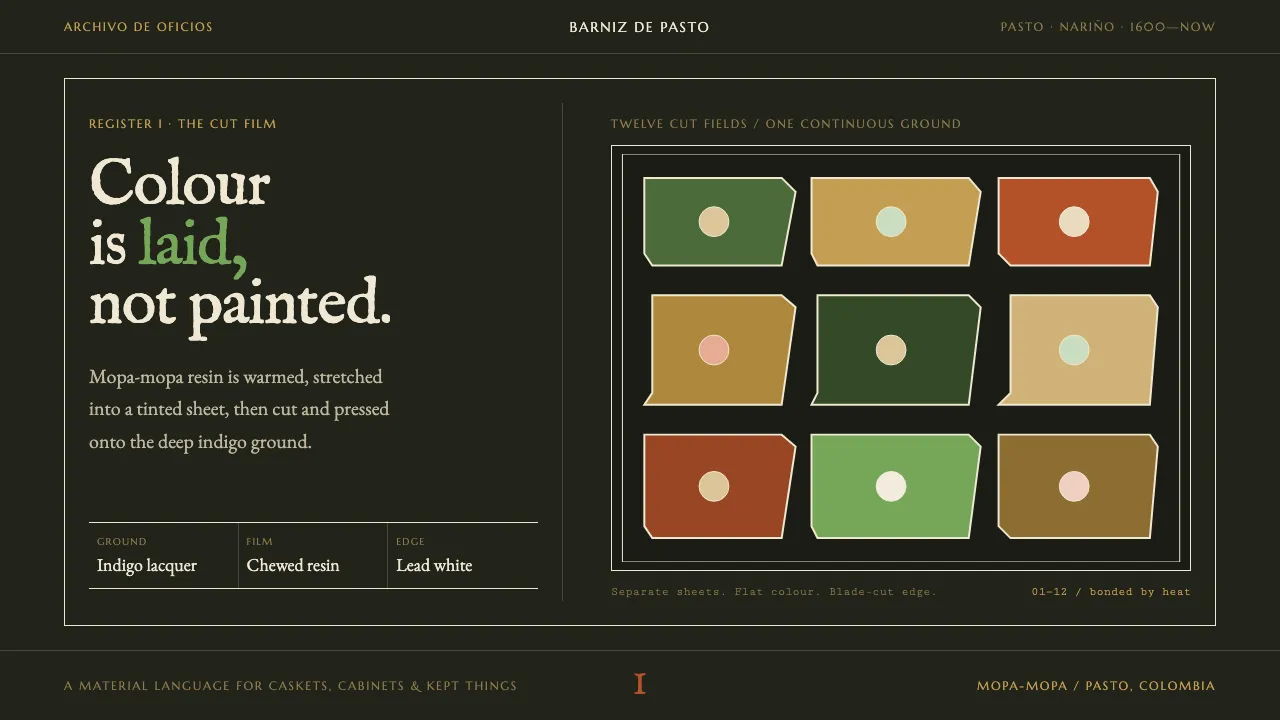
Barniz de Pasto is a lacquer made by hand, not by brush. Stipules of *Elaeagia pastoensis* are chewed and warmed until the mopa-mopa resin turns elastic, stretched into a translucent tinted film, cut with a blade, and heat-bonded onto wood. Every colour is a separate sheet.
The system inherits that logic. The page is the burnished indigo ground the caskets were built on — a warm near-black. Colour arrives as flat cut fields with a lead-white hairline around them, never as shading inside a shape. Depth comes from stacking films and from silver leaf glinting through where the resin runs thin.
- Origin
- Pasto, Nariño, southwestern Colombia (resin harvested in Putumayo)
- Era
- 17th–18th century peak (c. 1600–1750); continuously practised to the present
- Key figures
- Alexander von Humboldt · Luis Eduardo Mora-Osejo · Eduardo Muñoz Lora
- Movements
- viceregal Andean decorative arts · Nanban lacquer imitation · UNESCO Intangible Cultural Heritage 2020
Barniz de Pasto design spec
Colors
Typography
The other 11 sections — buttons, cards, spacing, motion, techniques and more — open once you unlock. Download the DESIGN.md or send it to your AI in one click. Unlock once, yours forever.
Sign up nowStyles similar to Barniz de Pasto
Also inspired by crafts & folk art, with a close feel.
 Yemeni Jambiya Curved DaggerLamp-lit status. Indigo-black fields, butter-yellow horn, and silver filigree borders.
 Ottoman Ebru MarblingLiquid, never tiled. Indigo bath, ochre veins, and glassy bloom edges carry the craft.
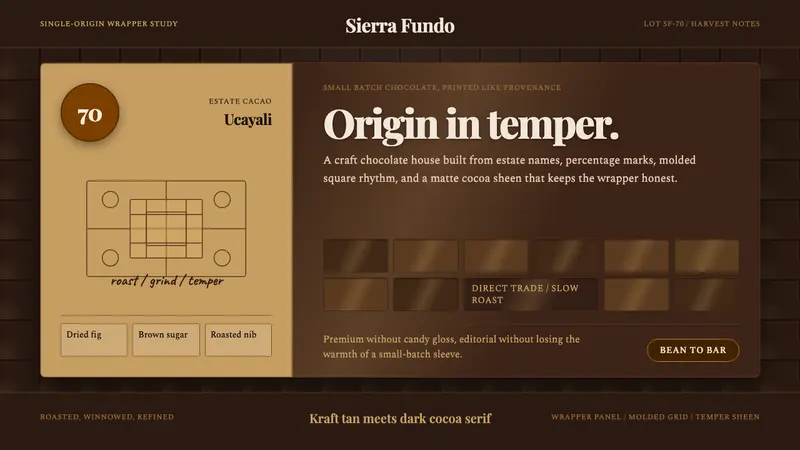 Bean-to-Bar ChocolateOrigin tastes tactile. Cocoa serif, kraft panel, and molded squares carry the story.
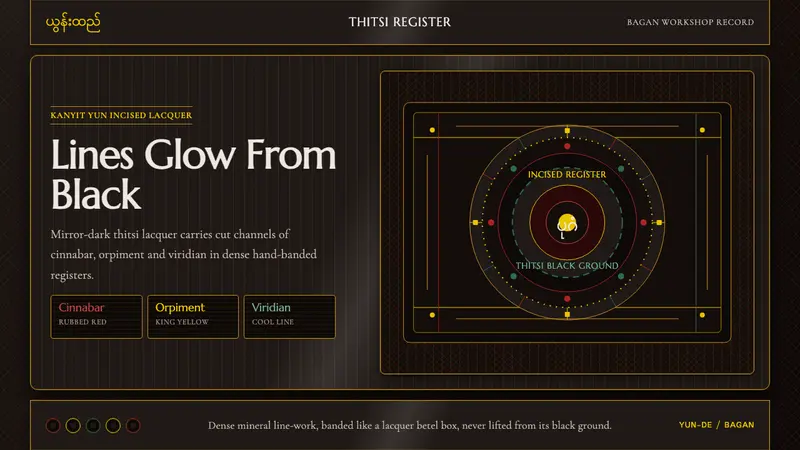 Burmese Yun LacquerwareLacquer glows in cut lines. Cinnabar, orpiment and viridian band a mirror-black grid.