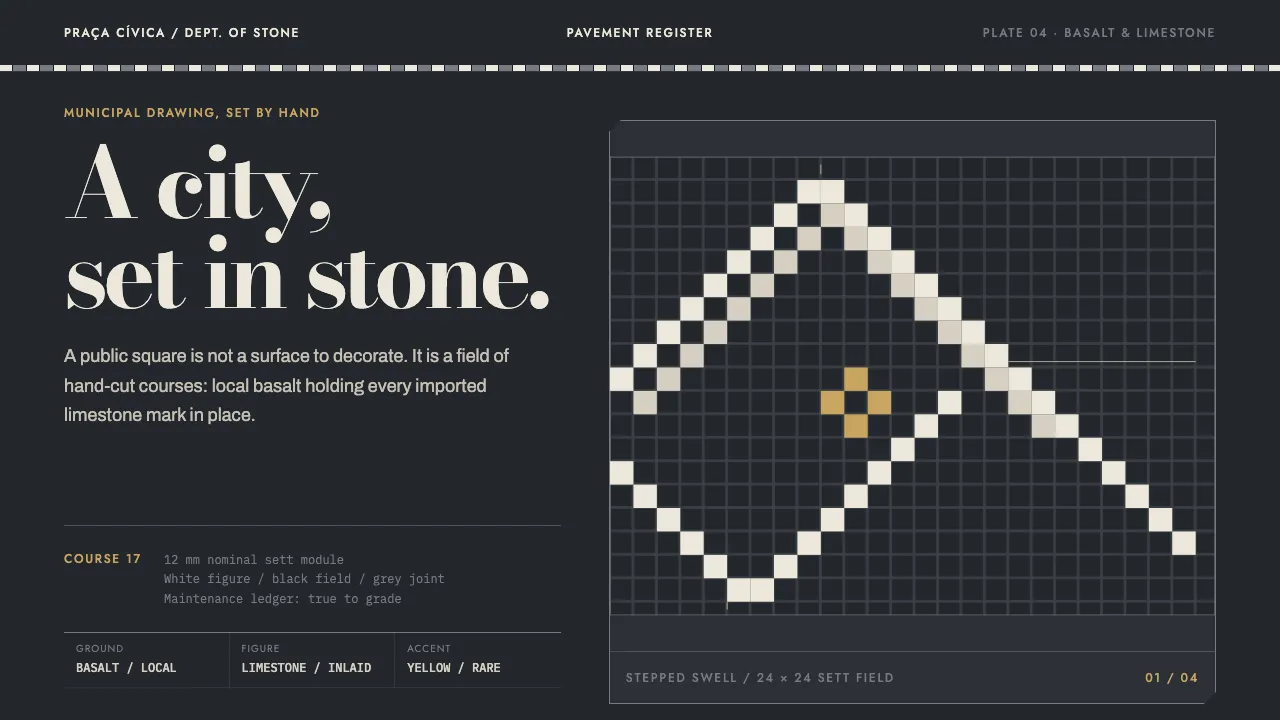
About Calçada Portuguesa
Calçada portuguesa is drawing at the scale of a city, executed in stone. A calceteiro cuts 4–6 cm cubes by hand, beds them on sand and lime, and sets them into waves, stars, compass roses, anchors and caravels. The mainland lays white limestone figures on a dark field; Ponta Delgada inverts the supply chain, quarrying its own black basalt for the ground and shipping limestone in from Portugal.
This system takes the pavement literally. The page is basalt. Every figure is quantised to the sett grid, so curves climb in stepped courses rather than sliding along a Bézier. Panels are inlaid, not floated. It is municipal infrastructure with a maintenance line item, and it should read that way.
- Origin
- Ponta Delgada, São Miguel, Azores, Portugal
- Era
- 1842 first trial pavement; the Azorean civic programme 1900–1950; still laid today
- Key figures
- Eusébio Pinheiro Furtado · the calceteiros of Lisbon and Ponta Delgada
- Movements
- calçada portuguesa · Portuguese civic paving · azulejo street-plate lettering
Calçada Portuguesa design spec
Colors
Typography
The other 11 sections — buttons, cards, spacing, motion, techniques and more — open once you unlock. Download the DESIGN.md or send it to your AI in one click. Unlock once, yours forever.
Sign up nowStyles similar to Calçada Portuguesa
Also inspired by crafts & folk art, with a close feel.
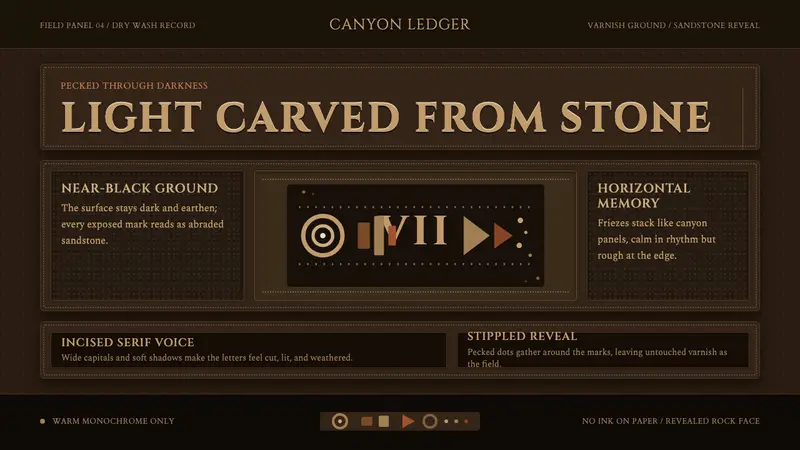 Desert VarnishStone remembers. Sandstone glyphs cut through near-black varnish in stacked friezes.
 Balinese Barong Mask (1920)Protection glows after dark. Cinzel capitals frame gold, ruby, and emerald geometry.
 Zoroastrian Fire TempleSacred fire in stone darkness. Cinzel capitals, ember orange, and gold relief symmetry.
 Haitian Vodou VèvèSomber ritual glow. Powder-white lines on violet-black earth, touched by candle gold.