
About Haitian Vodou Vèvè
Haitian Vodou vèvè are sacred ground-drawings, sprinkled by hand in flour and cornmeal directly onto the bare earth floor of a temple, each a cosmogram that summons a specific lwa. Born of the African diaspora in colonial Saint-Domingue, the tradition fuses Fon and Kongo religious signs with Catholic iconography, and is performed in candlelight — pale powder lines glowing against near-black violet-tinged ground.
Translated to interface, the aesthetic is somber and ceremonial: a dark earth-floor canvas, powder-white symmetrical line-art, Gede purple as the brand voice, and small bursts of candlelight gold. It is hand-drawn, never vector-clean — the lines carry the soft dispersion of sprinkled flour.
- Origin
- Haiti, Caribbean / African diaspora
- Era
- 1900–1950 (rooted in 18th-century colonial Saint-Domingue)
- Key figures
- Houngan and mambo (Vodou priests and priestesses) · the Gede family · Baron Samedi · Papa Legba
- Movements
- Haitian Vodou · syncretic Fon tradition · Kongo cosmology · Catholic iconography
Haitian Vodou Vèvè design spec
Colors
Typography
The other 11 sections — buttons, cards, spacing, motion, techniques and more — open once you unlock. Download the DESIGN.md or send it to your AI in one click. Unlock once, yours forever.
Sign up nowStyles similar to Haitian Vodou Vèvè
Also inspired by crafts & folk art, with a close feel.
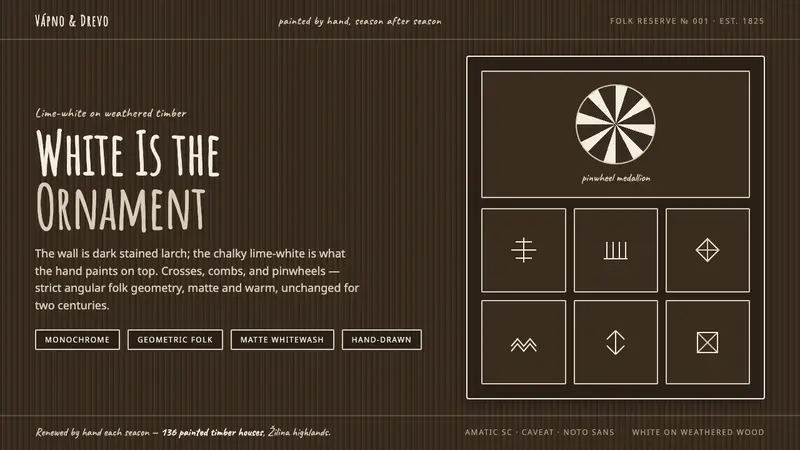 Čičmany Painted House OrnamentWhite is the ornament, not the page. Lime-white folk geometry on dark weathered Slovak timber.
 Hanukkah MenorahEight nights kindled in tekhelet. Royal blue and silver hold the dark room; gold is only the flame.
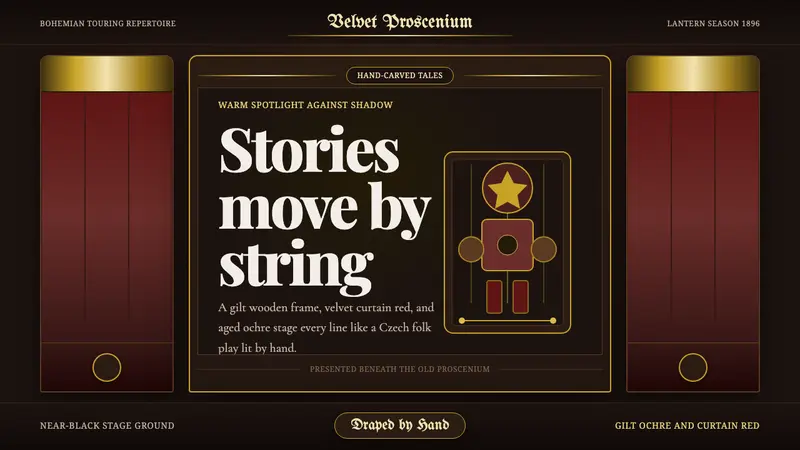 Marionette TheaterStorytelling feels hand-lit. Curtain red, gilt borders, and carved serif type frame the stage.
 Wayang Kulit ShadowNight makes gold sacred. Cinzel capitals and perforated ochre frames glow like lamp-cut hide.