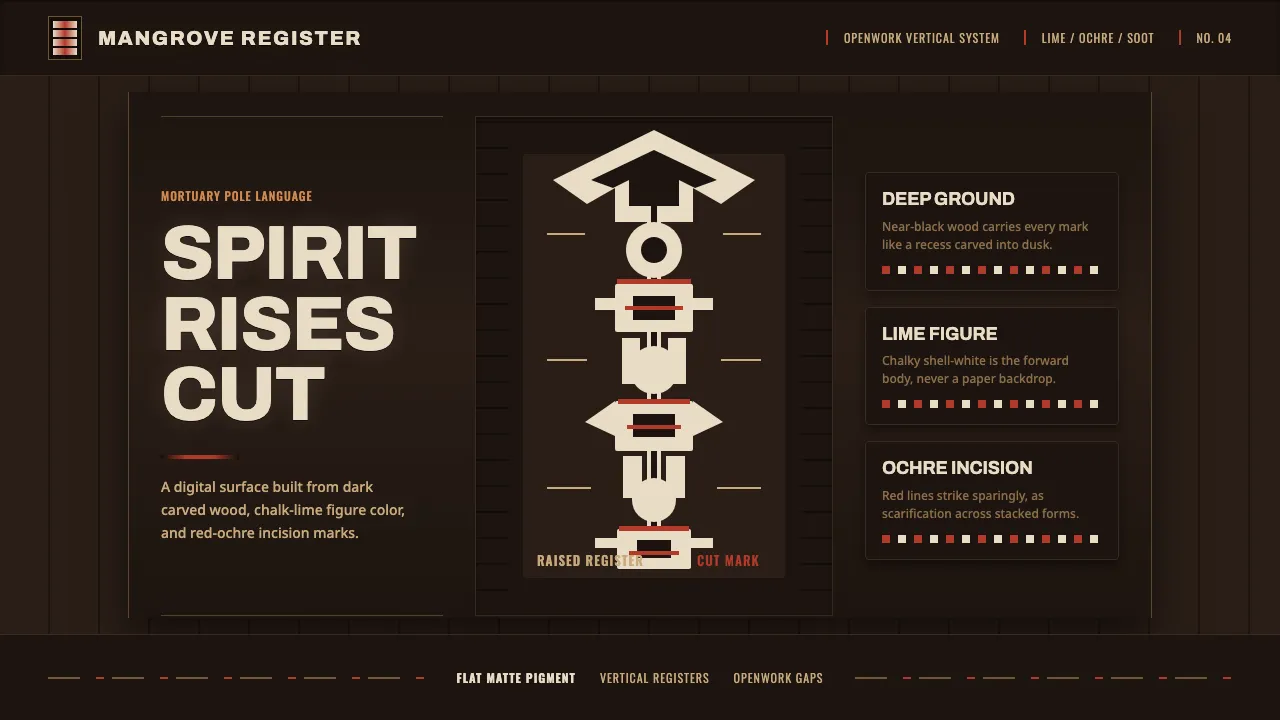
About Asmat Bisj Ancestor Pole
The Asmat *bisj* pole is a ritually felled mangrove-wood monument carved as stacked openwork human figures, crowned by a pierced *tjemen* wing-board, raised to honor the dead and summon their avenging spirit. Carvers first coat the entire surface in white burnt-shell lime, then mark it with red ochre for scarification lines and black soot for hair — a strict three-pigment code laid over deeply cut, matte wood.
This design system distills that monument into a digital language — a near-black carved-wood ground, lime-white as the glowing figure color (never mistaken for paper cream), and red-ochre as the primary accent. Every surface is flat, matte, and vertical, echoing the pole's unbroken rise from base to fretwork crest.
- Origin
- Asmat region, southwest New Guinea (now Papua, Indonesia), Oceania
- Era
- 1900–1950 ceremonial tradition (bisj feasts to honor and avenge the dead)
- Key figures
- Asmat wow-ipits (master carvers) · bisj feast sponsors and clan elders
- Movements
- Asmat bisj-pole mortuary tradition · ancestor-veneration and avenger imagery
Asmat Bisj Ancestor Pole design spec
Colors
Typography
The other 11 sections — buttons, cards, spacing, motion, techniques and more — open once you unlock. Download the DESIGN.md or send it to your AI in one click. Unlock once, yours forever.
Sign up nowStyles similar to Asmat Bisj Ancestor Pole
Also inspired by crafts & folk art, with a close feel.
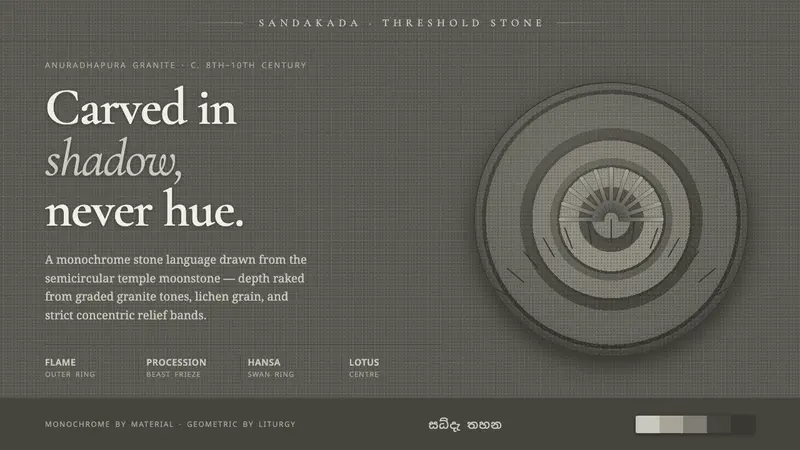 Sandakada Pahana MoonstoneDepth carved from shadow, never hue. Weathered-granite grays in concentric moonstone bands.
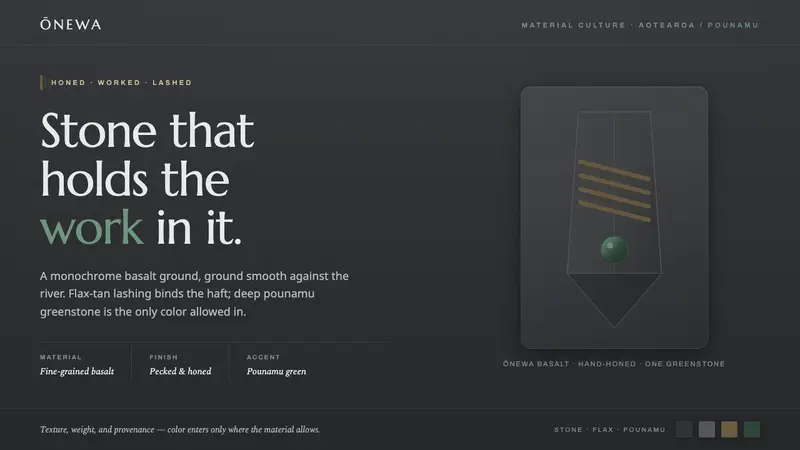 Māori Volcanic StoneColor enters only where the stone allows. Honed charcoal basalt, flax lashing, one pounamu green.
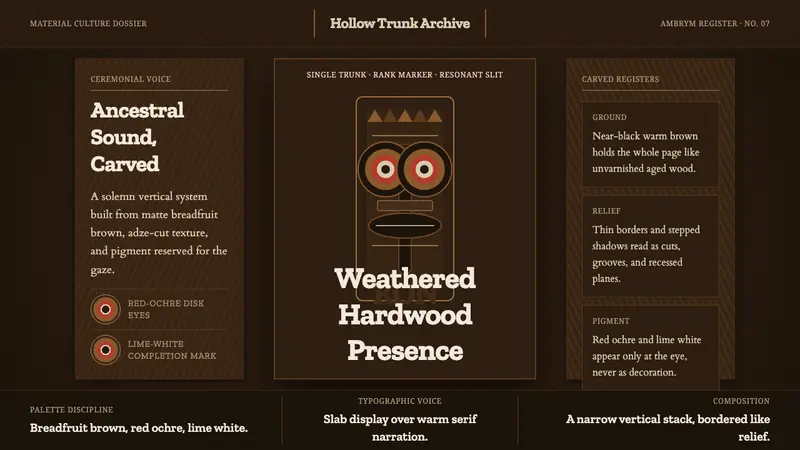 Ni-Vanuatu Slit Gong AmbrymSolemn wood made digital. Dark breadfruit brown, carved borders, red-ochre eye disks.
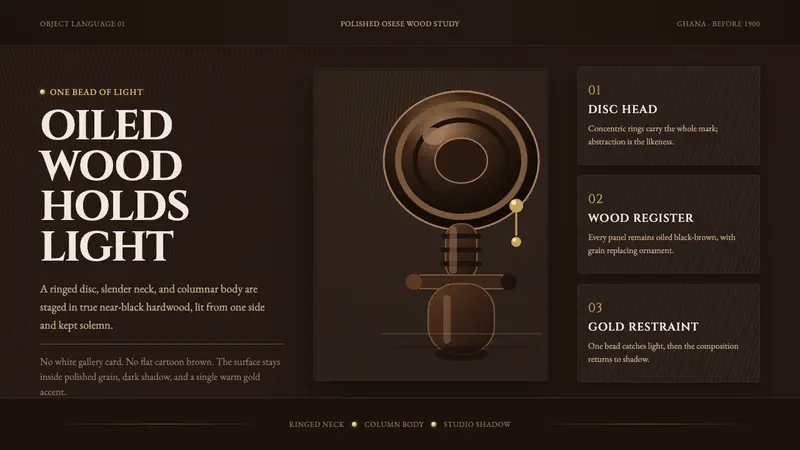 Akuaba Akan Fertility DollDarkness becomes sculpture. Near-black wood, ringed geometry, and one gold bead hold the light.