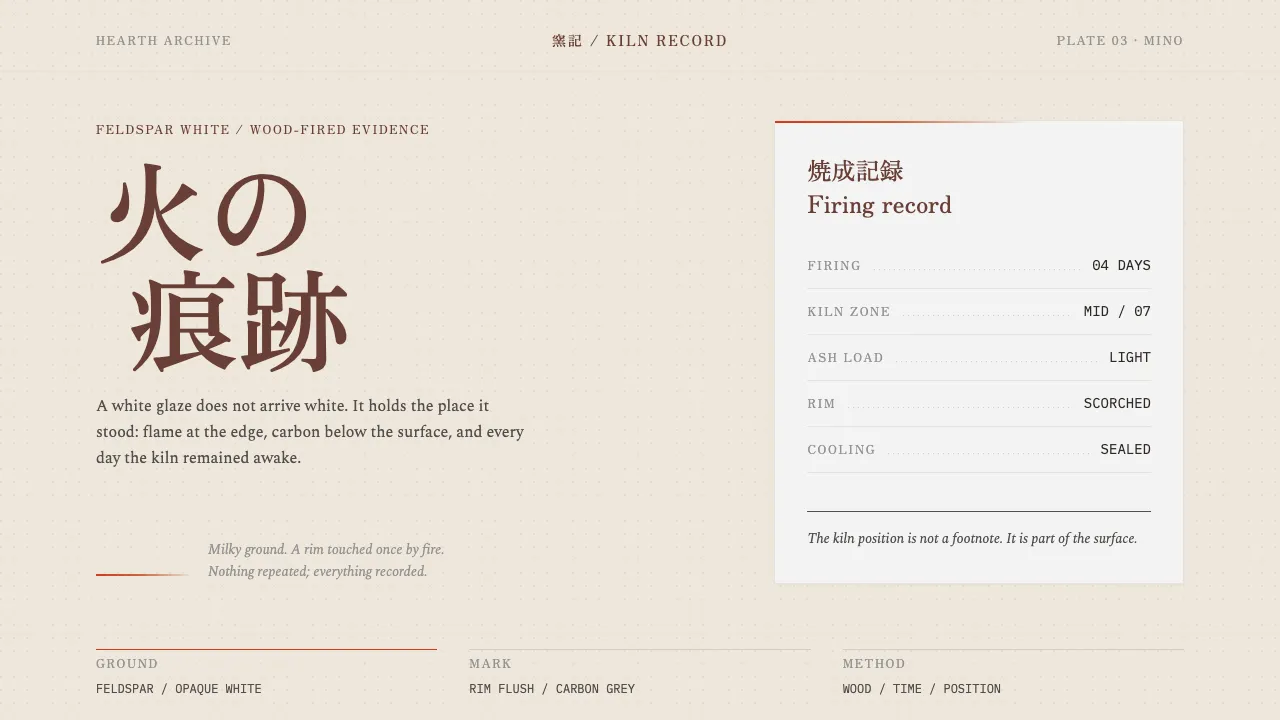
About Anagama Shino Glaze
Shino was the first white glaze in Japanese ceramics — ground local feldspar laid on thick and fired for days in a wood-burning tunnel kiln at Mino. It comes out milky and opaque, pinholed like citron skin, blushing orange-red where fire reached the rim and the glaze edge, spotted charcoal grey where carbon was trapped.
Because colour depends entirely on where a pot stood in the kiln, the pot is never shown alone. This system pairs a soft, off-axis form on generous empty ground with a square, sparse record card: firing days, kiln position, ash load. Hairline rules, no ornament, wide margins.
- Origin
- Mino, Gifu Prefecture, Japan
- Era
- Momoyama period c.1573–1615 at the Mino kilns; revived from 1930
- Key figures
- 荒川豊蔵 Arakawa Toyozō · 加藤唐九郎 Katō Tōkurō · 古田織部 Furuta Oribe
- Movements
- Momoyama tea ceramics and wabi-cha · Mino ware · anagama wood firing
Anagama Shino Glaze design spec
Colors
Typography
The other 11 sections — buttons, cards, spacing, motion, techniques and more — open once you unlock. Download the DESIGN.md or send it to your AI in one click. Unlock once, yours forever.
Sign up nowStyles similar to Anagama Shino Glaze
Also inspired by crafts & folk art, with a close feel.
 Undyed Khadi WhiteModest, never cream. Greige homespun cotton with gray slub flecks and plain humanist sans.
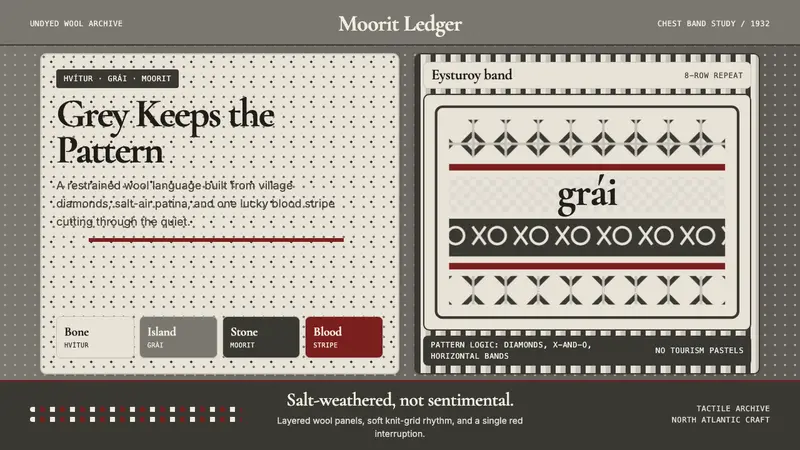 Faroese Knit Pattern Island GreyWeathered wool, not cozy kitsch. Island greys, Cormorant serif, one blood-red stripe.
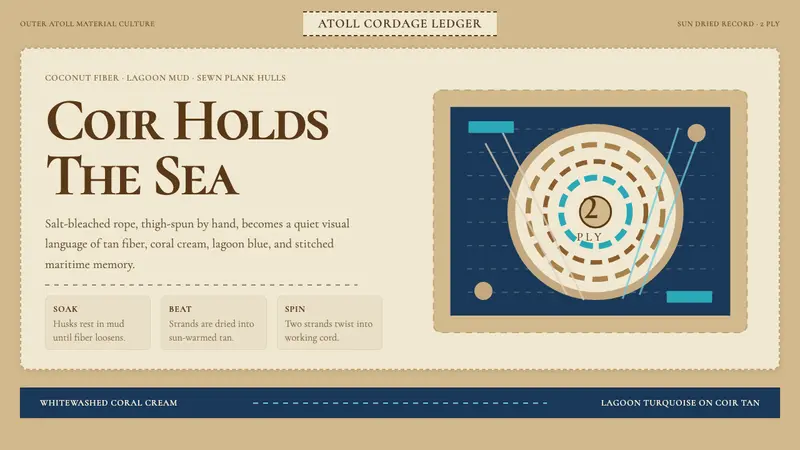 Maldivian Coir (Coconut Rope)Ocean-tested craft. Coir tan, coral cream, Cormorant type, and dashed seam geometry.
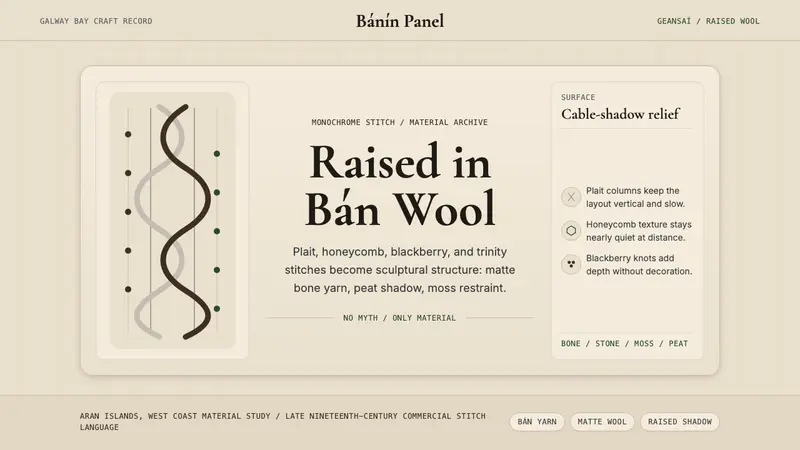 Irish Aran Island Cable KnitMaterial honesty raised in wool. Bone ground, moss ink, and cable columns cast quiet shadow.