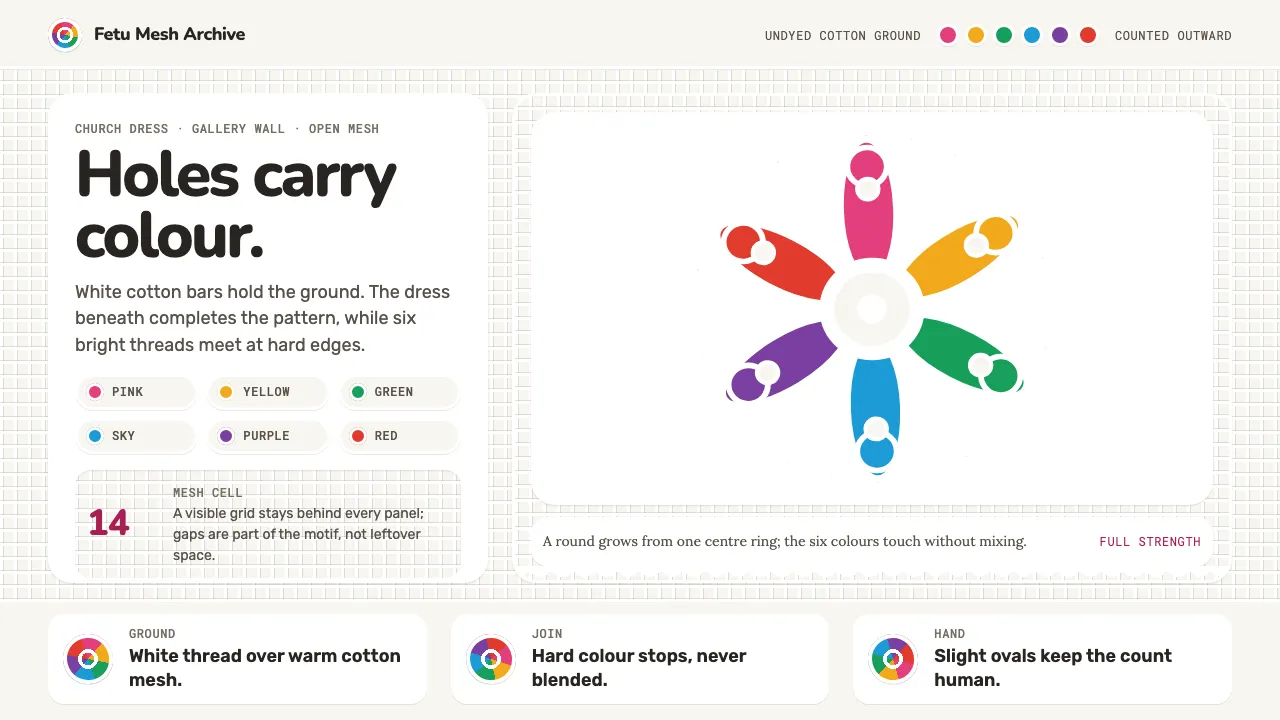
About Tuvaluan Kolose
Kolose is the Tuvaluan word for crochet, borrowed from the English and then made into something else entirely. The ground is a fine openwork mesh in undyed white mercerised cotton. Into that mesh go motifs in the brightest colours the maker can get — pink, yellow, red, sky blue, green, purple — set side by side at full strength with nothing blended between them.
The holes are not absence. A tiputa is worn to church over a coloured dress, so the open mesh reads as whatever is behind it. Fill the holes and the pattern is gone. Everything is worked in the round from a centre ring, counted by hand, and slightly oval because hands are.
- Origin
- Tuvalu, and the Tuvaluan communities of Aotearoa New Zealand
- Era
- introduced early 20th century via mission and church women's groups; mature by mid-century, still growing
- Key figures
- Lakiloko Keakea · Tuvaluan church women's groups · Pātaka Art + Museum
- Movements
- Pacific fibre arts · mission-era craft transfer localised into an indigenous form · contemporary Pacific art in Aotearoa
Tuvaluan Kolose design spec
Colors
Typography
The other 11 sections — buttons, cards, spacing, motion, techniques and more — open once you unlock. Download the DESIGN.md or send it to your AI in one click. Unlock once, yours forever.
Sign up nowStyles similar to Tuvaluan Kolose
Also inspired by crafts & folk art, with a close feel.
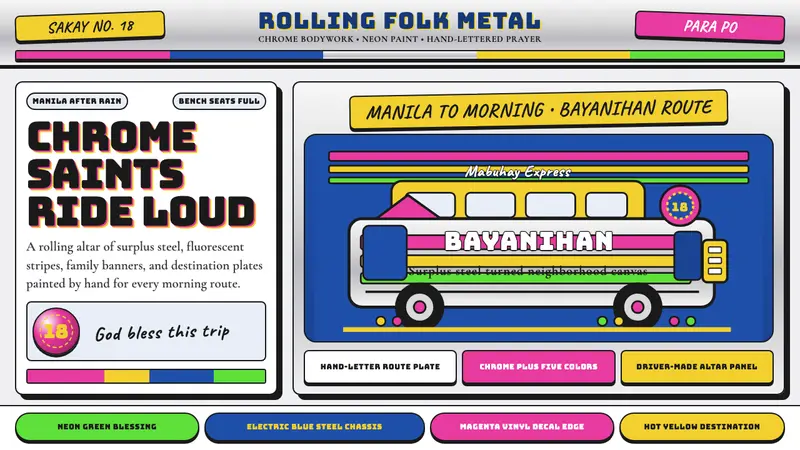 Filipino JeepneyLoud steel, made personal. Chrome gradients carry neon stripes and hand-lettered plates.
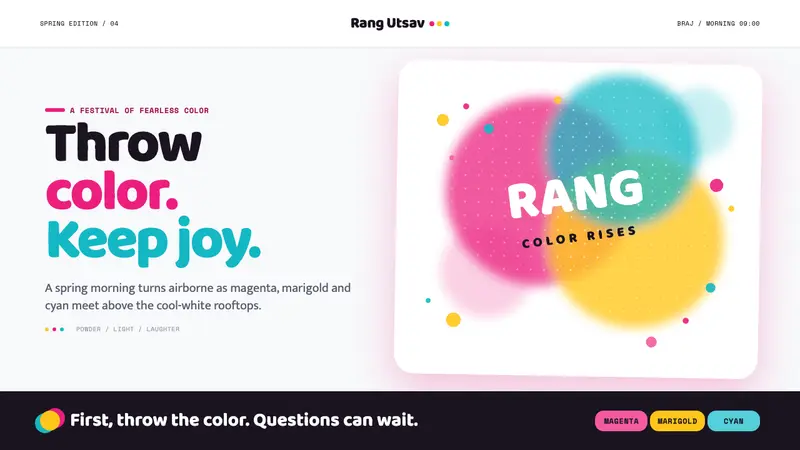 Holi Festival of ColorsColor refuses to sit still. Magenta, marigold and cyan powder bloom across cool white.
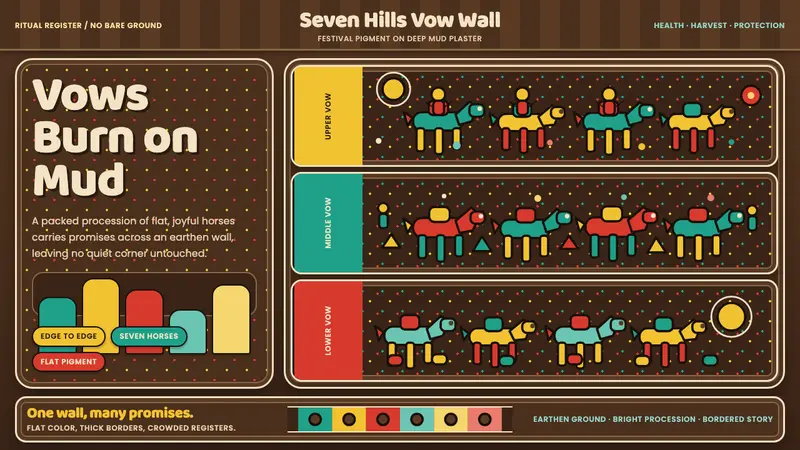 Pithora Rathwa Ritual WallVows fill the wall. Bright horse rows crowd deep mud-brown plaster edge to edge.
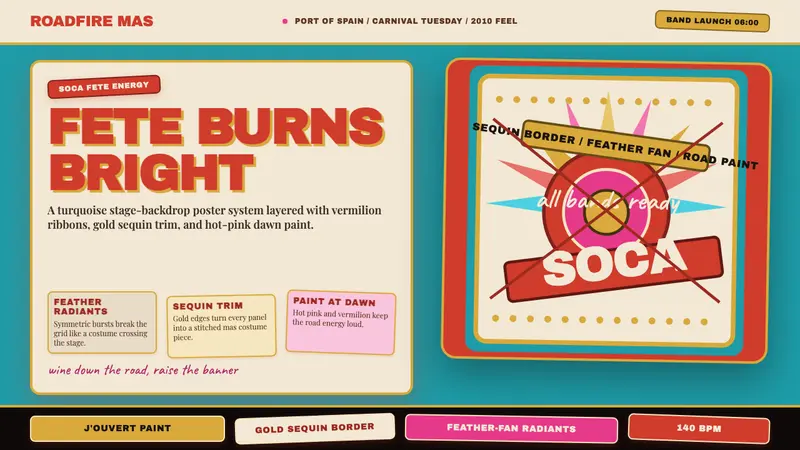 Trinidad Carnival Soca (2010)Joy overload. Turquoise field, vermilion banners, gold sequins, feather-fan geometry.