About Lepcha Bamboo Craft
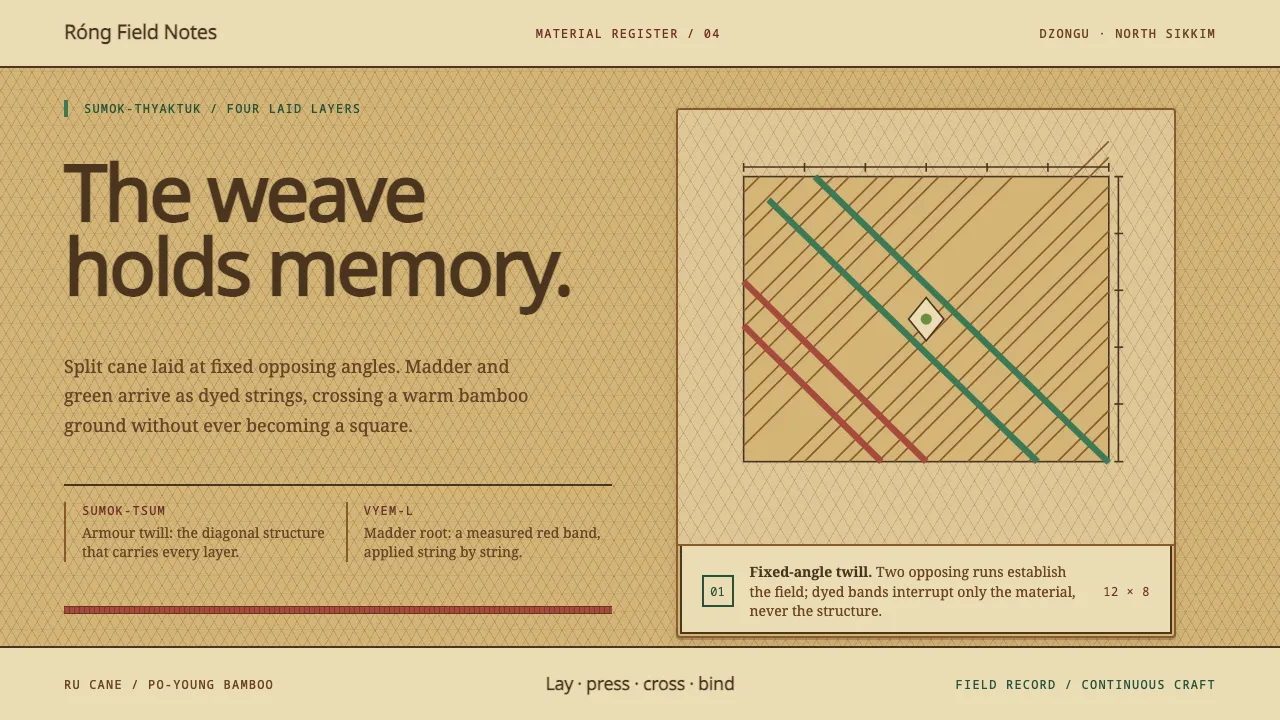
In Dzongu, North Sikkim, Lepcha weavers shred *Ru* cane and *Po-young* bamboo into strings no wider than a fingernail and lay them flat, layer over layer, into the conical Sumok-thyaktuk once worn by the Sikkim Guard. Each of the four layers has a name taken from what it resembles: the spider's web, the bee's eye, the design of armour.
This system takes the hat literally. The page is the colour of split bamboo, not paper. Structure runs on the diagonal, because the strings cross at fixed angles and never square up. Colour arrives as dyed bands — madder root and green — laid across the weave at intervals, not as gradient or wash.
- Origin
- Dzongu, North Sikkim, Eastern Himalaya, India
- Era
- pre-1900 and continuous; Sikkim Guard regalia of the Chogyal period, revived from the 2000s
- Key figures
- Jordan Lepcha · Sonam Lepcha · Ghanashyam Gurung · M. L. Arrawatia
- Movements
- Róng material culture · Himalayan cane-and-bamboo weaving · Thara craft of Sikkim
Lepcha Bamboo Craft design spec
Colors
Typography
The other 11 sections — buttons, cards, spacing, motion, techniques and more — open once you unlock. Download the DESIGN.md or send it to your AI in one click. Unlock once, yours forever.
Sign up nowStyles similar to Lepcha Bamboo Craft
Also inspired by crafts & folk art, with a close feel.
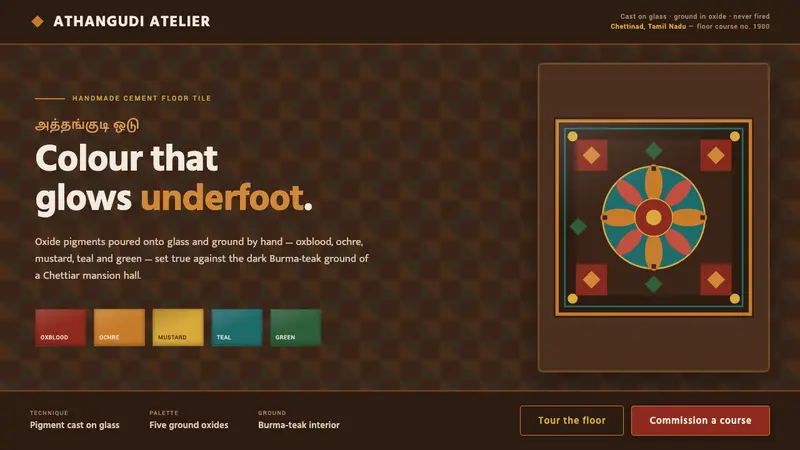 Chettinad Athangudi TilesColour that glows underfoot. Five ground-oxide tones on dark teak in bordered tile-grid medallions.
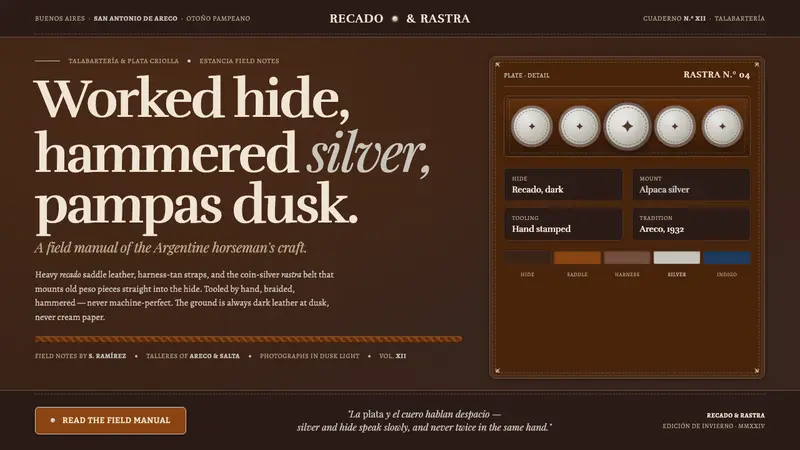 Gaucho LeatherHand-worked horseman craft. Dark recado leather, harness tan, coin-silver rastras at pampas dusk.
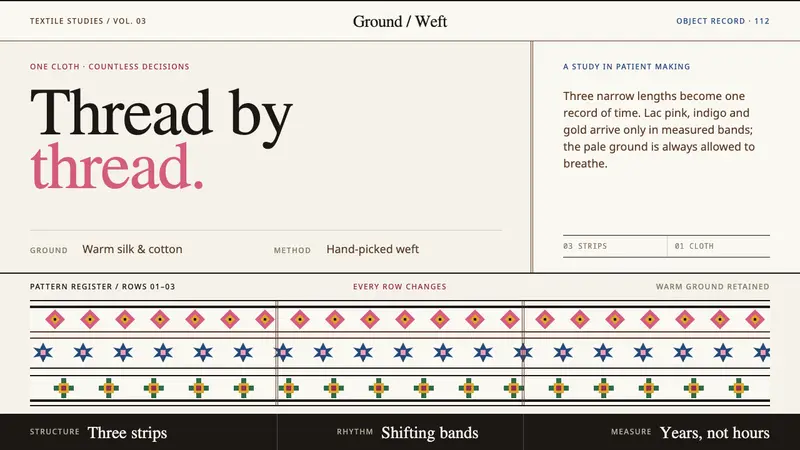 Bhutanese KushutharaPatience made visible. Lac pink and indigo bands shift across a warm silk ground.
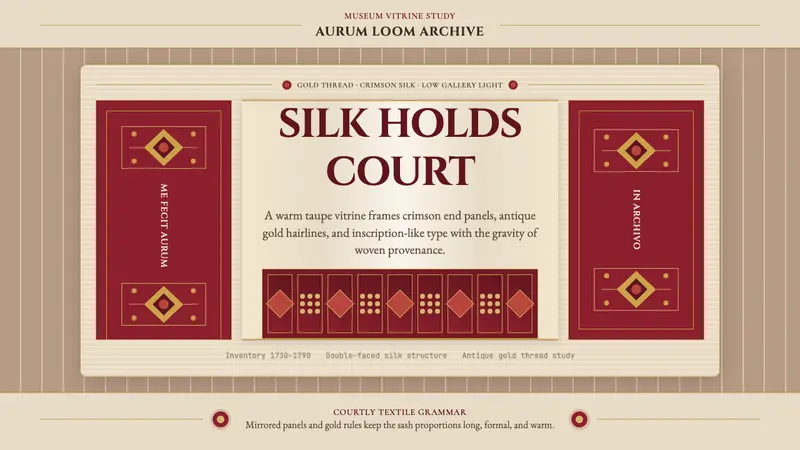 Belarusian Slutsk SashCourtly silk, vitrined. Taupe ground, crimson panels, Cinzel type, antique gold hairlines.