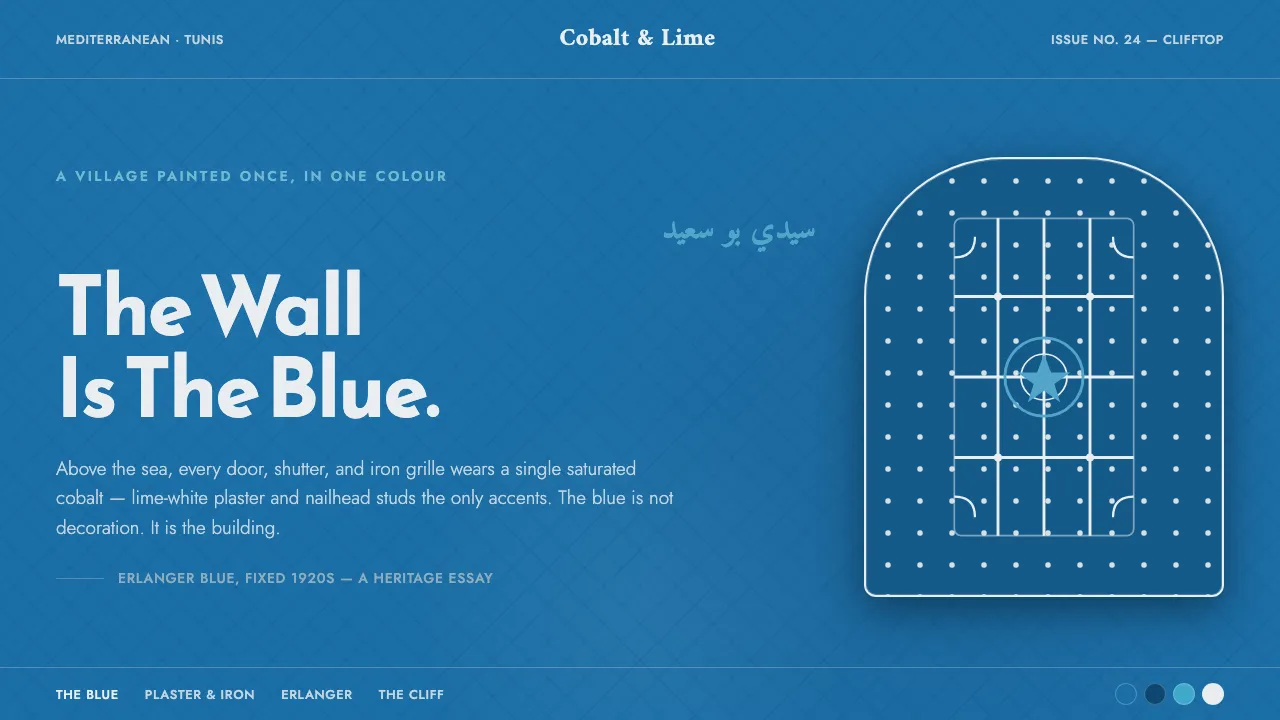
About Sidi Bou Said Blue
Sidi Bou Said is the Tunisian clifftop village whose whitewashed houses wear their doors, shutters, and wrought iron in a single saturated cobalt-cyan — the "Tunisian blue" fixed in the 1920s by Baron Rodolphe d'Erlanger. Above the Mediterranean, lime-white plaster and iron-black studs frame this deep painted blue.
This system makes the page itself the blue: a saturated cobalt-cyan ground, with crisp lime-white plaster as the accent and wrought-iron curls, nailhead studs, and mashrabiya lattice as recurring motifs. Reem Kufi and Amiri honor the Maghrebi-Arabic display register; Jost provides a clean Mediterranean Latin sans.
- Origin
- Sidi Bou Said, Tunisia (Mediterranean clifftop near Carthage/Tunis)
- Era
- 1900–1950 (the blue-and-white codification, 1920s onward)
- Key figures
- Baron Rodolphe d'Erlanger
- Movements
- Tunisian Mediterranean vernacular · Andalusian-Ottoman decorative tradition · Maghrebi blue-and-white architecture
Sidi Bou Said Blue design spec
Colors
Typography
The other 11 sections — buttons, cards, spacing, motion, techniques and more — open once you unlock. Download the DESIGN.md or send it to your AI in one click. Unlock once, yours forever.
Sign up nowStyles similar to Sidi Bou Said Blue
Also inspired by architecture & places, with a close feel.
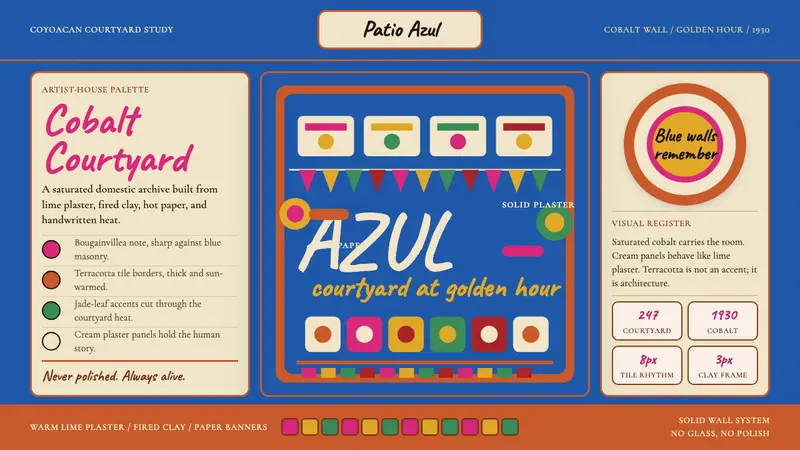 Mexican Frida Blue House (Coyoacán 1930)Maximum color, intimate walls. Cobalt, cream panels, terracotta grid, cut-paper rhythm.
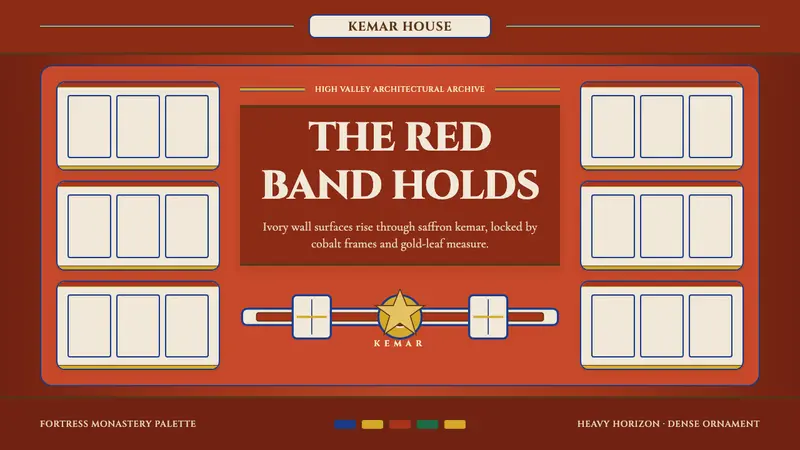 Bhutanese Dzong (Fortress Red)Monumental red holds the page. Cobalt frames and gold bands lock the fortress rhythm.
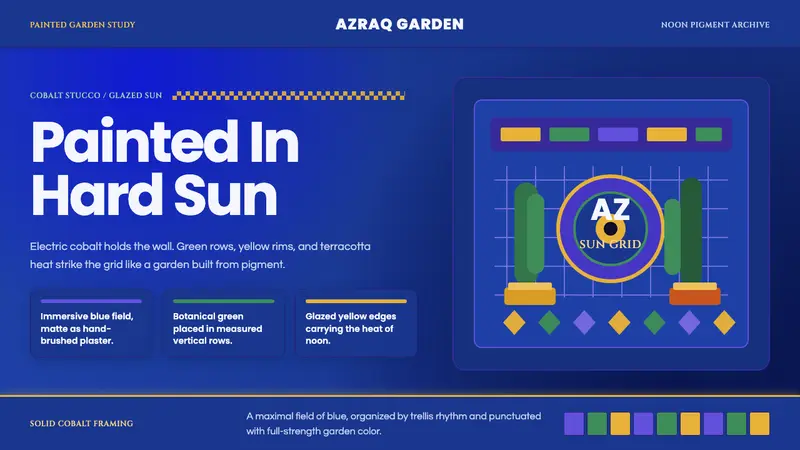 Jardin Majorelle BlueCobalt refuses restraint. Electric blue, glazed yellow and grid rhythm turn stucco into sun.
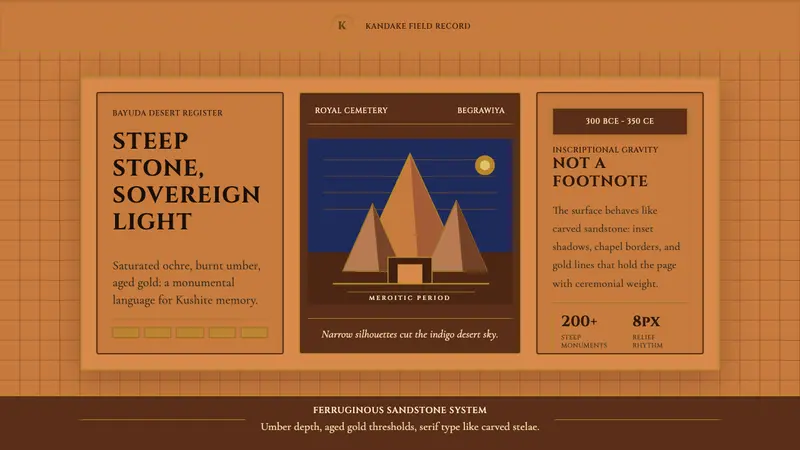 Sudanese Nubian Meroë PyramidMonumental, not muted. Ochre sandstone, umber depth, gold borders, and Cinzel stelae type.