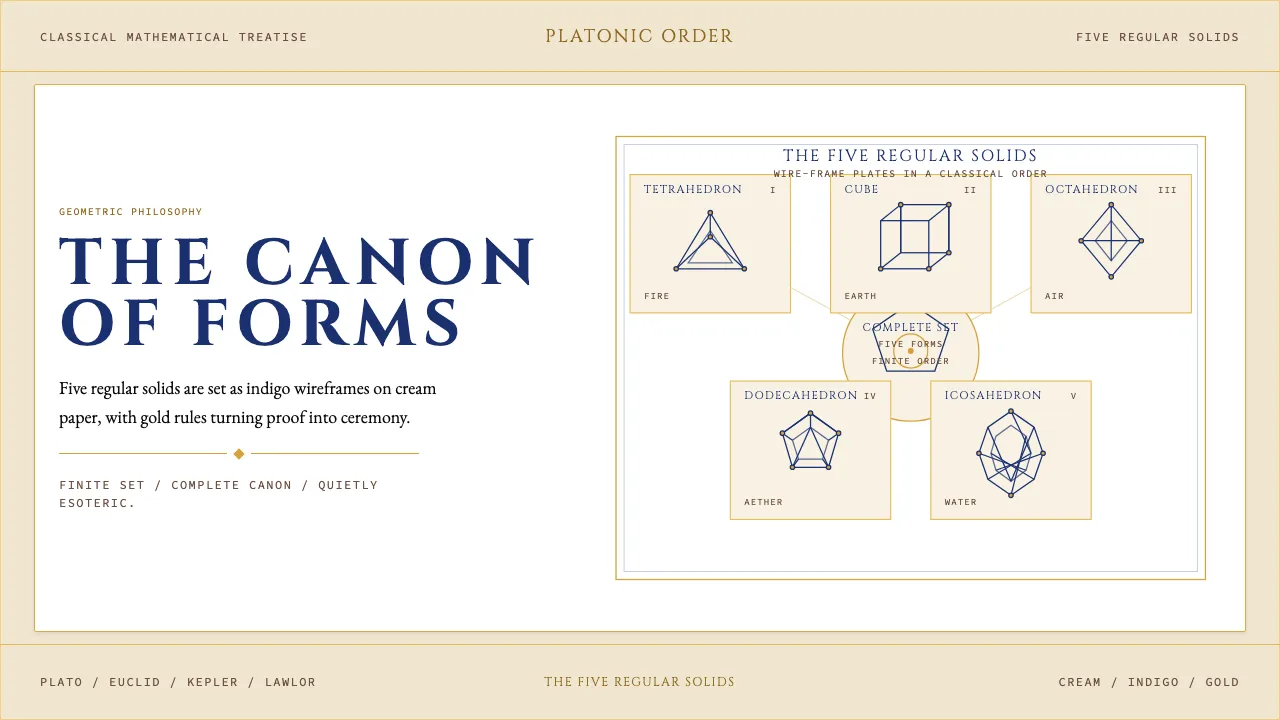
About Sacred Geometry Platonic Solids
Sacred Geometry Platonic Solids is the visual language of a classical mathematical treatise — warm cream paper, deep-indigo ink, warm-gold filigree, and the five Platonic solids rendered as 3D wireframes. It treats geometry as philosophy, not decoration.
The system reads like Plato's *Timaeus* set in metal type: generous letter-spacing, serif headings in Cinzel, body in EB Garamond, monospace formulas in Source Code Pro. Every page feels measured, restrained, and quietly esoteric — a contemplative object, not a marketing screen.
- Origin
- International — classical Greek origin, global mathematical canon
- Era
- Plato's Timaeus ~360 BCE + Euclid's Elements ~300 BCE; ongoing 2400+ year sacred-geometry tradition
- Key figures
- Plato · Euclid · Johannes Kepler · Robert Lawlor
- Movements
- classical Greek geometry · Renaissance Neoplatonism · esoteric mathematical tradition
Sacred Geometry Platonic Solids design spec
Colors
Typography
The other 11 sections — buttons, cards, spacing, motion, techniques and more — open once you unlock. Download the DESIGN.md or send it to your AI in one click. Unlock once, yours forever.
Sign up nowStyles similar to Sacred Geometry Platonic Solids
Also inspired by science & nature, with a close feel.
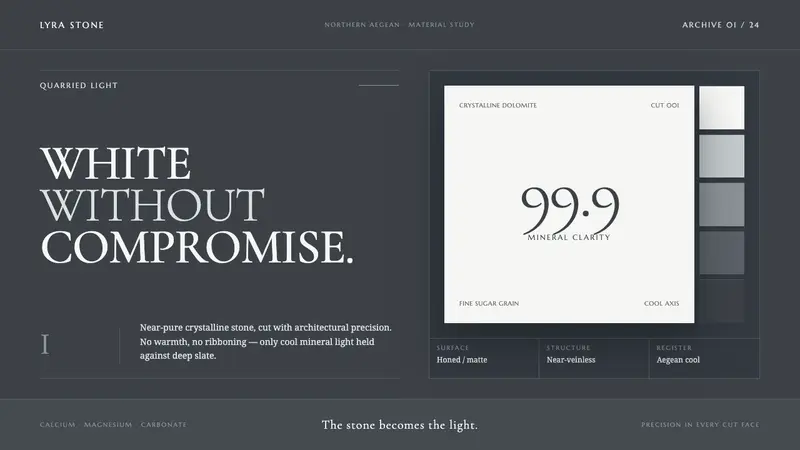 Thassos White MarbleWhite becomes material. Crystalline serif forms float on deep, cool Aegean slate.
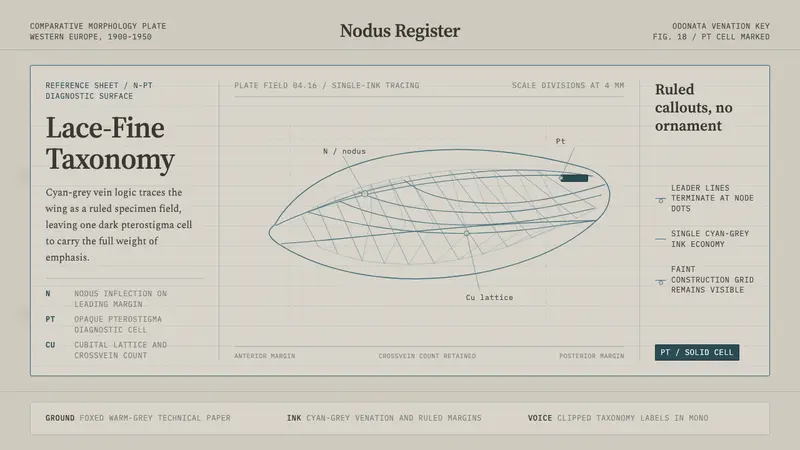 Dragonfly Wing VenationPrecision, nearly weightless. Cyan-grey veins rule a foxed paper taxonomy plate.
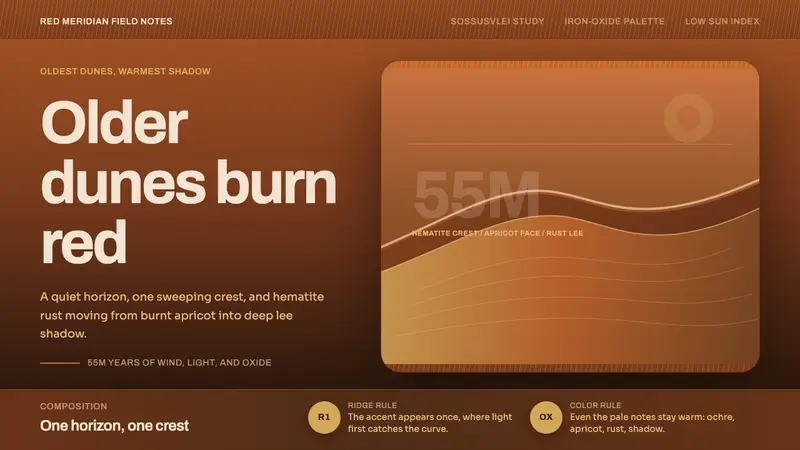 Namib Sand DunesStillness burns warm. Rust, apricot, and one S-curve ridge hold the whole poster.
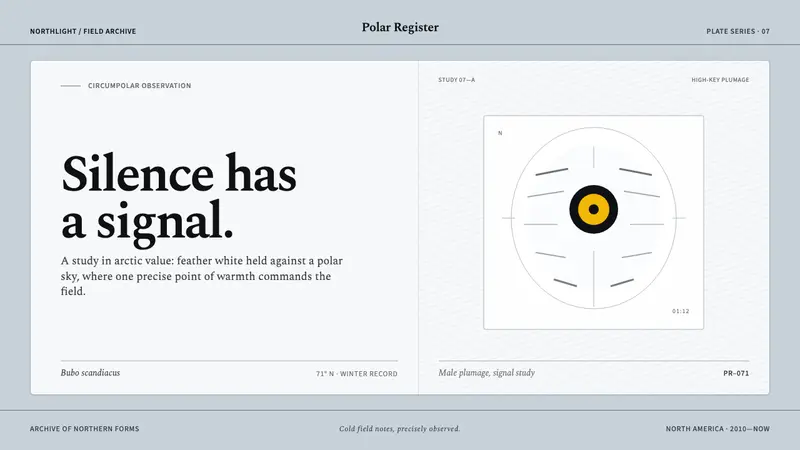 Snowy Owl TundraCold precision, one warm signal. Feather white and charcoal frame a lone lemon-yellow eye.