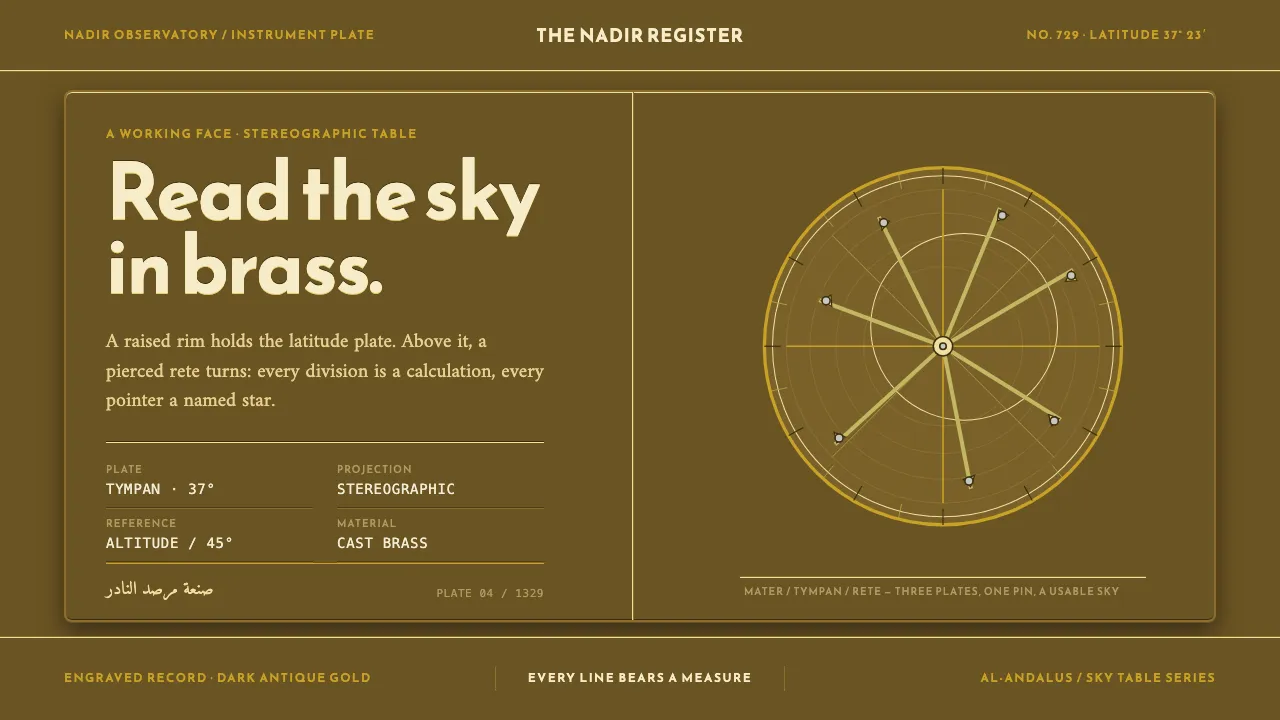
About Planispheric Astrolabe
A planispheric astrolabe is an analogue computer for the sky, cast in brass because wood warps. A raised-rim mater holds a stack of tympans — one engraved per latitude — under a pierced rete whose filed star-pointers and off-centre ecliptic ring turn over them.
The surviving instruments sit at a dark antique-gold patina, bright only where pointers and cut scales catch light. Star names run in Kufic beneath the pointers; the back carries the shadow square, the calendar and the trigonometric scales. Nothing on the face is decoration — every line is a working scale.
- Origin
- The Islamic world, from the Maghreb to al-Andalus — Alcalá, near Sevilla
- Era
- 12th–14th century instruments; Maghribi astrolabe c. 1145–1155 and al-Sharfi's of AH 729 / AD 1329
- Key figures
- Ahmad ibn Ali al-Sharfi
- Movements
- Islamic mathematical astronomy · Stereographic projection · Andalusi and Maghribi instrument-making
Planispheric Astrolabe design spec
Colors
Typography
The other 11 sections — buttons, cards, spacing, motion, techniques and more — open once you unlock. Download the DESIGN.md or send it to your AI in one click. Unlock once, yours forever.
Sign up nowStyles similar to Planispheric Astrolabe
Also inspired by science & nature, with a close feel.
 Slovenian Postojna Cave (Karst)Serious geology. Limestone gray, groundwater blue, and Inter type cut by one candle beam.
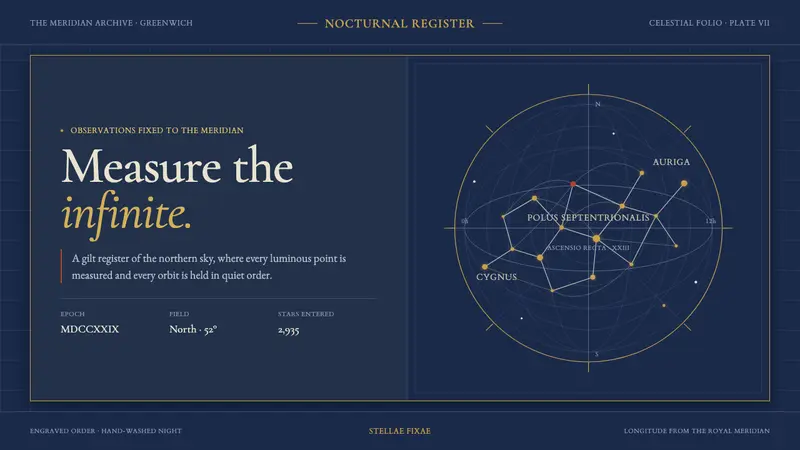 Flamsteed Atlas CoelestisMeasurement wears mythology. Ivory engravings and gilt stars cross a deep indigo grid.
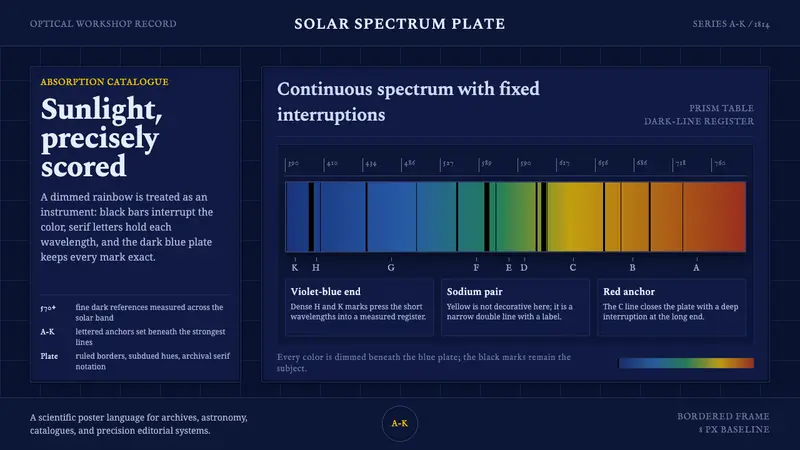 Fraunhofer Spectral LinesSunlight becomes measurement. A dimmed spectrum band is scored by black absorption lines.
 Badakhshan Lapis LazuliStone as manuscript. Ultramarine field, pyrite flecks, calcite veins, carved capitals.