What is Oud Incense Mashrabiya?
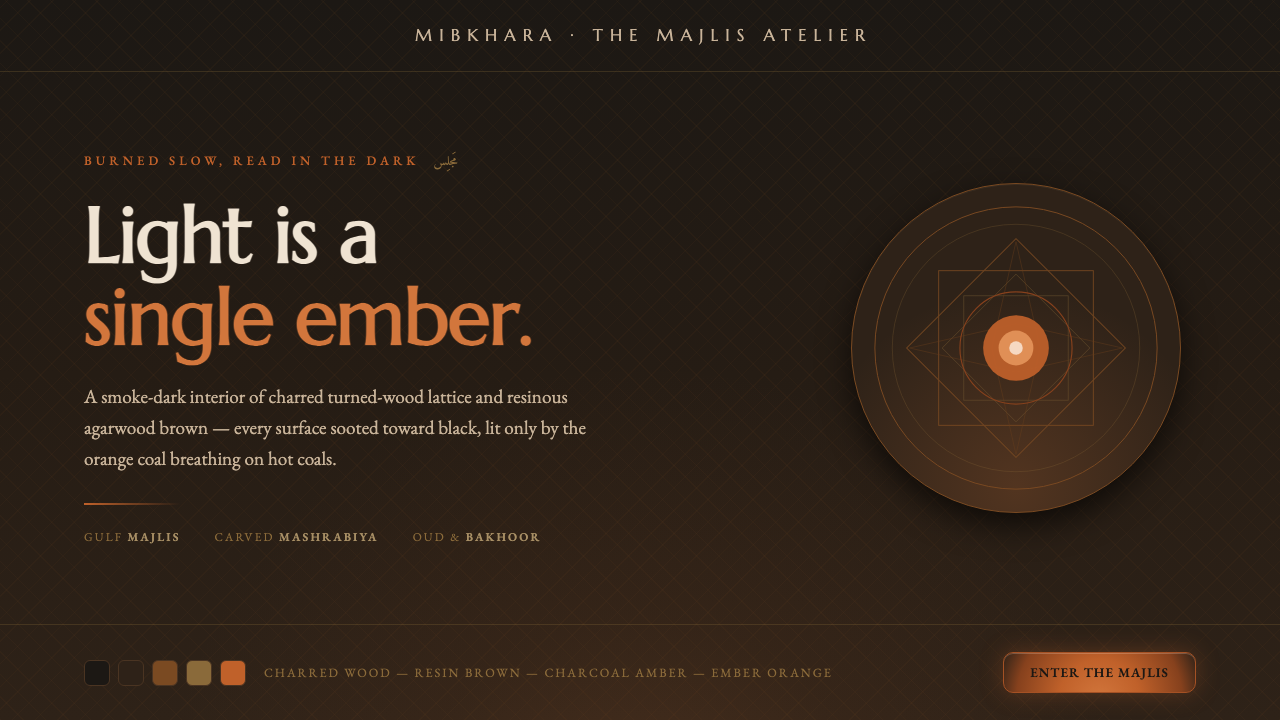
Oud Incense Mashrabiya holds a room at the edge of darkness: charred lattice, resin-brown depth, and one ember-orange point that makes the shadows feel inhabited.
Oud Incense Mashrabiya in brief
Oud Incense Mashrabiya is a dark ornamental design language distilled from the smoke-filled intimacy of a Gulf majlis: carved and turned wooden screens, charcoal incense burners, and agarwood slowly warming over coals. Its atmosphere is not simply dark-themed. It is soot-dark, as though smoke has settled into every carved recess and softened the distinction between architecture, furniture, and air. The visual center is never a bright room or a panoramic view; it is the small, living glow of an ember within an otherwise light-starved interior.
The system combines blackened mashrabiya lattice with resinous browns and a narrowly controlled warm orange accent. Mashrabiya is treated as both surface and boundary: a repeated wooden geometry that filters sight, breaks light into fragments, and makes enclosure feel intricate rather than empty. Brown does not behave like a casual neutral here. It suggests dark heartwood, resin, heated timber, and the dense material presence of oud and bakhoor. The orange ember is the only element that should feel actively luminous.
The result is intimate, ornate, and deliberately low-key. It should read at a true charred near-black, not as a sunlit regional interior with decorative dark accents added afterward. Light is scarce and consequential. Pattern is richly present but restrained by darkness; it appears through relief, silhouette, edge, and intermittent warm reflection rather than through busy all-over contrast. The mood is ceremonial without becoming theatrical, tactile without relying on bright texture, and luxurious through material depth rather than visual excess.
Where does Oud Incense Mashrabiya come from?
The visual source is the traditional Gulf majlis and its incense-burning culture, rooted in the Arabian and Persian Gulf before the twentieth century. A majlis is understood here as an interior of gathering: a place where hospitality, conversation, scent, shadow, and crafted enclosure belong to the same experience. Oud Incense Mashrabiya does not attempt to reproduce a museum interior. It extracts the conditions that make such an atmosphere legible: the surrounding darkness, the presence of carved wood, the concentrated heat of charcoal, and the small warmth released by burning agarwood.
Mashrabiya turned-lattice provides the system’s structural language. Its importance lies in repetition and filtering. Carved and turned wood creates a field of openings, joints, shadows, and small framed voids, so the room gains visual density without needing broad illustrated decoration. In this theme, the lattice is imagined after prolonged exposure to smoke: its wood appears blackened, its geometry recedes and reappears, and its relief catches only minimal reflected warmth. The pattern is not a flat ornamental print laid over a dark background; it is an architectural screen with depth, interruption, and accumulated soot.
The second source is oud and bakhoor perfumery. Agarwood burning on hot coals establishes the palette’s material logic: resin browns, charcoal darkness, and ember orange arise from one continuous ritual rather than from unrelated decorative choices. The ember is important precisely because it is limited. It offers a focal point, a suggestion of heat, and a way to read nearby surfaces, while leaving most of the setting unresolved in shadow. This asymmetry between vast darkness and minute warmth is the style’s emotional engine.
Its named cultural actors are collective rather than individual: Gulf majlis hosts, mashrabiya woodcarvers, and oud or bakhoor perfumers. Each contributes a different part of the visual vocabulary. Hosts establish the intimate social setting; woodcarvers create the patterned enclosure; perfumers and incense practitioners give the room its smoke, resin, charcoal, and ember. The style should respect that shared making by keeping its references material and atmospheric, rather than treating regional motifs as detached luxury decoration.
What defines the Oud Incense Mashrabiya look?
Charred Darkness
The ground is a smoke-soaked near-black rather than a neutral dark field. It should feel absorbent, mineral, and wood-dark, allowing surfaces to disappear before their edges slowly emerge. Bright white, ivory, and cream break the premise because they turn the setting into daylight. Darkness is the primary material, not an empty backdrop.
Mashrabiya Relief
Turned-wood lattice supplies the characteristic geometry: repeated apertures, carved contours, small voids, and layered screening. Treat the pattern as an object with thickness and shadow, not as wallpaper. Some portions can dissolve into darkness while selected ridges, joints, and openings receive the faintest warm trace.
Resin Browns
Brown carries the style’s material memory. It should suggest oud-darkened heartwood, resin, heated timber, and the interior surfaces nearest the incense. These tones belong in recesses, carved wood, vessels, and reflected warmth. They enrich the black without making the palette feel earthy, rustic, or brightly naturalistic.
Single Ember Accent
Orange ember light is scarce, local, and alive. Use it where heat, attention, or active presence must gather: a coal, an incense vessel, a narrow line caught on an edge, or a restrained interactive emphasis. It should never become a broad ambient wash. When the ember spreads everywhere, the room loses its silence.
Filtered Light
Light arrives indirectly, interrupted by lattice and smoke. High contrast is useful, but the style avoids broad, evenly lit zones. Let narrow openings, silhouette, and reflected warmth describe form. The eye should feel invited to adjust to the dark, discovering detail gradually rather than receiving the whole room at once.
Intimate Ornament
Ornament is present through craft and enclosure, not through indiscriminate layering. Repetition has a quiet rhythm; complexity remains contained within the lattice and its shadows. The atmosphere should feel private and close, as though the pattern gathers the space inward, rather than opening it into a spectacular or decorative display.
Who shaped Oud Incense Mashrabiya?
Gulf majlis hosts represent the social setting from which the style draws its intimacy. Their role is not decorative authorship but hospitality: an interior arranged for gathering, conversation, and the shared presence of incense. This makes warmth in the system relational and localized, never equivalent to a brightly illuminated public room.
Mashrabiya woodcarvers supply the language of turned-lattice geometry. Their work gives the theme its repeated openings, sculpted edges, and screened depth. In a contemporary application, this contribution is best honored by treating geometric pattern as crafted spatial structure, with relief and interruption, rather than as a generic ornamental overlay.
Oud and bakhoor perfumers establish the sensory material behind the palette. Agarwood, resin, charcoal, smoke, and ember form a connected sequence: dark heartwood and resinous brown give way to soot-black surfaces, while burning coals produce the style’s sole warm light. Their practice keeps the accent color tied to heat and scent rather than arbitrary branding.
How do you use Oud Incense Mashrabiya today?
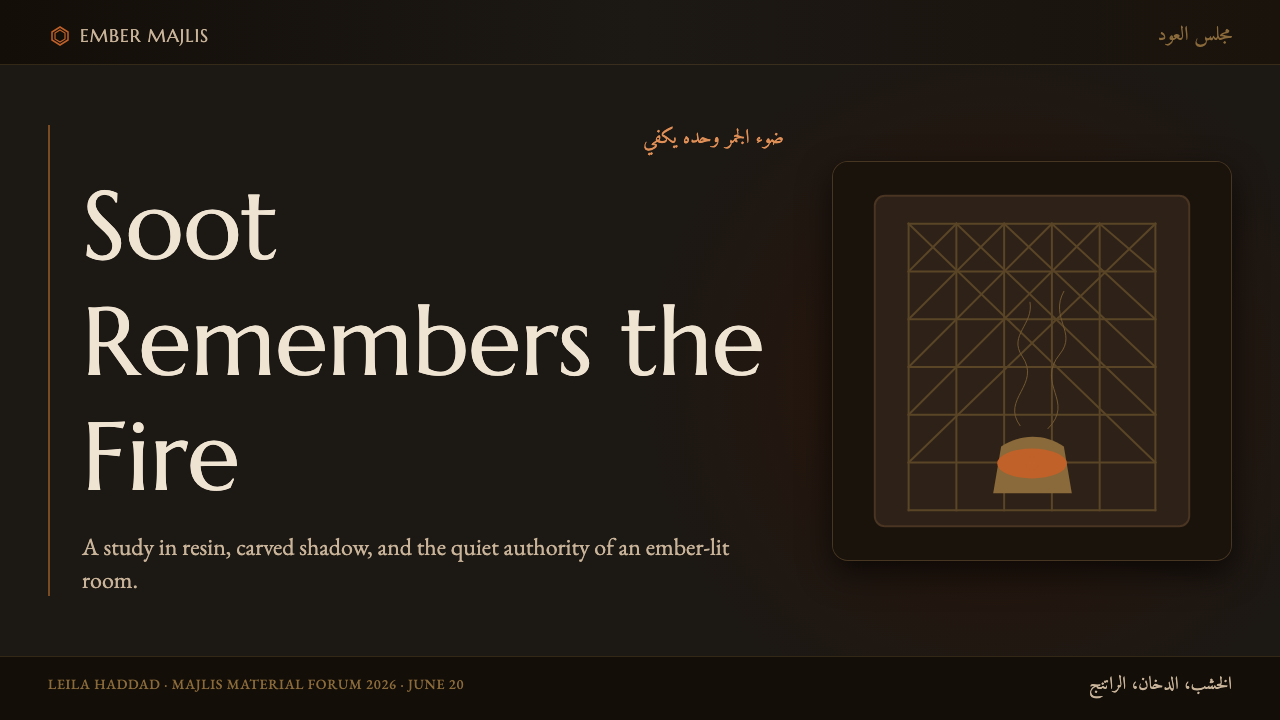
For presentation covers, let darkness establish the field before information arrives. A close crop of blackened lattice can frame a title, while a single ember-like accent marks the subject, speaker, or moment of emphasis. The title should remain clear and calm rather than ornate. On content slides, use the lattice as a peripheral boundary or occasional divider, keeping the reading area open enough for long-form text. The contrast between dense screen and quiet copy area preserves the style’s intimacy without making the presentation difficult to read.
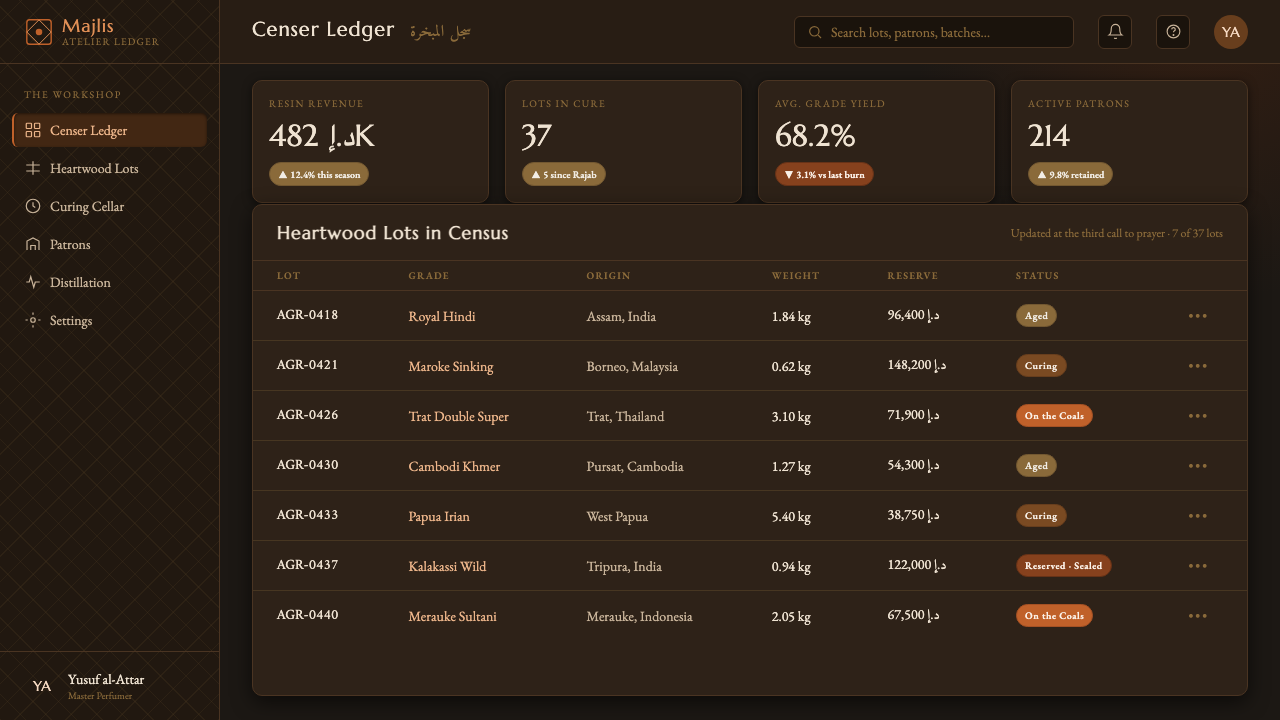
For data slides, make the ember accent carry the most important signal and allow charcoal and resin-brown tones to hold the supporting structure. Charts should feel like objects found in the room: restrained, low-lit, and sharply selective about what receives attention. Avoid turning every series into a glowing warm color. One active measure can burn; the rest should recede, so hierarchy is understood as an effect of light rather than merely an exercise in decoration.
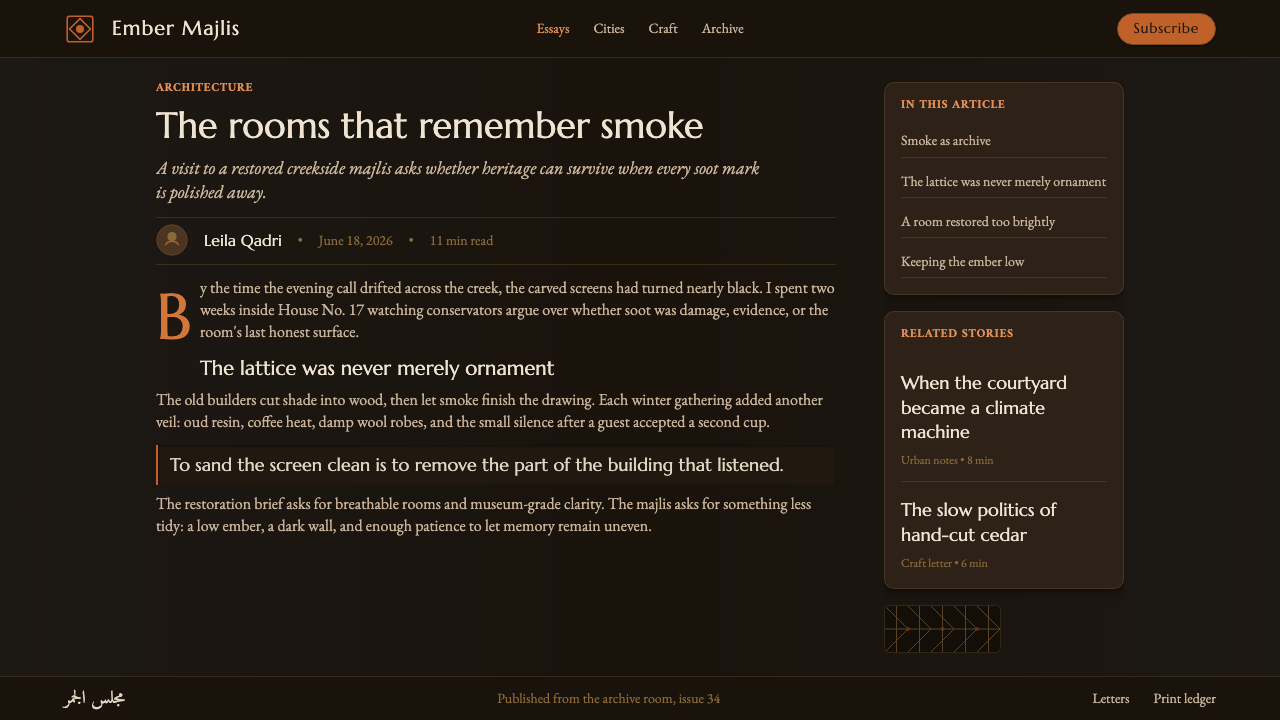
For web interfaces, the style suits dashboards, private member areas, and premium pricing experiences that benefit from focus, enclosure, and a sense of ritual. Keep primary navigation typographic and quiet. Use mashrabiya-derived pattern at boundaries, panels, loading states, or empty spaces where it can imply depth without competing with tasks. A dashboard can reserve the ember glow for a selected state, an urgent item, or the single action the user should take next. In pricing, the warm accent should identify a deliberate choice, not illuminate every offer equally.
For editorial and marketing work, use the system to create atmosphere around stories of craft, gathering, fragrance, material, or evening hospitality. Editorial layouts benefit from a dark opening spread, a patterned edge, and passages of text revealed against controlled shadow. Marketing can use a close, almost tactile view of lattice and charcoal, then let a small ember cue the call to action. The key is containment: the visual world should feel discovered within a room, not broadcast as a bright exotic spectacle.
The common mistake is to translate the theme into generic black-and-orange luxury styling. That removes its cultural and material logic. Another mistake is making the lattice uniformly visible, highly contrasted, and endlessly repeated; the screen then becomes a loud pattern rather than an atmospheric boundary. Preserve scarcity: scarce light, scarce orange, and selective visibility. If the composition feels bright, broad, or immediately legible everywhere, it has drifted away from the smoke-dark majlis interior that defines the style.
Oud Incense Mashrabiya — FAQ
Is Oud Incense Mashrabiya simply a dark version of mashrabiya decor?
No. Darkness is not an inversion applied after the fact; it is the condition that organizes the entire system. The lattice is blackened by smoke, brown is tied to resin and wood, and orange is tied to a coal’s small living heat. A light interior with dark mashrabiya motifs may reference similar forms, but it does not create the same atmosphere of filtered visibility and incense-dark enclosure.
Can the ember-orange accent be used for every interactive element?
It should not be. The accent works because it behaves like a scarce source of heat and attention. Use it for the most consequential active state, urgent signal, or call to action, then let secondary controls remain dark, brown, or quietly legible. If every button, badge, and chart segment glows warm, the interface loses the hierarchy that makes the ember meaningful.
How should mashrabiya pattern be handled in a readable interface?
Use it as enclosure and relief, not as a competing text surface. Place it at margins, behind nonessential atmosphere, within panel edges, or in areas with little informational density. Let portions fade into the near-black so the eye can prioritize labels, values, and actions. The pattern should suggest crafted depth and filtered light, while the functional reading path remains calm.
What makes the style feel inauthentic?
Bright daylit backgrounds, large fields of pale neutral color, broad warm gradients, and indiscriminate glowing orange all weaken it. So does using geometric lattice as a generic regional badge without soot, charcoal, resin, or the intimate setting of incense. The style becomes convincing when its visual decisions remain connected: dark wood, smoke-dark surfaces, filtered pattern, concentrated warmth, and a room that reveals rather than displays itself.
Related design styles
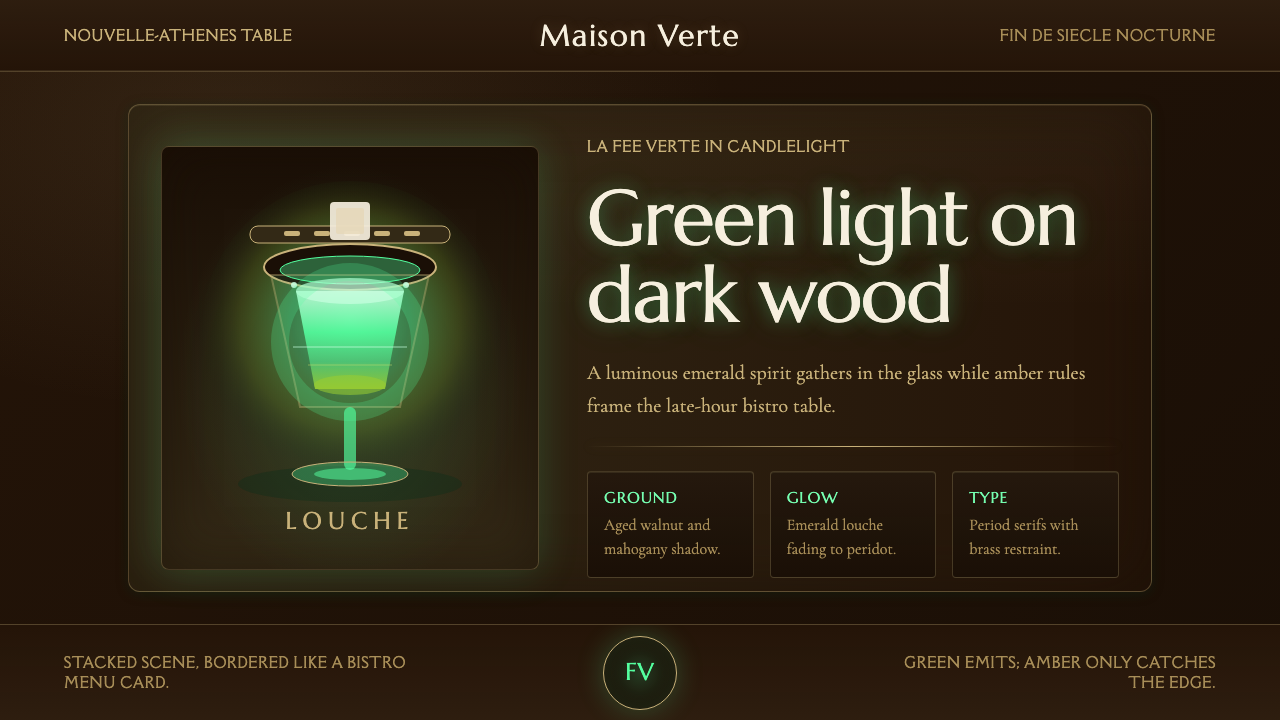 Absinthe Green Fairy GlowDarkness makes the fairy glow. Emerald louche on mahogany, framed by amber se…
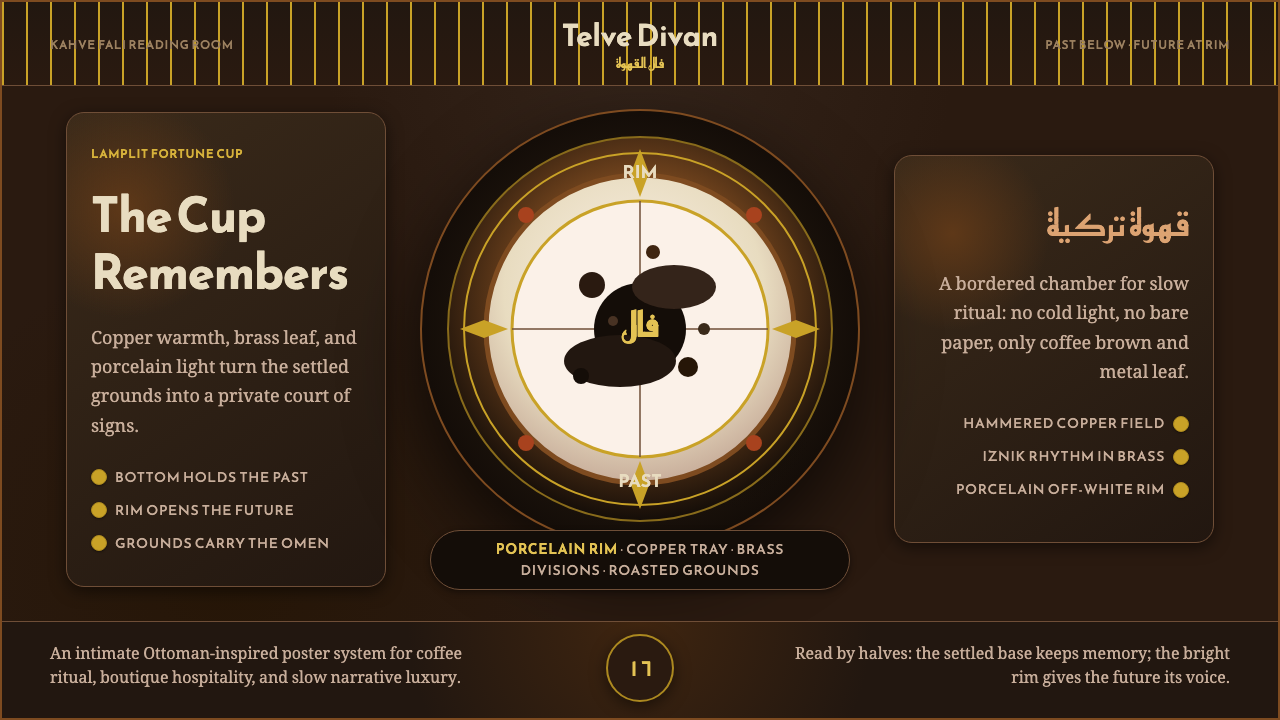 Turkish Coffee FortuneLamplit ritual, richly framed. Copper, brass, and Reem Kufi orbit a porcelain…
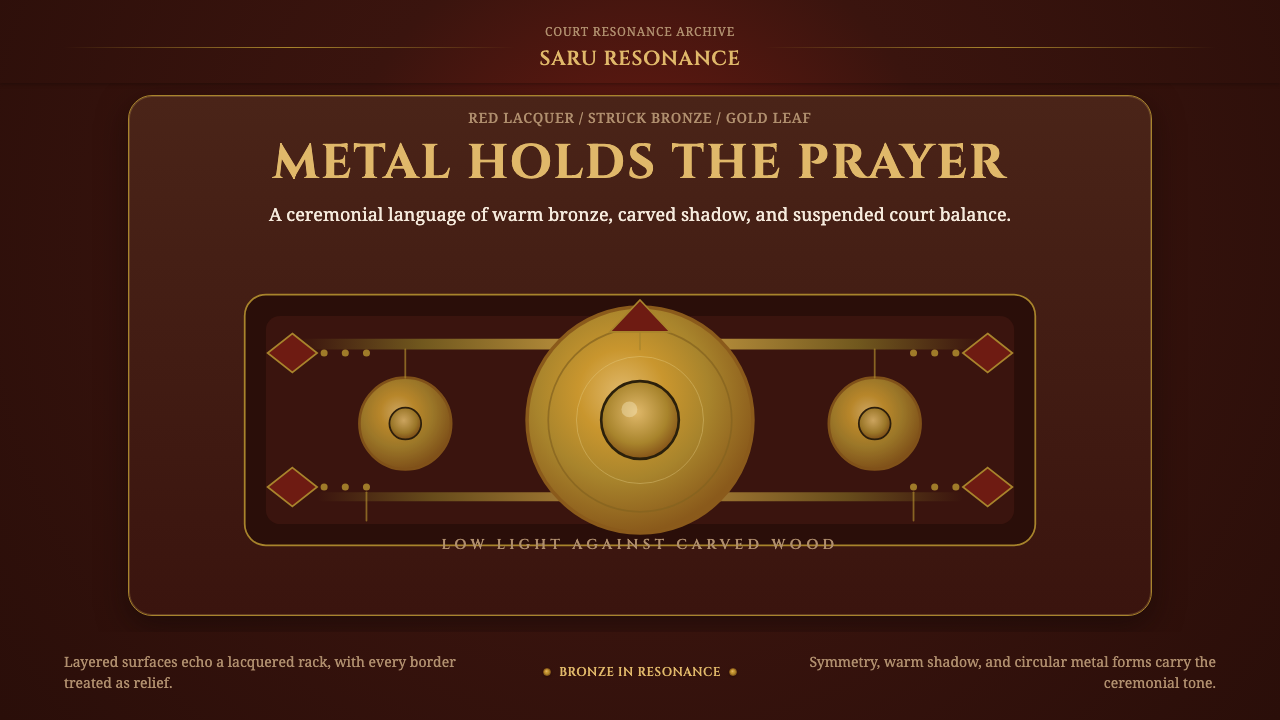 Gamelan BronzeCeremony in low light. Bronze circles glow inside red lacquer and gold-leaf f…
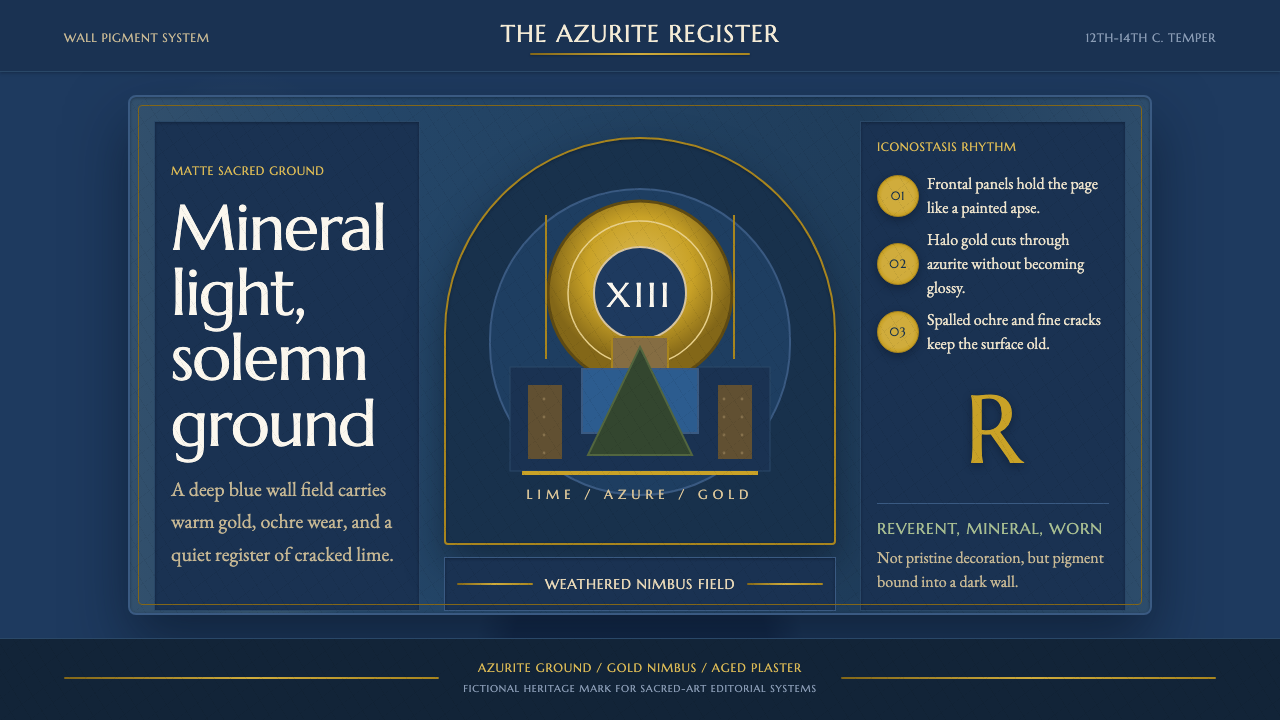 Serbian Medieval FrescoSacred wear becomes structure. Azurite fields, gold halos, and cracked plaste…
 Sikh Golden TempleReverent gold in dark water. Teal ground, Gurmukhi type, marble rules hold th…
 Armillary SphereMuseum darkness makes brass celestial. Cinzel capitals and concentric gold ri…