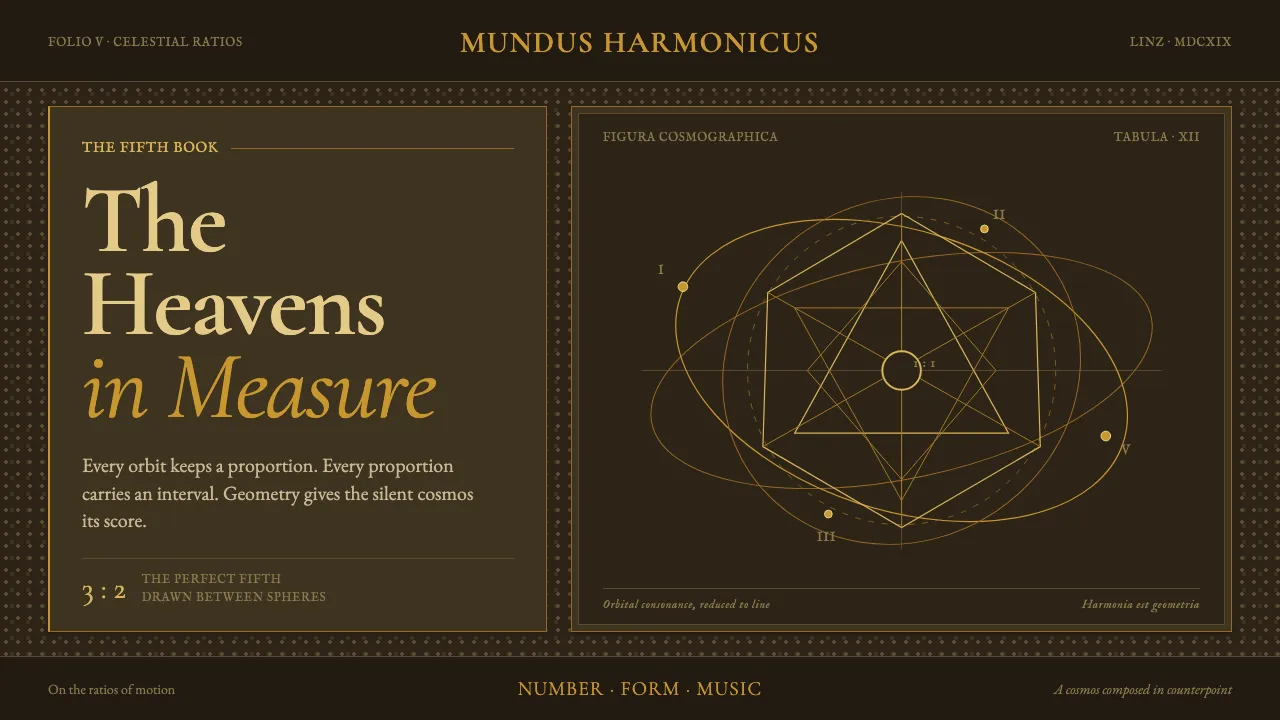
About Kepler Harmonices Mundi
In 1619 Johannes Kepler printed *Harmonices Mundi Libri V* in Linz — a copperplate and woodcut treatise binding regular polyhedra, tilings, and the musical ratios of planetary orbits into one Pythagorean cosmology. This system reads its figures back in aged parchment brown: fine ocher-gold line work — nested solids, orbital ellipses, ratio brackets — floating on a deep vellum field. It is hieratic, symmetrical, generous in margin. The register is humanist Latin old-style, the gold a flat drawn line rather than a glossy sheen. Rational mysticism, rendered as geometry you can trust.
- Origin
- Linz, Germany / Austria
- Era
- 1619 (published in Linz; late Renaissance / early scientific revolution)
- Key figures
- Johannes Kepler
- Movements
- Harmonic cosmology · Pythagorean-Platonic geometry · the early scientific revolution
Kepler Harmonices Mundi design spec
Colors
Typography
The other 11 sections — buttons, cards, spacing, motion, techniques and more — open once you unlock. Download the DESIGN.md or send it to your AI in one click. Unlock once, yours forever.
Sign up nowStyles similar to Kepler Harmonices Mundi
Also inspired by print & type, with a close feel.
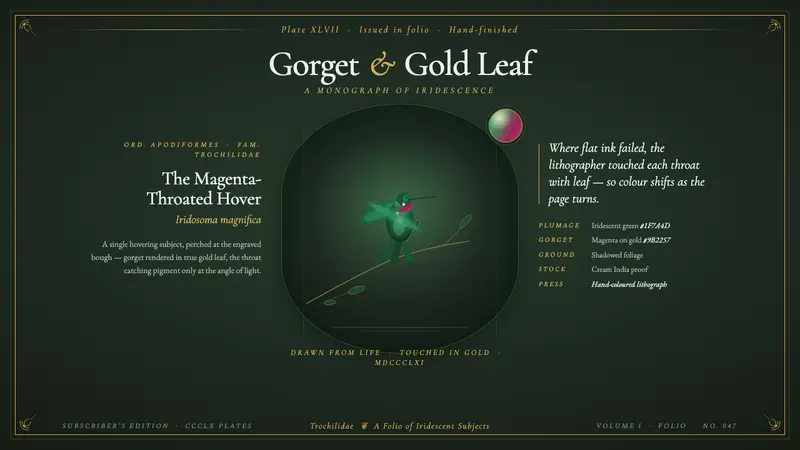 Gould Hummingbird PlateVictorian ornithology, jewel-grade. Green plumage on shadowed foliage, gorgets in gold leaf.
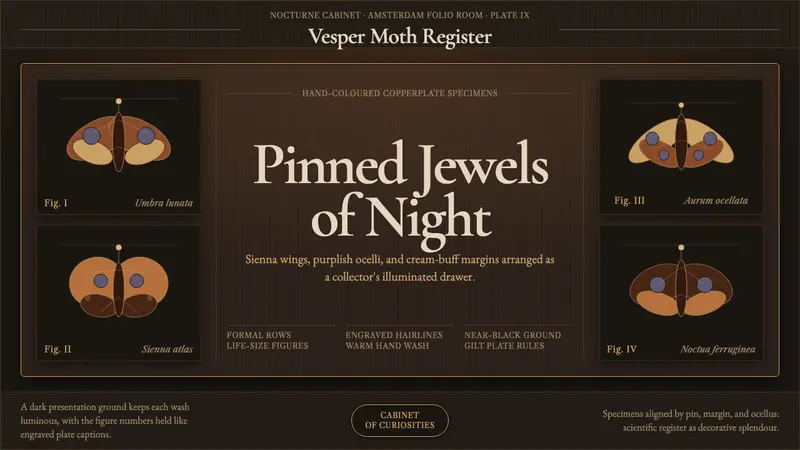 Cramer Exotic MothsJewel-like precision. Sienna specimens glow in formal rows on a near-black plate.
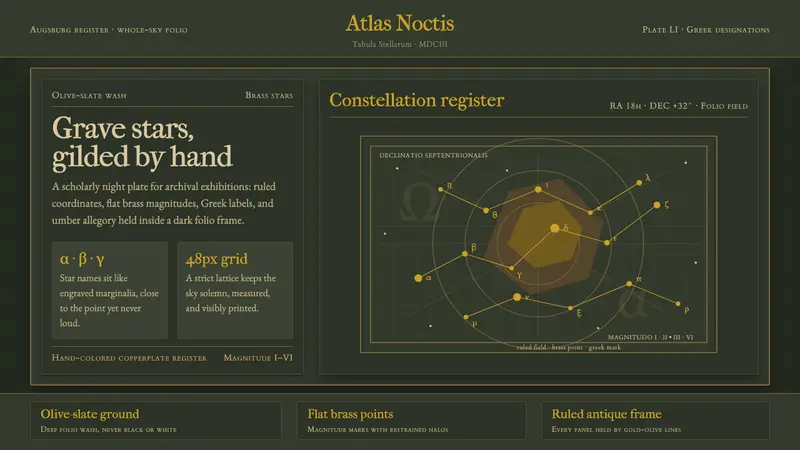 Bayer UranometriaGrave celestial folio. Olive-slate grid, brass stars, Greek labels, old-style type.
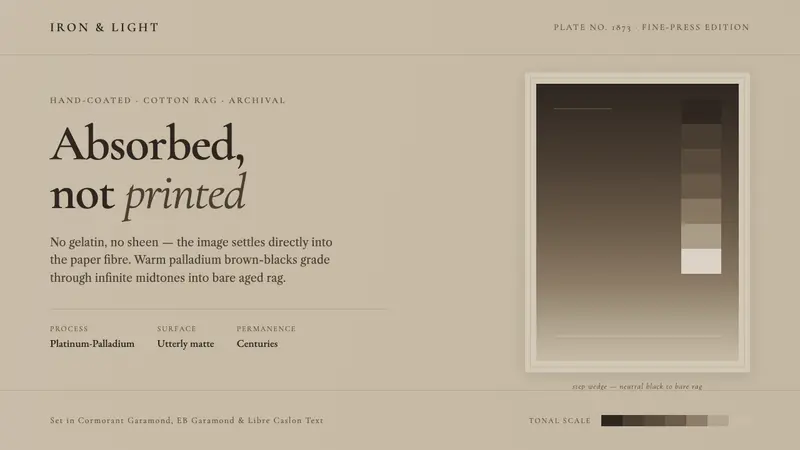 Platinum-Palladium PrintAbsorbed, not printed. Warm palladium brown-blacks grade into aged cotton-rag taupe, utterly matte.