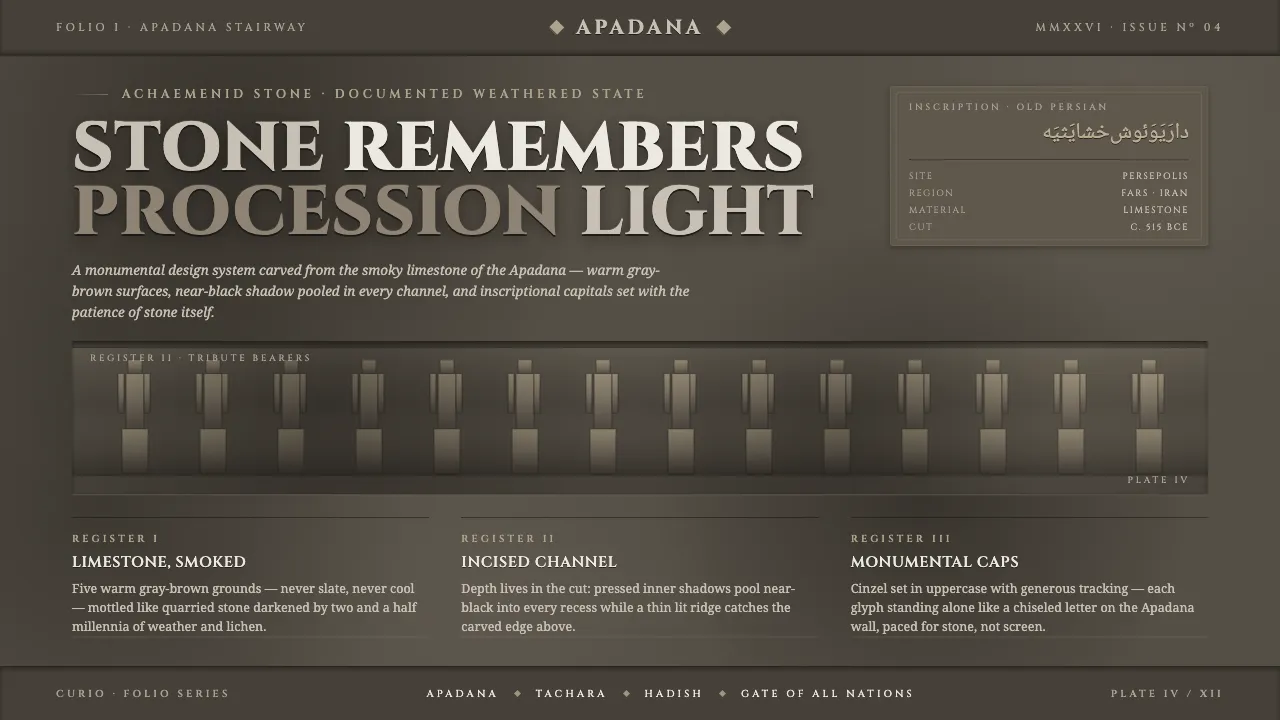
About Persian Gray Stone Relief
Persian Gray Stone Relief draws from the bas-reliefs of Persepolis — the Apadana stairway and the Gate of All Nations — where processions of tribute-bearers were incised into locally quarried Achaemenid limestone. Millennia of exposure weathered the stone to a smoky gray-brown, with near-black shadow pooling in the deep carved channels.
This system honors the documented weathered artifact, not its lost polychromy. It is built on warm limestone grays, deep incised shadow, and monumental carved serif capitals — a horizontal, banded, frieze-like composition of mottled stone surfaces.
- Origin
- Middle East (Persepolis, Fars, Iran)
- Era
- pre-1900 (Achaemenid Persia, c. 515 BCE; surface as weathered today)
- Key figures
- Darius I · Xerxes I · Achaemenid stone carvers
- Movements
- Achaemenid imperial relief sculpture · Persepolis procession friezes
Persian Gray Stone Relief design spec
Colors
Typography
The other 11 sections — buttons, cards, spacing, motion, techniques and more — open once you unlock. Download the DESIGN.md or send it to your AI in one click. Unlock once, yours forever.
Sign up nowStyles similar to Persian Gray Stone Relief
Also inspired by art & artists, with a close feel.
 The Little Mermaid (Andersen, 1837)Cold longing, cut clean. Foam-white silhouettes drift on harbour teal with one coral bruise.
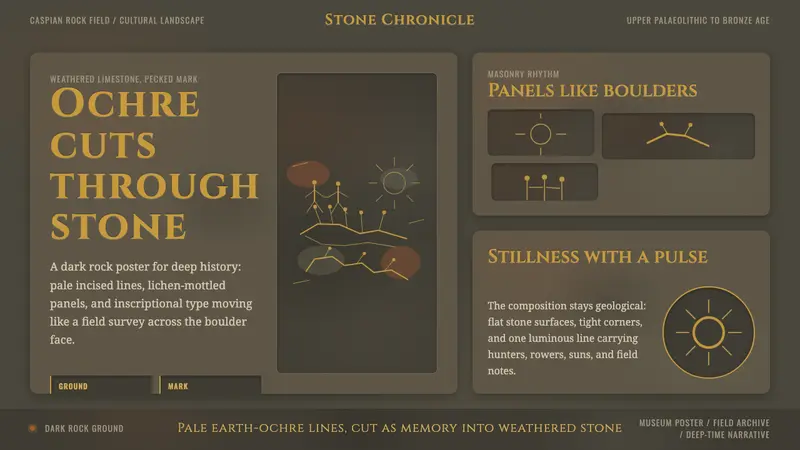 Azerbaijani Gobustan PetroglyphAncient rock speaks. Ochre incisions glow across dark lichen-mottled stone.
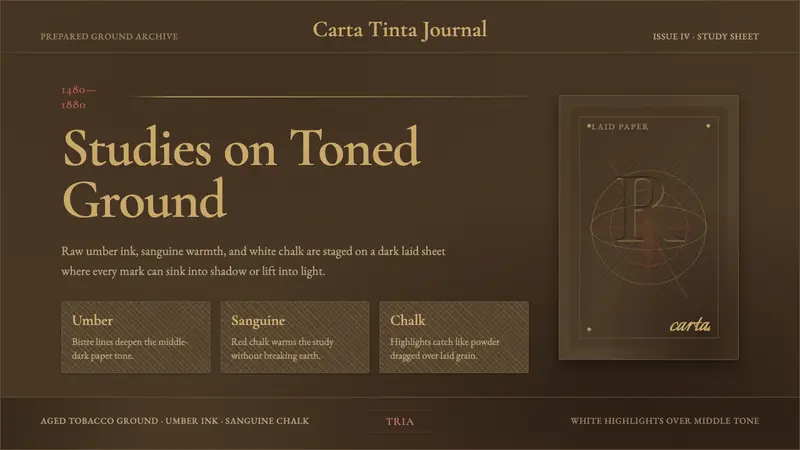 Raw Umber SketchbookMiddle tone becomes drama. Tobacco paper, Garamond type, sanguine marks, chalk hatching.
 Dunhuang Mogao MuralsTime lives in the wall. Mineral green and azurite endure on oxidised brown plaster.