About German Expressionist Cinema
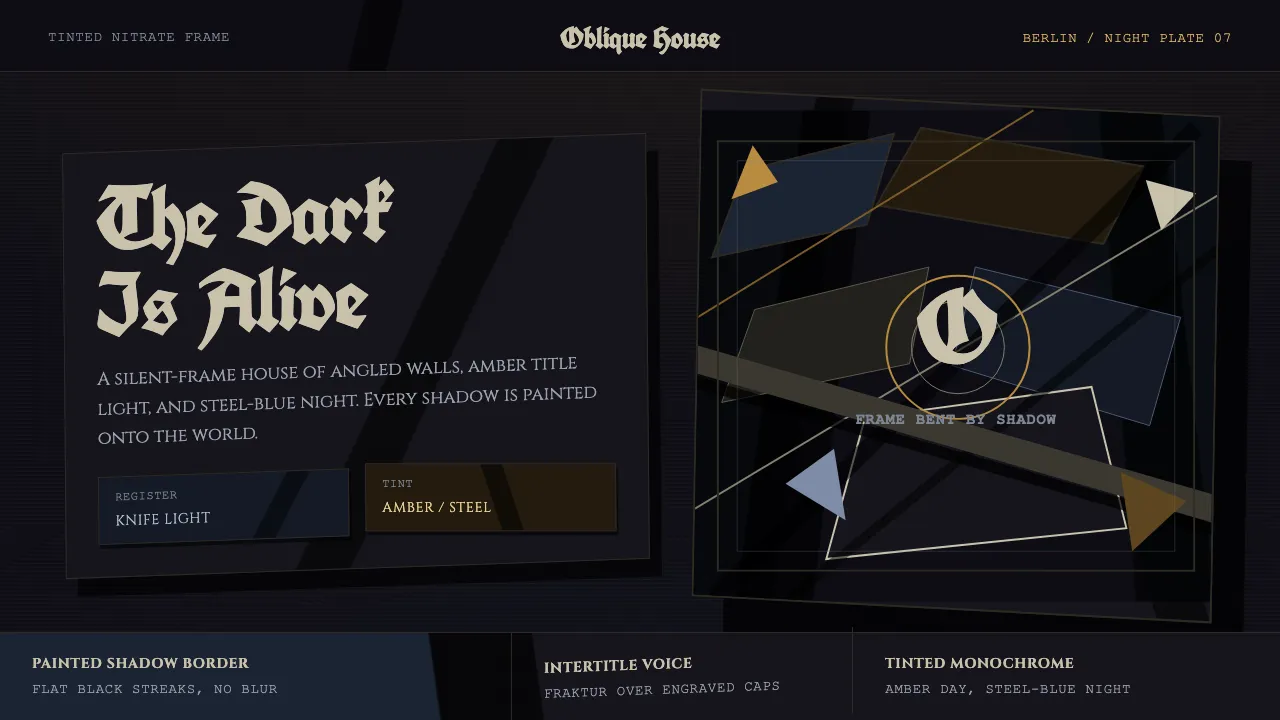
German Expressionist cinema, canonized by Das Cabinet des Dr. Caligari (1920), built its dread from hand-painted oblique shadows, jagged distorted sets, and acute angles raked across a black-and-white silent frame. Original nitrate prints were exhibited color-tinted — amber for daylight, steel-blue for night.
The defining look is the near-black projected frame edged by painted Caligari shadows: the world is bent, the light is a knife, the dark is alive.
- Origin
- Germany (Decla-Bioscop / UFA studios, Berlin)
- Era
- Weimar-era silent cinema, c. 1919–1927; Caligari premiered Berlin 1920
- Key figures
- Robert Wiene · Hermann Warm · Walter Reimann · Walter Röhrig · Conrad Veidt
- Movements
- German Expressionism · Weimar cinema · precursor to film noir
German Expressionist Cinema design spec
Colors
Background
Surface
Primary
Secondary
Accent
Text
Typography
UnifrakturCookHeadings
CinzelBody
Special ElegantMono
Unlock for 1 credit
The other 11 sections — buttons, cards, spacing, motion, techniques and more — open once you unlock. Download the DESIGN.md or send it to your AI in one click. Unlock once, yours forever.
Sign up nowHave an account? Sign in
Styles similar to German Expressionist Cinema
Also inspired by film, games & music, with a close feel.
 Brazil (1985)Bureaucracy turns hostile. Gray-green grids, duct bands, and manila stamps crowd the frame.
 Serial Experiments LainMuddy CRT dread from the 1998 Wired. Blue-grey murk, oxblood reds, one sickly neon-green signal.
 Czechoslovak New Wave CinemaNoir without nostalgia. Letterbox bars, off-white titling, and 35mm grain do the talking.
 Peaky Blinders (1919)Industrial menace, struck alive. Cold slate grids meet one rare furnace-orange ember.