About Basque Lauburu
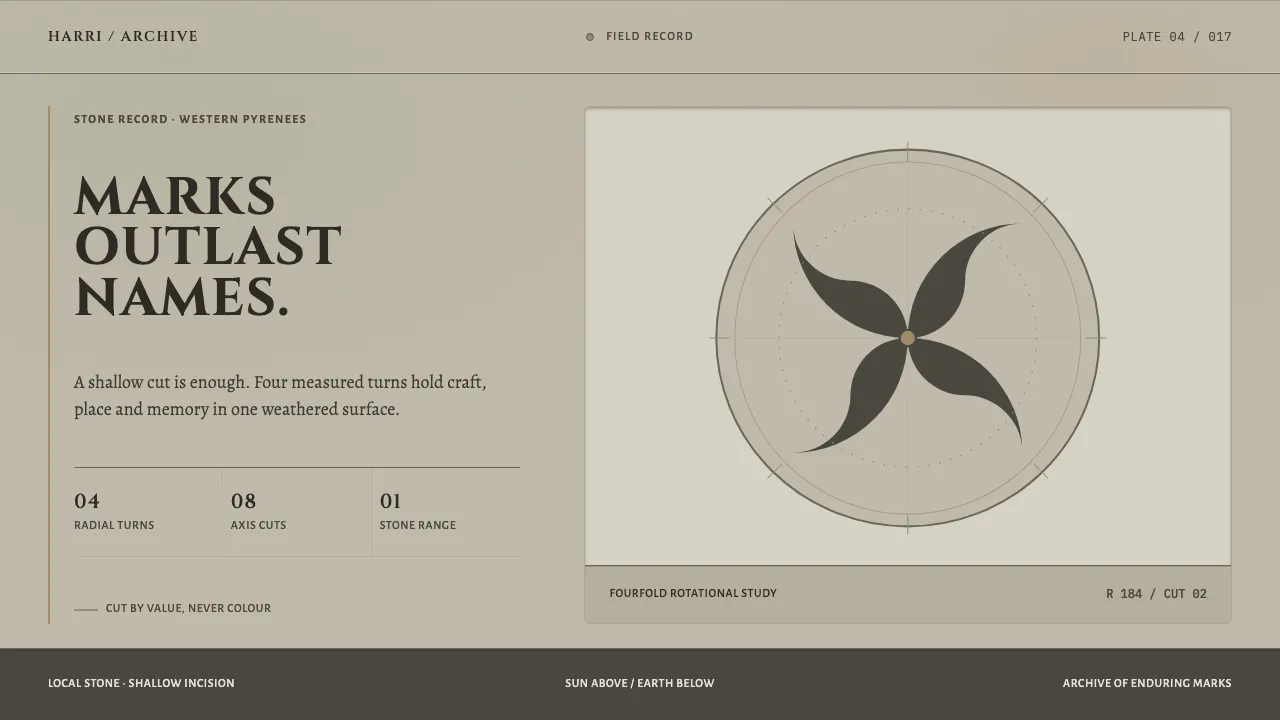
The Basque *hilarri* is a stone disc on a trapezoidal base, set at the head of a grave or leaned against a church wall. Cut from sandstone or limestone quarried within walking distance, it weathers to a lichen-flecked warm grey. The carving is shallow incision, never relief: the *lauburu* — four comma-shaped lobes in rotational symmetry — beside rosettes, plain crosses, astral discs and the tools of the trade of whoever lies below.
This system takes the stone itself as the page. Contrast is value, not colour: a dark line where the chisel went in, a lit arris where the sun catches the edge. Everything sits inside a scribed circle over a widening base — sun above earth.
- Origin
- The Basque Country — Gipuzkoa, Bizkaia, Navarre, Labourd and Lower Navarre
- Era
- 16th–17th century onward, with medieval antecedents; steles still cut today
- Key figures
- Louis Colas · José Miguel de Barandiarán · San Telmo Museoa
- Movements
- Basque popular stonecraft · Discoidal stele tradition of the western Pyrenees · Solar and geometric folk symbolism
Basque Lauburu design spec
Colors
Typography
The other 11 sections — buttons, cards, spacing, motion, techniques and more — open once you unlock. Download the DESIGN.md or send it to your AI in one click. Unlock once, yours forever.
Sign up nowStyles similar to Basque Lauburu
Also inspired by crafts & folk art, with a close feel.
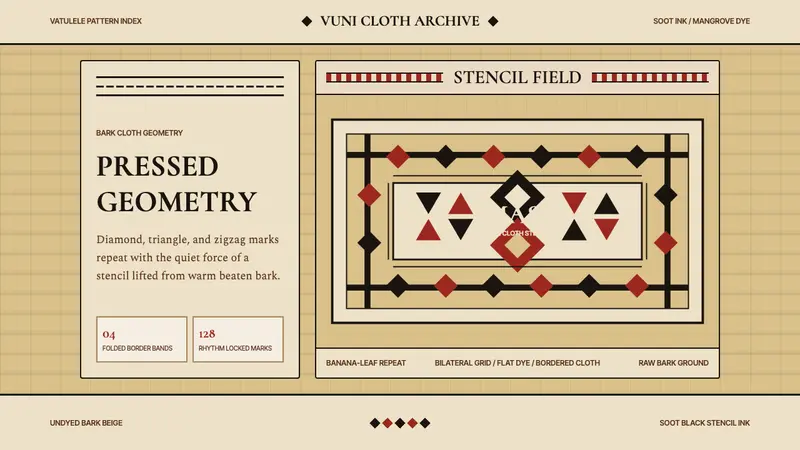 Fijian Masi Tapa StencilGeometry keeps ceremony. Soot-black diamonds repeat on bark beige with rust-red bands.
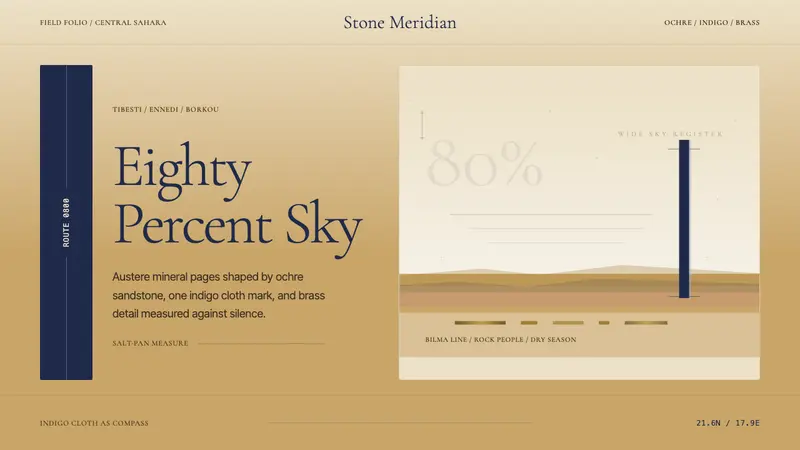 Chadian Toubou Saharan RouteRadical emptiness holds. Sandstone ochre, indigo serif, and one vertical mark cross the sky.
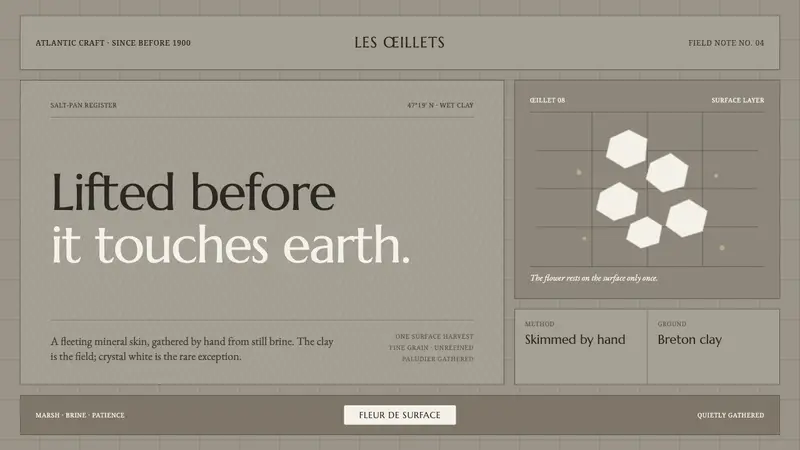 Guérande Fleur de SelCrystal white is the exception. Mineral serif and hairline grids rise from wet clay-grey.
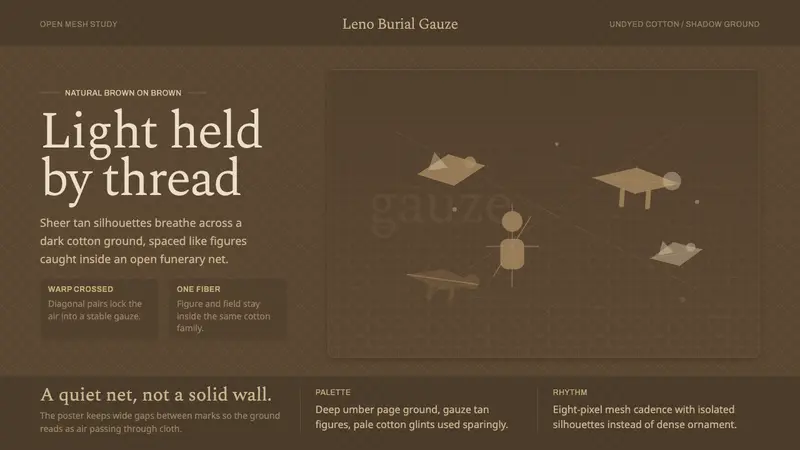 Chancay Gauze TextileQuiet woven dignity. Tan silhouettes float through a dark open cotton mesh.