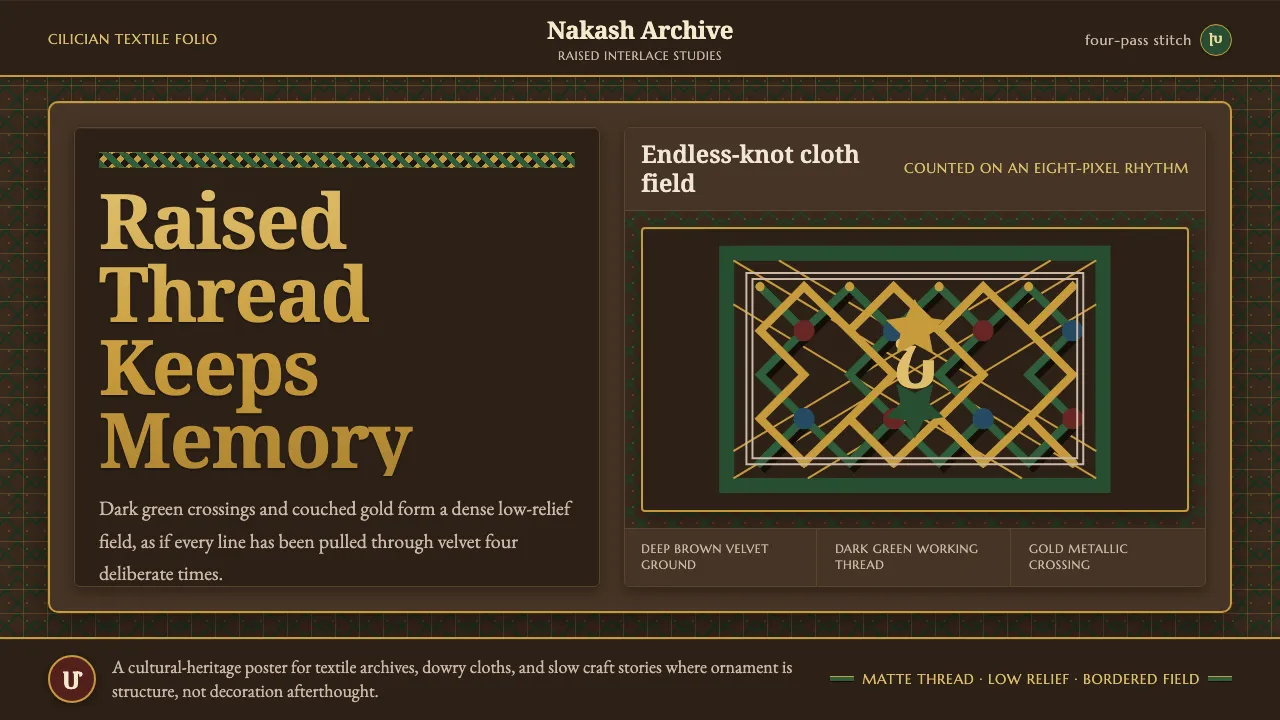
About Armenian Marash Interlace Embroidery
Marash embroidery is the tightly interlaced "woven" needlework of 19th-century Armenian Cilicia. In the nakash stitch, the thread crosses the same path four times, building raised interlinked crosses and endless-knot lattices that read as low-relief woven texture rather than flat pattern.
This design system translates that craft to screen: a deep brown velvet-cloth ground, dark-green interlace as the primary voice, gold-metallic thread as ornament, with deep red and indigo supporting. Everything raised, matte, tactile — never printed, never flat.
Learn more about the Armenian Marash Interlace Embroidery style
- Origin
- Anatolia-Cilicia — Armenian communities of Marash
- Era
- 19th century (Cilicia, historic Marash; classic pieces ~1850–1915)
- Key figures
- Armenian women embroiderers of Marash who worked the interlacing nakash stitch
- Movements
- Marash (nakash) interlace embroidery · Armenian needlework tradition
Armenian Marash Interlace Embroidery design spec
Colors
Typography
The other 11 sections — buttons, cards, spacing, motion, techniques and more — open once you unlock. Download the DESIGN.md or send it to your AI in one click. Unlock once, yours forever.
Sign up nowStyles similar to Armenian Marash Interlace Embroidery
Also inspired by crafts & folk art, with a close feel.
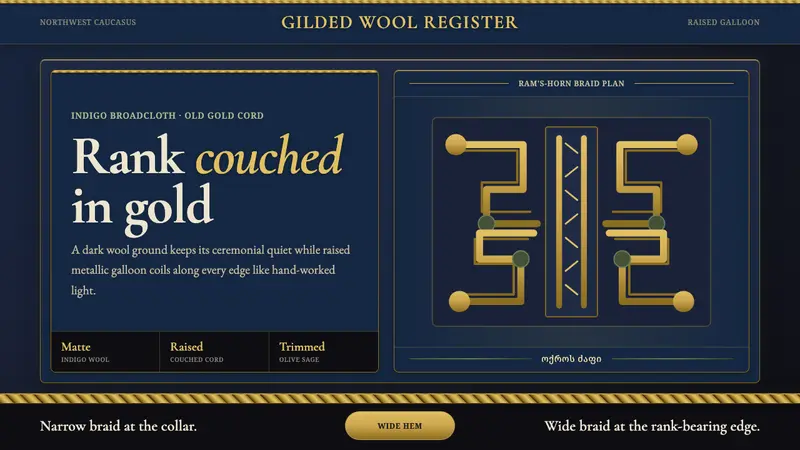 Circassian Adyghe Gold BraidCourtly gold on dark wool. Raised braid edges coil over indigo-black panels.
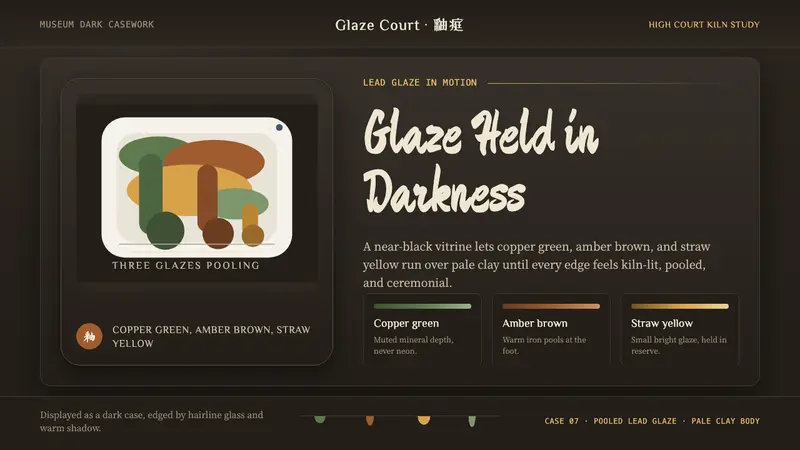 Tang Sancai 唐三彩Museum-dark and molten. Copper green, amber, and straw pools glow in bordered vitrines.
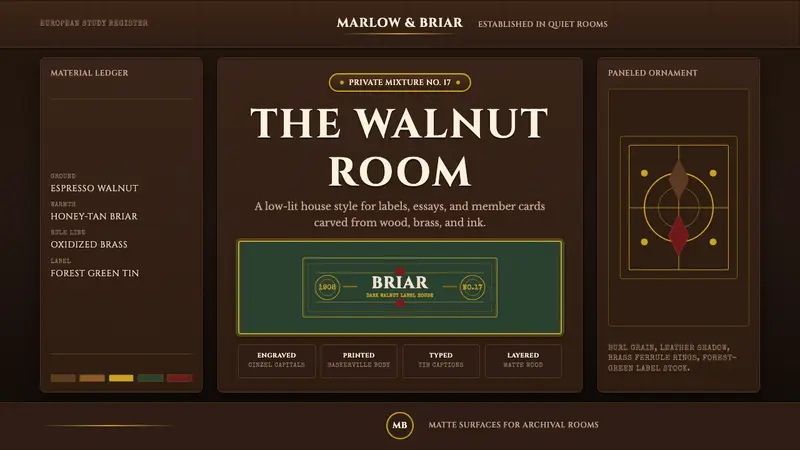 Briar Pipe & TobaccoWarm gloom, precisely aged. Brass rules and Cinzel capitals sit on espresso walnut.
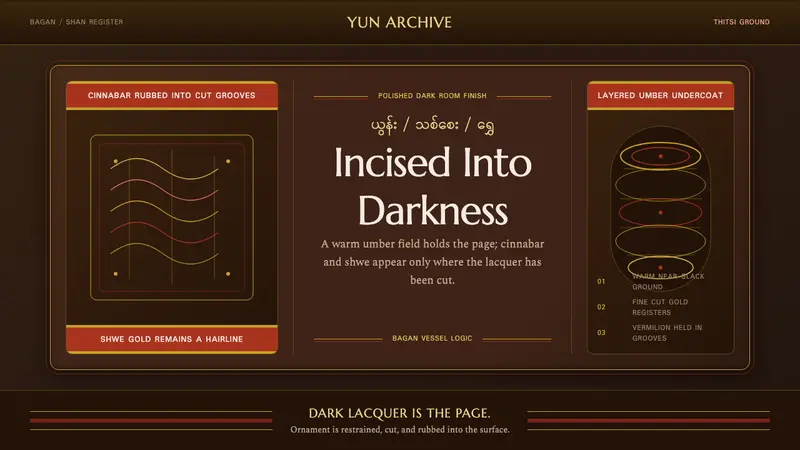 Burmese Shan Lacquer BrownDark lacquer leads. Cinnabar bands and shwe hairlines cut across a warm umber field.