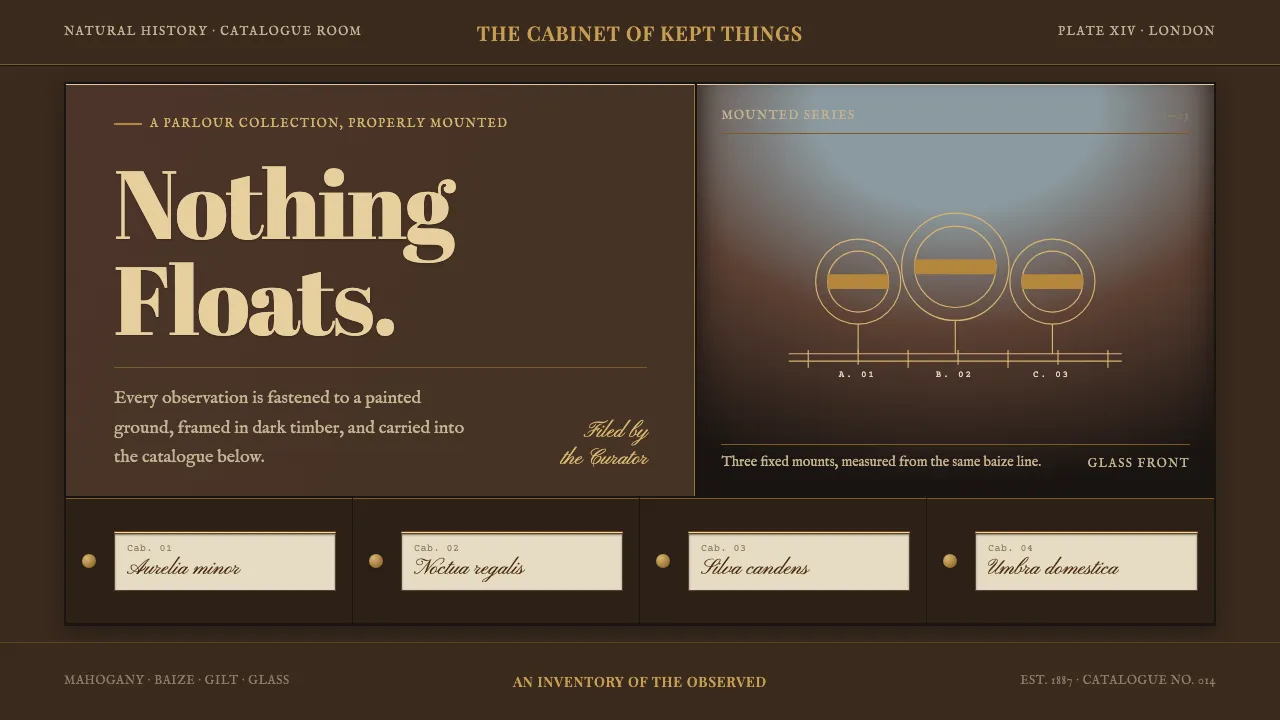
About Victorian Taxidermy Cabinet
A Victorian taxidermy case is parlour furniture first and natural history second: French-polished mahogany, ebonised beading, a glazed front, and a specimen standing on baize above shallow drawers. Rowland Ward sold them from Piccadilly, Walter Potter filled them with anthropomorphic tableaux, and Edward Booth built curved painted skies behind Brighton birds.
This system takes that construction literally. Everything is mounted, standing, or filed — never floating. Type is letterpress and copperplate, gilt lettering sits on dark timber, and depth comes from a lit top and a dark floor rather than from a drop shadow under a card.
- Origin
- Britain and Western Europe — Piccadilly, Bramber in Sussex, Brighton
- Era
- 1837–1901, the Victorian golden age of taxidermy
- Key figures
- Rowland Ward · Walter Potter · Edward Booth
- Movements
- Victorian natural history · cabinet of curiosities · habitat diorama · Linnaean cataloguing
Victorian Taxidermy Cabinet design spec
Colors
Typography
The other 11 sections — buttons, cards, spacing, motion, techniques and more — open once you unlock. Download the DESIGN.md or send it to your AI in one click. Unlock once, yours forever.
Sign up nowStyles similar to Victorian Taxidermy Cabinet
Also inspired by science & nature, with a close feel.
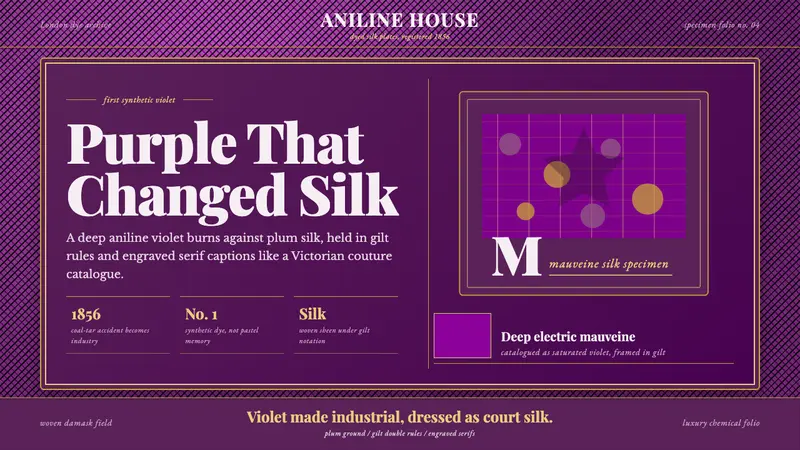 Mauveine (Perkin 1856)Electric purple, framed as luxury. Gilt rules and Playfair serifs turn dye into silk.
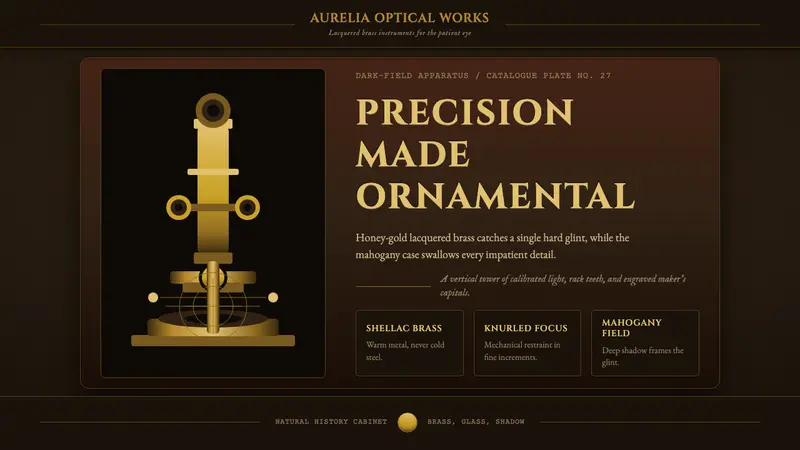 Victorian Brass MicroscopePrecision glows in shadow. Honey brass geometry rises from a mahogany dark-field.
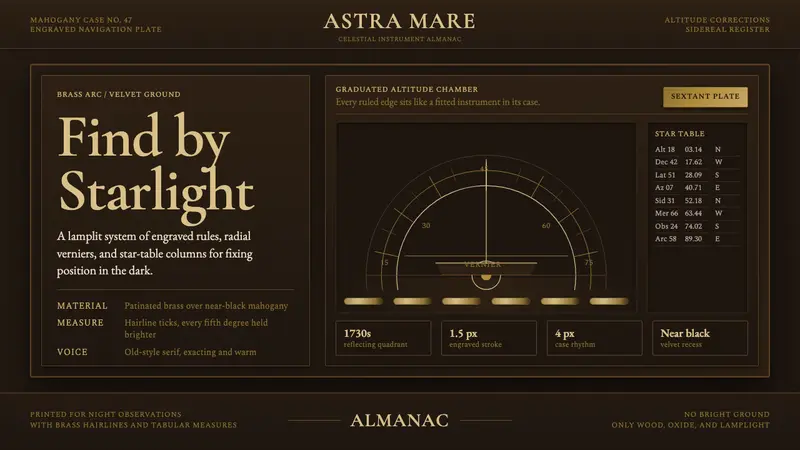 Sextant NavigationPrecision feels ceremonial. Brass ticks and mahogany grids chart the dark by starlight.
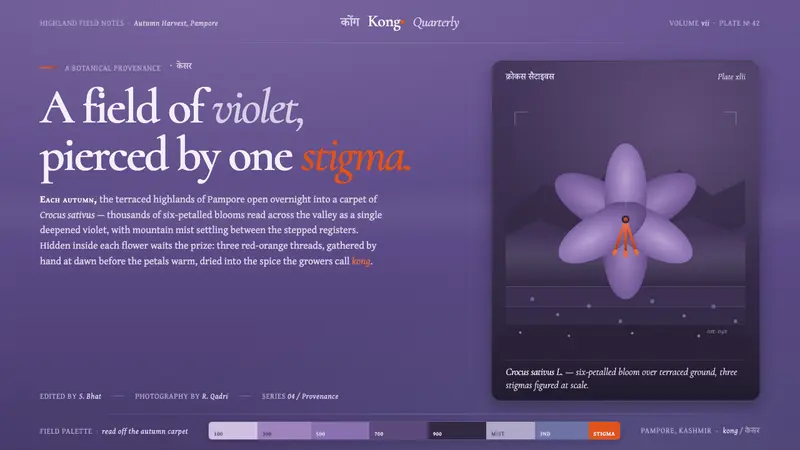 Kashmiri Crocus PurpleAbundance of one hue, scarcity of its complement. Crocus violet under mist, one saffron stigma.