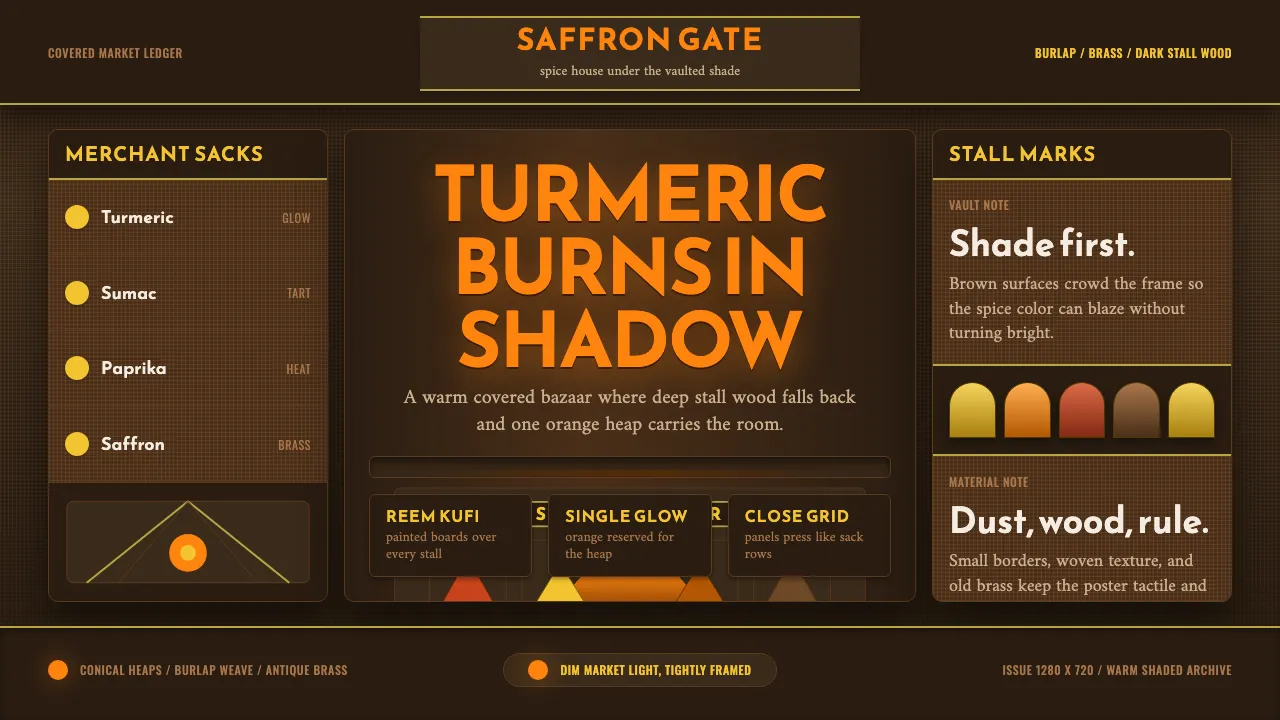
About Spice Souk Bazaar
The Spice Souk Bazaar draws from the covered markets of Aleppo and the Levant — al-Madina Souk and the spice halls of Damascus and Istanbul, where conical heaps of turmeric, saffron, paprika, and sumac blaze beside burlap sacks, hanging brass scales, and hand-painted Arabic signboards.
This is not a bright paper palette. It is a dim, warm-shaded covered market: sackcloth and dark stall-wood fill the frame in deep browns, and turmeric-orange is the single colour that glows out of the shade. Reem Kufi signboards crown each panel; Amiri and Naskh carry the detail beneath.
- Origin
- Aleppo, Syria and the wider Levant
- Era
- pre-1900 (medieval Silk-Road souks onward); al-Madina Souk inscribed UNESCO 1986
- Key figures
- Levantine spice-merchant guilds · al-Madina Souk of Aleppo
- Movements
- Silk-Road spice trade · Levantine bazaar culture · Arabic Kufi and Naskh calligraphy
Spice Souk Bazaar design spec
Colors
Typography
The other 11 sections — buttons, cards, spacing, motion, techniques and more — open once you unlock. Download the DESIGN.md or send it to your AI in one click. Unlock once, yours forever.
Sign up nowStyles similar to Spice Souk Bazaar
Also inspired by architecture & places, with a close feel.
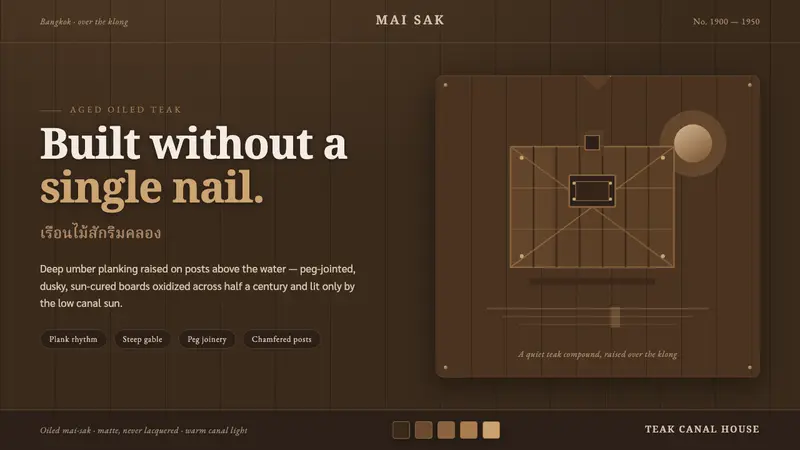 Thai Teak Canal HouseAged oiled teak, never fresh-sawn. Deep umber planks raised over the klong, lit by low canal sun.
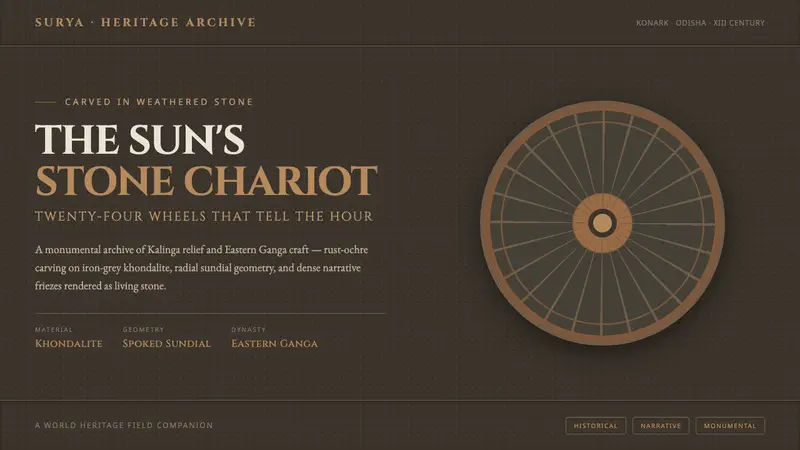 Konark Sun Temple WheelHeavy as carved stone. Rust-ochre sundial wheels and Cinzel inscription on iron-grey khondalite.
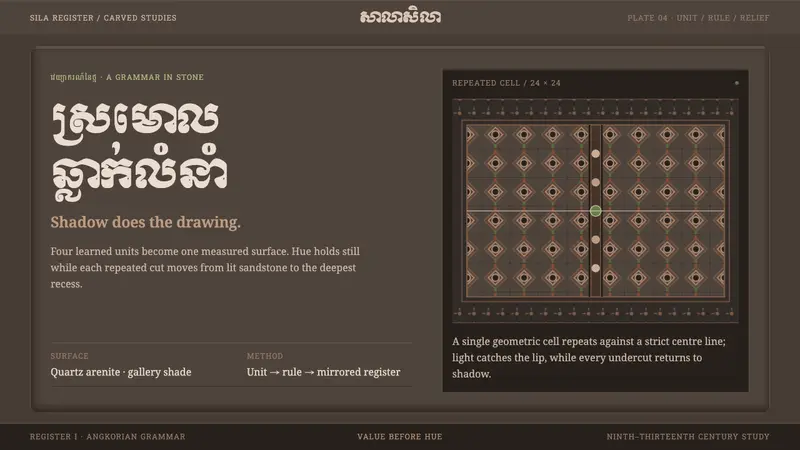 Khmer Kbach MotifShadow carves the grammar. Repeated stone cells turn a narrow sandstone palette into relief.
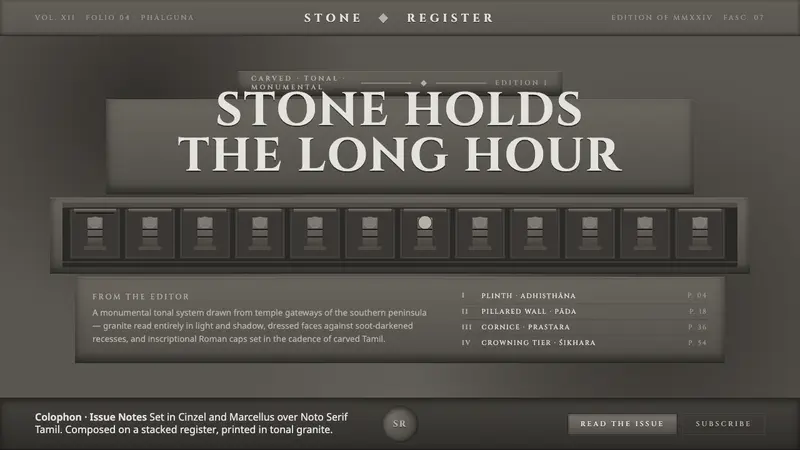 Dravidian Granite GrayscaleRead entirely in grayscale. Soot-dark recesses against dressed granite, Cinzel caps at carved scale.