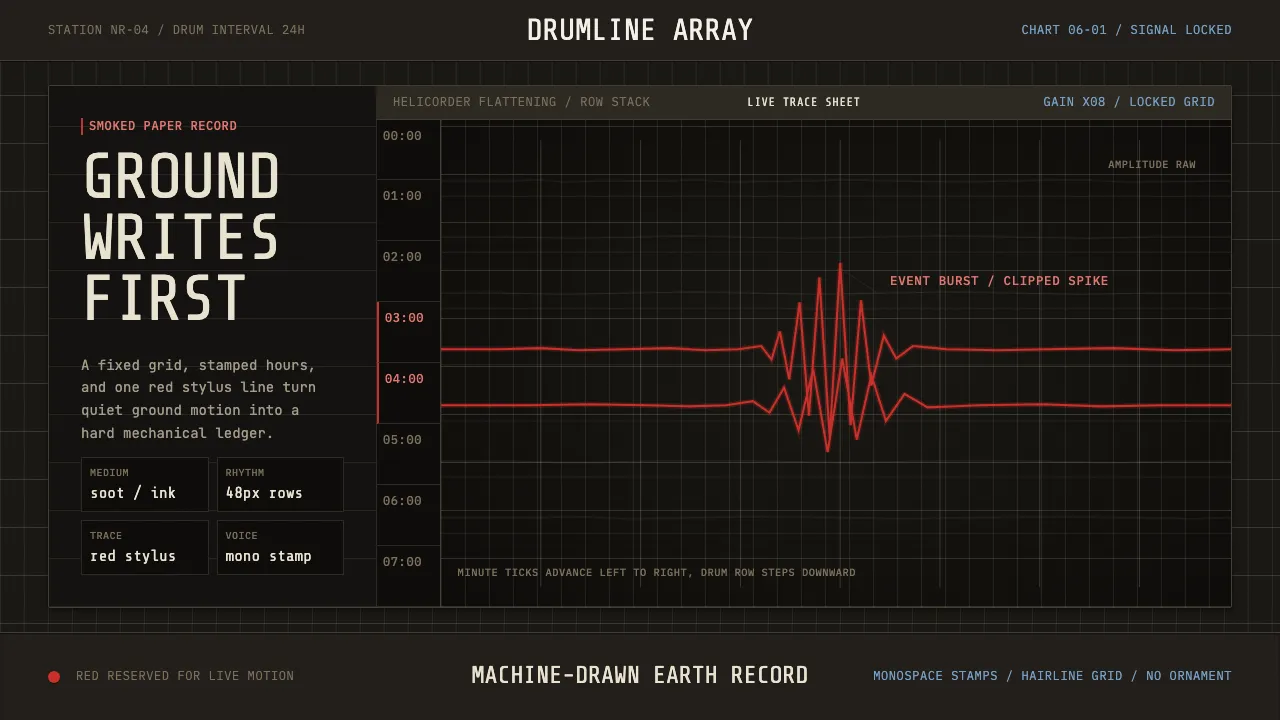
About Seismograph Trace
Seismograph Trace is the language of the helicorder drum — a rotating cylinder that drags a stylus across soot-blackened paper, leaving a helical record that flattens into stacked horizontal lines. Hours are stamped at the margins, minute tic marks run an inch apart, and the calm baseline erupts into sharp red spikes when the ground moves.
This is stark, instrument-honest design: monospace time-stamps, a fine grid ledger, and one iconic red trace against deep smoked black. Nothing is soft or decorative. Every line is sharp, linear, and grid-locked, the way a machine draws when it is only trying to tell the truth about the earth.
- Origin
- North America (USGS, PNSN seismic observatories)
- Era
- 1950–1990 (modern helicorder era; smoked-paper lineage from late 1800s)
- Key figures
- USGS · PNSN
- Movements
- Geophysical instrumentation · Scientific data recording
Seismograph Trace design spec
Colors
Typography
The other 11 sections — buttons, cards, spacing, motion, techniques and more — open once you unlock. Download the DESIGN.md or send it to your AI in one click. Unlock once, yours forever.
Sign up nowStyles similar to Seismograph Trace
Also inspired by science & nature, with a close feel.
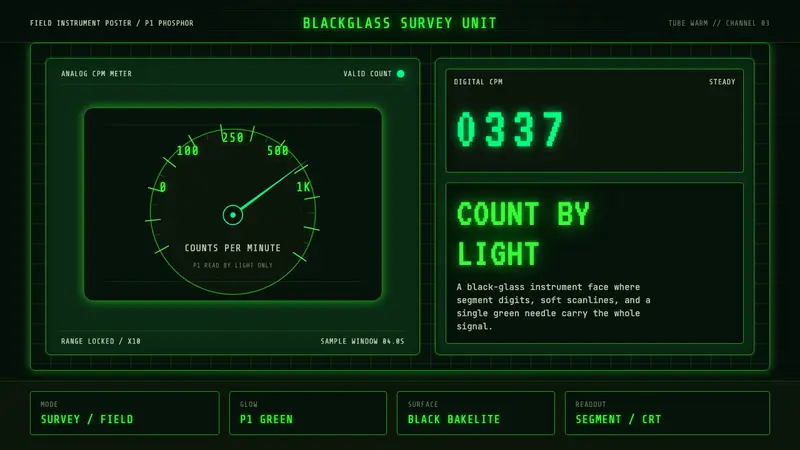 Geiger Counter Green ReadoutReads by glow. P1 green digits, scanlines, and a bordered black instrument grid.
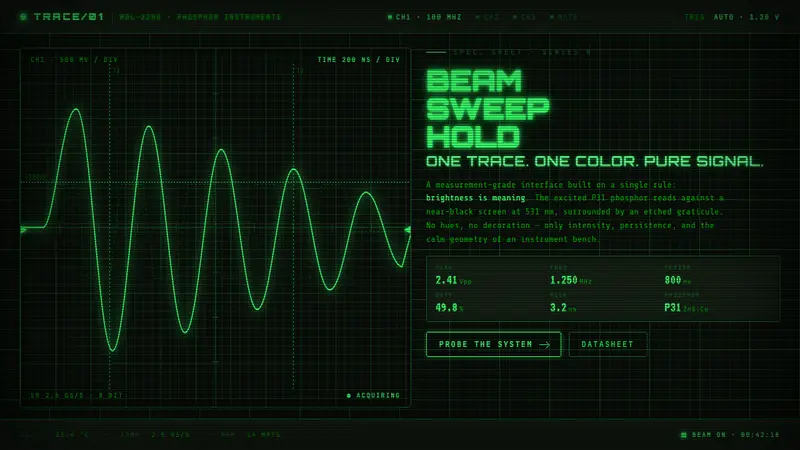 Oscilloscope WaveformBrightness is meaning. One P31 phosphor trace glowing across an etched graticule on a black screen.
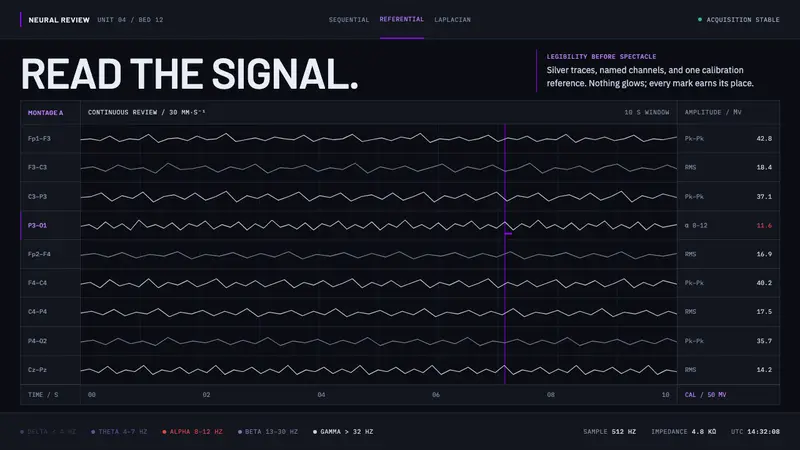 Neural Interface ClinicalClinical restraint makes signals legible. Silver traces cross near-black; violet marks calibration.
 Nanotech AssemblerNothing is illustrated. Grey micrograph fields and hairline measurement overlays make speculation accountable.