About Mapuche Witral
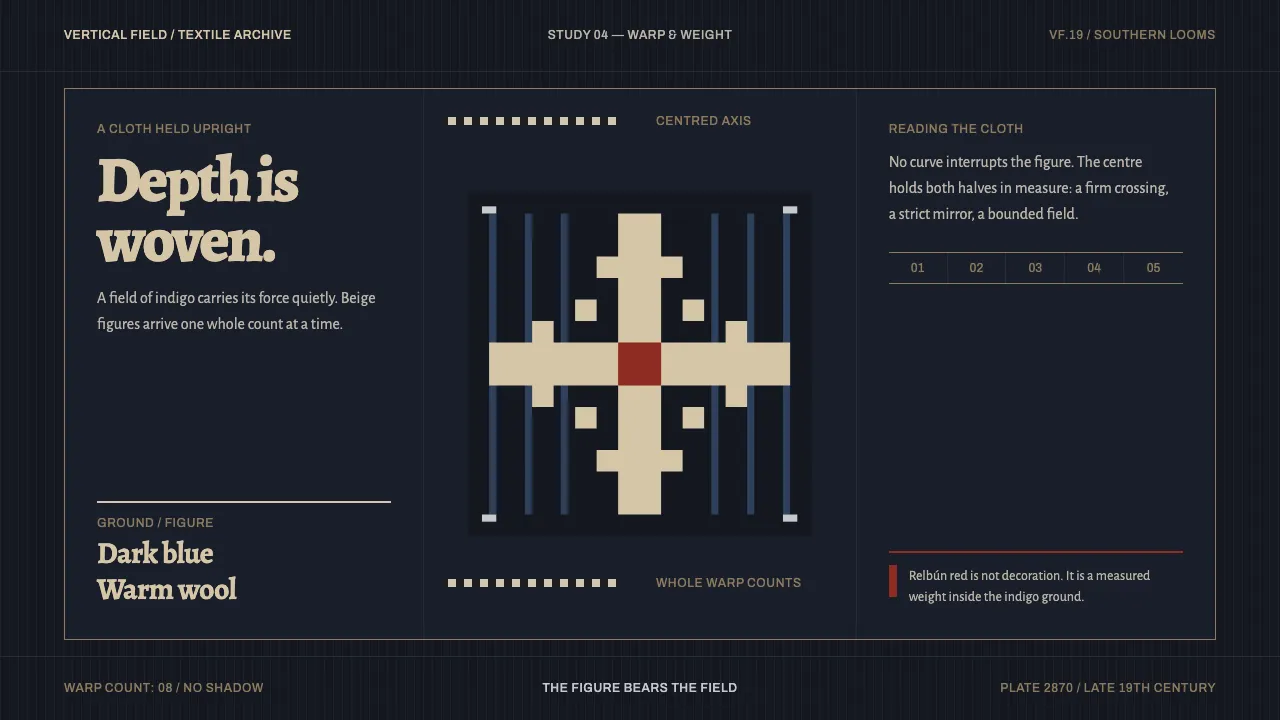
The witral is an upright loom — four stakes, a rectangular frame — and its name means "to be vertical." On it the makuñ, a lonko's poncho, is built warp by warp. From across a room it is black and white. Up close it is the deepest indigo and a warm beige, because black carries the depth of blue and is hard to make, and white is divine absence, so a beige white stands in its place.
This system takes that reading literally. Figures are stepped, never smoothed: every diagonal is a stack of whole squares, because supplementary-warp figuring cannot do otherwise. The wenufoye — the stepped cross — sits centred and load-bearing, mirrored across both halves. Corners are square. Nothing casts a shadow; the weave lies flat.
- Origin
- Wallmapu — south-central Chile and the Argentine Andean foothills
- Era
- pre-1900; MCHAP 2870 dates to the late 19th century
- Key figures
- María Teresa Curaqueo · the anonymous weaver of MCHAP 2870
- Movements
- Mapuche witral weaving · ñimin supplementary-warp figuring · rutran silverwork
Mapuche Witral design spec
Colors
Typography
The other 11 sections — buttons, cards, spacing, motion, techniques and more — open once you unlock. Download the DESIGN.md or send it to your AI in one click. Unlock once, yours forever.
Sign up nowStyles similar to Mapuche Witral
Also inspired by crafts & folk art, with a close feel.
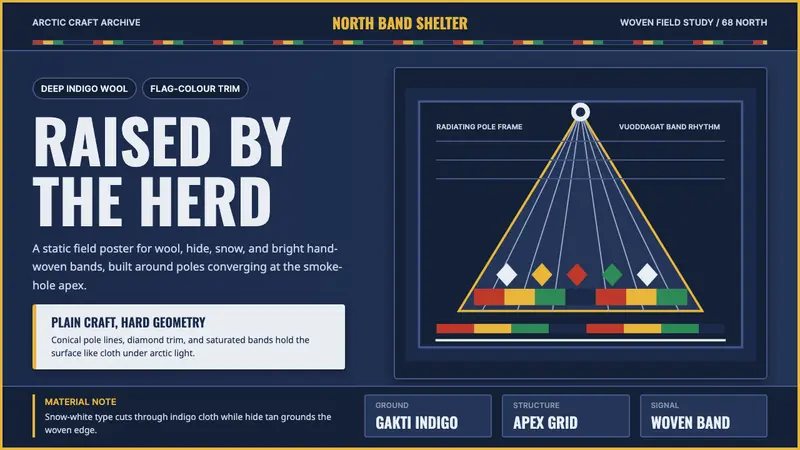 Sámi LavvuArctic craft stays bold. Indigo wool, Oswald type, and woven flag bands converge at an apex.
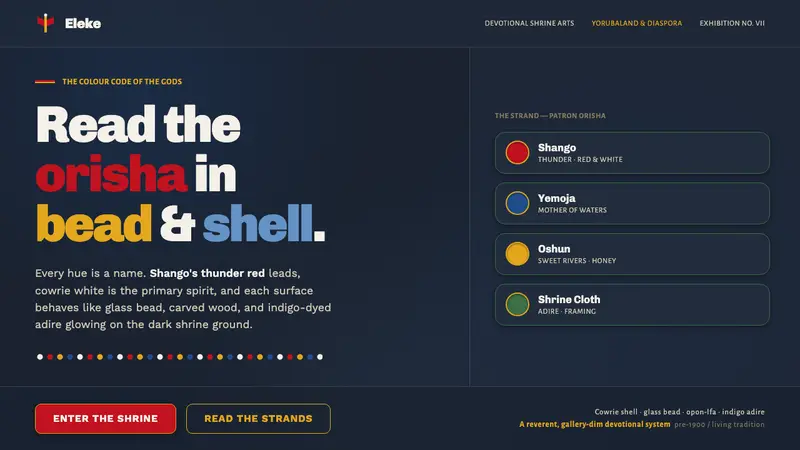 Yoruba Orisha ShrineThe colour code of the gods. Shango-red beadwork and cowrie white glow on dark indigo-wood.
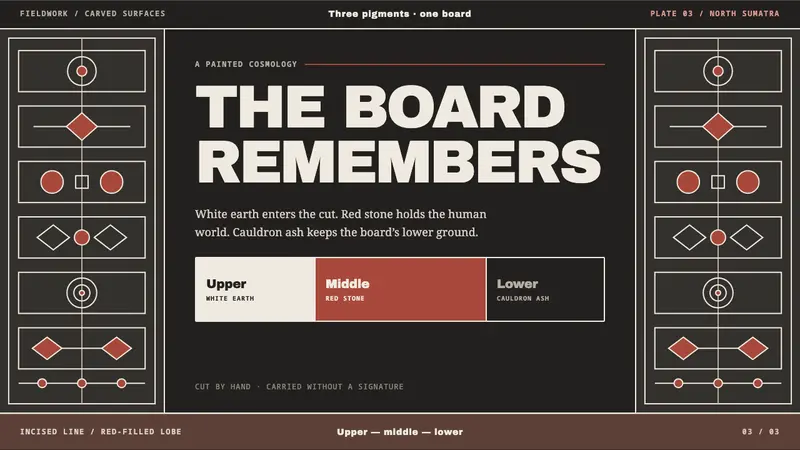 Batak GorgaCosmology cut into wood. Chalk-white lines and batu hula red hold a blackened field.
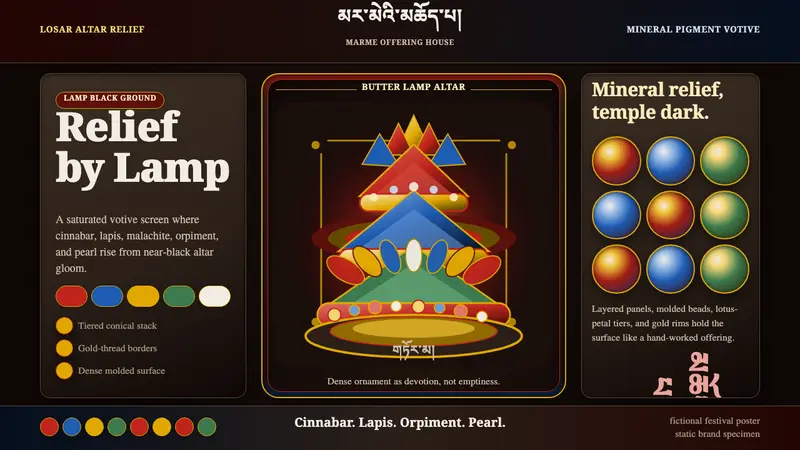 Tibetan Butter SculptureDevotion made dense. Cinnabar, lapis, and gold relief glow from altar black.