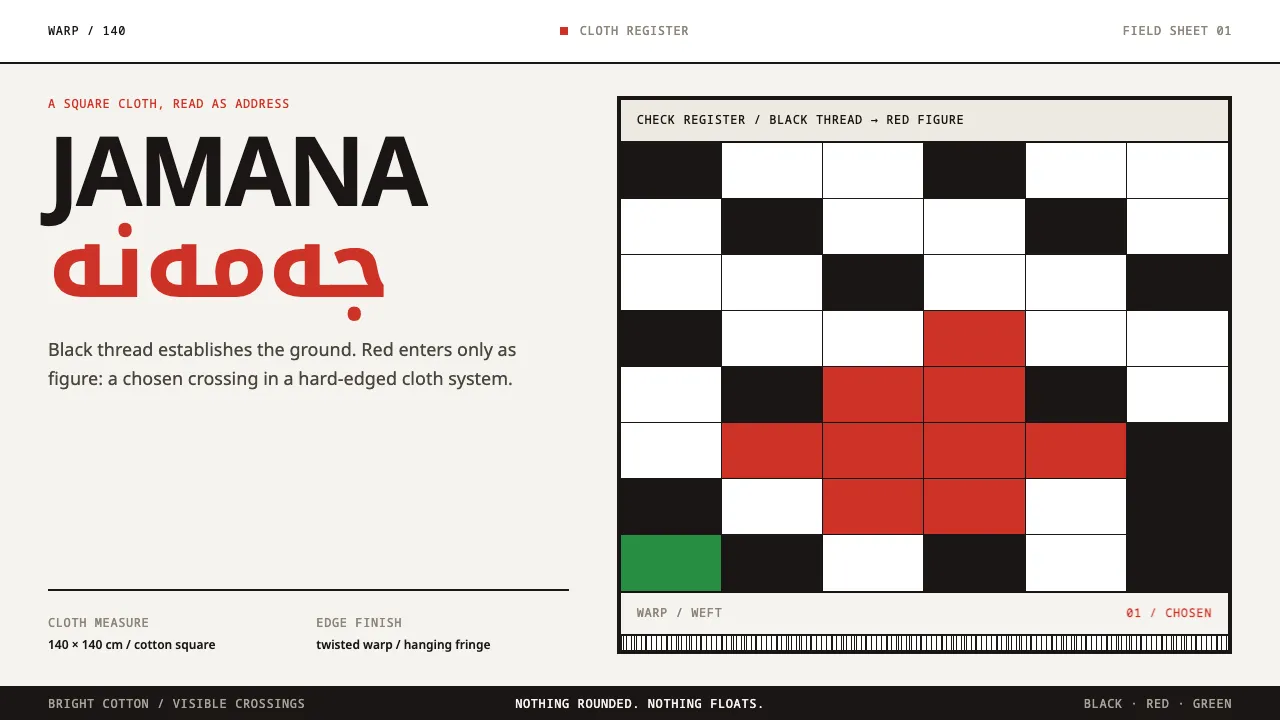
About Kurdish Jamana
The jamana is a square of cotton, about 140 by 140 centimetres, wound over the klaw skullcap with its fringed ends left hanging. The cloth is white; the pattern is black thread. Which pattern a man wears reads as tribe and region — black-and-white for the Zebari, Harki and Doski, red-and-white for the Barzani.
This system takes the cloth literally. Black check on bright white is the base state, red is brought in as figure, and every edge is a woven band or a run of fringe. Nothing is rounded, nothing floats: it is cloth, laid flat.
- Origin
- Kurdistan — Erbil, Barzan, Zebar and Duhok in Iraqi Kurdistan; Kurdish communities in Turkey, Iran and Syria
- Era
- pre-1900 and continuous as everyday and formal dress
- Key figures
- Mustafa Barzani · Zebari tribe · Harki tribe · Doski tribe
- Movements
- Kurdish traditional male dress (shal û shepik) · Tribal dress as regional identity marker
Kurdish Jamana design spec
Colors
Typography
The other 11 sections — buttons, cards, spacing, motion, techniques and more — open once you unlock. Download the DESIGN.md or send it to your AI in one click. Unlock once, yours forever.
Sign up nowStyles similar to Kurdish Jamana
Also inspired by crafts & folk art, with a close feel.
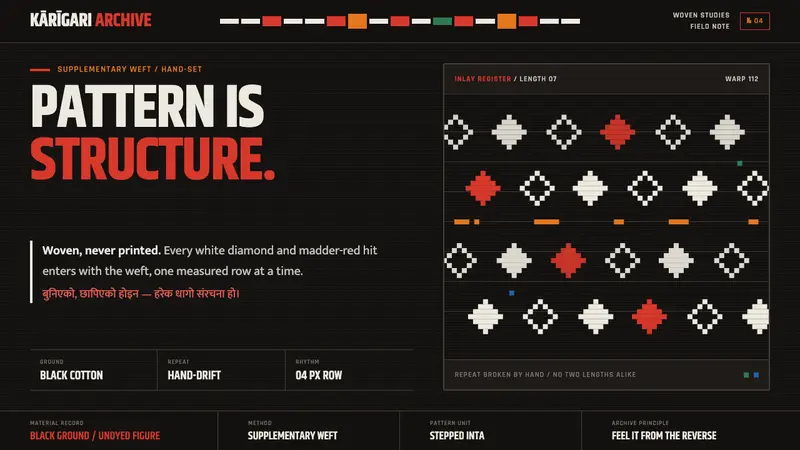 Nepali Dhaka TopiPattern becomes structure. White diamonds and madder-red hits advance row by woven row on black.
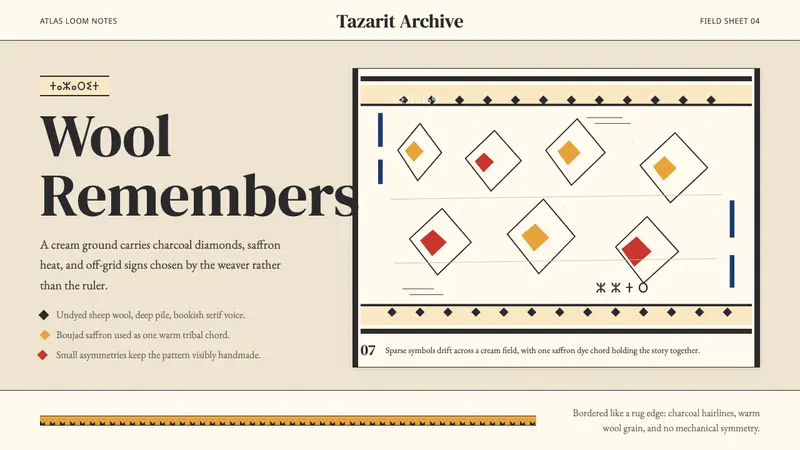 Moroccan Amazigh Berber RugAutobiography in wool. Cream ground, charcoal diamonds, saffron bands drift off-grid.
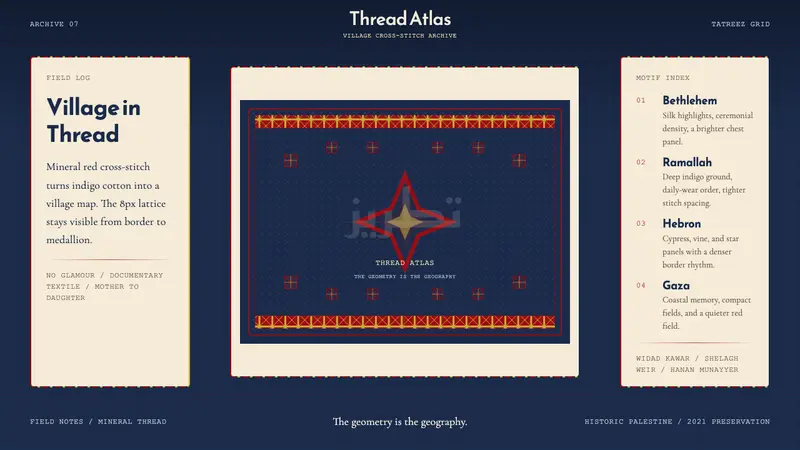 Palestinian Tatreez Cross-StitchMemory in thread. Red cross-stitch on indigo cotton, built on an 8px grid.
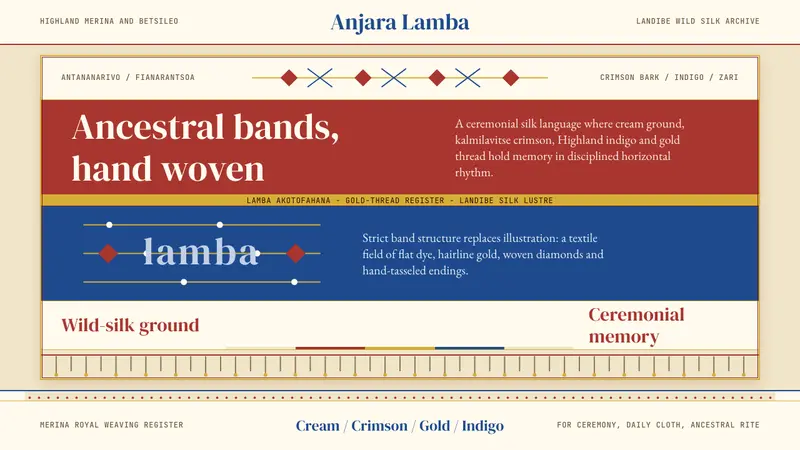 Madagascan Lamba SilkAncestry is woven flat. Crimson, indigo, cream and gold run in strict silk bands.