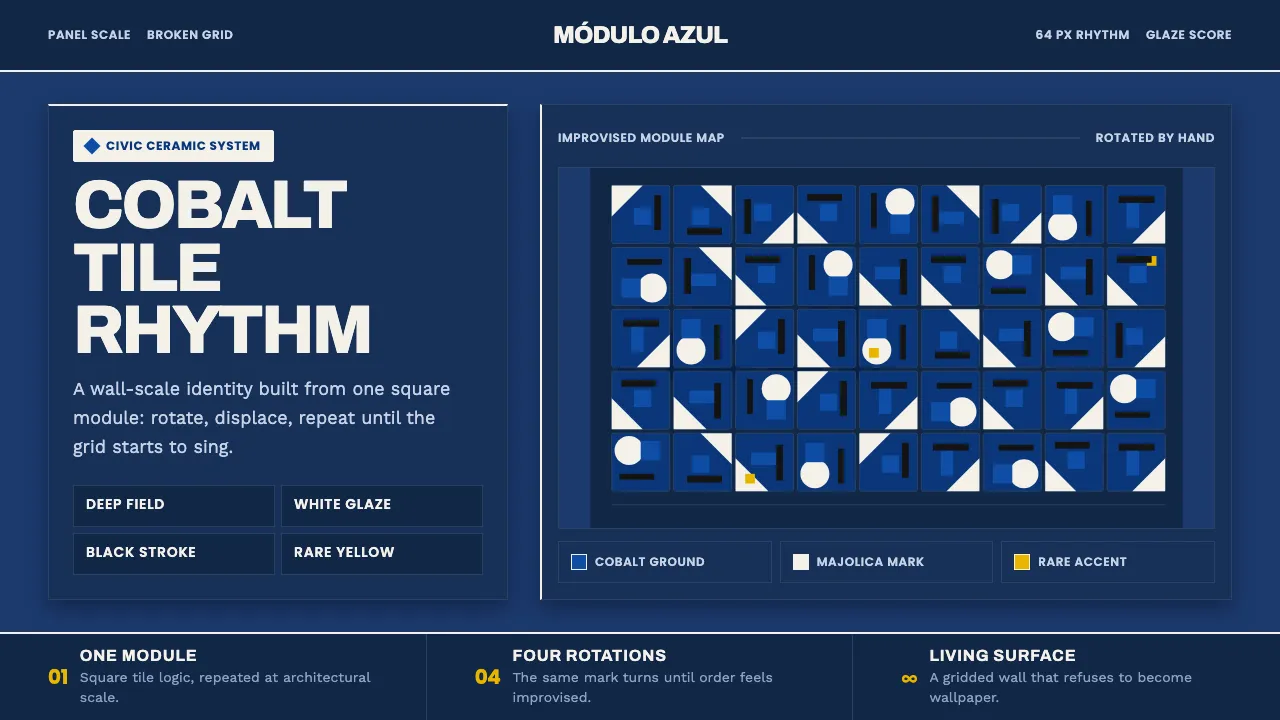
About Athos Bulcão Azulejo Panel
Athos Bulcão designed the glazed majolica azulejo panels that clad the modernist architecture of Brasília, working hand in hand with Oscar Niemeyer's buildings. From a single square white tile carrying a cobalt-blue (and black) geometric motif, he rotated and shuffled the module into improvised, near-random rhythms — a modernist blue-and-white tile score that reads as a deep cobalt field animated by white and dark marks, never as a flat, empty page. This system treats that panel as a living surface: a saturated cobalt/navy ground carries crisp white majolica glaze accents and black geometric strokes, with yellow and green reserved for later, sparser interventions. The grid is real but deliberately broken — regularity implied, then displaced — mirroring how Bulcão's tiles feel gridded yet improvised across a wall the size of a building.
- Origin
- Brasília, Brazil
- Era
- 1958–1980 (Brasília modernism); azulejo panels ongoing through the 1970s
- Key figures
- Athos Bulcão · Oscar Niemeyer
- Movements
- Brazilian modernism · mid-century architectural ceramics
Athos Bulcão Azulejo Panel design spec
Colors
Typography
The other 11 sections — buttons, cards, spacing, motion, techniques and more — open once you unlock. Download the DESIGN.md or send it to your AI in one click. Unlock once, yours forever.
Sign up nowStyles similar to Athos Bulcão Azulejo Panel
Also inspired by art & artists, with a close feel.
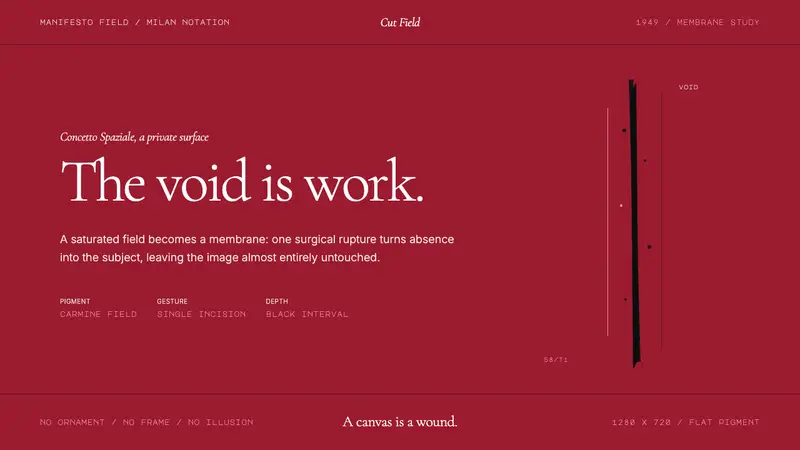 Spatialism (Fontana Cut, 1949)Absence becomes medium. Carmine field, Garamond restraint, one black incision.
 Soviet Cosmic MosaicMonumental and reverent. Cosmic-blue tesserae, red axis, gold orbital halo.
 Finnish Kalevala EpicEpic weight in cold night. Birch-white Cinzel, Sampo-gold rules, blue-grey fresco panels.
 Mamluk Quran IlluminationGilded density rules. Lapis ground, eightfold gold strapwork, and one red core lock the page.