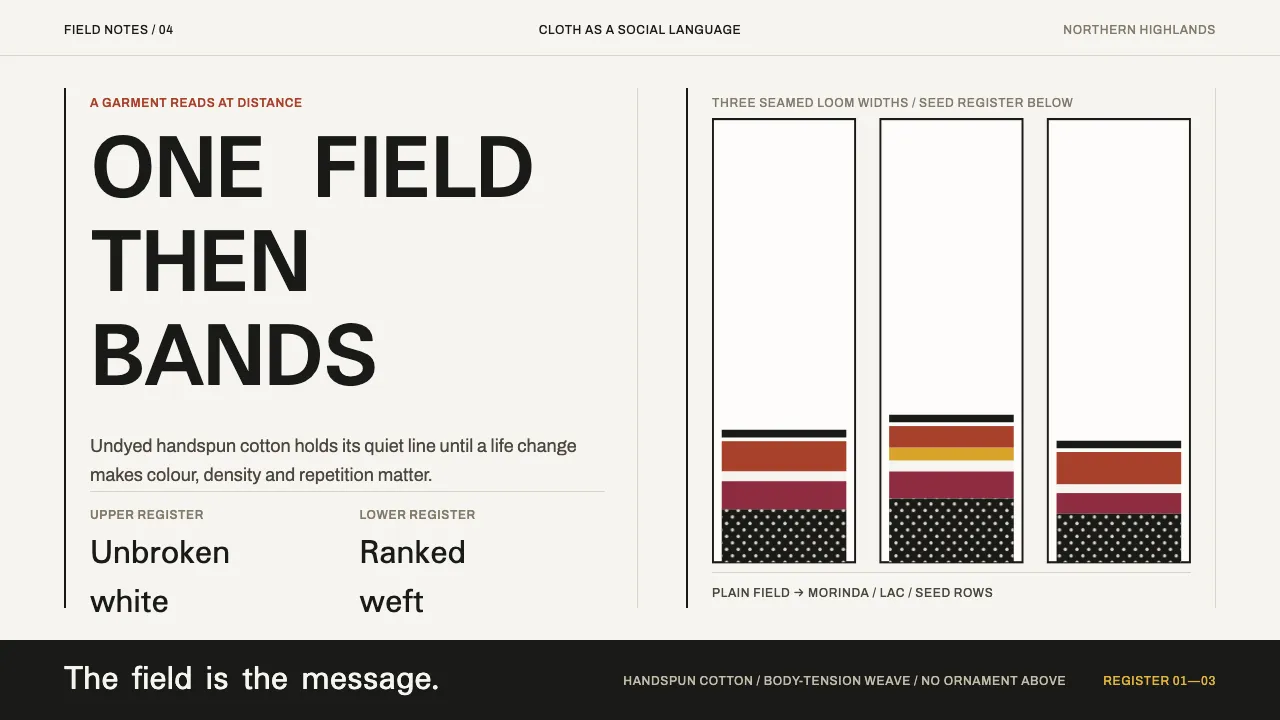
About Karen Woven Tunic
The *hse* is the long shift an unmarried Sgaw or Pwo Karen girl wears from childhood until her wedding day: handspun cotton, backstrap-woven, left undyed, and worn entirely without pattern. One uninterrupted field of bright white cloth is the whole statement, and it says something specific across a village.
After marriage the white goes away. In its place comes a banded tunic in morinda red and near-black, its lower half loaded with rows of hard white Job's tears seeds woven straight into the weft. This system takes that structure literally — a long plain field above, dense banding below, and nothing floating in between.
- Origin
- Karen State (Kayin), Myanmar; Mae Hong Son, Chiang Mai and Tak provinces, northern Thailand
- Era
- pre-1900, continuously worn into the present
- Key figures
- Dries Touw · Sgaw and Pwo backstrap weavers (anonymous) · British Museum Dye Detective research team
- Movements
- Southeast Asian backstrap (body-tension) weaving · Karen dress as marital signal · Job's tears (Coix lacryma-jobi) seed appliqué
Karen Woven Tunic design spec
Colors
Typography
The other 11 sections — buttons, cards, spacing, motion, techniques and more — open once you unlock. Download the DESIGN.md or send it to your AI in one click. Unlock once, yours forever.
Sign up nowStyles similar to Karen Woven Tunic
Also inspired by crafts & folk art, with a close feel.
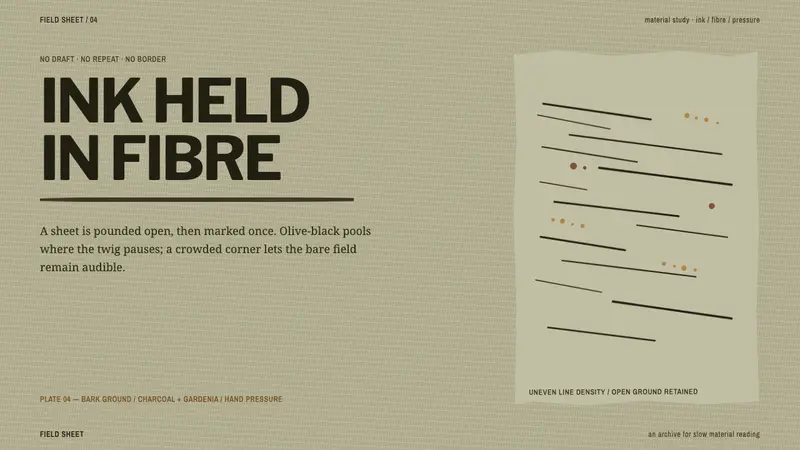 Mbuti BarkclothImprovisation stays visible. Olive-black marks bleed across a khaki fibre ground.
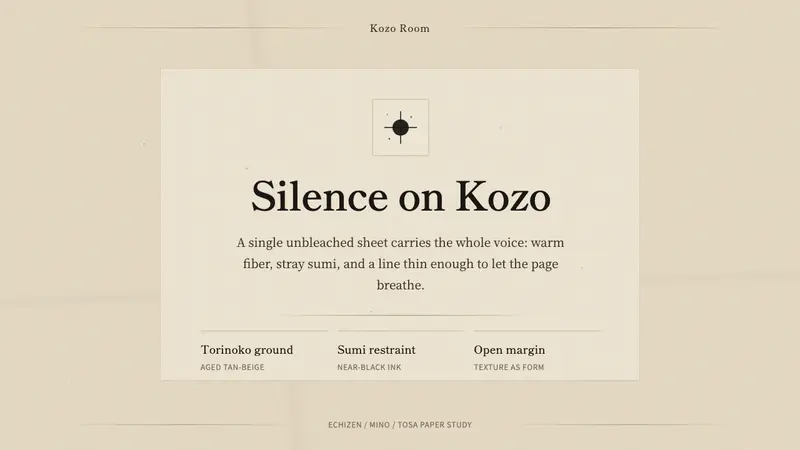 Washi Paper MinimalQuiet is material. Warm kozo grain, sumi specks, and hairline rules hold the page open.
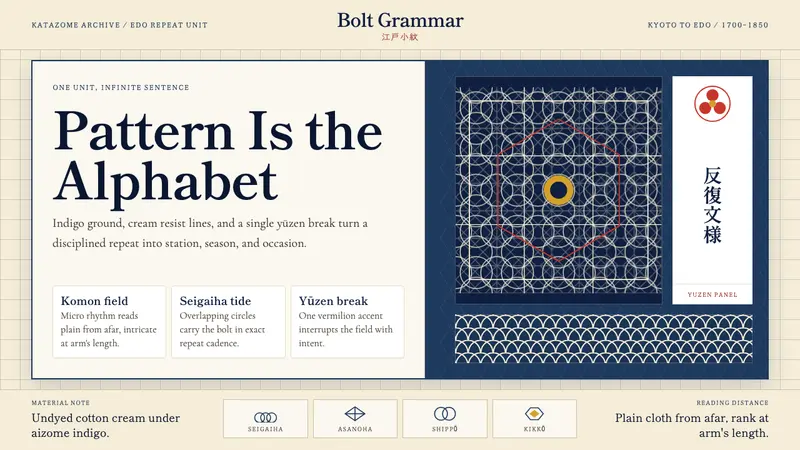 Edo Kimono TextilePattern becomes language. Indigo repeats, cream resist lines, one vermilion panel breaks the field.
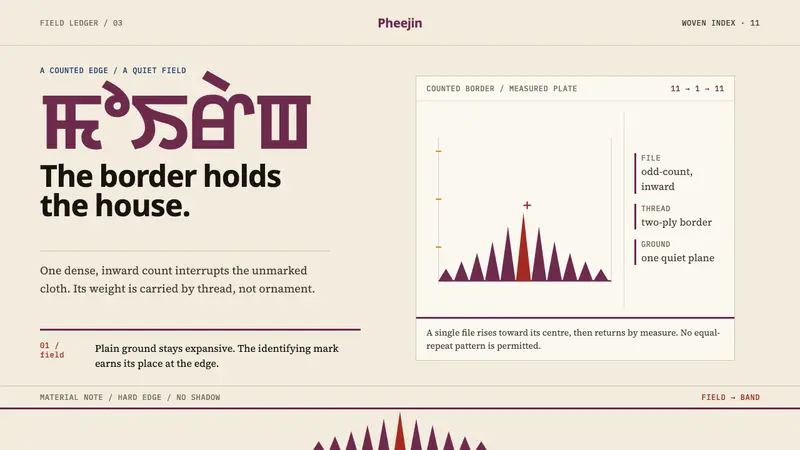 Manipuri PhanekOne border carries the whole cloth. Plum odd-count teeth cut through an expansive cream field.