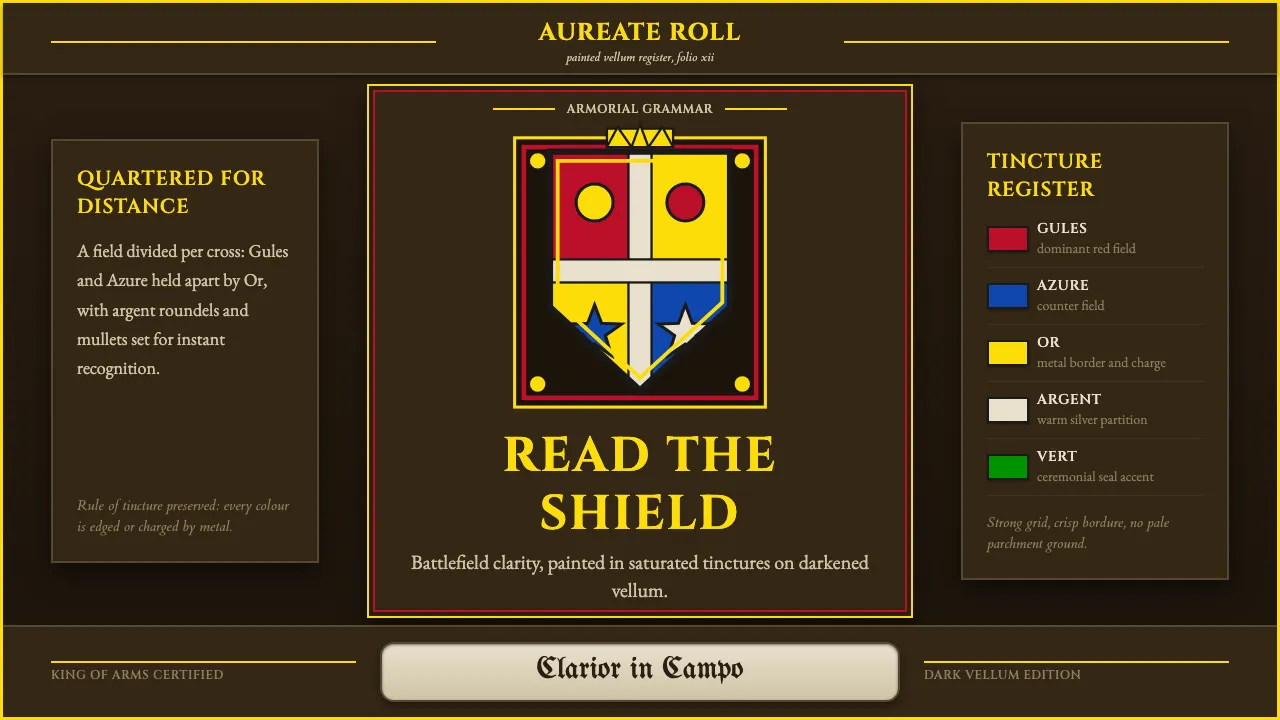
About Heraldic Blazon
Heraldic Blazon is the formal visual grammar of the coat of arms, recorded by heralds in armorial rolls across pre-1900 Western Europe. Painted shields divide the field into bold geometric partitions, charged with rampant lions and displayed eagles in a fixed set of tinctures — two metals and saturated colours — crowned with helm, crest and curling motto scroll. The authentic referent is a hand-painted armorial on darkened vellum, never a clean white page. Every pairing obeys the rule of tincture: metal never touches metal, colour never touches colour, so charges read crisply at a glance even from across a battlefield.
- Origin
- Western Europe (England, France, the German lands, the Low Countries)
- Era
- 12th century battlefield origin; formalised through medieval and early-modern periods (pre-1900)
- Key figures
- Kings of Arms · armorial-roll painters · blazon scribes
- Movements
- rule of tincture tradition · armorial roll painting · WappenWiki digital standardisation
Heraldic Blazon design spec
Colors
Typography
The other 11 sections — buttons, cards, spacing, motion, techniques and more — open once you unlock. Download the DESIGN.md or send it to your AI in one click. Unlock once, yours forever.
Sign up nowStyles similar to Heraldic Blazon
Also inspired by print & type, with a close feel.
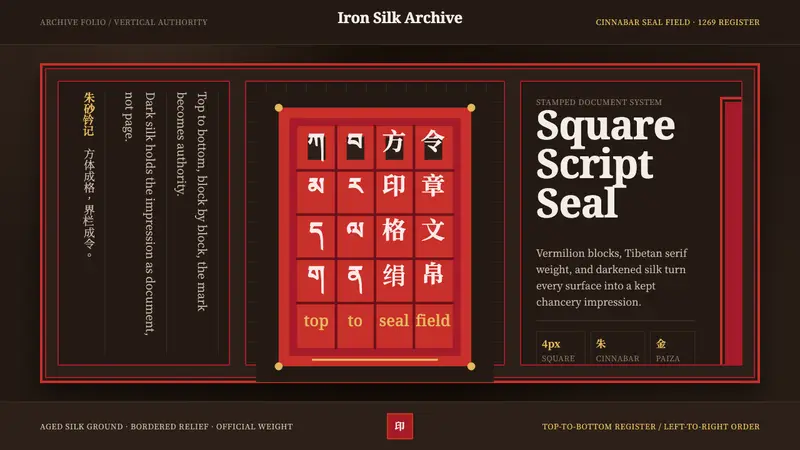 Phags-pa Seal ScriptAuthority, stamped vertical. Cinnabar borders press Tibetan serif blocks into aged silk.
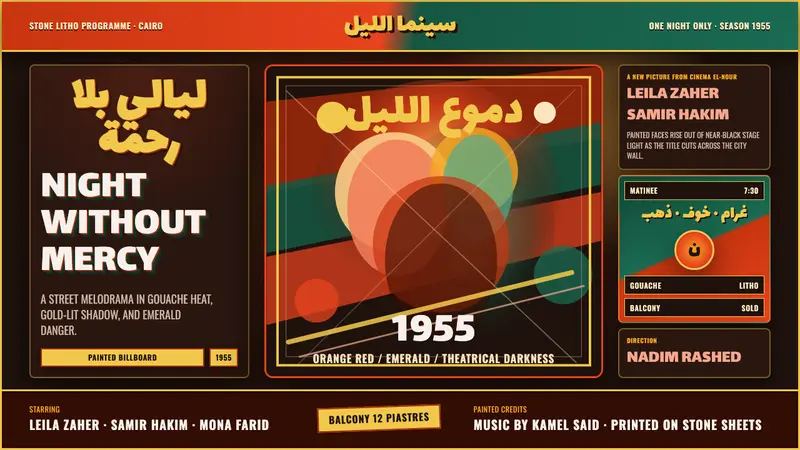 Egyptian Film Poster (Cairo)Melodrama at billboard scale. Near-black ground, ruq'ah titles, orange-red against emerald.
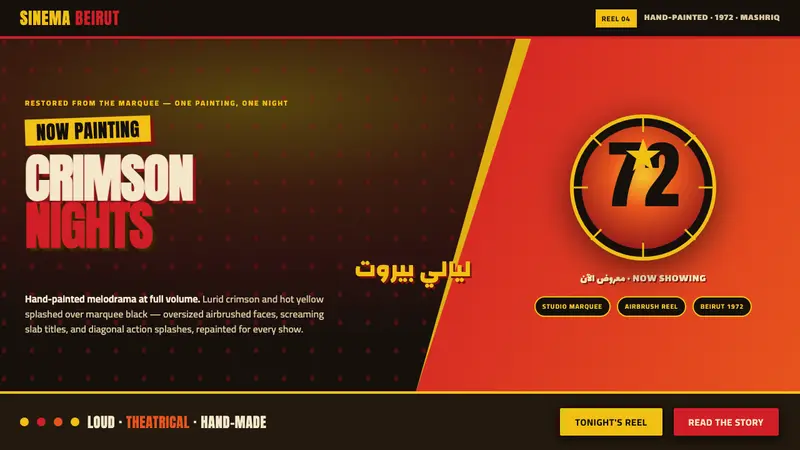 Lebanese Film PosterMelodrama at full volume. Lurid crimson and hot yellow on marquee black, slab titles screaming.
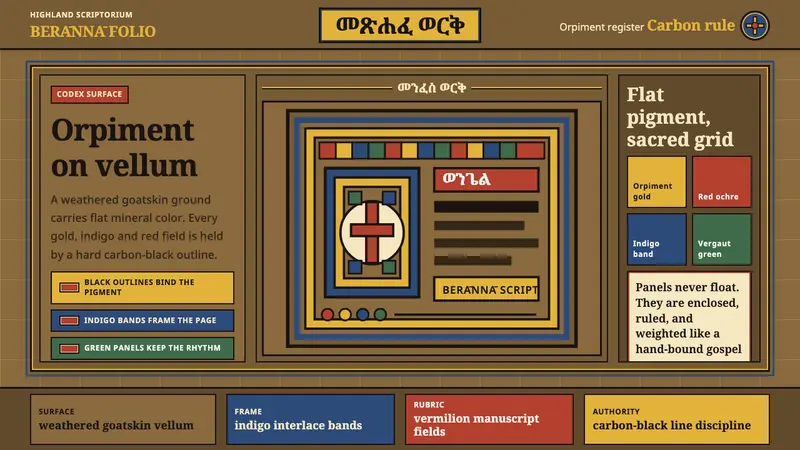 Ethiopian Ge'ez GospelSacred color held in line. Orpiment gold and indigo panels sit on weathered vellum.