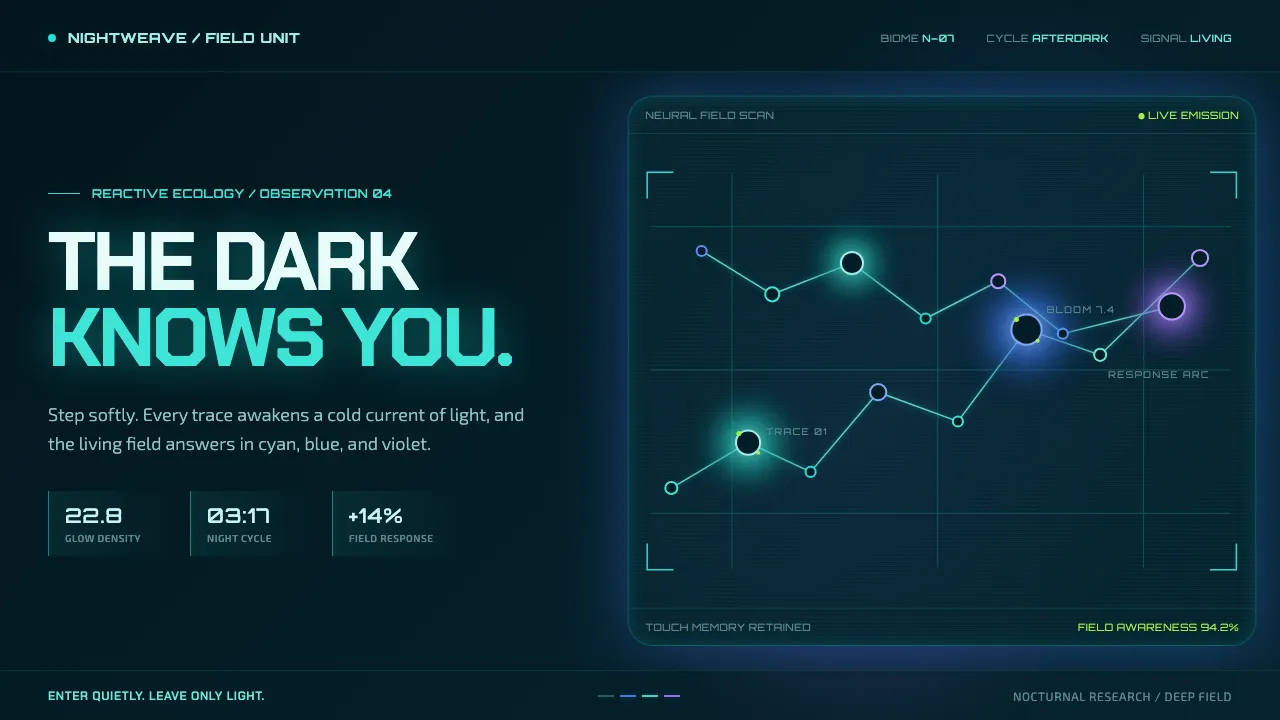
About Avatar — Pandora Bioluminescence (2009)
Pandora after dark is the moment the jungle floor lights up — a near-black teal forest where every leaf, spore, and footprint pulses with cold cyan bioluminescence, Na'vi skin glowing electric blue against the void. This system only makes sense in the dark, where color reads as emitted light rather than pigment: thin neon strokes on a deep-water ground, glows that bleed softly at their edges like reactive plankton responding to touch. Nothing here is flat fill; everything is a light source. Interfaces feel like a Na'vi neural interface or an RDA holo-tablet — floating luminous glyphs, teal darkness, and reactive glow trails. The aesthetic says the forest is alive, and it knows you are standing on it.
Learn more about the Avatar — Pandora Bioluminescence (2009) style
- Origin
- Hollywood, USA / Wellington, New Zealand
- Era
- 2009 (film release); design language extended through the Pandora franchise 2009–2022
- Key figures
- James Cameron · Jon Landau · Robert Stromberg · Paul Frommer
- Movements
- bioluminescent naturalism · photoreal CGI world-building · performance-capture cinema · eco-sci-fi
Avatar — Pandora Bioluminescence (2009) design spec
Colors
Typography
The other 11 sections — buttons, cards, spacing, motion, techniques and more — open once you unlock. Download the DESIGN.md or send it to your AI in one click. Unlock once, yours forever.
Sign up nowStyles similar to Avatar — Pandora Bioluminescence (2009)
Also inspired by film, games & music, with a close feel.
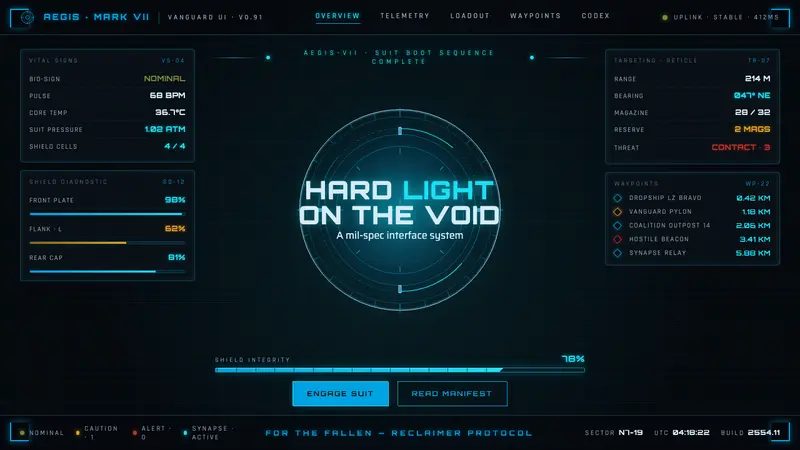 Halo (Forerunner UI)Hard light on the void. Cyan shield bars and concentric glyph rings glow on a black mil-spec visor.
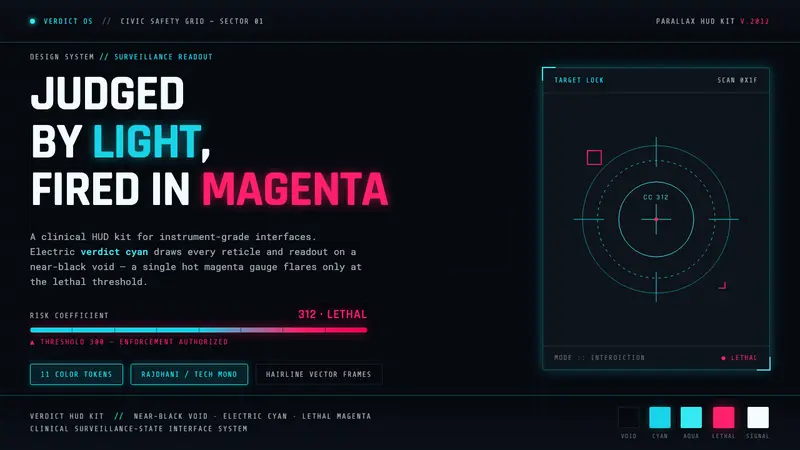 Psycho-Pass (Sibyl System)A surveillance HUD. Cyan reticles on a near-black void; magenta flares only at the kill threshold.
 Gundam Universal Century UIA war machine's eye. Phosphor wireframe and katakana telemetry glow inside a void-black sphere.
 Mass Effect N7Cold military futurism. Cyan HUD grids on near-black glass, cut by one red stripe.