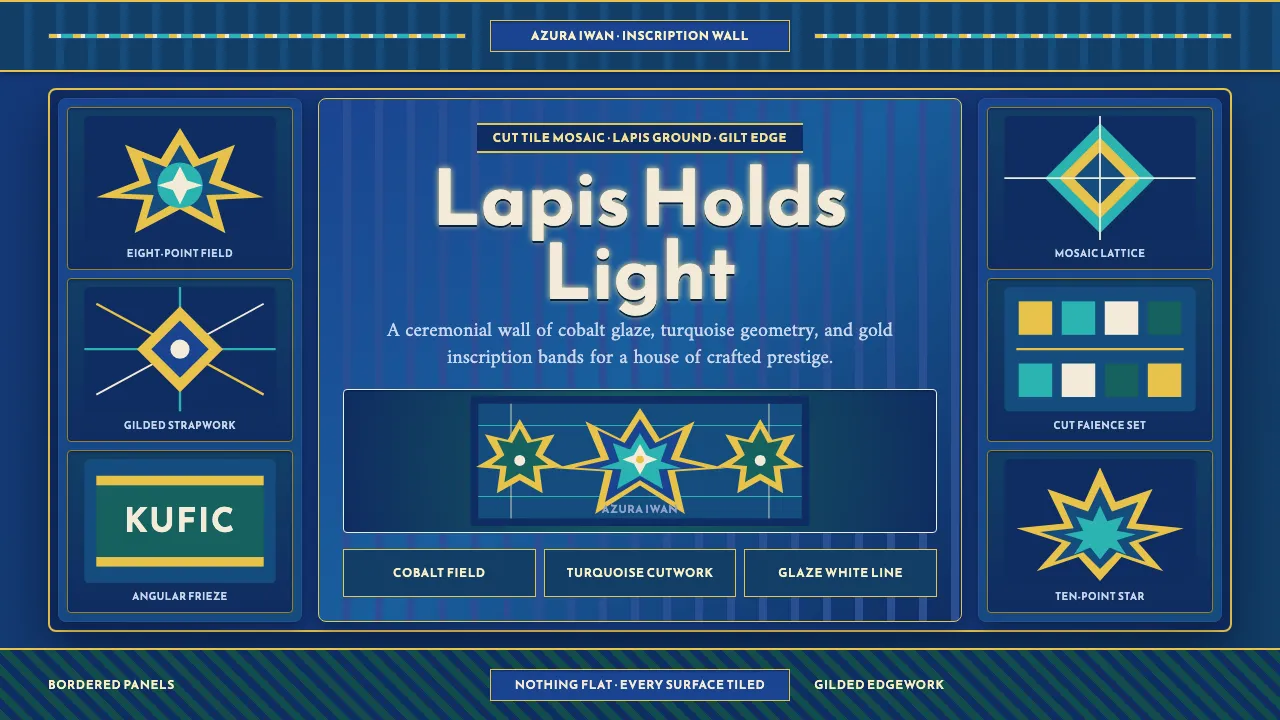
About Samarkand Tilework
Samarkand Tilework takes its surface from the Shah-i-Zinda — the "Living King" necropolis whose 14th–15th-century Timurid mausoleums are sheathed in deep cobalt faience-mosaic. The system treats the page as a tiled wall: a saturated lapis ground where eight- and ten-point stars, interlacing strapwork and angular Kufic friezes are drawn in turquoise, gold and glaze-white.
Every surface is a panel. Borders read as cut-tile mosaic, headers as inscription bands, and highlights as gilded edging that catches light against the blue. Nothing is flat or empty — density, glaze sheen and geometric repetition carry the brand.
- Origin
- Samarkand, Uzbekistan (Central Asia)
- Era
- Timurid, 14th–15th c. (Shah-i-Zinda built c. 1370–1450)
- Key figures
- Timur (Tamerlane) · Ulugh Beg · Tuman Aqa · Master kashi-tarosh tile-cutters
- Movements
- Timurid architecture · Faience cut-tile mosaic · Cuerda seca · Girih geometry
Samarkand Tilework design spec
Colors
Typography
The other 11 sections — buttons, cards, spacing, motion, techniques and more — open once you unlock. Download the DESIGN.md or send it to your AI in one click. Unlock once, yours forever.
Sign up nowStyles similar to Samarkand Tilework
Also inspired by architecture & places, with a close feel.
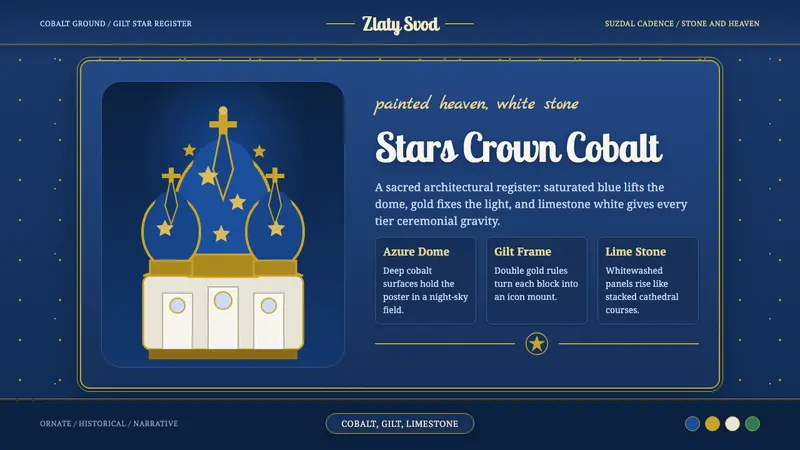 Russian Onion DomesSacred cobalt ascends. Gilt stars and limestone tiers frame an ornate dome poster.
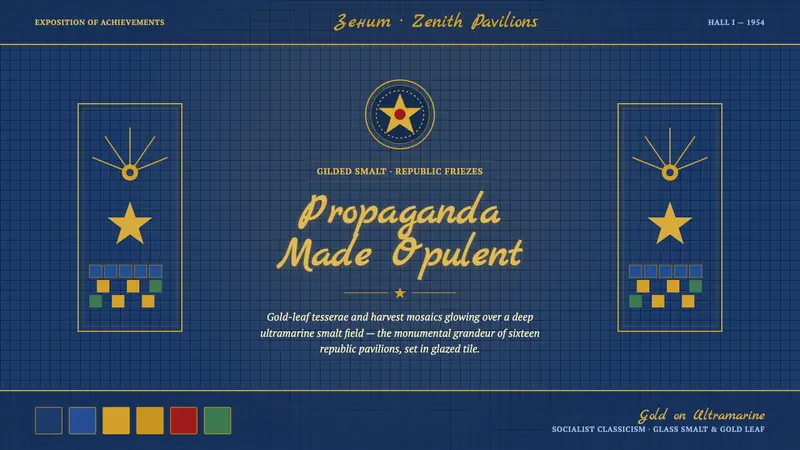 VDNKh Exhibition PavilionsPropaganda made opulent. Gold-leaf tesserae glow over a deep ultramarine smalt field.
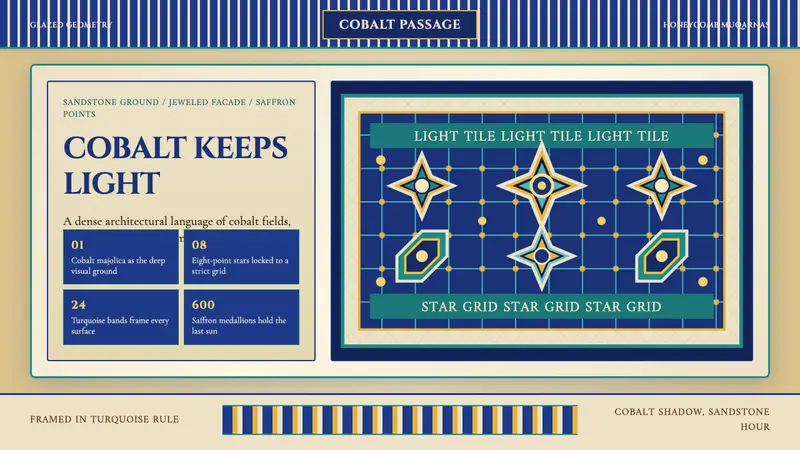 Uzbek Samarkand Shah-i-ZindaOpulent tile memory. Cobalt grids, turquoise bands, and saffron medallions crowd sandstone.
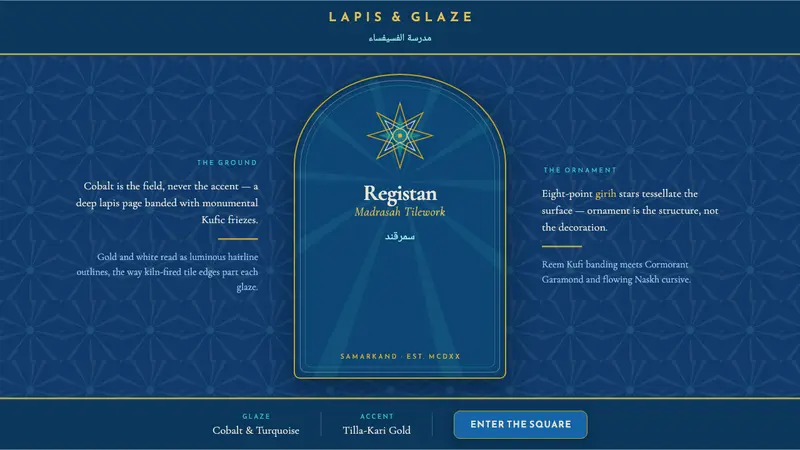 Registan Madrasah TileworkCobalt is the ground, not the accent. Gold girih stars tessellate deep lapis majolica tile.