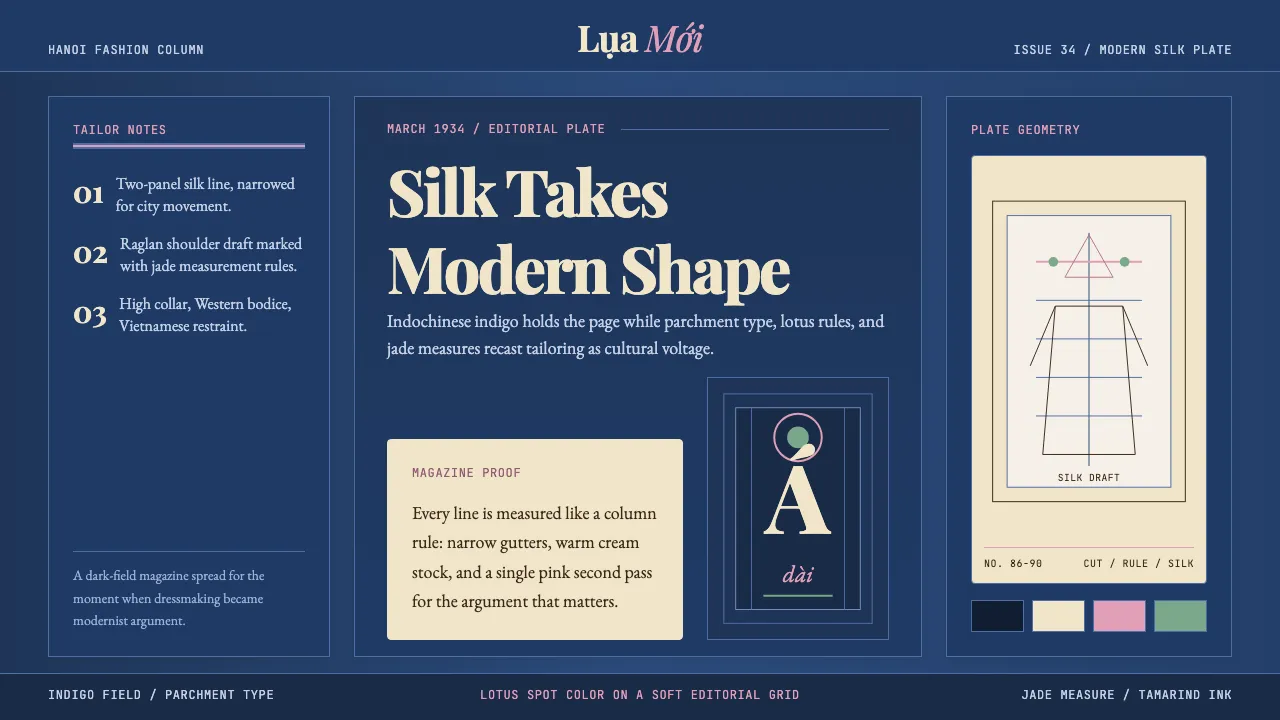
About Vietnamese Áo Dài 1934 (Cát Tường)
In March 1934, painter Nguyễn Cát Tường published tailor-plates in Phong Hóa magazine that remade Vietnam's national dress — trimming the five-panel áo ngũ thân into a fitted two-panel silk áo dài with raglan sleeves and a Western-cut bodice. The design was immediately controversial and immediately iconic.
This system channels the editorial surface of those original magazine pages: deep indochinese indigo fields, warm parchment-cream type, deco-condensed serifs carrying Vietnamese diacritics, and restrained spot color drawn from lotus silk and jade — the palette of a 1930s Hanoi fashion column rendered as a digital design language.
Learn more about the Vietnamese Áo Dài 1934 (Cát Tường) style
- Origin
- Vietnam, Hanoi
- Era
- 1934 specific; peak 1934–1939 colonial-modernist Hanoi
- Key figures
- Cát Tường (Nguyễn Cát Tường) · Lê Phổ · Nhất Linh · Ann Marie Leshkowich
- Movements
- Tự Lực Văn Đoàn literary modernism · École des Beaux-Arts de l'Indochine · Indochina colonial-modernist fashion publishing
Vietnamese Áo Dài 1934 (Cát Tường) design spec
Colors
Typography
The other 11 sections — buttons, cards, spacing, motion, techniques and more — open once you unlock. Download the DESIGN.md or send it to your AI in one click. Unlock once, yours forever.
Sign up nowStyles similar to Vietnamese Áo Dài 1934 (Cát Tường)
Also inspired by print & type, with a close feel.
 Patent Cyanotype Drawing (1880)Federal authority, chemically printed. Prussian blue gridwork carries aged-white patent lines.
 Argentine Tango Poster (1940)Nocturnal drama in ink. Oxblood ground, antique gold rules, Bodoni capitals.
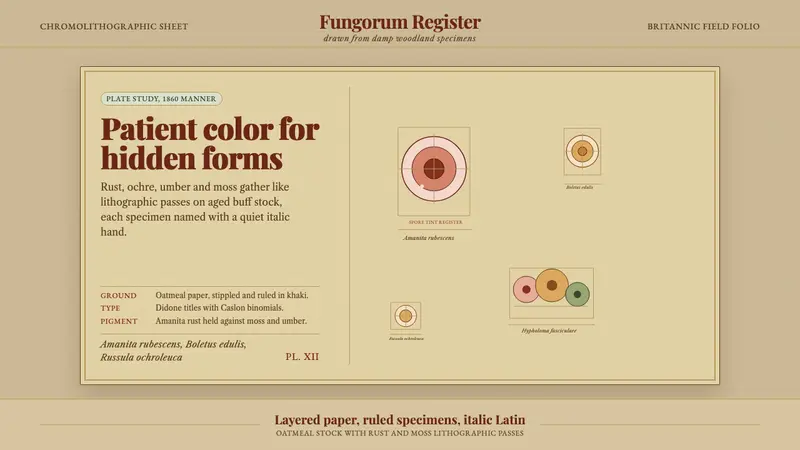 Victorian Mycology PlatePatient field science. Rust and moss specimens sit on stippled buff paper with italic Latin.
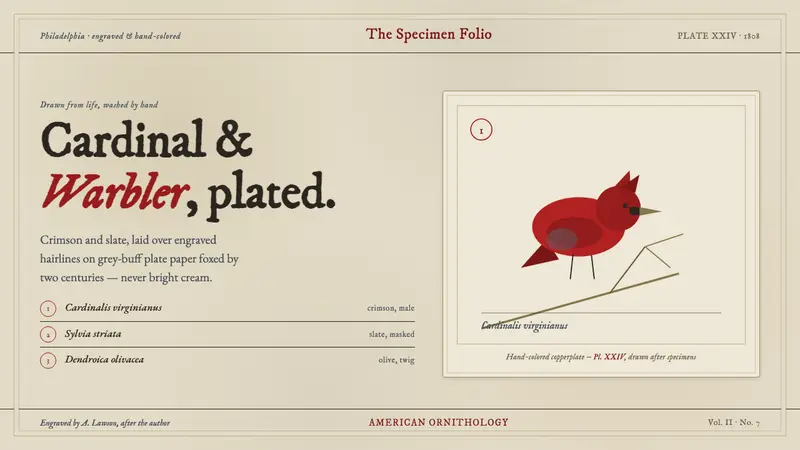 Wilson Ornithology PlateAn 1808 ornithology plate reborn. Cardinal crimson and slate, washed over engraving on foxed paper.